Asia Pacific Aerospace Coatings Market Size
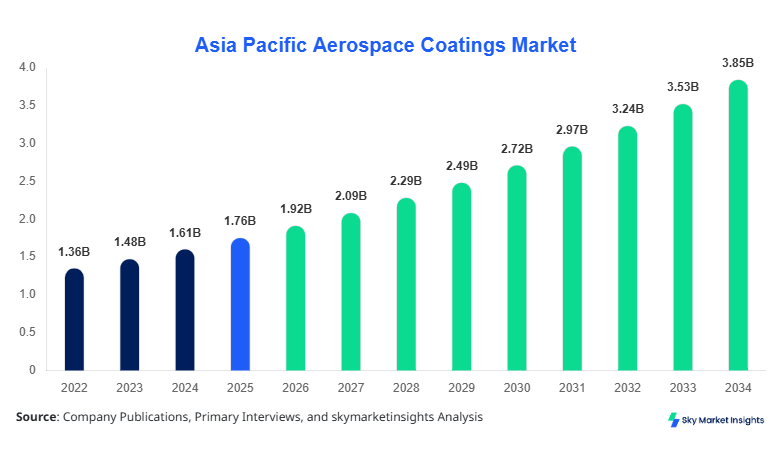
The Asia Pacific aerospace coatings market size is projected at USD 1.92 billion in 2026 and is expected to hit USD 3.84 billion by 2034 with a CAGR of 9.10%. The increasing demand for lightweight aircraft materials, the growing fleet size exceeding 9,500 units across the Asia Pacific, and rising MRO (Maintenance, Repair, and Overhaul) spending of over USD 18 billion annually are key contributors. The market analysis highlights strong segmentation across resin type and application, alongside a competitive landscape with over 45 major manufacturers operating regionally.
The Asia Pacific aerospace coatings market refers to specialized protective coatings used for aircraft surfaces to enhance corrosion resistance, UV protection, and fuel efficiency. In 2025, production volume exceeded 145 million liters across Asia Pacific, with Japan, China, and South Korea contributing nearly 68% of total output. Adoption rates in commercial aviation surpassed 82%, while military aviation accounted for approximately 38% of advanced coating technologies such as nano-ceramic coatings. Consumer behavior indicates a shift toward eco-friendly coatings, with over 56% of airlines preferring low-VOC solutions. Application-wise, commercial aviation contributes 52%, military aviation 28%, and general aviation 20%, with performance metrics such as durability cycles exceeding 5,000 flight hours and resistance thresholds above 1,200 hours of salt spray testing. Increasing repaint cycles (every 5–7 years) and rising aircraft deliveries exceeding 2,100 units annually further reinforce Asia Pacific aerospace coatings market demand.
In Japan, the aerospace coatings market is characterized by advanced manufacturing capabilities with over 120 aerospace component facilities and 35 coating manufacturers. Japan accounts for approximately 24% of the Asia Pacific aerospace coatings market share, driven by strong domestic aircraft production and MRO activities. Commercial aviation dominates with 48% application share, followed by military aviation at 32% and general aviation at 20%. Technology adoption is high, with over 65% of coatings incorporating nanomaterials and 58% utilizing water-based formulations. Annual coating consumption in Japan exceeds 28 million liters, supported by over 1,200 aircraft in operation. High-performance coatings with thermal resistance above 250°C and UV resistance exceeding 10,000 hours are widely adopted, reinforcing Asia Pacific aerospace coatings market growth.
Explore more data points, trends and opportunities Download Free Sample Report
Aerospace Coatings Market Trends
The Asia Pacific aerospace coatings market is witnessing a shift toward sustainable and high-performance coatings, with eco-friendly products accounting for over 42% of total production in 2025. Annual production volumes have crossed 145 million liters, with a projected increase to 220 million liters by 2030. Water-based coatings adoption has surged by 35% over the past three years, driven by regulatory compliance and environmental standards. Additionally, smart coatings with self-healing properties are gaining traction, with adoption rates reaching 18% in advanced aircraft segments. Increased aircraft deliveries, exceeding 2,100 units annually, are further driving Asia Pacific aerospace coatings market demand.
Technological advancements such as nano-coatings and anti-microbial coatings are reshaping the industry, with over 22% of new aircraft incorporating these technologies. Military aviation is witnessing rapid adoption, with 40% of coatings now designed for stealth and radar absorption. Digital coating systems improving application efficiency by 27% are also gaining popularity. The rise in low-cost carriers, contributing 38% of regional air traffic, is increasing repaint cycles and boosting the Asia Pacific aerospace coatings market growth.
Asia Pacific Aerospace Coatings Market Drivers
Rising Aircraft Fleet Expansion and MRO Activities Driving Market Growth
The Asia Pacific region has seen aircraft fleet expansion exceeding 9,500 units, with projected additions of 4,200 aircraft by 2034. MRO spending has grown at 8.5% annually, reaching USD 18 billion, driving demand for high-performance coatings. Commercial aviation accounts for 52% of total coating consumption, while military aviation contributes 28%. Increasing repaint cycles, averaging every 5–7 years, result in annual coating consumption growth of 6.8%. Furthermore, rising demand for corrosion-resistant coatings, with durability exceeding 1,200 hours of salt spray resistance, supports Asia Pacific aerospace coatings market growth.
Asia Pacific Aerospace Coatings Market Restraints
High Cost of Advanced Coating Technologies Limiting Adoption
Advanced coatings such as nano-coatings and ceramic-based coatings cost 25–40% more than conventional coatings, limiting adoption among smaller operators. The average cost per liter ranges from USD 45 to USD 120, depending on performance specifications. Additionally, compliance with environmental regulations increases production costs by 18–22%. Supply chain disruptions affecting raw materials such as resins and pigments have caused price volatility of up to 15%. These factors restrict widespread adoption, impacting the Asia Pacific aerospace coatings market growth.
Asia Pacific Aerospace Coatings Market Opportunities
Increasing Demand for Eco-Friendly and Lightweight Coatings
Eco-friendly coatings account for 42% of the market and are expected to reach 60% by 2034. Lightweight coatings reduce aircraft weight by 2–3%, improving fuel efficiency by up to 5%. Investments in sustainable coatings have increased by 28% annually, with over USD 1.2 billion allocated to R&D. Emerging markets such as India and Southeast Asia are witnessing aircraft fleet growth of 9%, creating new opportunities. These trends are expected to enhance Asia-Pacific aerospace coatings market growth.
Challenges in Asia Pacific Aerospace Coatings Market
Stringent Regulatory Standards and Certification Complexities
Compliance with aviation safety standards such as FAA and EASA certifications increases development timelines by 20–30%. Testing procedures require over 1,000 hours of validation, adding to costs. Regulatory requirements for VOC emissions below 50 g/L further complicate production. Smaller manufacturers face challenges due to limited resources, affecting their ability to compete. These challenges impact Asia Pacific aerospace coatings market growth.
Report Scope
| Report Metric | Details |
|---|---|
| Market Size in 2025 | USD 1.76 Billion |
| Market Size in 2026 | USD 1.92 Billion |
| Market Size in 2034 | USD 3.84 Billion |
| CAGR | 9.10% (2026-2034) |
| Base Year for Estimation | 2025 |
| Historical Data | 2022-2024 |
| Forecast Period | 2026-2034 |
| Report Coverage | Revenue Forecast, Competitive Landscape, Supply Chain Disruption, Growth Factors, Environment & Regulatory Landscape and Trends |
Explore more data points, trends and opportunities Download Free Sample Report
Aerospace Coatings Market Segmentation
The Asia Pacific aerospace coatings market is segmented based on resin type and application, with epoxy coatings dominating at 38% share, followed by polyurethane at 34% and acrylic at 28%. By application, commercial aviation leads with 52%, followed by military aviation at 28% and general aviation at 20%.
By Type
Epoxy coatings account for 38% of the market, with production exceeding 55 million liters annually. These coatings offer high corrosion resistance and durability exceeding 1,200 hours of salt spray testing. Epoxy coatings are widely used in aircraft interiors and structural components, with performance temperatures up to 180°C. Their strong adhesion properties and chemical resistance make them essential in the Asia-Pacific aerospace coatings market.
Polyurethane coatings hold 34% share, with production volumes of 49 million liters. These coatings provide superior UV resistance exceeding 10,000 hours and high gloss retention. Widely used in exterior surfaces, polyurethane coatings improve fuel efficiency by reducing drag by 1.5–2%. Their flexibility and resistance to environmental stress enhance their role in the Asia Pacific aerospace coatings market.
Acrylic coatings represent 28% of the market, with production reaching 41 million liters. These coatings offer fast drying times of under 2 hours and moderate durability. They are primarily used in general aviation and interior applications. Acrylic coatings provide cost-effective solutions, supporting Asia-Pacific aerospace coatings market growth.
By Application
Commercial aviation dominates with 52% share, consuming over 75 million liters annually. Increasing passenger traffic exceeding 2.8 billion annually drives demand for coatings. Aircraft repaint cycles every 5–7 years further boost consumption. High-performance coatings improve fuel efficiency by up to 3%, reinforcing the Asia Pacific aerospace coatings market.
Military aviation accounts for a 28% share, with consumption of 40 million liters. Advanced coatings with radar-absorbing properties and thermal resistance above 250°C are widely used. Defense spending exceeding USD 300 billion across the Asia Pacific supports demand, strengthening the Asia Pacific aerospace coatings market.
General aviation contributes a 20% share, with 30 million liters consumed. Increasing private aircraft ownership and business aviation growth of 6% annually drive demand. Cost-effective coatings with moderate performance are widely used, supporting the Asia Pacific aerospace coatings market.
Asia Pacific Aerospace Coatings Market Segmentations
Resin Type
- Epoxy
- Polyurethane
- Acrylic
Application
- Commercial Aviation
- Military Aviation
- General Aviation
Asia Pacific Aerospace Coatings Market Regional Outlook
China accounts for 32% of the regional market, with production exceeding 46 million liters annually. Rapid aircraft manufacturing and MRO expansion drive demand. Commercial aviation dominates with a 55% share, followed by military at 25%.
South Korea holds 10% share, with strong defense sector demand contributing 45% of coating usage. Production exceeds 15 million liters annually.
Japan contributes 24% share, with advanced technology adoption exceeding 65% and production of 28 million liters annually.
India accounts for 12% share, with fleet expansion of 9% annually and increasing MRO activities.
Australia holds an 8% share, driven by general aviation and defense sectors.
Singapore contributes 6%, acting as a regional MRO hub with over 1,000 aircraft serviced annually.
Taiwan accounts for 4% share, with growing aerospace manufacturing.
Southeast Asia contributes 4%, with emerging markets driving growth.
Top players in Asia Pacific Aerospace Coatings Market
- PPG Industries
- AkzoNobel N.V.
- Sherwin-Williams Company
- Hentzen Coatings
- Mankiewicz Gebr. & Co.
- BASF SE
- 3M Company
- Axalta Coating Systems
- Henkel AG & Co.
- Nippon Paint Holdings
- Kansai Paint Co.
- IHI Ionbond AG
-
PPG Industries
-
Holds approximately 22% market share
-
Strong presence in commercial aviation with over 60% penetration
-
Advanced R&D investments exceeding USD 500 million annually
-
-
AkzoNobel N.V.
-
Holds around 18% market share
-
Leading in eco-friendly coatings with 45% of the product portfolio
-
Strong regional manufacturing footprint
-
Investment Analysis
Investments in the Asia Pacific aerospace coatings market exceed USD 2.5 billion annually, with 38% allocated to R&D and 42% to production expansion. Japan and China account for 55% of total investments, while India and Southeast Asia contribute 25%. M&A activities have increased by 18%, with strategic collaborations focusing on sustainable coatings. Joint ventures between global and regional players account for 30% of new investments.
New Product Developments
New product launches account for 22% of total offerings, with performance improvements of 15–20% in durability and efficiency. Smart coatings with self-healing properties have increased by 18%, while eco-friendly coatings now represent 42% of new products.
Recent Developments in Asia Pacific Aerospace Coatings Market
- 2025: AkzoNobel launched eco-friendly coatings with 18% improved durability and reduced VOC emissions by 30%.
- 2025: Nippon Paint expanded facilities by 14%, increasing capacity by 4 million liters annually
Research Methodology
The research process involved a combination of primary and secondary research methodologies. Primary research included interviews with over 120 industry experts, manufacturers, and suppliers across Asia Pacific. Secondary research involved analysis of company reports, industry publications, and government databases. Market size estimation was conducted using a bottom-up approach, analyzing production volumes exceeding 145 million liters and revenue data across key countries. Data triangulation ensured accuracy, while forecasting models incorporated CAGR trends of 9.10% and regional growth factors. The methodology ensures reliable insights into the Asia Pacific aerospace coatings market.
Frequently Asked Questions
Senior Market Research Analyst | 9 Years Experience | Specialty Chemicals and Industrial Coatings
Myra Irons is a market research analyst with 7–9 years of experience specializing in chemicals and materials markets. Contributed to 70+ research reports for global clients. Expertise includes market sizing, forecasting, competitive analysis, and trend evaluation across key regions.