Europe Aerospace Coatings Market Size
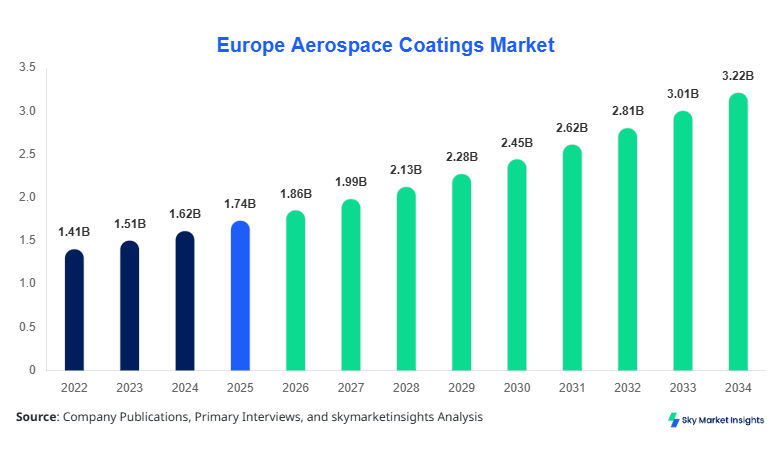
The European aerospace coatings market size is projected at USD 1.86 billion in 2026 and is expected to hit USD 3.21 billion by 2034 with a CAGR of 7.1%. The market expansion is being driven by increasing aircraft production, rising maintenance and overhaul activities, and the growing demand for lightweight and corrosion-resistant coating systems across commercial and military aviation sectors. Europe accounted for nearly 28.4% of global aerospace coatings consumption in 2025, with over 34.6 million liters of aerospace coatings utilized across OEM and MRO applications.
The report evaluates extensive segmentation based on resin type and application while assessing production capacity, consumption analytics, competitive positioning, regulatory framework, and technological adoption patterns. Growing investments in sustainable aviation materials, waterborne coating technologies, and high-performance polyurethane systems continue to reshape the European aerospace coatings market size landscape.
The aerospace coatings industry refers to specialized protective and decorative coatings applied on aircraft surfaces, structural components, cabin interiors, landing gears, fuselage sections, and engine components to enhance durability, corrosion resistance, UV stability, and operational performance. Europe manufactured approximately 2,460 commercial and military aircraft units during 2025, while aerospace coating demand from OEM operations represented nearly 41% of total regional consumption. Commercial aviation contributed 57.3% of total aerospace coatings demand, followed by military aviation with 28.9% and general aviation with 13.8%.
Adoption and penetration rates of advanced aerospace coatings increased significantly across Europe owing to stringent environmental regulations and fleet modernization programs. Waterborne and low-VOC aerospace coatings represented 36.2% of total coating consumption in 2025 compared to 28.4% in 2022. Approximately 61% of aerospace manufacturers in Europe integrated nanotechnology-based coating systems into structural aircraft components. Polyurethane coatings dominated exterior aircraft applications due to their superior abrasion resistance and gloss retention capabilities, accounting for nearly 44.8% of the total resin demand. Aircraft repainting cycles in Europe averaged between 5 and 7 years, while thermal-resistant coatings for engine components witnessed annual consumption growth of 8.6%.
Consumer behavior and demand analytics indicate strong airline preferences toward fuel-efficient coatings capable of reducing aircraft weight by 3%–5%. European airline operators collectively invested over USD 420 million in aircraft repainting and surface maintenance activities during 2025. Demand from low-cost carriers expanded by 9.2% year-on-year due to fleet expansion across Spain, Italy, and the United Kingdom. Technological performance metrics such as salt spray resistance exceeding 3,000 hours, UV resistance up to 10 years, and operating temperature tolerance above 250°C continue influencing procurement decisions. The increasing preference for eco-friendly and high-durability coating systems continues to reinforce Europe's aerospace coatings market share.
In France, the Aerospace Coatings Market accounted for approximately 24.7% of total European aerospace coatings revenue during 2025, supported by the presence of more than 320 aerospace manufacturing and maintenance facilities. France produced nearly 735 aircraft and aerospace assemblies in 2025, while Toulouse remained the primary aerospace manufacturing hub accounting for 46% of national aerospace output. Commercial aviation applications contributed 61% of aerospace coatings consumption in France, followed by military aviation at 27% and general aviation at 12%.
More than 68% of aerospace OEM facilities in France adopted low-VOC and chromium-free aerospace coatings technologies by the end of 2025. Polyurethane coatings represented nearly 48% of total aerospace coating demand within the country due to their superior weatherability and gloss performance. Aerospace MRO activities expanded by 7.8% annually owing to increasing aircraft repainting requirements and airline fleet modernization initiatives. France also witnessed a 14.2% rise in demand for thermal barrier coatings for turbine and engine applications. The strong integration of advanced coating technologies, aircraft manufacturing dominance, and rising defense expenditure continues strengthening Europe's aerospace coatings market growth.
Explore more data points, trends and opportunities Download Free Sample Report
Aerospace Coatings Market Trends
Rising Adoption of Sustainable and Low-VOC Aerospace Coatings
European aerospace manufacturers are increasingly transitioning toward sustainable coating technologies due to stringent environmental compliance standards under REACH regulations. Waterborne aerospace coatings consumption surpassed 12.8 million liters in 2025, representing an annual increase of 11.4% compared to 2024. More than 58% of newly manufactured commercial aircraft in Europe incorporated low-VOC coating systems capable of reducing solvent emissions by nearly 45%. Aerospace OEMs invested approximately USD 190 million in environmentally sustainable coating technologies during 2025. Demand for chrome-free primers increased by 13.6% due to regulatory restrictions on hazardous substances and increasing airline sustainability targets. Additionally, aerospace coating systems with self-healing and anti-corrosion properties witnessed penetration growth of 9.7% across military aviation programs. These technological developments are significantly transforming the Europe aerospace coatings market trends.
Increasing Demand from Aircraft MRO and Fleet Modernization
The expansion of aircraft maintenance, repair, and overhaul activities continues driving aerospace coating consumption across Europe. More than 7,800 commercial aircraft underwent surface maintenance or repainting operations in 2025 across European MRO centers. Germany, France, and the United Kingdom collectively accounted for 63% of total regional MRO coating demand. Airlines increasingly prefer lightweight coating technologies capable of reducing aircraft drag and improving fuel efficiency by 1.5%–2.0%. The military aviation segment also experienced rising coating demand due to the modernization of fighter aircraft and transport fleets, with defense-related aerospace coating consumption growing by 8.2% in 2025. Advanced anti-icing and heat-resistant coatings recorded double-digit growth due to rising adoption in high-performance aerospace applications. Such developments continue reinforcing Europe Aerospace Coatings Market Trends.
Europe Aerospace Coatings Drivers
Increasing Aircraft Production and Fleet Expansion Across Europe
Europe’s commercial and military aircraft manufacturing sector continues expanding steadily, significantly driving aerospace coatings demand. Aircraft production across Europe exceeded 2,460 units in 2025, reflecting a 6.8% increase compared to 2024. Airbus alone delivered over 760 commercial aircraft units globally, while approximately 38% of associated aerospace coating consumption originated from European facilities. The region’s growing airline passenger traffic, which surpassed 1.2 billion travelers in 2025, accelerated aircraft procurement and repainting cycles. Aerospace coatings are increasingly utilized for corrosion prevention, UV protection, and drag reduction, with polyurethane systems accounting for nearly 45% of total aerospace coating applications. The military aviation sector also contributed significantly as defense aircraft modernization programs expanded across France, Germany, and the United Kingdom. More than USD 4.8 billion was allocated toward military aircraft upgrades and maintenance across Europe during 2025. Rising aircraft production, expanding MRO infrastructure, and increasing investments in lightweight aviation technologies continue supporting Europe Aerospace Coatings Market Growth.
Europe Aerospace Coatings Restraints
Volatility in Raw Material Prices and Environmental Compliance Costs
Fluctuations in raw material costs continue creating operational challenges for aerospace coatings manufacturers across Europe. Key raw materials such as titanium dioxide, epoxy resins, polyurethane binders, and specialty solvents witnessed price increases ranging between 8% and 19% during 2025. Aerospace coating production costs rose by approximately 11.3% across major European manufacturing facilities due to supply chain disruptions and rising energy prices. Compliance with REACH regulations and stringent VOC emission standards significantly increased operational expenditure for coating manufacturers, particularly smaller regional suppliers. More than 41% of aerospace coatings producers reported increased capital spending on sustainable production technologies and waste treatment systems. Additionally, certification timelines for advanced aerospace coatings frequently extend beyond 18–24 months, delaying product commercialization. These pricing and compliance challenges continue limiting profitability margins and restraining expansion opportunities within the European aerospace coatings market.
Europe Aerospace Coatings Opportunities
Growing Demand for Advanced Thermal Barrier and Nanotechnology Coatings
Increasing adoption of next-generation aircraft systems is creating substantial opportunities for aerospace coatings manufacturers across Europe. Thermal barrier coatings for jet engines and turbine components experienced demand growth of 12.1% during 2025 due to rising deployment in high-temperature aerospace applications. Nanotechnology-based aerospace coatings demonstrated performance improvements exceeding 18% in abrasion resistance and 22% in corrosion protection compared to conventional systems. European defense aviation programs invested more than USD 740 million in advanced aerospace material innovations, including radar-absorbing and self-cleaning coatings. Electric and hybrid aircraft development initiatives across Germany, France, and the United Kingdom also accelerated demand for lightweight multifunctional coatings. Over 26 aerospace R&D facilities across Europe initiated pilot projects focused on graphene-enhanced aerospace coatings and anti-icing technologies. These advancements are expected to create long-term commercial potential across OEM and MRO segments while enhancing Europe's aerospace coatings market demand.
Challenges in European Aerospace Coatings
Complex Certification Procedures and Limited Skilled Workforce
Aerospace coatings manufacturers face substantial challenges associated with regulatory certification and workforce shortages across Europe. Aerospace coating formulations require extensive testing for adhesion, corrosion resistance, flammability, thermal stability, and UV durability before commercial deployment. Certification costs for new aerospace coatings frequently exceed USD 2.5 million per product line, while approval timelines often extend beyond 24 months. Approximately 37% of aerospace manufacturers reported delays in coating adoption due to prolonged validation procedures from aviation authorities. Simultaneously, Europe faces a shortage of skilled aerospace coating technicians and application specialists, particularly in France, Germany, and Italy. Workforce gaps increased labor costs by nearly 9.4% in 2025 across MRO facilities. Automation adoption in coating application processes remained limited to only 32% of regional aerospace facilities, further affecting productivity. These operational and certification complexities continue posing major challenges for sustained European aerospace coatings market demand.
Report Scope
| Report Metric | Details |
|---|---|
| Market Size in 2025 | USD 1.74 Billion |
| Market Size in 2026 | USD 1.86 Billion |
| Market Size in 2034 | USD 3.21 Billion |
| CAGR | 7.1% (2026-2034) |
| Base Year for Estimation | 2025 |
| Historical Data | 2022-2024 |
| Forecast Period | 2026-2034 |
| Report Coverage | Revenue Forecast, Competitive Landscape, Supply Chain Disruption, Growth Factors, Environment & Regulatory Landscape and Trends |
Explore more data points, trends and opportunities Download Free Sample Report
Aerospace Coatings Market Segmentation
The European aerospace coatings industry is segmented based on resin type and application. Polyurethane coatings dominated the market with nearly 44.8% revenue contribution in 2025 owing to superior durability and weather resistance. Commercial aviation accounted for approximately 57.3% of total application demand due to increasing airline fleet expansion and aircraft repainting activities.
By Type
Epoxy aerospace coatings accounted for approximately 31.5% of total market consumption in 2025 due to strong adhesion performance and chemical resistance properties. Nearly 9.6 million liters of epoxy aerospace coatings were utilized across aircraft structural components, fuel tanks, and primer applications. These coatings demonstrate corrosion resistance exceeding 3,500 salt spray hours and operational temperature tolerance up to 180°C. Aerospace OEM facilities across Germany and France increasingly adopted epoxy primer systems for fuselage and wing assemblies due to long-term durability benefits. Military aviation applications represented nearly 38% of epoxy coating demand owing to extensive use in combat aircraft structures. Rising investments in chromate-free epoxy technologies further accelerated adoption across environmentally regulated European aerospace facilities.
Polyurethane coatings represented the largest share within the European aerospace coatings industry, accounting for nearly 44.8% of total consumption during 2025. More than 13.8 million liters of polyurethane aerospace coatings were applied across commercial and military aircraft exteriors. These coatings provide high gloss retention exceeding 90%, UV stability above 10 years, and abrasion resistance improvements of nearly 25% compared to traditional systems. Commercial airlines increasingly prefer polyurethane topcoats to reduce repainting frequency and maintenance expenditure. France, Germany, and the United Kingdom collectively contributed over 67% of polyurethane aerospace coating consumption due to extensive aircraft manufacturing operations. Waterborne polyurethane systems also gained strong momentum, representing 29% of polyurethane coating demand during 2025.
Acrylic aerospace coatings accounted for approximately 23.7% of total market demand in 2025, primarily utilized for cabin interiors, decorative finishes, and lightweight aircraft applications. Nearly 7.1 million liters of acrylic coatings were consumed across Europe during the year. Acrylic systems offer rapid drying times below 40 minutes and enhanced flexibility for aircraft interior applications. General aviation and business jet segments represented over 46% of acrylic coating demand due to aesthetic preferences and reduced maintenance requirements. Italy and Spain emerged as key regional markets for acrylic aerospace coatings owing to rising private aviation activities and aircraft refurbishment operations. Increasing adoption of low-VOC acrylic technologies further supported market expansion.
By Application
Commercial aviation represented the dominant application segment, accounting for nearly 57.3% of aerospace coatings consumption in Europe during 2025. More than 17.9 million liters of aerospace coatings were utilized across narrow-body, wide-body, and regional commercial aircraft fleets. Airlines increasingly adopted lightweight coating systems capable of reducing aircraft weight by up to 4%, thereby improving fuel efficiency. Aircraft repainting cycles averaged between 5 and 6 years, while low-cost carriers increased maintenance-related coating expenditure by 8.9% during 2025. Airbus manufacturing facilities across France, Germany, and Spain remained the largest consumers of aerospace coatings for OEM applications. Rising passenger traffic and expanding aircraft fleets continue driving coating demand within commercial aviation operations.
Military aviation accounted for approximately 28.9% of aerospace coating demand in Europe during 2025. Nearly 8.7 million liters of aerospace coatings were consumed for fighter aircraft, transport aircraft, helicopters, and unmanned aerial systems. Defense modernization programs across France, the United Kingdom, and Germany significantly increased demand for radar-absorbing, anti-corrosion, and thermal-resistant coatings. Heat-resistant coatings capable of withstanding temperatures above 500°C gained substantial adoption in jet engine and turbine applications. Military aircraft maintenance cycles also expanded coating demand across European defense MRO facilities. Investments exceeding USD 4.8 billion in aircraft modernization and defense aviation infrastructure continue supporting segment expansion.
General aviation contributed approximately 13.8% of total aerospace coatings demand in Europe during 2025. Nearly 4.2 million liters of aerospace coatings were utilized across private jets, business aircraft, training aircraft, and recreational aviation fleets. Acrylic and polyurethane coatings dominated general aviation applications due to superior aesthetics and lightweight performance. Italy, Spain, and the United Kingdom collectively accounted for over 52% of regional general aviation coating demand owing to rising private aircraft ownership and tourism-related aviation activities. Cabin refurbishment projects increased by 11.6% during 2025, further boosting demand for decorative aerospace coating systems. Technological advancements in scratch-resistant and self-cleaning coatings continue supporting adoption across premium business aviation applications.
Europe Aerospace Coatings Market Segmentations
Resin Type
- Epoxy
- Polyurethane
- Acrylic
Application
- Commercial Aviation
- Military Aviation
- General Aviation
Europe Aerospace Coatings Regional Outlook
United Kingdom
The United Kingdom accounted for approximately 18.6% of the European aerospace coatings industry during 2025. The country operated more than 190 aerospace manufacturing and MRO facilities, consuming nearly 5.8 million liters of aerospace coatings annually. Commercial aviation represented 54% of national aerospace coating demand, while military aviation contributed 34%. The UK government allocated over USD 2.1 billion toward aerospace innovation and defense modernization initiatives during 2025. Demand for thermal-resistant and anti-corrosion coatings increased by 9.1% due to expanding military aircraft programs. Sustainable waterborne coating adoption reached nearly 39% of total aerospace coating consumption across the country.
Germany
Germany represented approximately 21.4% of Europe’s aerospace coatings industry in 2025. The country produced more than 420 aerospace systems and aircraft components while operating nearly 240 aerospace manufacturing units. Commercial aviation accounted for 59% of aerospace coating demand, supported by strong Airbus supply chain operations. Germany consumed approximately 6.4 million liters of aerospace coatings during 2025, with polyurethane systems representing 46% of total demand. Investments in aerospace R&D exceeded USD 1.8 billion, particularly focusing on lightweight and nanotechnology-enhanced coatings. Demand for low-VOC aerospace coatings increased by 13.3% due to stringent environmental regulations.
France
France remained the leading country within the European aerospace coatings sector, contributing approximately 24.7% of total regional demand in 2025. The country consumed over 7.2 million liters of aerospace coatings across OEM and MRO operations. Toulouse emerged as the largest aerospace manufacturing cluster in Europe, accounting for 46% of national aerospace activity. Commercial aviation represented 61% of coating demand, while military aviation accounted for 27%. More than 68% of aerospace facilities adopted advanced low-VOC and chromate-free coatings technologies. Rising aircraft exports and fleet modernization programs continue strengthening France’s position in the European aerospace coatings industry.
Spain
Spain accounted for approximately 11.2% of Europe’s aerospace coatings market during 2025. The country produced nearly 210 aircraft components and aerospace assemblies annually while operating more than 95 aerospace manufacturing facilities. Commercial aviation represented 63% of total aerospace coating consumption owing to strong tourism-driven airline expansion. Spain consumed approximately 3.5 million liters of aerospace coatings in 2025, with acrylic coatings accounting for 28% of total demand. Aircraft maintenance and repainting activities expanded by 8.7% year-over-year due to increasing low-cost carrier operations.
Italy
Italy contributed nearly 10.1% of the European aerospace coatings sector during 2025. The country consumed approximately 3.1 million liters of aerospace coatings across military, commercial, and general aviation applications. General aviation represented 18% of national aerospace coating demand due to rising business jet and private aviation operations. Aerospace manufacturing investments exceeded USD 620 million during 2025, supporting the adoption of advanced polyurethane and thermal barrier coating systems. Italy also witnessed increasing demand for cabin interior coatings and lightweight aircraft surface technologies.
Russia
Russia accounted for approximately 14% of regional aerospace coating demand during 2025 despite geopolitical and trade-related constraints. The country operated over 160 aerospace manufacturing and maintenance facilities while consuming approximately 4.6 million liters of aerospace coatings annually. Military aviation represented nearly 49% of aerospace coating demand due to extensive defense aircraft production and modernization programs. Demand for thermal-resistant and anti-corrosion coatings remained high across engine and structural applications. Domestic aerospace coating production increased by 7.4% in 2025 to reduce dependence on imported aerospace materials.
Top players in European aerospace coatings
- PPG Industries Inc.
- Akzo Nobel N.V.
- Sherwin-Williams Company
- Mankiewicz Gebr. & Co.
- Hentzen Coatings Inc.
- Henkel AG & Co. KGaA
- BASF SE
- Sophomore
- IHI Ionbond AG
- BryCoat Inc.
- Saint-Gobain S.A.
- Axalta Coating Systems
- 3M Company
- Kansai Paint Co. Ltd.
- Zircotec Ltd.
PPG Industries Inc.
-
Estimated European aerospace coatings market share: 18.2%
-
Strong presence across OEM and MRO applications
-
Extensive portfolio of polyurethane, epoxy, and low-VOC aerospace coatings
-
Operates multiple aerospace coating production facilities across France and Germany
PPG Industries maintained a dominant position within Europe due to its strong partnerships with major aircraft manufacturers and airline operators. The company supplied coating systems for more than 35% of Airbus commercial aircraft deliveries in 2025. PPG invested over USD 140 million in sustainable aerospace coating innovations and expanded its low-VOC product portfolio by 16% during the year. Its advanced thermal-resistant coatings demonstrated operational temperature stability exceeding 600°C, supporting military and engine-related applications.
Akzo Nobel N.V.
-
Estimated European aerospace coatings market share: 15.7%
-
Major supplier for commercial aviation repainting operations
-
Strong focus on environmentally sustainable aerospace coatings
-
Expanding waterborne coating production capacity
Akzo Nobel strengthened its market position through advanced chromate-free aerospace coating technologies and strategic airline collaborations across Europe. The company supplied nearly 5.2 million liters of aerospace coatings during 2025 and expanded waterborne coating capacity by 18%. Akzo Nobel invested heavily in nanotechnology-enhanced coatings capable of improving corrosion resistance by 21% compared to conventional systems. The company also supported aerospace MRO operations across the United Kingdom, Germany, and France through integrated technical service networks.
Investment Analysis
Investments within the European aerospace coatings industry increased significantly during 2025 due to rising aircraft manufacturing and sustainable coating technology adoption. More than USD 3.8 billion was allocated toward aerospace surface technologies, coating production facilities, and advanced materials research across Europe. France accounted for approximately 31% of total aerospace coatings investments, followed by Germany with 24% and the United Kingdom with 19%. Nearly 42% of investments targeted environmentally sustainable coating technologies, including waterborne and low-VOC systems. Commercial aviation applications attracted 57% of total aerospace coating investments, while military aviation represented 29%.
Mergers, acquisitions, and strategic collaborations also intensified within the aerospace coatings sector. More than 18 partnership agreements were announced across Europe during 2025 involving aerospace manufacturers, coating suppliers, and material science companies. Joint ventures focusing on graphene-enhanced coatings, thermal barrier technologies, and smart self-healing coatings received funding exceeding USD 620 million. Aerospace OEMs increasingly collaborated with specialty coating manufacturers to improve fuel efficiency and reduce aircraft maintenance cycles. Germany and France collectively represented 54% of all aerospace coating R&D partnerships in Europe. Investments in automated coating application systems also expanded by 11.8%, improving operational productivity across aerospace manufacturing facilities.
New Product Developments
Aerospace coating manufacturers across Europe introduced several advanced coating solutions during 2025, focusing on lightweight performance, corrosion resistance, and sustainability. More than 26% of newly launched aerospace coatings incorporated nanotechnology or self-healing capabilities. Waterborne aerospace coatings with VOC reduction levels exceeding 45% gained rapid adoption among commercial airline operators and OEM manufacturers. Advanced polyurethane coating systems demonstrated gloss retention improvements of nearly 18% and abrasion resistance enhancements above 22% compared to conventional technologies.
Thermal barrier coating innovations capable of operating above 1,000°C also witnessed rising deployment across military and engine-related applications. More than 14 new aerospace coating product lines were introduced by leading manufacturers during 2025. Smart anti-icing coatings capable of reducing ice accumulation by 31% gained significant interest within commercial aviation applications. Sustainable aerospace coating technologies continue reshaping aircraft maintenance and manufacturing standards across Europe.
Recent Developments in European Aerospace Coatings
- 2025: PPG Industries expanded aerospace coating production capacity in France by 14% to support increasing Airbus manufacturing demand. The facility expansion increased annual coating output by nearly 1.2 million liters while improving low-VOC aerospace coating availability across Europe. The investment exceeded USD 85 million and focused heavily on sustainable polyurethane technologies and advanced aircraft surface protection systems.
- 2025: Akzo Nobel launched a new generation of chromate-free aerospace primers capable of improving corrosion resistance by 19% compared to previous technologies. The new product line targeted commercial and military aviation applications and achieved strong adoption across Germany and the United Kingdom. Production volume for the new coating systems exceeded 420,000 liters during initial deployment.
Research Methodology
The European aerospace coatings market assessment was developed through a comprehensive combination of primary and secondary research methodologies. The research process included detailed evaluation of aerospace manufacturing output, aircraft delivery statistics, coating consumption volumes, and MRO operational analytics across Europe between 2022 and 2025. Primary research involved interviews with aerospace coating manufacturers, airline maintenance operators, aerospace OEM executives, raw material suppliers, and aviation regulatory authorities. More than 65 industry stakeholders contributed quantitative and qualitative insights related to pricing trends, production capacities, technological developments, and investment patterns.
Secondary research included the analysis of aerospace manufacturing databases, aviation trade publications, company annual reports, government aerospace statistics, customs databases, and environmental regulatory documents. Market size estimation utilized bottom-up and top-down analytical approaches integrating aircraft production volumes, coating consumption per aircraft, repainting cycles, and regional trade flows. Forecast models were developed using historical growth patterns, macroeconomic indicators, aviation demand projections, and technology adoption trends. Data triangulation techniques ensured high accuracy and consistency across all market segments and regional evaluations.
Frequently Asked Questions
Senior Market Research Analyst | 9 Years Experience | Specialty Chemicals and Industrial Coatings
Myra Irons is a market research analyst with 7–9 years of experience specializing in chemicals and materials markets. Contributed to 70+ research reports for global clients. Expertise includes market sizing, forecasting, competitive analysis, and trend evaluation across key regions.