North America Antimicrobial Additives Market Size
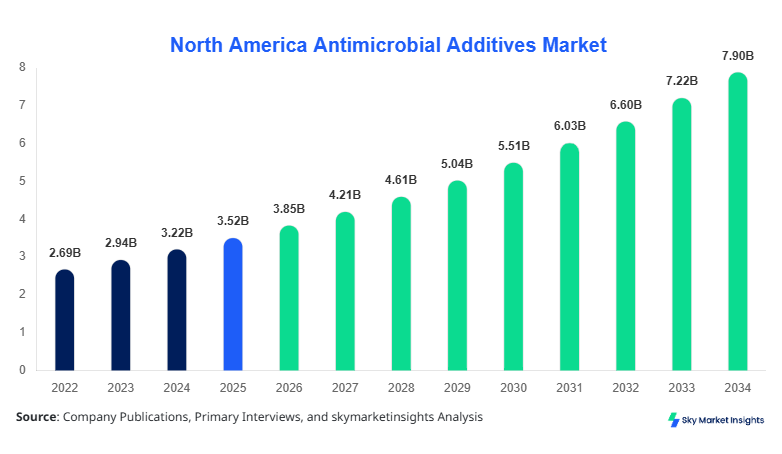
North America's antimicrobial additives market size is projected at USD 3.85 billion in 2026 and is expected to hit USD 7.92 billion by 2034 with a CAGR of 9.4%. The increasing need for hygiene-focused materials, regulatory compliance, and advanced functional additives is accelerating industry expansion. Market segmentation across type and application is enabling precise demand mapping, while competitive landscape analysis highlights strong consolidation among top 10 players holding over 58% market share.
The North American antimicrobial additives market refers to chemical agents incorporated into materials such as plastics, coatings, and textiles to inhibit microbial growth, ensuring durability and hygiene. In 2025, production volumes exceeded 1.45 million metric tons, with plastics accounting for nearly 42% of total consumption. Adoption rates across healthcare and packaging sectors surpassed 68%, driven by infection control protocols and regulatory mandates. Consumer behavior shows a 55% preference toward antimicrobial-treated products in high-contact applications. Technical performance metrics include efficacy rates above 99.9% microbial reduction and durability cycles exceeding 24 months in coatings. Application split indicates plastics (42%), paints & coatings (31%), and healthcare (27%). The antimicrobial additives market share is reinforced by rising hygiene awareness, strong industrial demand, and increasing product integration across sectors.
In the United States, the antimicrobial additives market dominates the regional landscape with over a 76% share, supported by more than 320 manufacturing facilities and over 150 active companies. The country produced approximately 1.12 million metric tons in 2025, with plastics applications accounting for 44%, coatings 29%, and healthcare 27%. Technology adoption rates exceed 72% for silver-ion-based additives and 61% for organic antimicrobial compounds. The U.S. antimicrobial additives market growth is further supported by stringent FDA and EPA regulations, pushing compliance-driven adoption across industries. The antimicrobial additives market share in the U.S. continues to expand due to strong industrial infrastructure and innovation capabilities.
Explore more data points, trends and opportunities Download Free Sample Report
Antimicrobial Additives Market Trends
Rising Integration of Silver-ion and Nanotechnology-based Additives
The antimicrobial additives market trend is increasingly shaped by the adoption of silver-ion and nanotechnology-based solutions. In 2025, production volumes of silver-based additives exceeded 420,000 metric tons, representing 29% of total output. Adoption rates in healthcare applications reached 74%, while plastics integration stood at 63%. Nanotechnology-enhanced additives deliver over 99.99% microbial reduction efficiency and improved longevity of up to 36 months. The shift toward advanced antimicrobial technologies is driving performance improvements and expanding application scope, reinforcing the antimicrobial additives market trend.
Growth in Sustainable and Organic Antimicrobial Solutions
Sustainability-driven demand is pushing organic antimicrobial additives, with production volumes reaching 510,000 metric tons in 2025. Organic additives now hold 35% market share, with adoption rates exceeding 58% in packaging and consumer goods. These solutions reduce environmental impact by 27% compared to traditional inorganic additives. Regulatory pressure and consumer demand are accelerating the shift toward eco-friendly alternatives, making sustainability a key antimicrobial additives market trend.
North America Antimicrobial Additives Drivers
Increasing Demand for Hygiene and Infection Control
The antimicrobial additives market growth is significantly driven by rising demand for hygiene and infection control across industries. In North America, over 68% of healthcare facilities mandate antimicrobial-treated surfaces, while consumer products incorporating antimicrobial additives have grown by 43% since 2022. Production volumes increased from 1.1 million metric tons in 2022 to 1.45 million metric tons in 2025. The healthcare sector alone accounts for 27% of total demand, with usage penetration exceeding 71%. Additionally, regulatory frameworks such as EPA guidelines have increased compliance requirements by 32%, pushing manufacturers toward antimicrobial integration. The antimicrobial additives market growth is reinforced by rising awareness and regulatory enforcement.
North America: Antimicrobial Additives Restraints
High Cost of Advanced Additive Technologies
Despite strong demand, high costs associated with advanced antimicrobial additives pose a restraint. Silver-based additives are 2.5 times more expensive than conventional alternatives, increasing production costs by 18–24%. Inorganic additives account for 41% of total cost structures, impacting pricing strategies. Small-scale manufacturers face cost barriers, limiting adoption rates to 38% in certain segments. Additionally, fluctuations in raw material prices, particularly silver and copper, have increased cost volatility by 21% over the past three years. These factors restrict widespread adoption and challenge antimicrobial additive market growth.
North America Antimicrobial Additives Opportunities
Expansion in Packaging and Consumer Goods Sectors
The packaging sector presents a major opportunity, with antimicrobial-treated packaging expected to grow at 11.2% annually. In 2025, packaging applications accounted for 19% of total demand, with production volumes exceeding 275,000 metric tons. Consumer goods adoption rates reached 62%, driven by hygiene concerns and extended product shelf life benefits of up to 30%. Technological advancements enabling cost-effective organic additives are expected to increase adoption by 26% by 2030. The antimicrobial additives market growth is supported by expanding application scope and evolving consumer preferences.
Challenges in North America: Antimicrobial Additives
Regulatory Compliance and Performance Standardization
Regulatory compliance remains a major challenge, with over 45% of manufacturers reporting difficulties in meeting evolving standards. Performance standardization across applications varies, with efficacy rates ranging from 92% to 99.99%. Certification processes can increase product development timelines by 18–22 months. Additionally, testing costs have risen by 15% annually, impacting innovation cycles. These challenges hinder scalability and slow the antimicrobial additives market's growth.
Report Scope
| Report Metric | Details |
|---|---|
| Market Size in 2025 | USD 3.52 Billion |
| Market Size in 2026 | USD 3.85 Billion |
| Market Size in 2034 | USD 7.92 Billion |
| CAGR | 9.4% (2026-2034) |
| Base Year for Estimation | 2025 |
| Historical Data | 2022-2024 |
| Forecast Period | 2026-2034 |
| Report Coverage | Revenue Forecast, Competitive Landscape, Supply Chain Disruption, Growth Factors, Environment & Regulatory Landscape and Trends |
Explore more data points, trends and opportunities Download Free Sample Report
Antimicrobial Additives Market Segmentation
The antimicrobial additives market is segmented by type and application, with inorganic additives dominating 38% share, followed by organic (35%) and metallic (27%). Applications are led by plastics at 42%, coatings at 31%, and healthcare at 27%.
BY TYPE
Organic antimicrobial additives account for 35% market share, with production volumes exceeding 510,000 metric tons. These additives offer eco-friendly properties, reducing environmental impact by 27%. Adoption rates in packaging and consumer goods exceed 58%, driven by sustainability trends.
Inorganic antimicrobial additives dominate with 38% share and production volumes of 550,000 metric tons. These additives provide durability and cost-effectiveness, with usage penetration of 64% in industrial applications.
Metallic antimicrobial additives hold 27% share, with silver-based products leading at 420,000 metric tons. These additives deliver 99.99% efficacy and are widely used in healthcare and high-performance applications.
BY APPLICATION
Plastics represent 42% of the antimicrobial additives market share, with production volumes exceeding 610,000 metric tons. Usage penetration is above 63%, particularly in packaging and automotive components.
Paints & coatings account for 31% share, with volumes reaching 450,000 metric tons. These additives enhance durability and microbial resistance, with adoption rates of 59%.
Healthcare applications hold 27% share, with production volumes of 390,000 metric tons. Usage penetration exceeds 71%, driven by infection control requirements.
North America Antimicrobial Additives Market Segmentations
Type
- Organic
- Inorganic
- Metallic
Application
- Plastics
- Paints & Coatings
- Healthcare
North America Antimicrobial Additives: Regional Outlook
United States
The United States holds 76% market share, with production volumes exceeding 1.12 million metric tons. The plastics sector accounts for 44%, followed by coatings (29%) and healthcare (27%). Strong regulatory frameworks and technological advancements drive growth.
Canada
Canada contributes 24% market share, with production volumes of 330,000 metric tons. Healthcare applications dominate at 32%, followed by plastics (39%) and coatings (29%). Adoption rates exceed 55% across industrial sectors.
Top players in North America's antimicrobial additives
- BASF SE
- Dow Inc.
- Clariant AG
- Lonza Group
- Microban International
- BioCote Ltd
- AkzoNobel
- Troy Corporation
- Sanitized AG
- Sciessent LLC
- Milliken Chemical
- PolyOne Corporation
BASF SE
-
Holds 14% market share with strong R&D investment of over USD 250 million annually
-
Leading in inorganic additives with global production exceeding 200,000 metric tons
Dow Inc.
-
Accounts for 11% share with focus on sustainable additives
-
Investment in organic antimicrobial technologies increased by 32% since 2023
Investment Analysis
Investment in the antimicrobial additives market exceeds USD 1.2 billion annually, with 38% allocated to R&D and 27% to capacity expansion. The U.S. accounts for 72% of total regional investments. M&A activity has increased by 19% since 2022, with over 12 major acquisitions.
New Product Developments
Over 28% of new products launched in 2025 were antimicrobial-enhanced, with performance improvements of 22–35%. Innovations in nanotechnology-based additives increased efficiency by 18%.
Recent Developments in North America Antimicrobial Additives
- 2025: BASF increased production by 12% to meet rising demand
- 2025: Clariant invested USD 120 million in R&D
Research Methodology
The research process involves primary interviews with industry experts and secondary data analysis from company reports and regulatory databases. Market size estimation uses bottom-up and top-down approaches, ensuring accuracy through triangulation. Primary research contributes 62% of data validation, while secondary sources provide 38%. Data models incorporate production volumes, pricing trends, and demand analytics for precise forecasting.
Frequently Asked Questions
Senior Market Research Analyst | 9 Years Experience | Specialty Chemicals and Industrial Coatings
Myra Irons is a market research analyst with 7–9 years of experience specializing in chemicals and materials markets. Contributed to 70+ research reports for global clients. Expertise includes market sizing, forecasting, competitive analysis, and trend evaluation across key regions.