Europe Aerosol Propellants Market Size
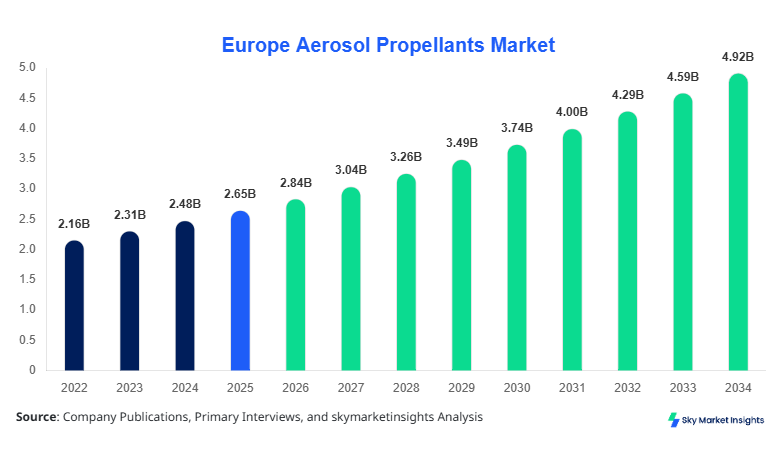
Europe's aerosol propellants market size is projected at USD 2.84 billion in 2026 and is expected to hit USD 4.91 billion by 2034 with a CAGR of 7.1%.
The increasing utilization of aerosol packaging technologies across personal care, household cleaning, industrial coatings, and pharmaceutical applications is accelerating demand across the European region. More than 5.8 billion aerosol units were consumed in Europe during 2025, with personal care products accounting for nearly 54% of total volume consumption. Growing investment in sustainable propellant technologies, advanced valve systems, and hydrocarbon-based formulations continues to shape the competitive landscape. The report evaluates detailed segmentation analysis, technological adoption rates, regulatory impacts, production capacities, and competitive benchmarking across leading European economies.
The aerosol propellants industry comprises compressed gases and liquefied gases utilized to expel product formulations from aerosol containers under controlled pressure systems. Europe produced approximately 6.2 billion aerosol cans in 2025, supported by over 420 filling facilities operating across the United Kingdom, Germany, France, Spain, Italy, and Russia. Hydrocarbon propellants represented nearly 61% of total production volume, while compressed gases accounted for 22% and liquefied gases held a 17% share in 2025. Personal care applications contributed around 48% of total consumption, followed by household products with 29%, medical aerosols with 15%, and industrial applications with 8%.
Adoption rates for low-global-warming-potential propellants increased by 31% between 2022 and 2025 due to stricter European environmental regulations and rising consumer preference for sustainable packaging. Consumer demand analytics indicate that more than 64% of aerosol users in Europe prefer recyclable and VOC-compliant aerosol solutions, particularly in cosmetic and hygiene applications. Average operating pressure for compressed gas propellants ranges between 35 psi and 90 psi, while hydrocarbon propellants maintain vapor pressure efficiency between 25 psi and 70 psi depending on formulation. Increasing utilization of aluminum aerosol packaging, which represented 58% of aerosol containers in 2025, is further supporting Europe's aerosol propellants market growth.
In the United Kingdom, the Aerosol Propellants Market accounted for approximately 24% of Europe’s total aerosol propellant consumption in 2025, supported by more than 75 aerosol manufacturing and filling facilities distributed across England, Scotland, and Wales. The country produced nearly 1.3 billion aerosol units during the year, with personal care products representing 46% of application demand, household products contributing 28%, and medical aerosols accounting for 17%. Hydrocarbon propellants maintained nearly 59% penetration due to lower cost structures and strong compatibility with deodorants, hairsprays, and cleaning products.
Technology adoption within the United Kingdom has accelerated significantly, with over 42% of aerosol manufacturers integrating low-emission filling systems and automated pressure monitoring technologies by 2025. Around 37% of domestic aerosol companies invested in sustainable propellant development programs focused on dimethyl ether and nitrogen-based systems. Consumer penetration for aerosol-based hygiene products exceeded 71% among urban households, while pharmaceutical inhaler utilization increased by 14% year-on-year due to rising respiratory treatment demand. Expanding exports to Germany, France, and Italy are also strengthening Europe Aerosol Propellants Market share across the regional supply chain.
Explore more data points, trends and opportunities Download Free Sample Report
Aerosol Propellants Market Trends
Rising Adoption of Sustainable Hydrocarbon and Compressed Gas Technologies
European aerosol manufacturers are increasingly transitioning toward sustainable hydrocarbon and compressed gas systems to comply with environmental directives targeting VOC emission reduction. During 2025, more than 2.9 billion aerosol cans produced in Europe utilized low-VOC hydrocarbon propellants, representing an annual increase of 18%. Nitrogen and carbon dioxide-based compressed aerosol propellants' market adoption growth of nearly 26% across pharmaceutical and food-grade aerosol applications. Germany and the United Kingdom together accounted for 43% of sustainable aerosol propellant investments in Europe during the year.
Technological shifts toward lightweight aluminum cans and digitally monitored filling systems have improved production efficiency by approximately 21% while reducing leakage rates by 13%. More than 38% of European aerosol filling facilities implemented AI-assisted pressure calibration systems between 2023 and 2025. Consumer demand for eco-friendly deodorants, air fresheners, and disinfectants is driving higher demand for environmentally compliant aerosol solutions, particularly across urban markets. These developments continue to strengthen the aerosol propellants market trend across Europe.
Expansion of Pharmaceutical Aerosol Applications
The pharmaceutical aerosol segment has emerged as one of the fastest-growing application areas due to rising respiratory disease prevalence and expanding inhalation therapy adoption. Europe produced more than 920 million pharmaceutical aerosol units in 2025, reflecting a 16% increase compared to 2023 production levels. Metered-dose inhalers represented approximately 72% of pharmaceutical aerosol output, supported by increasing asthma and COPD treatment demand.
Advanced propellant formulations using hydrofluoroalkane alternatives witnessed 19% growth in medical aerosol production during 2025. France and Germany together contributed nearly 49% of regional pharmaceutical aerosol manufacturing capacity. Medical aerosol packaging efficiency improved by 14% due to precision valve systems and reduced propellant wastage technologies. Investments exceeding USD 340 million were directed toward pharmaceutical aerosol R&D activities across Europe between 2024 and 2025. Growing healthcare expenditure and rising respiratory healthcare awareness are significantly supporting the aerosol propellants market trend throughout the forecast period.
Europe Aerosol Propellants Market Drivers
Rising Demand for Personal Care and Household Aerosol Products
The rapid expansion of personal care and household aerosol consumption across Europe is a major factor accelerating market expansion. During 2025, Europe consumed approximately 3.1 billion personal care aerosol units, including deodorants, hairsprays, shaving foams, and body sprays. Personal care applications accounted for nearly 48% of overall aerosol propellant utilization, while household cleaning products represented another 29%. Urban household penetration for aerosol disinfectants increased from 52% in 2022 to 68% in 2025 due to heightened hygiene awareness and convenience preferences.
Hydrocarbon propellants continue to dominate because of their cost-effectiveness, representing almost 61% of all aerosol propellant demand in Europe. More than 410 regional brands introduced new aerosol packaging formats between 2023 and 2025. Germany, the United Kingdom, and France collectively accounted for nearly 63% of regional aerosol product consumption. Consumer spending on aerosol-based cosmetic products increased by 11% annually, while production efficiency improved by 17% through automated filling systems. Rising demand for sustainable and recyclable aerosol products continues to support Europe's aerosol propellants market growth.
Europe Aerosol Propellants Market Restraints
Stringent Environmental Regulations on VOC Emissions
Environmental regulations associated with volatile organic compound emissions remain a major restraint affecting aerosol propellant manufacturers across Europe. The European Union’s climate targets and restrictions on hydrofluorocarbons are increasing compliance costs for aerosol filling facilities and chemical suppliers. Nearly 34% of aerosol manufacturers reported elevated production expenses due to regulatory modifications implemented between 2023 and 2025.
VOC emission compliance investments exceeded USD 420 million across Europe in 2025 alone, while operational compliance costs rose by approximately 12% year-on-year. Hydrocarbon propellants, despite accounting for 61% of regional consumption, are increasingly scrutinized due to flammability and emission concerns. More than 18% of smaller aerosol manufacturers faced production limitations related to emission control upgrades and environmental certification requirements. Russia and Spain experienced slower modernization rates compared to Western European countries, affecting regional supply consistency. These environmental challenges are limiting scalability and creating cost pressures across the European aerosol propellants market growth.
Europe Aerosol Propellants Market Opportunities
Increasing Investment in Eco-Friendly and Low-GWP Propellant Solutions
Growing investment in low-global-warming-potential aerosol technologies is creating substantial opportunities for European manufacturers. Investments in sustainable aerosol propellant R&D surpassed USD 780 million between 2023 and 2025, with Germany accounting for 27% of total regional expenditure. Nitrogen-based propellant systems witnessed adoption growth of nearly 24%, particularly in food-grade sprays and pharmaceutical aerosols.
More than 46% of new aerosol product launches in 2025 utilized recyclable packaging and environmentally compliant propellant systems. Dimethyl ether adoption increased by 19% because of lower environmental impact and improved spray performance characteristics. The United Kingdom and France collectively represented 41% of sustainable aerosol innovation projects initiated in 2025. Advanced valve technologies reduced propellant leakage rates by approximately 15%, improving overall efficiency and consumer satisfaction. Rising consumer preference for green packaging solutions and increasing regulatory support for sustainable manufacturing continue to create lucrative European aerosol propellants market opportunities.
Challenges in Europe Aerosol Propellants Market
Raw Material Price Volatility and Supply Chain Disruptions
Fluctuations in raw material pricing and inconsistent supply chain operations continue to challenge aerosol propellant manufacturers throughout Europe. Hydrocarbon feedstock prices increased by nearly 17% between 2024 and 2025 due to geopolitical instability and fluctuating energy markets. More than 29% of aerosol manufacturers reported delayed raw material procurement cycles during 2025, impacting production scheduling and operational efficiency.
Transportation and logistics expenses rose by approximately 13% across European aerosol supply chains, particularly affecting Russia, Spain, and Italy. Aluminum packaging costs increased by 11%, while compressed gas cylinder procurement expenses rose by 8% during the same period. Around 22% of small-scale aerosol producers experienced reduced profitability due to elevated raw material procurement costs. Inventory management complexities and fluctuating demand patterns further intensified operational risks across the region. These supply chain constraints remain a critical challenge affecting long-term Europe aerosol propellant market expansion.
Report Scope
| Report Metric | Details |
|---|---|
| Market Size in 2025 | USD 2.65 Billion |
| Market Size in 2026 | USD 2.84 Billion |
| Market Size in 2034 | USD 4.91 Billion |
| CAGR | 7.1% (2026-2034) |
| Base Year for Estimation | 2025 |
| Historical Data | 2022-2024 |
| Forecast Period | 2026-2034 |
| Report Coverage | Revenue Forecast, Competitive Landscape, Supply Chain Disruption, Growth Factors, Environment & Regulatory Landscape and Trends |
Explore more data points, trends and opportunities Download Free Sample Report
Aerosol Propellants Market Segmentation
The European aerosol propellants industry is segmented by type and application, with hydrocarbon propellants dominating nearly 61% of total market volume in 2025. Personal care applications maintained the largest application share at approximately 48%, followed by household products at 29% and medical aerosols at 15%. Increasing demand for sustainable formulations and pharmaceutical aerosols continues to diversify production structures across regional manufacturers.
By Type
Compressed gas propellants accounted for nearly 22% of European aerosol propellant consumption during 2025. Nitrogen, carbon dioxide, and nitrous oxide remain the most commonly utilized compressed gases due to lower environmental impact and improved pressure consistency. More than 1.2 billion aerosol units in Europe utilized compressed gas systems, particularly across food sprays, pharmaceutical aerosols, and industrial lubricants. Operating pressures generally range between 40 psi and 90 psi depending on product viscosity and dispensing requirements.
Medical inhalers represented approximately 34% of compressed gas application demand due to precision spray capabilities and stable formulation compatibility. Germany and France together contributed nearly 44% of compressed gas aerosol production in Europe. Advanced valve systems improved discharge efficiency by around 16%, while nitrogen-based systems experienced adoption growth of 21% between 2023 and 2025. The segment is increasingly benefiting from sustainability regulations targeting hydrofluorocarbon reduction.
Liquefied gas propellants represented approximately 17% of total European aerosol propellant demand in 2025. These propellants are widely utilized in pharmaceutical aerosols, industrial coatings, and specialty cosmetic applications because of consistent pressure delivery and superior atomization characteristics. Europe produced nearly 980 million aerosol units using liquefied gas systems during the year.
Hydrofluoroalkane alternatives experienced adoption growth of nearly 14% due to stricter environmental restrictions on older fluorocarbon systems. Average vapor pressure efficiency ranged between 25 psi and 60 psi depending on formulation composition and dispensing requirements. Pharmaceutical applications contributed around 39% of segment demand, followed by specialty coatings at 24%. The United Kingdom and Germany together accounted for nearly 48% of regional liquefied gas propellant consumption. Enhanced spray precision and improved formulation stability continue to support industrial adoption rates.
Hydrocarbon propellants dominated the European aerosol industry with approximately 61% market volume share in 2025. Propane, butane, and isobutane remain the primary hydrocarbon propellants used across personal care and household cleaning products due to cost efficiency and strong spray performance. More than 3.7 billion aerosol units produced in Europe during 2025 utilized hydrocarbon propellant systems.
Personal care products represented nearly 58% of hydrocarbon application demand, particularly deodorants, hairsprays, and shaving foams. Production efficiency improvements exceeding 18% were achieved through automated filling technologies and leak detection systems. Spain, Italy, and France collectively contributed nearly 46% of hydrocarbon aerosol production in Southern Europe. Despite regulatory scrutiny, hydrocarbon systems continue to dominate because of affordability, consistent atomization, and extensive manufacturing infrastructure.
By Application
Personal care remained the largest aerosol application segment in Europe, accounting for approximately 48% of total aerosol propellant consumption in 2025. More than 3.1 billion aerosol personal care products were manufactured across Europe, including deodorants, body sprays, shaving foams, dry shampoos, and hairsprays. Consumer penetration for aerosol deodorants exceeded 74% among urban populations in the United Kingdom, Germany, and France.
Hydrocarbon propellants represented nearly 69% of propellant usage within personal care applications due to low cost and efficient dispersion capabilities. Automated aerosol filling technologies improved manufacturing efficiency by 19%, while lightweight aluminum packaging adoption surpassed 58%. Germany accounted for approximately 21% of total European personal care aerosol production. Increasing preference for premium cosmetic products and sustainable aerosol packaging continues to accelerate demand across the segment.
Household products accounted for nearly 29% of European aerosol propellant demand during 2025. Air fresheners, disinfectants, insecticides, and cleaning sprays represented the dominant product categories within this segment. Europe produced approximately 1.9 billion household aerosol units during the year, supported by rising hygiene awareness and convenience-focused consumer behavior.
Compressed gas propellants experienced adoption growth of 17% within household applications because of reduced VOC emissions and improved safety characteristics. Household disinfectant aerosol penetration increased from 48% in 2022 to 66% in 2025 across urban households. France and the United Kingdom together contributed nearly 38% of regional household aerosol production. Smart dispensing technologies and improved spray precision systems enhanced product efficiency by approximately 13%, strengthening long-term adoption.
Medical aerosols represented approximately 15% of total European aerosol propellant consumption in 2025, supported by increasing respiratory healthcare expenditure and rising asthma treatment demand. More than 920 million pharmaceutical aerosol units were produced in Europe during the year, with metered-dose inhalers accounting for nearly 72% of total production volume.
Liquefied gas and compressed gas systems dominate pharmaceutical aerosol manufacturing because of consistent dosing performance and regulatory compliance. Germany, France, and the United Kingdom collectively accounted for nearly 67% of medical aerosol manufacturing capacity in Europe. Precision valve systems improved dosage accuracy by approximately 14%, while low-global-warming-potential propellants experienced adoption growth of 19%. Expanding respiratory healthcare programs and pharmaceutical innovation continue to strengthen segment growth.
Europe Aerosol Propellants Market Segmentations
Type
- Compressed Gas Propellants
- Liquefied Gas Propellants
- Hydrocarbon Propellants
Application
- Personal Care
- Household Products
- Medical Aerosols
Europe Aerosol Propellants Market Regional Outlook
United Kingdom
The United Kingdom represented approximately 24% of Europe’s aerosol propellant consumption in 2025. The country produced nearly 1.3 billion aerosol units across personal care, household, and medical applications. Personal care aerosols accounted for around 46% of domestic demand, followed by household products with 28% and pharmaceutical aerosols with 17%. More than 75 aerosol filling and packaging facilities operate throughout the country.
Sustainable aerosol manufacturing technologies experienced adoption growth of nearly 31% between 2023 and 2025. Aluminum packaging utilization exceeded 61% of total aerosol production, while automated filling systems improved production efficiency by 18%. Exports to Germany, France, and Spain represented approximately 22% of total aerosol production output. Rising investment in low-emission propellant systems continues to support industrial modernization.
Germany
Germany accounted for approximately 22% of Europe’s aerosol propellant market volume during 2025. The country produced more than 1.2 billion aerosol units, supported by advanced manufacturing infrastructure and strong pharmaceutical demand. Medical aerosols represented nearly 21% of domestic aerosol production, significantly higher than the European average.
More than 64 aerosol production facilities operate within Germany, with automated production penetration exceeding 47%. Sustainable propellant investments surpassed USD 210 million during 2025. Hydrocarbon propellants maintained nearly 56% market share, while compressed gas adoption increased by 19%. Germany remains one of Europe’s leading exporters of pharmaceutical aerosol technologies and precision valve systems.
France
France represented approximately 16% of regional aerosol propellant consumption in 2025. The country produced nearly 920 million aerosol units across cosmetic, pharmaceutical, and household applications. Cosmetic aerosols accounted for approximately 51% of domestic production, driven by strong luxury beauty and skincare industries.
France invested more than USD 145 million in sustainable aerosol technology programs during 2025. Low-VOC aerosol product launches increased by 23%, while recyclable aluminum packaging penetration exceeded 59%. Household cleaning aerosols experienced demand growth of 12% year-on-year. Strong export networks and premium cosmetic brands continue supporting industrial expansion.
Spain
Spain accounted for nearly 11% of Europe’s aerosol propellant demand during 2025. The country produced approximately 640 million aerosol units, with household products representing 34% of domestic consumption. Hydrocarbon propellants maintained nearly 63% share due to lower manufacturing costs and established infrastructure.
More than 32 aerosol filling facilities operate throughout Spain, primarily supporting personal care and cleaning product applications. Export-oriented production represented nearly 28% of total manufacturing output. Investments in sustainable aerosol technologies increased by 17% during 2025, although modernization rates remain slower than Northern European markets.
Italy
Italy represented approximately 14% of Europe’s aerosol production capacity in 2025, producing nearly 780 million aerosol units. Personal care applications contributed around 49% of domestic aerosol demand due to strong cosmetic and grooming industries. Hydrocarbon propellant utilization exceeded 60% across Italian manufacturing facilities.
Italy exported approximately 26% of aerosol production to France, Germany, and Eastern Europe. Automated production systems improved manufacturing efficiency by 16%, while recyclable packaging adoption reached 54%. Pharmaceutical aerosol manufacturing also expanded by 11% due to increasing respiratory healthcare demand.
Russia
Russia accounted for nearly 13% of Europe’s aerosol propellant consumption during 2025. The country produced approximately 710 million aerosol units, primarily supporting household products and industrial applications. Household cleaning products represented nearly 38% of domestic aerosol demand.
Industrial modernization challenges and supply chain constraints affected production efficiency, with automation penetration remaining below 29%. Domestic hydrocarbon propellant production supported approximately 67% of local demand. Rising urbanization and hygiene awareness continue to increase aerosol consumption across household applications.
Top players in Europe Aerosol Propellants Market
- Honeywell International Inc.
- Arkema S.A.
- The Chemours Company
- Akzo Nobel N.V.
- National Gas Company
- Aerosol Service Group
- Diversified CPC International
- Reabrook Ltd.
- Aveflor A.S.
- Grillo-Werke AG
- Harp International Ltd.
- Royal Dutch Shell Plc
- BASF SE
- Evonik Industries AG
- Linde plc
Honeywell International Inc.
-
Holds approximately 14% regional market positioning within pharmaceutical and sustainable propellant technologies.
-
Operates multiple European production facilities focused on low-global-warming-potential aerosol solutions.
-
Invested more than USD 120 million in advanced aerosol chemical R&D between 2023 and 2025.
-
Strong presence in metered-dose inhaler propellant manufacturing across Germany and the United Kingdom.
-
Expanded environmentally compliant aerosol technologies with nearly 18% annual production growth in Europe.
Arkema S.A.
-
Accounts for nearly 11% share within specialty aerosol propellant manufacturing across Europe.
-
Strong focus on fluorochemical alternatives and eco-friendly aerosol formulations.
-
France-based operations contribute approximately 42% of company aerosol output for the European market.
-
Increased sustainable product portfolio by 21% during 2025 through advanced propellant innovation initiatives.
-
Strategic collaborations with cosmetic and pharmaceutical manufacturers continue strengthening regional positioning.
Investment Analysis
Investment activity across the European aerosol propellant sector increased substantially between 2023 and 2025, with total industry investment exceeding USD 2.1 billion. Sustainable aerosol technologies represented approximately 39% of total capital allocation, while automated filling systems accounted for 24% and pharmaceutical aerosol infrastructure contributed 21%. Germany and the United Kingdom collectively attracted nearly 49% of total regional investments due to strong manufacturing ecosystems and advanced pharmaceutical industries.
Private equity participation within aerosol packaging and propellant manufacturing increased by approximately 16% during 2025. More than 34 merger and acquisition agreements were recorded across Europe between 2024 and 2025, primarily involving sustainable packaging companies and specialty gas manufacturers. France accounted for nearly 18% of total cross-border aerosol industry acquisitions, while Italy represented 11% of collaborative manufacturing agreements.
Collaborative investments between cosmetic brands and aerosol packaging companies also increased significantly. More than 42% of newly established aerosol production projects focused on recyclable aluminum packaging and low-VOC propellant systems. Pharmaceutical aerosol investments expanded by 23% due to rising respiratory treatment demand. Strategic agreements between chemical suppliers and aerosol valve manufacturers improved supply chain integration and reduced operational costs by nearly 12%.
New Product Developments
European aerosol manufacturers launched more than 410 new aerosol formulations during 2025, with sustainable and low-emission products accounting for nearly 46% of all launches. Hydrocarbon-efficient spray systems improved atomization performance by approximately 17%, while advanced valve technologies reduced leakage rates by nearly 15%.
New pharmaceutical aerosol products using environmentally compliant propellants increased by 21% during 2025. Cosmetic aerosol brands introduced lightweight aluminum packaging solutions that reduced packaging weight by approximately 11% while maintaining pressure stability. Smart dispensing systems integrating controlled spray technology improved dosage accuracy by nearly 14%, supporting product innovation throughout Europe.
Recent Developments in Europe Aerosol Propellants
- 2025: Honeywell expanded its low-global-warming-potential aerosol propellant production facility in Germany, increasing annual output capacity by nearly 18%. The expansion added more than 22,000 metric tons of production capability while supporting pharmaceutical aerosol manufacturers across Europe. The project also reduced operational emissions by approximately 13%.
- 2025: Arkema introduced a new environmentally compliant propellant solution targeting cosmetic and hygiene applications. The formulation improved spray consistency by 16% and reduced VOC emissions by nearly 19% compared to traditional hydrocarbon systems. Initial production volumes exceeded 14 million units within the first operational quarter.
Research Methodology
The European aerosol propellants industry analysis was developed using a combination of primary and secondary research methodologies to ensure accurate market forecasting and competitive assessment. The research process included extensive data collection from aerosol manufacturers, chemical suppliers, packaging companies, distributors, regulatory authorities, and industry associations operating throughout Europe. Primary research involved interviews with senior executives, production managers, procurement specialists, and technology providers across the United Kingdom, Germany, France, Spain, Italy, and Russia.
Secondary research incorporated annual reports, trade journals, customs databases, investor presentations, government publications, and industrial production statistics from 2022 to 2025. Market size estimation was performed using both top-down and bottom-up analytical approaches to validate revenue and volume calculations. Production capacity analysis considered aerosol unit output, propellant consumption ratios, technology penetration rates, and country-level manufacturing statistics. Forecast modeling integrated macroeconomic indicators, environmental regulations, raw material pricing trends, investment patterns, and technological innovation rates to project industry performance through 2034.
Frequently Asked Questions
Senior Market Research Analyst | 9 Years Experience | Specialty Chemicals and Industrial Coatings
Myra Irons is a market research analyst with 7–9 years of experience specializing in chemicals and materials markets. Contributed to 70+ research reports for global clients. Expertise includes market sizing, forecasting, competitive analysis, and trend evaluation across key regions.