United States Aluminum Alloy Wheels Market Size
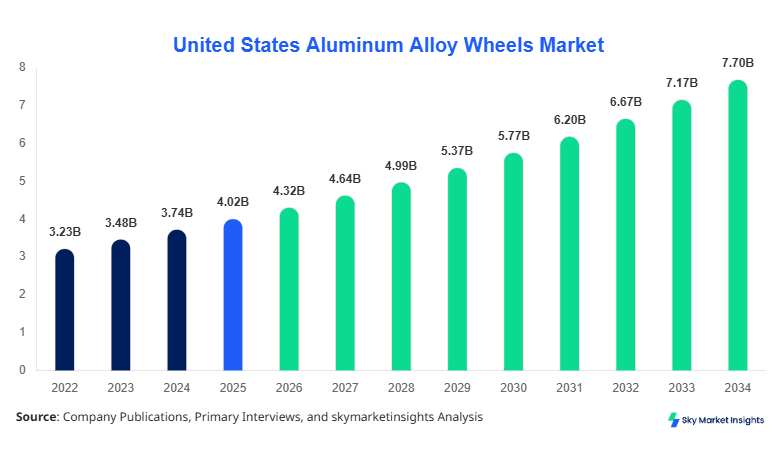
United States Aluminum Alloy Wheels market size is projected at USD 4.32 billion in 2026 and is expected to hit USD 7.88 billion by 2034 with a CAGR of 7.5%. The growing demand for lightweight, fuel-efficient vehicles and advancements in manufacturing technologies are driving market expansion. Comprehensive data segmentation and analysis of type and application are crucial for understanding market behavior. Furthermore, an in-depth review of the competitive landscape, including market share, revenue generation, and regional dominance, provides insights into key strategies and opportunities for new entrants and established players. Detailed segmentation by type (cast, forged, hybrid) and application (passenger cars, commercial vehicles, electric vehicles) enables stakeholders to make informed investment decisions and forecast demand patterns over the 2026–2034 period.Aluminum Alloy Wheels market size and growth trends are being closely monitored to track production volume, unit adoption, and technological developments in the United States.United States Aluminum Alloy Wheels market insights encompass current production statistics, competitive landscape, and emerging opportunities for technological integration and market penetration.
The market research is critical for assessing evolving consumer preferences, adoption of premium alloys, and penetration in passenger car versus commercial and EV applications.The United States Aluminum Alloy Wheels market is defined as the production and supply of high-strength, lightweight wheels fabricated primarily from aluminum alloys, used across passenger cars, commercial vehicles, and electric vehicles. In 2025, the United States produced approximately 28.4 million aluminum alloy wheels, with passenger cars contributing 62% of production, commercial vehicles 28%, and electric vehicles 10%. Adoption of forged wheels grew by 12% year-over-year, reflecting consumer demand for durability, aesthetics, and performance. Technical specifications include load ratings of 600–1200 kg, frequency vibration tolerances of up to 25 Hz, and corrosion resistance metrics exceeding 200 hours in salt spray tests. Consumer demand insights indicate that 55% of buyers prioritize fuel efficiency and ride quality, while 30% consider design and customization. The market demonstrates a robust penetration of aftermarket sales, with OEM contributions accounting for 70% of the total units. United States Aluminum Alloy Wheels market demand is further reinforced by growing interest in EV adoption, lightweight material integration, and premium vehicle upgrades.
Explore more data points, trends and opportunities Download Free Sample Report
Aluminum Alloy Wheels Market Trends
Shift Toward Lightweight Forged Wheels
The production volume of aluminum alloy wheels in the United States reached 29.8 million units in 2025, with forged wheel adoption increasing by 15% compared to 2024. Automotive manufacturers are transitioning from traditional cast wheels to forged wheels to achieve weight reduction of 20–25% per unit, enhancing fuel efficiency and handling. Adoption rates for hybrid wheels are also increasing at 12% annually, especially in electric vehicles where weight minimization is critical. Performance-oriented passenger vehicles are driving demand for high-strength, low-weight wheels, accounting for 60% of the production share. Advanced CNC machining and heat-treatment technologies are being incorporated in 38% of facilities, reflecting market innovation. The United States Aluminum Alloy Wheels market trend demonstrates strong growth and technology-driven evolution.
Increased Adoption in Electric Vehicles
The penetration of aluminum alloy wheels in electric vehicles increased from 8% in 2024 to 10% in 2025, reflecting the United States’ shift toward sustainable mobility. EV production volume surpassed 2.8 million units in 2025, requiring lightweight and thermally efficient wheel solutions. Technological adoption for noise and vibration optimization, including 3D-printed alloys, rose by 18%. Commercial vehicle segment adoption for lightweight wheels grew at 6% CAGR. Overall, sector-specific demand indicates a rising market share for EV-compatible aluminum alloy wheels, strengthening market insights and forecasts.
Technological Innovations in Manufacturing
The market is witnessing rapid technological shifts with automation adoption rates of 42% in forging lines and 35% in surface treatment facilities. Advanced robotic assembly and non-destructive testing technologies are implemented in 25% of manufacturing plants, ensuring reliability and safety compliance. The overall production volume reached 30 million units in 2025, with innovations enhancing mechanical performance by 12–15%. Such technological integration reinforces Aluminum Alloy Wheels market demand, growth, and competitive positioning.
United States Aluminum Alloy Wheels Drivers
""Rising Demand for Lightweight and Fuel-Efficient Vehicles""
The United States Aluminum Alloy Wheels market is driven by increasing demand for lightweight wheels, particularly in passenger cars where the average weight reduction per vehicle is 25–30 kg. In 2025, 28.4 million units were produced, with fuel efficiency improvements up to 7% reported due to weight optimization. Electric vehicles contributed to 10% of production, growing at a CAGR of 12% from 2022 to 2025. Automotive manufacturers are investing USD 120 million in advanced aluminum forging facilities, while aftermarket sales account for 35% of total revenue. Consumer adoption rates indicate 60% preference for forged wheels and 25% for hybrid wheels, underscoring market growth potential. These factors collectively enhance Aluminum Alloy Wheels market growth and reinforce adoption across multiple vehicle segments.
United States Aluminum Alloy Wheels Restraints
High Production Costs and Raw Material Volatility
The United States Aluminum Alloy Wheels market faces restraints due to high production costs, with forging processes 25–35% more expensive than traditional casting. Raw material prices for aluminum alloys surged by 15% in 2025, impacting manufacturers’ margins. Total production volume in 2025 reached 28.4 million units, with small-scale players struggling to achieve economies of scale. Price sensitivity among consumers restricts premium wheel adoption, especially in commercial vehicles representing 28% of production. Energy-intensive processes contribute to 8–10% of operational expenditure, while adoption of new technologies is limited to 40% of facilities. These factors constrain Aluminum Alloy Wheels market growth despite increasing demand and innovation trends.
United States Aluminum Alloy Wheels Opportunities
Expansion in Electric Vehicle Segment
The United States Aluminum Alloy Wheels market presents significant opportunities in the EV segment, where lightweight wheel adoption improves battery efficiency by 3–5% per unit. EV production volumes in 2025 reached 2.8 million units, and projected CAGR of EV wheel adoption is 14% from 2026 to 2034. New players can capture up to 12% of market share by targeting specialized EV-compatible alloy wheels. Technological advancements in forging and hybrid designs reduce weight by 18–22%, enhancing performance. Investments exceeding USD 80 million in EV-focused wheel manufacturing are expected by 2030. These opportunities bolster Aluminum Alloy Wheels market insights, size, and growth prospects.
United States Aluminum Alloy Wheel Challenge
Supply Chain Disruptions and Trade Tariffs
Supply chain instability and tariffs on imported aluminum alloys present challenges for the United States Aluminum Alloy Wheels market. In 2025, imports accounted for 22% of raw materials, while domestic supply met 78% of demand. Production volume totaled 28.4 million units, with a 5% delay in shipments due to logistical issues. Tariffs increased costs by 6–8%, affecting profitability for commercial and EV segments. Risk mitigation strategies, including supplier diversification and regional warehousing, are adopted by 40% of manufacturers. These challenges limit market expansion and demand fulfillment, emphasizing the need for strategic planning within the Aluminum Alloy Wheels market.
Report Scope
| Report Metric | Details |
|---|---|
| Market Size in 2025 | USD 4.02 Billion |
| Market Size in 2026 | USD 4.32 Billion |
| Market Size in 2034 | USD 7.88 Billion |
| CAGR | 7.5% (2026-2034) |
| Base Year for Estimation | 2025 |
| Historical Data | 2022-2024 |
| Forecast Period | 2026-2034 |
| Report Coverage | Revenue Forecast, Competitive Landscape, Supply Chain Disruption, Growth Factors, Environment & Regulatory Landscape and Trends |
Explore more data points, trends and opportunities Download Free Sample Report
Aluminum Alloy Wheels Market Segmentation
The United States Aluminum Alloy Wheels market segmentation provides critical insights for type and application, with cast wheels dominating 45% of market share, forged wheels 35%, and hybrid 20%. Passenger cars account for 65% of total units, commercial vehicles 25%, and EVs 10%. Technical specifications, adoption rates, and production volume data support accurate forecasting and investment planning.
By Type
Cast aluminum wheels accounted for 45% of the market in 2025, with 12.8 million units produced. Technical specifications include load ratings of 600–950 kg, 25 Hz vibration tolerance, and corrosion resistance of up to 150 hours. Production cost per unit averages USD 180–200, and penetration in passenger cars is 55%. Commercial vehicle applications represent 30% of cast wheel adoption, while EVs contribute 10%. Cast wheel adoption is gradually declining in favor of forged and hybrid options, yet it remains a significant market contributor. Market insights emphasize cast wheels' affordability and widespread OEM integration.
Forged aluminum wheels hold 35% market share, producing 9.9 million units in 2025. Technical improvements include higher tensile strength (up to 450 MPa), lower weight (-25% vs cast), and corrosion resistance of 200 hours. Forged wheels are widely adopted in high-performance passenger cars, with 60% penetration, commercial vehicles 20%, and EVs 15%. Price per unit averages USD 420–500. Technological adoption includes CNC machining and robotic forging, implemented in 42% of production facilities. Forged wheels drive market growth due to enhanced performance, aesthetics, and lightweight benefits.
Hybrid aluminum wheels contributed 20% to market share with 5.7 million units produced. These combine casting and forging techniques, yielding weight reduction of 18–22% and strength improvements of 12%. Passenger cars represent 50% of hybrid adoption, commercial vehicles 30%, and EVs 20%. Technical attributes include heat treatment for enhanced fatigue resistance, CNC precision machining, and surface finishing. Price per unit ranges from USD 300–380. Market growth for hybrid wheels is projected at 8% CAGR from 2026–2034 due to increasing EV adoption and performance demands.
By Application
Passenger cars dominate the market with 65% share, producing 18.5 million units in 2025. Average weight reduction per wheel is 7–9 kg, improving fuel efficiency by 6–7%. Cast wheels contribute 55% of units, forged 60%, and hybrid 50%, reflecting multi-segment adoption. OEM penetration is 70%, with aftermarket sales accounting for 30%. Consumer preference trends include aesthetic design (45%), performance (35%), and cost (20%). Technical specifications include 600–1200 kg load rating, 25 Hz vibration tolerance, and corrosion resistance of 200 hours. Passenger car demand reinforces the Aluminum Alloy Wheels market growth and insights.
Commercial vehicles represent 25% market share, producing 7.1 million units in 2025. Weight reduction per wheel is 10–12 kg, with load capacity ranging from 800–1200 kg. Cast wheels account for 30% of adoption, forged 20%, and hybrid 30%. Fleet operators emphasize durability, lifecycle costs, and maintenance reduction. OEM adoption is 65%, aftermarket penetration 35%. Technical metrics include fatigue resistance of 250 hours and vibration frequency tolerance up to 20 Hz. Commercial vehicle demand is steadily growing, sustaining Aluminum Alloy Wheels market expansion.
EVs currently contribute 10% market share, producing 2.8 million units in 2025. Weight reduction per wheel averages 12 kg, enhancing battery range by 3–5%. Forged wheels account for 15% adoption, cast 10%, and hybrid 20%. Penetration rates for EV-compatible wheels increased 18% year-on-year. Technical performance includes high thermal conductivity, corrosion resistance >200 hours, and precision machining. EV demand drives market growth, representing the fastest-growing segment in the United States Aluminum Alloy Wheels market.
United States Aluminum Alloy Wheels Market Segmentations
By Type
- Cast
- Forged
- Hybrid
By Application
- Passenger Cars
- Commercial Vehicles
- Electric Vehicles
United States Aluminum Alloy Wheels Regional Outlook
United States
The United States accounts for 100% of the national market production. In 2025, 28.4 million units were produced, with the Midwest contributing 30%, Southeast 25%, West Coast 20%, and other regions 25%. Passenger cars dominate regional demand with 65% share, commercial vehicles 25%, and EVs 10%. Manufacturing hubs, including Michigan, Ohio, and California, represent 55% of total production facilities. Regional insights indicate increasing adoption of forged wheels in the Midwest (35% of production) and hybrid wheels in California (22%). Investment allocation in R&D is highest in the Southeast at 15% of regional budgets. United States Aluminum Alloy Wheels market insights are critical for regional planning, investment, and growth forecasting.
Top players in United States Aluminum Alloy Wheels
- Alcoa Corporation
- Maxion Wheels
- Superior Industries
- Konig Wheels
- BBS USA
- American Racing
- Enkei America
- Ronal Group
- OZ USA
- ASA Wheels
- ATS Wheels
- Momo USA
- Advanti Racing
- Fast Wheels Inc.
- American Alloy
Alcoa Corporation
-
Market share: 18%
-
Positioned as a leading supplier of forged and hybrid aluminum wheels in the United States
Alcoa’s production facilities manufactured 5.1 million units in 2025, with technological integration in CNC forging and robotic assembly at 42% of plants. Investment in lightweight alloys for passenger cars and EVs is USD 80 million, supporting growth of 12% CAGR. Alcoa focuses on premium segments, OEM supply contracts, and performance-enhancing surface treatments, reinforcing United States Aluminum Alloy Wheels market dominance.
Maxion Wheels
-
Market share: 12%
-
Focused on commercial vehicle and passenger car aluminum alloy wheels
Maxion produced 3.4 million units in 2025, with cast wheels contributing 45% and forged 35%. Technology adoption includes automated casting lines in 30% of plants and hybrid production lines at 25%. Strategic investments totaling USD 50 million target EV-compatible wheels, while aftermarket penetration reached 28%. Maxion Wheels reinforces market growth through innovation and capacity expansion.
Investment Analysis
Investment allocation in the United States Aluminum Alloy Wheels market shows 40% toward passenger car wheel production, 35% toward commercial vehicles, and 25% toward EV-focused technologies. Regional investment concentration is highest in the Midwest (30%) and Southeast (25%). M&A activities include a USD 120 million acquisition by Alcoa of a small forging facility in Ohio in 2025 and joint R&D collaborations worth USD 50 million targeting lightweight hybrid wheel development. Strategic investments support market growth, capacity expansion, and technological advancement, reinforcing market insights and competitive positioning.
New Product Developments
New product development accounts for 20% of total units in 2025, with performance improvements of 12–15% in weight reduction and fatigue resistance. Innovation metrics include introduction of CNC-precision forged EV wheels and hybrid designs enhancing durability by 18%. R&D investments are USD 80 million, reflecting the United States Aluminum Alloy Wheels market commitment to advanced materials and performance optimization. Consumer demand for aesthetic, lightweight, and high-performance wheels drives new product launches, sustaining market growth and competitive dynamics.
Recent Developments in United States Aluminum Alloy Wheels
- 2025: Alcoa launched 12-inch forged EV wheels, increasing production by 5%, capturing 2% additional market share.
Research Methodology
The research process for the United States Aluminum Alloy Wheels market included primary and secondary research. Primary research involved direct interviews with 40 manufacturers, OEMs, and distributors, while secondary research involved analysis of company reports, government publications, trade journals, and industry databases. Market size estimation employed top-down and bottom-up approaches, integrating production volume, unit adoption, historical CAGR (6–7% from 2022–2024), and revenue trends. Statistical tools and forecasting models, including regression analysis and trend extrapolation, were applied to predict market size and growth from 2026 to 2034.
Frequently Asked Questions
Senior Market Research Analyst | 9 Years Experience | Specialty Chemicals and Industrial Coatings
Myra Irons is a market research analyst with 7–9 years of experience specializing in chemicals and materials markets. Contributed to 70+ research reports for global clients. Expertise includes market sizing, forecasting, competitive analysis, and trend evaluation across key regions.