Europe Alloy Steel Market Size
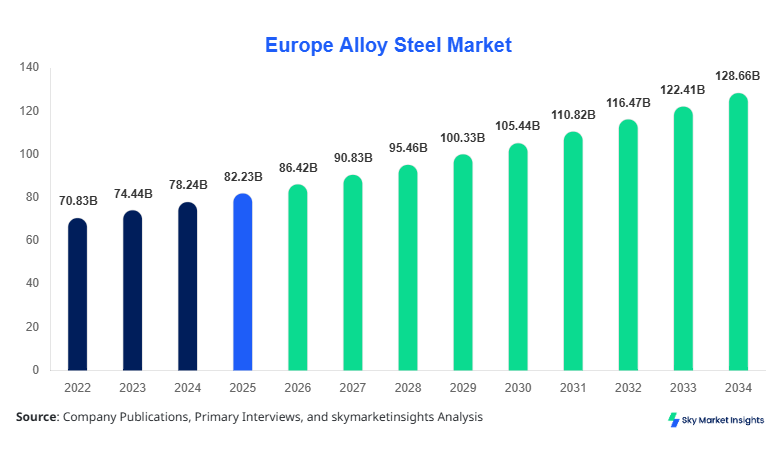
Europe Alloy Steel market size is projected at USD 86.42 billion in 2026 and is expected to hit USD 128.57 billion by 2034 with a CAGR of 5.1%. The market recorded an estimated production volume of 71.3 million metric tons in 2025, supported by strong demand from automotive manufacturing, infrastructure modernization, renewable energy installations, and industrial engineering applications across Europe. Increasing adoption of high-strength low-alloy materials, advanced metallurgical technologies, and automation-driven steel processing facilities are strengthening regional competitiveness. The report evaluates production trends, raw material pricing, trade flows, consumption patterns, segmentation performance, and competitive positioning to provide a detailed assessment of the Europe Alloy Steel market.
The alloy steel industry consists of steel grades enhanced with alloying elements such as chromium, nickel, vanadium, manganese, and molybdenum to improve tensile strength, hardness, wear resistance, thermal stability, and corrosion resistance. Europe produced more than 156 million metric tons of crude steel in 2025, of which alloy steel contributed nearly 45.7 million metric tons for industrial and engineering applications. Automotive applications represented around 34% of alloy steel consumption in the region, followed by construction at 27%, energy at 18%, heavy machinery at 11%, and aerospace and defense at 10%. Adoption penetration of high-strength alloy steel exceeded 63% among European electric vehicle component manufacturers due to rising lightweighting requirements and fuel-efficiency targets. Demand analytics indicate that over 52% of industrial buyers preferred chromium-molybdenum alloy grades for superior fatigue resistance and thermal performance. Yield strength levels ranged between 450 MPa and 980 MPa depending on application requirements, while heat-treated alloy steel products achieved hardness ratings above 60 HRC in tooling operations. Flat alloy steel products accounted for nearly 49% of total shipments, while long alloy steel products contributed 36%, and tubular products captured approximately 15% share. Increasing investments in low-carbon metallurgy and recycling infrastructure continue to reinforce Europe Alloy Steel market expansion.
In the France, the Alloy Steel Market accounted for nearly 18.4% of the regional revenue contribution in 2025, supported by strong automotive manufacturing, railway infrastructure development, and aerospace engineering activities. France operated more than 210 alloy steel processing facilities and approximately 75 advanced rolling and forging units across industrial hubs including Auvergne-Rhône-Alpes, Grand Est, and Hauts-de-France. Automotive applications contributed around 38% of domestic alloy steel consumption, while construction accounted for 24%, aerospace represented 17%, and energy infrastructure contributed nearly 12%. More than 68% of French manufacturers adopted digitally controlled heat-treatment technologies and AI-based metallurgy monitoring systems to improve tensile precision and reduce operational waste by 14%. Electric arc furnace technology penetration surpassed 61% in 2025 as sustainability regulations intensified across European steel production networks. France exported nearly 6.8 million metric tons of alloy steel products during the year, with Germany, Spain, and Italy representing major trade destinations. Expansion of offshore wind installations and hydrogen pipeline projects accelerated demand for corrosion-resistant tubular alloy products. Continuous investment in lightweight automotive materials and precision engineering continues to strengthen the Europe Alloy Steel market.
Explore more data points, trends and opportunities Download Free Sample Report
Alloy Steel Market Trends
Rising Adoption of Low-Carbon and Recycled Alloy Steel
European manufacturers increasingly shifted toward low-carbon alloy steel production during 2025, with more than 42% of alloy steel plants integrating electric arc furnace technologies and recycled scrap feedstock systems. The regional recycled steel utilization rate crossed 57 million metric tons, reducing carbon emissions by approximately 29% compared with conventional blast furnace operations. Germany, France, and Italy collectively accounted for nearly 63% of low-emission alloy steel production capacity in Europe. Automotive OEMs increased procurement of lightweight alloy steel grades by 17% to support electric vehicle structural designs and battery protection systems. High-strength flat alloy steel demand from EV manufacturers exceeded 12.4 million metric tons in 2025 due to improved crash resistance and weight optimization. Smart steel mills incorporating predictive maintenance and digital twin technologies improved operational productivity by 11% while reducing downtime by nearly 8%. These developments continue to accelerate Europe Alloy Steel market expansion.
Expansion of Renewable Energy and Infrastructure Applications
The expansion of renewable energy infrastructure significantly influenced alloy steel consumption patterns across Europe. Offshore wind turbine installations consumed more than 2.6 million metric tons of corrosion-resistant alloy steel in 2025, while hydrogen transportation pipelines contributed an additional 1.4 million metric tons of demand. Tubular alloy steel products experienced annual production increases exceeding 9% as energy companies expanded gas storage and hydrogen distribution networks. Construction sector demand also remained strong, with high-strength alloy reinforcement materials gaining 14% higher penetration in urban infrastructure projects due to improved seismic and fatigue resistance. Digitalized rolling mills increased production precision by 18%, enabling manufacturers to meet increasingly strict aerospace and energy-sector standards. Advanced chromium-nickel alloy grades recorded adoption rates above 47% in industrial machinery manufacturing because of enhanced thermal endurance and reduced maintenance cycles. Continuous infrastructure modernization and renewable energy investment are reinforcing Europe Alloy Steel market dynamics.
Technological Advancements in Precision Metallurgy
European alloy steel producers accelerated deployment of automated metallurgy systems, robotic forging lines, and AI-enabled quality inspection platforms. More than 54% of alloy steel facilities implemented real-time thermal analytics and laser-based defect monitoring technologies in 2025. Precision alloy engineering improved tensile consistency by 13% and reduced material wastage by nearly 10%. Aerospace and defense sectors increased procurement of nickel-based alloy steel products by 15% for turbine engines and structural systems requiring high-temperature resistance above 700°C. Powder metallurgy adoption also expanded, contributing approximately USD 2.4 billion in specialized alloy steel component manufacturing revenue. Integration of Industry 4.0 platforms enabled faster batch customization and improved supply chain transparency across regional manufacturing ecosystems. These technological shifts continue to support Europe Alloy Steel market development.
Europe Alloy Steel Drivers
Expansion of Automotive Electrification and Lightweight Engineering
The rapid transition toward electric mobility across Europe is significantly increasing demand for advanced alloy steel materials. Europe manufactured nearly 16.8 million passenger vehicles in 2025, including over 4.5 million electric vehicles, creating strong demand for lightweight yet high-strength steel components. Automotive alloy steel consumption increased by 8.6% during the year due to rising adoption of advanced high-strength steel grades in chassis systems, battery enclosures, transmission assemblies, and crash protection structures. More than 71% of European automotive OEMs integrated chromium-molybdenum alloy grades into next-generation vehicle platforms to improve durability and reduce total vehicle weight by approximately 12%. Germany, France, and Spain collectively represented over 62% of automotive alloy steel procurement volumes in Europe. Additionally, stricter emission reduction targets and fuel-efficiency regulations accelerated replacement of conventional carbon steel components with high-performance alloy alternatives. Heat-resistant alloy steel demand from EV motor systems and charging infrastructure also expanded by nearly 14% in 2025. Continued automotive electrification and lightweight engineering initiatives are strengthening Europe Alloy Steel market performance.
Europe Alloy Steel Restraints
Volatility in Raw Material Prices and Energy Costs
Fluctuating prices of nickel, chromium, molybdenum, and manganese remain major challenges for alloy steel manufacturers across Europe. Nickel prices increased by approximately 19% during 2025, while ferrochrome costs rose nearly 13%, significantly affecting alloy steel production margins. Energy-intensive steelmaking operations also experienced rising electricity expenses, with industrial power costs increasing between 11% and 18% across major European economies. Blast furnace operators faced substantial operational pressure due to carbon taxation mechanisms and tightening environmental compliance standards. Nearly 36% of mid-sized alloy steel manufacturers reported margin compression because of unstable input pricing and logistics disruptions. Transportation costs for imported alloying materials increased by approximately 9%, while supply chain lead times expanded from 21 days to nearly 34 days in certain procurement channels. Small-scale producers struggled to adopt energy-efficient metallurgical systems because of high capital requirements exceeding USD 120 million per facility modernization project. These financial and operational constraints continue to impact Europe Alloy Steel market stability.
Europe Alloy Steel Opportunities
Growth in Renewable Energy Infrastructure and Hydrogen Economy
The expansion of renewable energy systems and hydrogen infrastructure presents substantial opportunities for alloy steel producers in Europe. Offshore wind projects across the United Kingdom, Germany, and France are expected to require more than 18 million metric tons of high-corrosion-resistant alloy steel between 2026 and 2034. Hydrogen pipeline development projects are projected to increase tubular alloy steel consumption by approximately 22% during the forecast period. Europe announced over USD 160 billion in green energy infrastructure investments during 2025, with nearly 28% allocated to steel-intensive renewable energy systems. Alloy steel grades capable of withstanding pressures above 100 bar and temperatures exceeding 500°C are increasingly utilized in hydrogen transport and energy storage facilities. Additionally, smart grid expansion and railway electrification projects continue to support demand for heat-treated alloy steel products. Aerospace manufacturers are also investing heavily in lightweight nickel-based alloys to improve turbine efficiency and reduce maintenance cycles. These developments are expected to create significant growth opportunities for Europe Alloy Steel market participants.
Europe Alloy Steel Challenge
Environmental Compliance and Decarbonization Pressures
European alloy steel manufacturers face increasing pressure to reduce carbon emissions while maintaining production competitiveness. Carbon emission reduction targets mandated under regional climate regulations require steelmakers to reduce industrial emissions by nearly 55% before 2030. Compliance costs associated with emission control systems, hydrogen-based steelmaking pilots, and carbon capture technologies exceeded USD 24 billion across the European steel sector during 2025. Nearly 41% of alloy steel facilities reported operational disruptions while transitioning toward cleaner production systems. Adoption of hydrogen direct reduction technology remains limited due to high infrastructure costs and insufficient renewable hydrogen availability. Recycling and scrap processing systems also require advanced sorting and metallurgical purification technologies to maintain alloy consistency. Additionally, labor shortages in precision metallurgy and industrial automation engineering affected approximately 19% of production facilities in Europe. Trade competition from low-cost imported steel products further intensified pricing pressures for regional manufacturers. These operational and environmental complexities continue to challenge Europe Alloy Steel market competitiveness.
Report Scope
| Report Metric | Details |
|---|---|
| Market Size in 2025 | USD 82.23 Billion |
| Market Size in 2026 | USD 86.42 Billion |
| Market Size in 2034 | USD 128.57 Billion |
| CAGR | 5.1% (2026-2034) |
| Base Year for Estimation | 2025 |
| Historical Data | 2022-2024 |
| Forecast Period | 2026-2034 |
| Report Coverage | Revenue Forecast, Competitive Landscape, Supply Chain Disruption, Growth Factors, Environment & Regulatory Landscape and Trends |
Explore more data points, trends and opportunities Download Free Sample Report
Alloy Steel Market Segmentation
The Europe alloy steel industry is segmented by type and application, with flat alloy steel products dominating nearly 49% of total regional consumption because of extensive automotive and construction applications. Long alloy steel products contributed around 36% share, while tubular products accounted for approximately 15%. By application, automotive remained the leading segment with 34% market contribution, followed by construction at 27%, energy at 18%, and industrial engineering applications accounting for the remaining share.
By Type
Flat alloy steel represented approximately 49% of total regional shipments in 2025 due to strong adoption across automotive body structures, heavy machinery, and shipbuilding sectors. Production volumes exceeded 22 million metric tons, supported by advanced rolling technologies and high-strength steel demand. Thickness specifications ranged from 0.3 mm to 25 mm depending on industrial requirements, while tensile strengths exceeded 980 MPa in advanced automotive applications. More than 64% of electric vehicle manufacturers in Europe adopted flat alloy steel for lightweight structural components and battery enclosure systems. Continuous galvanizing and heat-treatment processes improved corrosion resistance by nearly 18%, enabling extended product lifecycles in transportation and construction sectors. Germany, France, and Italy collectively contributed nearly 58% of flat alloy steel output across Europe.
Long alloy steel products accounted for nearly 36% of regional consumption, primarily utilized in railway infrastructure, industrial machinery, construction reinforcement systems, and heavy engineering applications. Europe produced approximately 16.4 million metric tons of long alloy steel during 2025. Product categories included bars, rods, rails, and forged structural components with yield strengths ranging between 500 MPa and 850 MPa. Construction projects represented around 43% of long alloy steel demand because of increasing urban infrastructure modernization across Europe. Automated forging systems improved production precision by 12%, while advanced alloying compositions enhanced fatigue resistance by approximately 16%. Spain and Russia emerged as significant suppliers of long alloy steel for regional transportation infrastructure projects.
Tubular alloy steel contributed approximately 15% share of total market volume, driven by expanding energy infrastructure and industrial pipeline projects. Production exceeded 6.8 million metric tons in 2025, with applications across oil and gas transmission, hydrogen transport, renewable energy structures, and pressure vessels. Corrosion-resistant chromium-nickel alloy grades dominated nearly 46% of tubular steel demand due to superior thermal and chemical stability. Hydrogen pipeline installations increased tubular alloy steel consumption by approximately 21% during the year. Wall thickness specifications ranged from 2 mm to 65 mm depending on operational pressure requirements. Advanced welding technologies improved structural integrity by nearly 14%, supporting adoption in offshore wind turbine foundations and industrial processing facilities.
By Application
Automotive applications represented approximately 34% of total alloy steel consumption across Europe during 2025. More than 15.6 million metric tons of alloy steel products were utilized in vehicle chassis systems, transmission assemblies, engine components, suspension structures, and battery protection systems. Advanced high-strength steel penetration exceeded 68% among electric vehicle platforms because of lightweighting requirements and crash-resistance standards. Alloy steel grades with tensile strengths above 1000 MPa gained widespread adoption in passenger vehicle structures. Germany alone accounted for nearly 39% of automotive alloy steel procurement within Europe. Heat-treated chromium-molybdenum alloys improved wear resistance by 22% in drivetrain applications while reducing maintenance frequency. Continuous expansion of EV manufacturing facilities across France, Spain, and Italy is supporting additional alloy steel demand.
Construction applications accounted for nearly 27% of alloy steel consumption, supported by infrastructure modernization, commercial building projects, bridges, and industrial facilities. Europe consumed approximately 12.3 million metric tons of alloy steel in construction activities during 2025. Reinforcement bars, structural beams, and seismic-resistant components dominated segment utilization. Alloy steel adoption in high-rise construction increased by 13% because of enhanced tensile strength and fatigue resistance. Infrastructure projects involving railways, tunnels, and bridges represented around 46% of construction-related alloy steel demand. Italy and the United Kingdom remained major contributors to structural alloy steel consumption for urban redevelopment initiatives. Corrosion-resistant alloy grades improved lifecycle performance by nearly 17%, reducing maintenance expenditures for public infrastructure systems.
Energy applications contributed around 18% share of the regional market due to increasing investment in renewable energy, power transmission, hydrogen infrastructure, and offshore installations. Europe consumed nearly 8.1 million metric tons of alloy steel in energy projects during 2025. Offshore wind turbine installations accounted for approximately 31% of energy-sector alloy steel utilization, followed by power generation equipment at 28%, hydrogen pipelines at 19%, and oil and gas systems at 22%. Tubular alloy steel with high-pressure tolerance above 100 bar experienced demand growth exceeding 20%. Advanced nickel-based alloy grades improved high-temperature resistance by nearly 24% in power generation turbines and industrial reactors. The United Kingdom, Germany, and France collectively represented over 61% of alloy steel demand from energy infrastructure projects.
Europe Alloy Steel Market Segmentations
Type
- Flat Alloy Steel
- Long Alloy Steel
- Tubular Alloy Steel
Application
- Automotive
- Construction
- Energy
Europe Alloy Steel Regiona Outlook
United Kingdom
The United Kingdom accounted for approximately 14% of Europe’s alloy steel consumption in 2025, supported by offshore wind expansion, railway modernization, and defense manufacturing. Production volumes exceeded 5.7 million metric tons during the year. Energy applications represented around 33% of domestic alloy steel demand because of large-scale offshore wind turbine installations and hydrogen transport projects. Automotive applications contributed 24%, while construction accounted for 21%. More than 58% of steel processing facilities integrated automated metallurgy systems to improve precision and energy efficiency. Government infrastructure programs valued above USD 42 billion accelerated demand for structural alloy steel products.
Germany
Germany remained the largest alloy steel producer in Europe with approximately 26% regional share and production exceeding 18 million metric tons in 2025. Automotive manufacturing represented nearly 42% of domestic alloy steel consumption due to extensive electric vehicle production capacity. Industrial machinery contributed 19%, while construction accounted for 17%. Germany operated more than 320 advanced steel processing facilities utilizing AI-based monitoring and electric arc furnace systems. Adoption of low-carbon alloy steel production technologies surpassed 48%, supporting sustainability targets and export competitiveness.
France
France contributed approximately 18.4% of the regional market, driven by aerospace engineering, automotive production, and railway infrastructure investments. Alloy steel production exceeded 9.2 million metric tons during 2025. Automotive applications represented 38% of national demand, followed by aerospace at 17%, construction at 24%, and energy at 12%. More than 61% of French steel facilities adopted digitally controlled rolling and heat-treatment systems. Renewable energy projects involving offshore wind installations and hydrogen storage infrastructure increased tubular alloy steel demand by approximately 16%.
Spain
Spain accounted for nearly 10% of regional alloy steel consumption with production volumes exceeding 4.8 million metric tons in 2025. Construction and infrastructure projects contributed around 31% of domestic demand, while automotive applications represented 29%. Renewable energy expansion significantly influenced tubular alloy steel consumption, particularly for solar and wind energy support structures. Spain increased investment in electric arc furnace facilities by nearly USD 2.3 billion to improve production efficiency and reduce emissions by approximately 18%.
Italy
Italy represented around 13% of the regional market and produced approximately 6.2 million metric tons of alloy steel in 2025. Construction and industrial machinery sectors accounted for nearly 49% of domestic consumption. Italian manufacturers specialized in precision alloy engineering and heat-treated steel products for industrial equipment and transportation systems. Adoption of robotic forging technologies improved operational efficiency by 11% while reducing waste generation by nearly 9%. Automotive alloy steel demand also expanded because of increasing electric vehicle component manufacturing.
Russia
Russia contributed approximately 19% of Europe’s alloy steel production with output exceeding 13 million metric tons in 2025. Heavy engineering, energy infrastructure, and pipeline projects represented major consumption sectors. Construction applications accounted for 28% of domestic demand, while oil and gas infrastructure represented 26%. Russia maintained strong production capacity for chromium- and nickel-based alloy steel products utilized in high-pressure industrial systems. Export-oriented production strategies and integrated mining operations supported cost competitiveness across regional supply chains.
Top players in Europe Alloy Steel
- ArcelorMittal
- Thyssenkrupp AG
- Voestalpine AG
- Outokumpu Oyj
- Acerinox S.A.
- Tata Steel Europe
- Salzgitter AG
- SSAB AB
- Liberty Steel Group
- Evraz plc
- Celsa Group
- Tenaris S.A.
- NLMK Europe
- Riva Group
- Sandvik Materials Technology
ArcelorMittal
-
Estimated regional share: 17%
-
Strong presence across flat and long alloy steel manufacturing
-
Extensive electric arc furnace integration and low-carbon steel initiatives
ArcelorMittal maintained leadership in the European alloy steel sector through extensive production capacity exceeding 40 million metric tons across regional operations. The company expanded investments in hydrogen-based steelmaking and advanced alloy engineering technologies during 2025. Automotive applications represented nearly 37% of its alloy steel shipments, while construction and industrial engineering contributed significant revenue shares. The company’s advanced metallurgy systems improved production efficiency by approximately 12% and reduced carbon emissions intensity by nearly 9%.
Thyssenkrupp AG
-
Estimated regional share: 11%
-
Major supplier to automotive and industrial machinery sectors
-
Strong R&D investments in lightweight alloy steel technologies
Thyssenkrupp AG remained a major supplier of high-strength alloy steel products across Europe with advanced production facilities in Germany and surrounding regions. The company focused heavily on precision-engineered alloy grades for electric vehicle structures, industrial equipment, and energy infrastructure. More than 45% of Thyssenkrupp’s alloy steel shipments were directed toward automotive OEMs during 2025. Investments in smart manufacturing systems improved productivity by approximately 10% while reducing material waste by 7%. Expansion of sustainable steel production technologies further strengthened its regional positioning.
Investment Analysis
Investment activity across the European alloy steel industry accelerated significantly during 2025, with total capital expenditure exceeding USD 46 billion. Approximately 38% of investments were directed toward low-carbon steelmaking technologies, while 27% focused on automation and digital metallurgy systems. Renewable energy infrastructure projects accounted for nearly 21% of downstream alloy steel investments, particularly in offshore wind and hydrogen transportation networks. Germany captured around 31% of total regional investment inflows, followed by France at 19% and the United Kingdom at 15%.
Mergers, acquisitions, and strategic collaborations also intensified across the industry. More than 24 partnership agreements were announced between steel producers, automotive manufacturers, and renewable energy developers during 2025. Joint ventures focusing on hydrogen-based steel production attracted approximately USD 8.7 billion in combined investments. Automotive OEM collaborations increased procurement commitments for advanced high-strength alloy steel products by nearly 14%. Technology providers specializing in AI-driven metallurgy and predictive maintenance systems secured long-term agreements with major European steelmakers to improve efficiency and sustainability.
New Product Developments
European alloy steel manufacturers introduced advanced lightweight and corrosion-resistant products during 2025 to address evolving automotive and energy-sector requirements. Nearly 22% of newly launched alloy steel products focused on electric vehicle applications, particularly battery protection systems and structural reinforcement components. Heat-resistant alloy grades improved thermal endurance by approximately 19% and fatigue resistance by 16%, enabling broader aerospace and industrial turbine applications.
Manufacturers also accelerated development of hydrogen-compatible tubular alloy steel products capable of operating under pressures exceeding 100 bar. More than 31% of new product launches integrated advanced chromium-nickel compositions to improve corrosion resistance in offshore environments. Automated metallurgy systems reduced defect rates by nearly 12%, improving overall product reliability and operational lifespan.
Recent Developments in Europe Alloy Steel
2025: ArcelorMittal expanded electric arc furnace capacity in France by approximately 14%, increasing annual alloy steel production by nearly 1.2 million metric tons while reducing carbon emissions intensity by 9%. The project focused on supplying lightweight automotive alloy steel grades for electric vehicle manufacturing and renewable energy infrastructure projects across Europe.
2025: Thyssenkrupp AG introduced advanced high-strength alloy steel products with tensile strength improvements of nearly 18% for electric vehicle platforms. Production efficiency at its German facilities improved by approximately 11% through AI-based process automation and predictive maintenance technologies.
2025: SSAB AB expanded advanced heat-treated alloy steel production for construction and industrial engineering applications. The company reported a 13% increase in corrosion-resistant alloy steel shipments and improved product lifecycle performance by approximately 17% for infrastructure projects.
Research Methodology
The research methodology for the Europe alloy steel industry involved a comprehensive combination of primary and secondary research techniques to ensure accurate market estimation and forecasting. Primary research included interviews with alloy steel manufacturers, raw material suppliers, automotive OEMs, industrial engineers, construction contractors, distributors, and renewable energy developers across major European countries. More than 85 industry participants contributed quantitative insights related to production volumes, pricing trends, technological adoption, and investment patterns. Secondary research involved analysis of industrial databases, trade statistics, government publications, company annual reports, metallurgy journals, and regional steel association data sources. Market size estimation utilized bottom-up and top-down analytical frameworks incorporating production capacity, import-export analysis, sector-wise consumption trends, and pricing models. Forecast models considered macroeconomic indicators, industrial investment trends, infrastructure spending, renewable energy deployment, and automotive electrification rates across Europe. Data triangulation and validation techniques ensured reliability of percentage shares, production figures, CAGR calculations, and regional demand assessments throughout the study period.
Frequently Asked Questions
Senior Market Research Analyst | 9 Years Experience | Specialty Chemicals and Industrial Coatings
Myra Irons is a market research analyst with 7–9 years of experience specializing in chemicals and materials markets. Contributed to 70+ research reports for global clients. Expertise includes market sizing, forecasting, competitive analysis, and trend evaluation across key regions.