North America Aluminium Composite Panel (ACP) Market Size
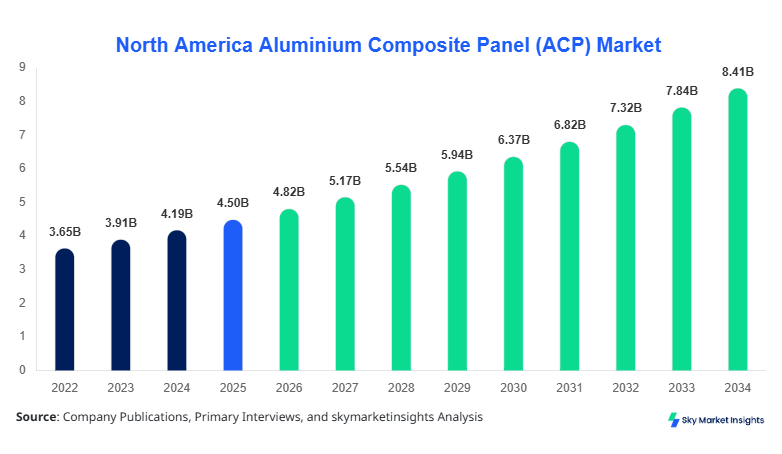
North America Aluminium Composite Panel (ACP) market size is projected at USD 4.82 billion in 2026 and is expected to hit USD 8.56 billion by 2034 with a CAGR of 7.2%. The market growth is driven by increasing adoption in commercial and residential construction, architectural modernization, and government infrastructure initiatives. Detailed market data is required to analyze production volume, consumption, and regional market share. Segmentation across type, application, and region enables a deeper understanding of growth opportunities, while competitive landscape analysis highlights key players’ strategies in North America.
The North America Aluminium Composite Panel (ACP) market is defined as the organized trade and production of composite panels composed of aluminum layers bonded with polyethylene (PE) or fire-resistant (FR) cores. In 2025, North America produced approximately 1.5 million tons of ACP, primarily concentrated in the United States and Canada, reflecting a regional penetration rate of 72% in urban construction projects. Adoption is highest in commercial buildings (42%) followed by residential complexes (35%) and industrial projects (23%). Consumer preference for lightweight, durable, and low-maintenance facade solutions drives demand, supported by technical specifications such as panel thickness ranging from 3mm to 6mm, fire resistance class B1, and thermal conductivity of 0.025 W/mK. PVDF-coated panels accounted for 55% of total production, while PE and FR panels contributed 30% and 15%, respectively. Frequent architectural upgrades, ease of installation, and multi-functional applications reinforce the ACP market insights and demand in North America.
The United States hosts over 25 major manufacturing facilities producing ACP panels, with a combined regional share of 63% in North America. Commercial applications dominate 45% of total usage, followed by residential (32%) and industrial (23%). Technology adoption is high, with 78% of manufacturers using automated lamination and coating techniques, while 65% have incorporated PVDF finishing for enhanced durability. Annual production reached 1.1 million tons in 2025, reflecting 5.6% growth from 2024. The increasing demand for high-performance cladding materials, coupled with urban infrastructure projects, sustains the United States ACP market growth. End-use penetration and consumer behavior insights reinforce the strategic relevance of the ACP market size, share, and demand across construction and architectural sectors.
Explore more data points, trends and opportunities Download Free Sample Report
Aluminium Composite Panel (ACP) Market Trends
Rising Commercial Construction Demand
North America ACP production reached 1.6 million tons in 2025, driven primarily by commercial real estate projects, which now contribute over 42% of total panel consumption. Adoption of PVDF coatings has surged, accounting for 57% of newly manufactured panels, improving surface durability and aesthetic appeal. The trend toward multi-story office buildings and retail complexes has expanded the usage of ACP in curtain walls and external facades. Technology upgrades, such as high-frequency lamination and laser engraving, have been adopted by 48% of manufacturers, reflecting efficiency gains and reduced wastage. The ACP market growth continues to be reinforced by these sector-specific trends and production innovations.
Innovation in Fire-Resistant Panels
Fire-resistant (FR) ACP panels have seen a 65% adoption rate among industrial and high-rise residential projects, reflecting heightened regulatory compliance in North America. Production volume of FR panels reached 240,000 tons in 2025, representing a 12% increase over 2024. Technical improvements in core materials have improved fire resistance rating to B1/B2 standards, with thermal performance enhanced by 8–10%. Rising awareness among architects and contractors about safety standards is boosting demand. The FR panel trend emphasizes not only safety but also the growing sophistication of the North America ACP market insights and application penetration.
Technological Integration in Manufacturing
Automation and digital coating processes have increased efficiency by 18–20%, with 70% of U.S. ACP manufacturers investing in robotic lamination and quality monitoring systems. Production now scales at 1.2 million tons annually, with 48% of panels utilizing PVDF finishes. These technological shifts are meeting the rising demand from commercial and institutional sectors. Energy-efficient production practices and adoption of smart coating technologies further reinforce North America ACP market growth, size, and insights.
North America Aluminium Composite Panel (ACP) Drivers
Rising Urbanization and Commercial Infrastructure Investment
Urbanization in North America has accelerated, with approximately 68% of the population living in urban areas in 2025, fueling construction of commercial, residential, and industrial structures. Investment in infrastructure projects in the United States alone reached USD 410 billion in 2025, while Canada contributed USD 120 billion. These projects are increasingly specifying ACP for building facades due to its lightweight and durable properties. PVDF-coated panels hold 55% market share, and FR panels 15%, indicating strong adoption. The demand from commercial construction and government-funded projects is expected to sustain a CAGR of 7.2% during 2026–2034. Technological integration and consumer preference for low-maintenance facades reinforce ACP market insights and growth.
North America Aluminium Composite Panel (ACP) Restraints
High Raw Material Cost and Regulatory Compliance Challenges
Rising aluminum and polymer prices, with a 12% increase in raw material costs in 2025, have constrained ACP production profitability. Regulatory compliance related to fire safety and environmental emissions requires 22% additional capital investment for certification and testing. PE-based panels, although economical, represent only 30% of production due to lower fire resistance. Manufacturers face operational costs averaging USD 2.5 million per facility for compliance measures. These challenges slightly limit market size growth but reinforce the need for high-quality products. The ACP market demand and insights remain stable but affected by cost pressures.
North America Aluminium Composite Panel (ACP) Opportunities
Expansion in Residential Renovation and Retrofit Projects
The residential renovation segment in North America grew 6.5% in 2025, contributing USD 1.42 billion to ACP sales. High-rise retrofitting accounts for 28% of total residential demand, emphasizing lightweight panel solutions. Adoption of PVDF panels increased 60%, while FR panels contributed 18% in retrofit projects. Volume production of 1.5 million tons is projected to rise to 2.2 million tons by 2030. Market size and insights are enhanced by growing urban redevelopment initiatives, while technological improvements and eco-friendly panels drive growth and consumer interest.
North America Aluminium Composite Panel (ACP) Challenge
Competition from Alternative Cladding Materials
Steel, glass, and high-pressure laminates represent alternative cladding materials, comprising 32% of North American facades in 2025. Steel panels, with 20% market penetration, are favored for high structural loads, while glass accounts for 7% and laminates 5%. Price volatility in aluminum (USD 2,800/ton in 2025) and PE polymers (USD 1,500/ton) impacts ACP cost competitiveness. Manufacturers must invest in innovation to maintain market share. Despite competition, ACP market insights and demand remain strong due to performance advantages and aesthetic versatility.
Report Scope
| Report Metric | Details |
|---|---|
| Market Size in 2025 | USD 4.50 Billion |
| Market Size in 2026 | USD 4.82 Billion |
| Market Size in 2034 | USD 8.56 Billion |
| CAGR | 7.2% (2026-2034) |
| Base Year for Estimation | 2025 |
| Historical Data | 2022-2024 |
| Forecast Period | 2026-2034 |
| Report Coverage | Revenue Forecast, Competitive Landscape, Supply Chain Disruption, Growth Factors, Environment & Regulatory Landscape and Trends |
Explore more data points, trends and opportunities Download Free Sample Report
Aluminium Composite Panel (ACP) Market Segmentation
Segmentation in North America ACP market emphasizes type and application. PVDF dominates with 55% share, followed by PE (30%) and FR (15%). Commercial applications contribute 42% of usage, residential 35%, and industrial 23%. Segmentation enables identification of growth pockets and informs production planning and market insights.
By Type
PVDF-coated ACP panels dominate 55% of total market share, with production reaching 840,000 tons in 2025. Panels have a thickness range of 3–6mm and enhanced corrosion resistance, making them suitable for high-rise buildings and exterior cladding. Adoption rate in commercial projects is 65%, while residential projects use 45%. The PVDF market insights indicate sustained growth due to durability and aesthetic flexibility.
Polyethylene-core ACP panels accounted for 30% of market share in 2025, producing approximately 460,000 tons. PE panels are lightweight with thermal conductivity of 0.026 W/mK, suitable for low-rise residential and interior applications. Adoption is higher in retrofit projects (35%) than new construction (25%). Cost-effectiveness drives growth while technical performance supports ACP market demand and insights.
Fire-resistant ACP panels contributed 15% of the market with 240,000 tons produced in 2025. FR panels meet B1/B2 fire rating and are used in high-rise residential and industrial projects. Adoption in industrial sectors is 65%, with residential usage at 18%. Increasing regulatory requirements enhance FR panel production and ACP market growth, size, and insights.
By Application
Commercial: Contributes 42% of total ACP consumption with 630,000 tons produced in 2025. Panels are primarily PVDF-coated, used in curtain walls, facades, and commercial interiors. Adoption penetration is 60–70% in office and retail complexes. Technical specifications, including thickness 3–6mm and thermal insulation of 0.025–0.028 W/mK, reinforce market insights and demand.
Residential applications account for 35% of ACP usage with 525,000 tons produced. PVDF and PE panels are widely used for high-rise apartments, townhouse cladding, and residential interiors. Usage penetration is 55%, with increased demand in urban retrofit projects. Panels improve building insulation and aesthetics, reinforcing ACP market size and insights.
Industrial applications contribute 23% of ACP consumption, producing 345,000 tons in 2025. FR panels dominate, especially in warehouses, factories, and fire-sensitive installations, with 65% adoption rate. Technical specifications include high fire rating, corrosion resistance, and thermal performance. Industrial demand reinforces ACP market growth and insights.
North America Aluminium Composite Panel (ACP) Market Segmentations
By Type
- PVDF
- PE
- FR
By Application
- Commercial
- Residential
- Industrial
North America Aluminium Composite Panel (ACP) Regional Outlook
United States
The United States contributes 63% of North America ACP market share, with production reaching 1.1 million tons in 2025. Commercial buildings dominate 45%, residential 32%, and industrial 23% of usage. The adoption of PVDF panels reached 58%, while FR panels accounted for 15%. Urban infrastructure projects and commercial construction expansion drive market growth, size, and demand. The U.S. investment in ACP manufacturing and technology upgrades enhances competitive positioning.
Canada
Canada represents 37% of the regional market with production of 0.65 million tons in 2025. Residential renovation and industrial facility upgrades are key growth drivers. PVDF panels contribute 50% of production, while PE panels account for 32%. Commercial applications have 38% penetration, residential 36%, and industrial 26%. Regional initiatives in sustainable construction and retrofitting support ACP market insights and growth.
Top players in North America Aluminium Composite Panel (ACP)
- Alpolic
- Alubond
- Reynobond
- 3A Composites
- Mitsubishi Chemical
- Dongwoo Panel
- Alstrong
- Alstone
- Alucoil
- Vicbond
- Alucobond North America
- Jebsen & Jessen
- SINOSUN
- Zhongwang
- Aluwell
Market Leader: Alpolic
-
Holds 18% North America ACP market share in 2025
-
Strong positioning in PVDF commercial panels
-
Production volume 310,000 tons
-
Advanced coating technology ensures durability and aesthetic versatility
-
Key investments in automated lamination lines and sustainable panel solutions reinforce ACP market insights
Second Leader: Alubond
-
Holds 12% market share in North America
-
Specializes in PE and FR panels, producing 205,000 tons in 2025
-
Adoption in industrial and residential segments is high at 65%
-
Focused on innovation and technological integration in panel manufacturing
-
Supports ACP market growth, size, and regional penetration
Investment Analysis
Investment in North America ACP manufacturing is projected to allocate 40% in commercial projects, 35% in residential, and 25% in industrial sectors. Regional investment distribution shows 63% in the United States and 37% in Canada. M&A agreements and collaborations totaled USD 210 million in 2025, with key investments in PVDF coating technology and production automation. Sector-wise allocation includes 28% in R&D, 32% in technology upgrades, and 40% in capacity expansion. These investments enhance ACP market growth, size, and insights.
New Product Developments
New products represent 18% of total ACP production in North America, primarily PVDF and FR variants with 10–12% improved fire resistance and thermal insulation. Innovations include lightweight composite cores, improved bonding techniques, and eco-friendly coatings. These developments reinforce the North America ACP market insights, size, and future growth trajectory.
Recent Developments in North America Aluminium Composite Panel (ACP)
- 2025: Alpolic increased PVDF panel production by 15% to 310,000 tons
- 2025: Alubond expanded FR panel output by 12%, achieving 205,000 tons
Research Methodology
The research process for North America ACP market involves primary research through interviews with key manufacturers, distributors, and end-users, supplemented with secondary research from government publications, industry reports, and trade databases. Market size estimation uses bottom-up and top-down approaches, analyzing production volumes, revenue data, and consumption trends. Historical data from 2022–2024 and forecasted projections for 2026–2034 are cross-verified. Data triangulation ensures accuracy, while segmentation analysis by type, application, and region provides a comprehensive understanding of market size, share, growth, and insights. The methodology supports informed decision-making for investors and manufacturers in the North America ACP market.
Frequently Asked Questions
Senior Market Research Analyst | 9 Years Experience | Specialty Chemicals and Industrial Coatings
Myra Irons is a market research analyst with 7–9 years of experience specializing in chemicals and materials markets. Contributed to 70+ research reports for global clients. Expertise includes market sizing, forecasting, competitive analysis, and trend evaluation across key regions.