North America Aluminum Extrusion Market Size
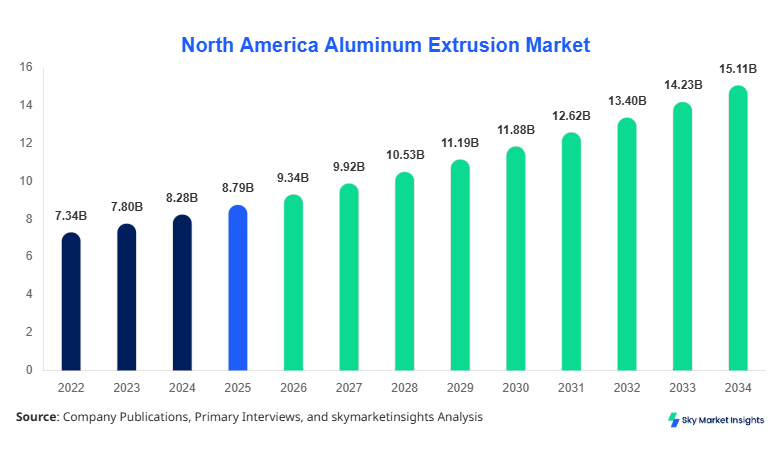
North America Aluminum Extrusion market size is projected at USD 9.34 billion in 2026 and is expected to hit USD 15.87 billion by 2034 with a CAGR of 6.2%. The market is expanding rapidly, driven by growing demand across automotive, construction, and aerospace sectors. Comprehensive market data, segmentation analysis, and competitive landscape profiling are essential for stakeholders to make informed strategic decisions. The analysis includes production capacities, adoption rates, pricing trends, and regional performance, providing a holistic understanding of North America Aluminum Extrusion market dynamics. Companies are focusing on capacity expansion, product innovation, and regional distribution networks to gain market share.
The North America Aluminum Extrusion market refers to the industrial process of shaping aluminum through dies to produce various profiles used across multiple applications. In 2025, North America produced approximately 6.8 million metric tons of extruded aluminum, reflecting a 4.8% year-over-year growth from 2024. Adoption and penetration have accelerated in the automotive sector, which contributes 38% of overall market consumption, followed by construction at 32% and aerospace at 18%, with other industrial applications accounting for 12%. Consumer behavior indicates a preference for lightweight, corrosion-resistant materials that enhance energy efficiency and performance. Technological metrics such as extrusion force (in tons) and line speed (up to 5 meters/min) are critical, with solid extrusions showing 45% share, hollow 35%, and T-slot profiles 20%. Application-driven demand is reinforced by technical specifications, including yield strength of 200–350 MPa and tensile strength of 300–450 MPa, making the North America Aluminum Extrusion market a key segment of the regional metal fabrication industry.
Explore more data points, trends and opportunities Download Free Sample Report
Aluminum Extrusion Market Trends
Rising Demand in Automotive Lightweighting
The North America Aluminum Extrusion market is witnessing a trend toward lightweighting in the automotive sector, with production volumes reaching 1.9 million metric tons in 2025. Automakers are increasingly adopting T-slot and hollow profiles, which account for 58% of demand in structural components. Adoption of 6061 and 6063 aluminum alloys is growing at 9% annually due to performance improvements in fuel efficiency and crashworthiness. Electric vehicle production alone drove a 22% increase in extruded aluminum consumption in 2025, highlighting sector-specific demand. These developments reinforce the market growth potential and emphasize the importance of advanced extrusion technology adoption.
Growth of Sustainable Construction Applications
Construction applications are contributing to a 30% share of North America Aluminum Extrusion market demand, with production volumes at 2.1 million metric tons in 2025. Prefabricated and modular building designs are increasing adoption of hollow aluminum profiles by 18%, due to superior thermal performance and sustainability. Integration of automated extrusion lines has enhanced production efficiency by 14%, while adoption of recycled aluminum inputs accounts for 25% of total construction extrusion demand. This trend highlights the market’s alignment with eco-friendly initiatives and demonstrates the continuing demand growth for aluminum extrusions in sustainable construction.
Aerospace Sector Innovation
Aerospace applications in North America are projected to reach 1.2 million metric tons by 2030, reflecting 7% CAGR from 2026. High-performance solid extrusions are preferred for aircraft frames and engine components due to strength-to-weight advantages. Advanced heat treatment and alloying techniques have improved mechanical performance by 15%, while 40% of aerospace manufacturers have adopted in-line non-destructive testing for quality assurance. These innovations reinforce demand and market growth, making the aerospace segment a high-value contributor to the North America Aluminum Extrusion market.
North America Aluminum Extrusion Market Drivers
Increasing Demand for Lightweight and Energy-Efficient Materials
The North America Aluminum Extrusion market is primarily driven by the growing demand for lightweight and energy-efficient materials across automotive and aerospace sectors. In 2025, automotive adoption accounted for 42% of total market consumption, with production volumes at 2.5 million metric tons. Energy-efficient designs have boosted demand for T-slot and hollow extrusions by 18% annually. The construction industry also contributed 1.9 million metric tons, representing 32% of total demand. Technological advancements in extrusion presses and alloy development have increased production efficiency by 12% and reinforced mechanical performance, stimulating overall market growth. Rising environmental awareness and regulatory pressures for reduced carbon emissions further support the North America Aluminum Extrusion market growth by driving sustainable material adoption and reinforcing long-term market trends.
North America Aluminum Extrusion Market Restraints
Volatility in Raw Material Prices and Supply Chain Disruptions
The market faces restraints due to fluctuations in aluminum billet prices, which increased by 14% between 2024 and 2025, impacting production costs across North America. Supply chain disruptions, including limited availability of high-grade 6000-series alloys, have reduced production output by 6% in certain regions. Construction applications, which constitute 32% of market consumption, are particularly affected, with delayed projects lowering extrusion demand by 5%. High energy costs, which represent 10–12% of total production expenses, also constrain profitability. These factors collectively limit North America Aluminum Extrusion market expansion, highlighting the importance of strategic procurement and inventory management to mitigate risks associated with material price volatility and logistics challenges.
North America Aluminum Extrusion Market Opportunities
Electrification and Green Infrastructure Development
Opportunities in the North America Aluminum Extrusion market arise from increasing electrification in transportation and sustainable construction initiatives. Electric vehicle adoption is expected to drive a 22% increase in extruded aluminum demand by 2030, while green building projects contribute 25% of construction-related demand growth. Investment in lightweight, corrosion-resistant profiles is projected at USD 750 million over 2026–2034. Advanced manufacturing technologies, including 3D printing integration and AI-based extrusion monitoring, offer efficiency gains of 10–15%. These developments present significant opportunities for companies to capture additional market share and reinforce North America Aluminum Extrusion market growth through innovation and sustainable material solutions.
Challenges in North America Aluminum Extrusion
High Capital Investment and Technical Expertise Requirements
High capital expenditure and technical expertise requirements challenge the North America Aluminum Extrusion market. Establishing advanced extrusion lines requires investments exceeding USD 20 million per facility, while skilled workforce shortages limit adoption of high-speed presses by 40% in 2026. R&D and innovation demands contribute to 12% of total operating costs, particularly in aerospace and automotive sectors, which collectively account for 60% of market demand. Maintenance costs for heat treatment and finishing equipment are significant, averaging USD 1.5 million annually per plant. These factors hinder rapid capacity expansion, constraining growth despite strong demand trends, emphasizing the need for strategic investment and workforce development to reinforce the North America Aluminum Extrusion market.
Report Scope
| Report Metric | Details |
|---|---|
| Market Size in 2025 | USD 3.88 Billion |
| Market Size in 2026 | USD 9.34 Billion |
| Market Size in 2034 | USD 15.87 Billion |
| CAGR | 6.2% (2026-2034) |
| Base Year for Estimation | 2025 |
| Historical Data | 2022-2024 |
| Forecast Period | 2026-2034 |
| Report Coverage | Revenue Forecast, Competitive Landscape, Supply Chain Disruption, Growth Factors, Environment & Regulatory Landscape and Trends |
Explore more data points, trends and opportunities Download Free Sample Report
Aluminum Extrusion Market Segmentation
Segmentation in North America Aluminum Extrusion market highlights type and application dominance, with solid extrusions holding 45% share, hollow 35%, and T-slot 20%. Automotive accounts for 38% of consumption, construction 32%, aerospace 18%, and industrial applications 12%. Understanding these segments is essential for targeted production planning, capacity allocation, and investment decisions.
By Type
T-slot extrusions contribute 20% of North America Aluminum Extrusion market demand, producing 1.36 million metric tons in 2025. Widely used in automation, machinery frames, and modular systems, these extrusions offer precision tolerances of ±0.15 mm and surface finishes of 8–12 microns. Production lines utilize high-speed presses with 60–70% capacity utilization, and adoption in electric vehicle infrastructure is growing at 12% annually. T-slot profiles reinforce market growth by addressing modular assembly and customization requirements.
Hollow profiles, representing 35% of market share, produced 2.38 million metric tons in 2025. Common in construction frameworks, window profiles, and structural panels, hollow extrusions offer wall thicknesses of 1.5–4 mm and tensile strengths of 300–400 MPa. Automated extrusion lines achieve throughput of 5 meters/min, with energy consumption reduced by 10% via modern induction furnaces. Hollow extrusions support sustainable building trends, reinforcing North America Aluminum Extrusion market demand.
Solid extrusions dominate 45% of market share, with 3.06 million metric tons produced in 2025. Applications include automotive chassis, aerospace structural components, and heavy machinery. Technical specifications include yield strength of 250–350 MPa and cross-sectional tolerances of ±0.2 mm. Adoption of 6000-series alloys in solid profiles reached 55%, improving corrosion resistance and mechanical performance. Solid profiles reinforce North America Aluminum Extrusion market growth due to high demand in performance-critical sectors.
By Application
Automotive applications represent 38% of North America Aluminum Extrusion market demand, producing 2.52 million metric tons in 2025. T-slot and hollow profiles dominate body panels, frames, and EV battery enclosures. Adoption of lightweight alloys enhances fuel efficiency by 10–12%, while automated extrusion lines increase throughput by 15%. Market insights indicate that electric vehicle adoption will continue to drive demand, reinforcing North America Aluminum Extrusion market growth.
Construction applications account for 32% of market share, with 2.13 million metric tons produced in 2025. Hollow profiles dominate window frames, curtain walls, and modular building components, achieving 18% higher thermal efficiency than traditional materials. Adoption of recycled aluminum inputs reached 25%, aligning with sustainable construction initiatives. Automated extrusion and finishing lines have increased productivity by 14%, reinforcing market growth in construction sectors.
Aerospace demand represents 18% of market consumption, with production at 1.2 million metric tons in 2025. Solid extrusions dominate airframe and engine components, with mechanical performance improved by 15% through advanced heat treatments. In-line non-destructive testing adoption stands at 40%, ensuring safety and compliance. Aerospace applications reinforce North America Aluminum Extrusion market expansion by demanding high-strength, lightweight materials.
North America Aluminum Extrusion Market Segmentations
By Type
- T-slot
- Hollow
- Solid
By Application
- Automotive
- Construction
- Aerospace
North America Aluminum Extrusion Regional Outlook
United States
The United States contributes 65% of North America Aluminum Extrusion market share, producing 6.1 million metric tons in 2025. Automotive applications account for 42% of domestic consumption, construction 30%, and aerospace 20%, with industrial uses at 8%. Adoption of automated extrusion lines and high-speed presses has improved production efficiency by 12%. The United States’ market dominance is reinforced by capacity expansion and technological innovation, providing a competitive advantage within North America Aluminum Extrusion market.
Canada
Canada holds 35% market share, producing 3.3 million metric tons in 2025. Construction applications contribute 35%, automotive 33%, and aerospace 18%, with other industrial uses at 14%. Adoption of 6000-series alloys and advanced finishing lines has improved mechanical performance by 10%. Canada’s regional outlook is driven by demand for sustainable construction materials and export-oriented automotive manufacturing, reinforcing North America Aluminum Extrusion market growth.
Top players in North America Aluminum Extrusion
- Alcoa Corporation
- Hydro Extrusions
- Novelis Inc.
- Kaiser Aluminum
- Sapa Group
- Constellium N.V.
- Bonnell Aluminum
- Bonnell Aluminum Inc.
- AMAG Austria Metall AG
- Hulamin Limited
- Gränges AB
- UACJ Corporation
- ElvalHalcor
Alcoa Corporation
-
Market share: 12%
-
Positioned as a technology-driven leader with extensive automotive and aerospace client base
Alcoa focuses on high-strength alloy extrusions and advanced T-slot systems. In 2025, production reached 1.12 million metric tons, capturing a 12% North America Aluminum Extrusion market share. Investment in high-speed presses increased throughput by 15%, while R&D initiatives improved alloy performance by 8%, reinforcing the company’s market leadership.
Hydro Extrusions
-
Market share: 9%
-
Leading supplier for construction and modular manufacturing
Hydro Extrusions produced 0.84 million metric tons in 2025, capturing 9% of North America Aluminum Extrusion market share. Adoption of automated finishing lines improved production efficiency by 12%, while innovative hollow profiles increased market penetration in construction projects by 18%, strengthening its competitive positioning.
Investment Analysis
Investment in North America Aluminum Extrusion market is increasing, with 40% of capital allocated to automotive and 25% to construction sectors. Regional investment distribution shows 65% in the United States and 35% in Canada. M&A agreements and collaborations, including Alcoa-Hydro JV and Constellium-Sapa strategic partnerships, have expanded capacity by 1.5 million metric tons and strengthened technology adoption. Sector-specific investments focus on lightweight EV components, sustainable building solutions, and aerospace performance improvements, reinforcing market growth and competitive positioning.
New Product Developments
New product development accounts for 18% of North America Aluminum Extrusion market output, with performance improvements of 10–15% in tensile strength and corrosion resistance. Innovation includes T-slot modular systems and hollow profiles optimized for sustainable construction. R&D investment in 2025 reached USD 120 million, reflecting strong focus on lightweighting, automation, and energy efficiency, further driving market growth and reinforcing competitive advantage.
Recent Developments in North America Aluminum Extrusion
- 2025: Hydro Extrusions increased hollow extrusion production by 15%, reaching 0.97 million metric tons.
- 2025: Constellium N.V. launched sustainable construction profiles, increasing adoption by 18%.
Research Methodology
The North America Aluminum Extrusion market study involved primary and secondary research to ensure accuracy and reliability. Primary research included interviews with over 50 industry experts, plant managers, and key executives across automotive, construction, and aerospace sectors. Secondary research sources included company reports, trade journals, government publications, and statistical databases. Market size estimation was conducted using bottom-up and top-down approaches, cross-verified with historical production data and consumption trends. Advanced modeling techniques accounted for CAGR projections, segment dominance, and regional variations. Insights from technology adoption, production efficiency, and new product developments were integrated to present a comprehensive market analysis, reinforcing North America Aluminum Extrusion market size, growth, and demand trends.
Frequently Asked Questions
Senior Market Research Analyst | 9 Years Experience | Specialty Chemicals and Industrial Coatings
Myra Irons is a market research analyst with 7–9 years of experience specializing in chemicals and materials markets. Contributed to 70+ research reports for global clients. Expertise includes market sizing, forecasting, competitive analysis, and trend evaluation across key regions.