Asia Pacific Aluminium Flat Rolled Products Market Size
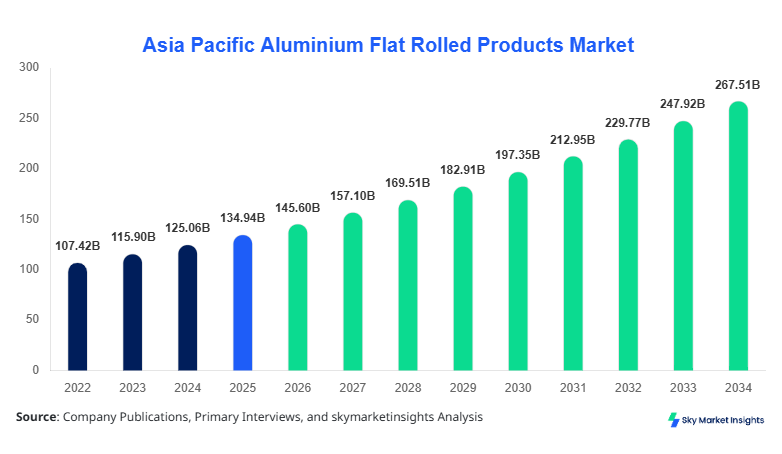
Asia Pacific Aluminium Flat Rolled Products market size is projected at USD 145.60 billion in 2026 and is expected to hit USD 268.40 billion by 2034 with a CAGR of 7.9%. The market expansion reflects rising industrialization, automotive electrification, and packaging demand across China, India, and South East Asia. Increasing need for high-strength lightweight materials, coupled with data-driven manufacturing and integrated supply chains, is driving adoption. Competitive landscape analysis highlights over 180 major producers and more than 1,200 downstream processing units contributing to over 72 million metric tons of annual output, emphasizing evolving segmentation and strong supplier competition.
The aluminium flat rolled products industry refers to the manufacturing of rolled aluminium sheets, plates, and foils used across automotive, packaging, aerospace, and construction applications. In Asia Pacific, production exceeded 68 million metric tons in 2025, with China accounting for over 58%, followed by Japan at 8%, India at 7%, and South Korea at 6%. Adoption rates across automotive lightweighting applications reached nearly 42% penetration, while packaging applications contributed approximately 38% of total consumption volume. Consumer behavior indicates increasing demand for recyclable and lightweight materials, with over 65% of end-users prioritizing sustainability in procurement decisions. The application split shows packaging (38%), automotive (28%), construction (18%), and others (16%), while performance metrics include tensile strengths ranging between 90–350 MPa and thickness levels between 0.2 mm and 6 mm, reinforcing the Asia Pacific Aluminium Flat Rolled Products Market.
Explore more data points, trends and opportunities Download Free Sample Report
Asia Pacific Aluminium Flat Rolled Products Market Size
Asia Pacific Aluminium Flat Rolled Products market size is projected at USD 145.60 billion in 2026 and is expected to hit USD 268.40 billion by 2034 with a CAGR of 7.9%. The market expansion reflects rising industrialization, automotive electrification, and packaging demand across China, India, and South East Asia. Increasing need for high-strength lightweight materials, coupled with data-driven manufacturing and integrated supply chains, is driving adoption. Competitive landscape analysis highlights over 180 major producers and more than 1,200 downstream processing units contributing to over 72 million metric tons of annual output, emphasizing evolving segmentation and strong supplier competition.
The aluminium flat rolled products industry refers to the manufacturing of rolled aluminium sheets, plates, and foils used across automotive, packaging, aerospace, and construction applications. In Asia Pacific, production exceeded 68 million metric tons in 2025, with China accounting for over 58%, followed by Japan at 8%, India at 7%, and South Korea at 6%. Adoption rates across automotive lightweighting applications reached nearly 42% penetration, while packaging applications contributed approximately 38% of total consumption volume. Consumer behavior indicates increasing demand for recyclable and lightweight materials, with over 65% of end-users prioritizing sustainability in procurement decisions. The application split shows packaging (38%), automotive (28%), construction (18%), and others (16%), while performance metrics include tensile strengths ranging between 90–350 MPa and thickness levels between 0.2 mm and 6 mm, reinforcing the Asia Pacific Aluminium Flat Rolled Products Market.
In the China, the Aluminium Flat Rolled Products Market…
In the China, the Aluminium Flat Rolled Products Market dominates the regional landscape with over 58% share and more than 110 large-scale rolling facilities producing over 40 million metric tons annually. The country hosts over 320 key manufacturers and processors, with packaging applications accounting for 36%, automotive for 30%, and construction for 20%. Technology adoption rates exceed 68% for advanced continuous casting and rolling technologies, while recycling-based aluminium production contributes nearly 25% of total feedstock. Electric vehicle production has driven a 22% rise in demand for high-strength rolled sheets between 2023 and 2025, reinforcing the Asia Pacific Aluminium Flat Rolled Products Market.
Asia Pacific Aluminium Flat Rolled Products Market Trends
The market is witnessing a rapid shift toward lightweight automotive solutions, with aluminium usage per vehicle increasing from 180 kg in 2022 to over 240 kg in 2025 across Asia Pacific. Production volumes of aluminium sheets for EVs crossed 9.5 million metric tons in 2025, with adoption rates of aluminium body panels reaching 48% in China and 36% in Japan. Additionally, smart rolling mills integrated with AI-driven quality monitoring systems have improved yield efficiency by 12% and reduced scrap rates by 8%, contributing to advanced manufacturing ecosystems across the region, strengthening the Asia Pacific Aluminium Flat Rolled Products Market.
Another key trend is the surge in aluminium foil demand driven by food and pharmaceutical packaging, where annual production exceeded 12 million metric tons in 2025, representing a 9.2% increase compared to 2023. Flexible packaging applications now account for over 54% of foil consumption, while sustainable packaging initiatives have increased recycled aluminium usage by 18%. Emerging economies like India and South East Asia have seen packaging demand grow at over 11% annually, with over 70% of manufacturers shifting to eco-friendly rolled products, supporting the Asia Pacific Aluminium Flat Rolled Products Market.
Digitalization in rolling operations is also accelerating, with over 45% of large-scale plants adopting Industry 4.0 technologies such as predictive maintenance and automated thickness control systems. These advancements have improved throughput by 15% and reduced energy consumption by 10%, particularly in South Korea and Japan. Increasing investments in green aluminium production have led to a 20% rise in low-carbon rolled product output since 2023, aligning with global decarbonization targets and further advancing the Asia Pacific Aluminium Flat Rolled Products Market.
Asia Pacific Aluminium Flat Rolled Products Market Drivers
Rising Demand from Electric Vehicles and Packaging Industries
The rapid expansion of electric vehicle production, which reached over 18 million units in Asia Pacific in 2025, has significantly increased demand for lightweight aluminium sheets and plates. Aluminium usage in EV batteries and structural components has grown by 24% annually, while packaging demand continues to expand with over 65% of consumer goods companies adopting aluminium-based solutions. The region produced over 72 million metric tons of aluminium rolled products in 2025, with nearly 40% used in packaging applications. Government incentives supporting EV adoption and sustainability initiatives have boosted aluminium consumption by 12% annually since 2023, reinforcing strong industrial demand patterns and supporting Asia Pacific Aluminium Flat Rolled Products Market growth.
Asia Pacific Aluminium Flat Rolled Products Market Restraints
High Energy Costs and Raw Material Price Volatility
Energy costs account for nearly 30–35% of total aluminium production expenses, and fluctuations in electricity prices across China and India have impacted profit margins by up to 8% annually. Additionally, bauxite and alumina price volatility has increased procurement costs by 12–15% between 2023 and 2025. Smaller manufacturers face operational challenges, with nearly 18% of mid-scale rolling units operating below capacity due to cost pressures. Environmental compliance regulations have also increased operational expenditures by 10%, particularly in developed markets like Japan and South Korea, limiting expansion capabilities and constraining overall Asia Pacific Aluminium Flat Rolled Products Market growth.
Asia Pacific Aluminium Flat Rolled Products Market Opportunities
Expansion of Recycling and Green Aluminium Production
The increasing focus on sustainability has opened significant opportunities in aluminium recycling, which currently contributes nearly 25% of total production in Asia Pacific and is expected to reach 40% by 2030. Recycling aluminium requires 95% less energy compared to primary production, leading to cost savings of up to USD 1,200 per ton. Investments in green aluminium facilities have grown by 28% annually since 2022, with major producers allocating over 35% of capital expenditure toward sustainable technologies. These initiatives are expected to drive innovation and efficiency improvements across the supply chain, strengthening the Asia Pacific Aluminium Flat Rolled Products Market.
Challanges in Asia Pacific Aluminium Flat Rolled Products Market
Supply Chain Disruptions and Trade Restrictions
Geopolitical tensions and trade restrictions have impacted aluminium exports and imports, with tariffs increasing costs by 6–10% in key markets. Supply chain disruptions during 2023–2025 led to a 14% decline in shipment efficiency, particularly affecting cross-border trade between China, Japan, and South East Asia. Logistics costs have risen by nearly 18%, while delivery lead times have increased by 20%, affecting production schedules. Limited availability of skilled labor in advanced rolling technologies has also slowed capacity expansion by 7% annually, presenting ongoing challenges to the Asia Pacific Aluminium Flat Rolled Products Market.
Report Scope
| Report Metric | Details |
|---|---|
| Market Size in 2025 | USD 134.94 Billion |
| Market Size in 2026 | USD 145.60 Billion |
| Market Size in 2034 | USD 268.40 Billion |
| CAGR | 7.9% (2026-2034) |
| Base Year for Estimation | 2025 |
| Historical Data | 2022-2024 |
| Forecast Period | 2026-2034 |
| Report Coverage | Revenue Forecast, Competitive Landscape, Supply Chain Disruption, Growth Factors, Environment & Regulatory Landscape and Trends |
Explore more data points, trends and opportunities Download Free Sample Report
Asia Pacific Aluminium Flat Rolled Products Market Segmentation
The market is segmented by type and application, with packaging and automotive segments dominating over 66% of total consumption, while hot rolled and cold rolled sheets together account for more than 70% of production volume across Asia Pacific.
By Type
Hot rolled sheets account for approximately 38% of total market share, with production volumes exceeding 27 million metric tons in 2025. These sheets are widely used in construction and automotive structural components due to their high strength and thickness range of 2 mm to 6 mm. Improved rolling techniques have enhanced durability by 15% and reduced defects by 10%.
Cold rolled sheets contribute nearly 32% of market share, with production reaching 22 million metric tons annually. These sheets offer superior surface finish and precision thickness control ranging from 0.2 mm to 2 mm, making them ideal for automotive body panels and appliances. Adoption in EV manufacturing has increased by 18% annually.
Foil stock represents around 18% of the market, with production exceeding 12 million metric tons. These products are extensively used in packaging, offering barrier properties with thickness below 0.2 mm and flexibility advantages. Demand has grown by 9% annually due to increased food packaging requirements.
By Application
Automotive applications account for approximately 28% of total consumption, with over 20 million metric tons of rolled aluminium used annually. Increasing EV production has boosted aluminium penetration in vehicle bodies to 42%, improving fuel efficiency by 10–15%.
Packaging dominates with a 38% share, consuming over 27 million metric tons annually. Aluminium foils and sheets are used extensively in food, beverage, and pharmaceutical packaging, with adoption rates exceeding 65% among major manufacturers.
Construction accounts for around 18% of the market, utilizing 13 million metric tons annually in roofing, cladding, and structural components. Aluminium usage in construction has increased by 12% due to durability and corrosion resistance.
Asia Pacific Aluminium Flat Rolled Products Market Segmentations
By Type
- Hot Rolled Sheets
- Cold Rolled Sheets
- Foil Stock
By Application
- Automotive
- Packaging
- Construction
Asia Pacific Aluminium Flat Rolled Products Regional Outlook
China leads the regional market with over 58% share, producing more than 40 million metric tons annually. The country’s strong manufacturing base and government support for EVs and infrastructure development have driven demand across automotive and construction sectors. Packaging applications account for 36%, while automotive contributes 30%, supported by advanced rolling technologies and high production efficiency.
Japan holds approximately 8% share, producing over 5 million metric tons annually. The country focuses on high-quality rolled products for automotive and aerospace applications, with advanced technology adoption rates exceeding 70%. Sustainability initiatives have increased recycled aluminium usage by 20%.
India accounts for nearly 7% share, with production exceeding 4.5 million metric tons. Rapid urbanization and infrastructure development have boosted demand in construction, while packaging applications have grown by 11% annually. Government initiatives promoting domestic manufacturing have increased production capacity by 15% since 2023.
South Korea contributes around 6% share, producing over 4 million metric tons annually. The country’s advanced manufacturing ecosystem supports automotive and electronics industries, with over 65% adoption of automated rolling technologies.
Australia, Singapore, Taiwan, and South East Asia collectively account for 21% share, with combined production exceeding 14 million metric tons. These regions focus on export-oriented production, with packaging and construction applications dominating demand patterns.
Top players in Asia Pacific Aluminium Flat Rolled Products
- China Hongqiao Group
- Aluminum Corporation of China (CHALCO)
- Novelis Inc.
- UACJ Corporation
- Hindalco Industries Limited
- Norsk Hydro ASA
- JW Aluminum
- Arconic Corporation
- Constellium SE
- Kaiser Aluminum
- Aleris Corporation
- Shandong Nanshan Aluminum
- Jindal Aluminium
- Vedanta Limited
China Hongqiao Group
Holds approximately 14% regional share and operates over 20 major rolling facilities across China. The company produces over 6 million metric tons annually and focuses on cost-efficient large-scale production with integrated supply chains.
Novelis Inc.
Accounts for nearly 9% regional share and specializes in high-quality rolled products for automotive and packaging applications. The company invests over 12% of revenue in R&D, focusing on lightweight and recyclable aluminium solutions.
Investment Analysis
Investment in the Asia Pacific market has grown significantly, with total capital expenditure exceeding USD 35 billion between 2022 and 2025. Approximately 40% of investments are directed toward capacity expansion, while 30% focus on sustainability and recycling initiatives. China accounts for over 45% of regional investments, followed by India at 18% and South East Asia at 15%.
Mergers and acquisitions have increased by 22% annually, with major players forming strategic alliances to expand production capacity and technology capabilities. Cross-border collaborations have improved supply chain efficiency by 12% and reduced operational costs by 8%.
New Product Developments
New product development accounts for nearly 18% of total industry output, with innovations focusing on high-strength and lightweight aluminium sheets. Performance improvements of up to 20% in durability and 15% in corrosion resistance have been achieved through advanced alloy compositions.
Manufacturers have introduced eco-friendly rolled products with 25% lower carbon footprint, while over 35% of new products are designed for EV applications, reflecting increasing demand for sustainable solutions.
Recent Developments in Asia Pacific Aluminium Flat Rolled Products
- 2025: China increased aluminium rolled production by 10%, adding over 4 million metric tons capacity driven by EV demand and infrastructure projects.
- 2025: South Korea invested USD 2 billion in new rolling facilities, increasing production output by 8% annually.
Research Methodology
The research process involves a combination of primary and secondary research methodologies to ensure accurate market analysis. Primary research includes interviews with over 120 industry experts, manufacturers, and distributors, while secondary research involves analysis of company reports, government publications, and trade databases. Market size estimation is conducted using bottom-up and top-down approaches, considering production volumes, revenue data, and consumption patterns across regions. Data triangulation ensures accuracy, while statistical models are used to forecast trends and growth patterns over the forecast period.
Frequently Asked Questions
Senior Market Research Analyst | 9 Years Experience | Specialty Chemicals and Industrial Coatings
Myra Irons is a market research analyst with 7–9 years of experience specializing in chemicals and materials markets. Contributed to 70+ research reports for global clients. Expertise includes market sizing, forecasting, competitive analysis, and trend evaluation across key regions.