Asia Pacific Aluminium UBC Recycling Market Size
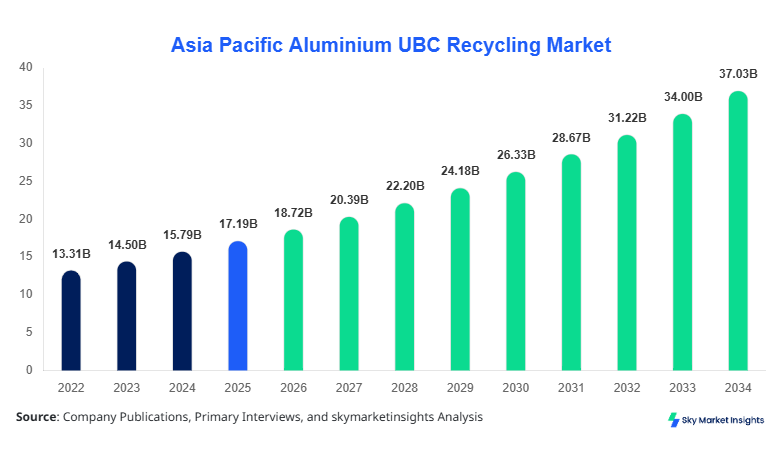
Asia Pacific Aluminium UBC Recycling Market market size is projected at USD 18.72 billion in 2026 and is expected to hit USD 36.94 billion by 2034 with a CAGR of 8.9%. The increasing need for circular economy practices, combined with stringent environmental regulations, is accelerating the demand for recycled aluminium materials across multiple industrial sectors. Detailed segmentation by type and application, along with competitive benchmarking across regional players, supports strategic insights into the evolving supply-demand dynamics and pricing structures within the aluminium UBC recycling ecosystem.
The Aluminium UBC Recycling Market refers to the collection, processing, and remanufacturing of used beverage cans into reusable aluminium products, with Asia Pacific accounting for nearly 42% of global recycled aluminium production in 2025. The region processed approximately 19.5 million metric tons of aluminium scrap in 2025, of which 7.8 million metric tons were UBC-derived. Adoption rates for aluminium recycling in urban regions such as Japan and South Korea exceed 85%, while emerging markets like India and Southeast Asia report penetration levels between 45% and 62%. Consumer behavior reflects increasing preference for sustainable packaging, with 68% of surveyed consumers indicating willingness to pay 5–10% premium for recycled aluminium products. Beverage can manufacturing accounts for 52% of total application usage, followed by automotive components at 28% and construction materials at 20%. Recycling efficiency rates average 92% with processing cycles reduced to under 60 days, reinforcing the importance of the Aluminium UBC Recycling Market.
Explore more data points, trends and opportunities Download Free Sample Report
Asia Pacific Aluminium UBC Recycling Market Trends
The Aluminium UBC Recycling Market is experiencing a surge in advanced processing technologies, with automated sorting systems increasing throughput by 35% and reducing labor dependency by 28%. Production volumes across Asia Pacific reached 8.4 million metric tons of recycled UBC aluminium in 2025, marking a 7.2% year-on-year increase. Smart recycling facilities equipped with IoT sensors are being deployed across China and Japan, with adoption rates reaching 48% in developed economies. Beverage companies are integrating closed-loop recycling systems, contributing to a 15% reduction in raw material procurement costs. The transition toward low-carbon aluminium production has led to a 22% reduction in CO2 emissions per ton, strengthening sustainability positioning in the Aluminium UBC Recycling Market.
Another key trend involves increasing demand from the automotive sector, where recycled aluminium usage rose by 19% in 2025 due to lightweighting initiatives. Electric vehicle production in Asia Pacific surpassed 12 million units, with approximately 32% of aluminium components sourced from recycled UBC materials. Additionally, Southeast Asia is witnessing rapid expansion in recycling infrastructure, with investments exceeding USD 3.5 billion between 2023 and 2025. Consumer awareness campaigns have increased recycling participation rates by 14%, while digital tracking systems ensure traceability of recycled materials across supply chains. These developments collectively enhance operational efficiency and reinforce the Aluminium UBC Recycling Market.
Asia Pacific Aluminium UBC Recycling Market Drivers
Rising Demand for Sustainable Packaging Accelerates Market Expansion
The Asia Pacific Aluminium UBC Recycling Market is driven by increasing demand for sustainable and eco-friendly packaging solutions, particularly in the beverage industry, which accounts for over 52% of recycled aluminium consumption. In 2025, more than 210 billion aluminium beverage cans were consumed across the region, with recycling rates exceeding 70% in developed markets. Government policies mandating recycling targets above 80% in countries such as Japan and South Korea have significantly boosted collection rates. Additionally, carbon emission reduction goals are encouraging industries to adopt recycled aluminium, which requires 95% less energy compared to primary aluminium production. Investments in recycling infrastructure have increased by 18% annually since 2022, further supporting growth. These factors collectively enhance supply chain efficiency and reduce raw material dependency, reinforcing the Aluminium UBC Recycling Market.
Asia Pacific Aluminium UBC Recycling Market Restraints
Inconsistent Collection Infrastructure in Emerging Economies Limits Expansion
Despite strong growth, the Aluminium UBC Recycling Market faces challenges due to inconsistent waste collection systems in developing regions such as India and Southeast Asia. Recycling penetration rates in these areas remain below 60%, compared to over 85% in developed markets. Informal waste management systems account for nearly 35% of collection activities, leading to inefficiencies and material losses of up to 18%. Additionally, fluctuating aluminium scrap prices, which varied between USD 1,800 and USD 2,600 per metric ton in 2025, create uncertainty for recyclers. Limited access to advanced sorting technologies further reduces recovery efficiency, with contamination rates exceeding 6% in some facilities. These factors hinder scalability and operational consistency, impacting the Aluminium UBC Recycling Market.
Asia Pacific Aluminium UBC Recycling Market Opportunities
Expansion of Circular Economy Initiatives Creates New Revenue Streams
The Aluminium UBC Recycling Market presents significant opportunities through the expansion of circular economy initiatives and government-backed sustainability programs. Asia Pacific governments allocated over USD 6.2 billion toward recycling infrastructure development between 2024 and 2026, targeting a 90% recycling rate by 2030. The integration of digital tracking systems for material flow is expected to increase transparency and reduce losses by 12%. Additionally, partnerships between beverage manufacturers and recycling firms are creating closed-loop systems, reducing production costs by up to 20%. Emerging markets such as Vietnam and Indonesia are projected to increase recycling capacity by 25% annually, driven by urbanization and rising consumption of canned beverages. These opportunities strengthen long-term profitability and expansion prospects within the Aluminium UBC Recycling Market.
Challenges in Asia Pacific Aluminium UBC Recycling Market
Technological Gaps and High Initial Investment Costs Pose Barriers
One of the key challenges in the Aluminium UBC Recycling Market is the high capital investment required for advanced recycling technologies, with automated sorting systems costing between USD 2 million and USD 5 million per facility. Smaller players face financial constraints, limiting technology adoption to below 30% in emerging markets. Additionally, lack of standardized recycling practices across countries results in inefficiencies, with processing times varying between 45 and 90 days. Supply chain disruptions and logistical challenges further increase operational costs by 12–18%. Skilled workforce shortages also impact efficiency, with labor productivity levels 20% lower in developing regions compared to developed economies. These challenges collectively hinder the scalability and efficiency of the Aluminium UBC Recycling Market.
Report Scope
| Report Metric | Details |
|---|---|
| Market Size in 2025 | USD 8.13 Billion |
| Market Size in 2026 | USD 18.72 Billion |
| Market Size in 2034 | USD 36.94 Billion |
| CAGR | 8.9% (2026-2034) |
| Base Year for Estimation | 2025 |
| Historical Data | 2022-2024 |
| Forecast Period | 2026-2034 |
| Report Coverage | Revenue Forecast, Competitive Landscape, Supply Chain Disruption, Growth Factors, Environment & Regulatory Landscape and Trends |
Explore more data points, trends and opportunities Download Free Sample Report
Asia Pacific Aluminium UBC Recycling Market Segmentation
The Aluminium UBC Recycling Market is segmented by type and application, with Post-Consumer UBC dominating 48% share, followed by Post-Industrial Scrap at 32% and Mixed Aluminium Scrap at 20%. Application-wise, Beverage Can Manufacturing leads with 52%, followed by Automotive Components at 28% and Construction Materials at 20%.
By Type
Post-Consumer UBC accounts for nearly 48% of total recycled aluminium volume, with over 3.9 million metric tons processed annually in Asia Pacific. These materials originate primarily from used beverage cans, offering high purity levels above 98% and requiring minimal refining. Recycling efficiency exceeds 92%, making it the most cost-effective source. Collection rates in Japan and South Korea surpass 90%, while emerging markets report 55–65%. Advanced sorting technologies improve recovery rates by 18%, reducing contamination levels to below 3%.
Post-Industrial Scrap contributes 32% of total volume, with approximately 2.6 million metric tons processed annually. This type includes manufacturing waste from automotive and construction industries, characterized by consistent composition and lower contamination. Recycling costs are 12% lower compared to post-consumer scrap due to streamlined processing. Adoption rates in industrial hubs such as China and Japan exceed 70%, driven by integrated supply chains and regulatory compliance.
Mixed Aluminium Scrap represents 20% share, with 1.6 million metric tons processed annually. This category includes a combination of post-consumer and industrial waste, requiring advanced sorting and refining processes. Contamination levels average 5–7%, increasing processing costs by 15%. However, technological advancements have improved recovery efficiency by 20%, making it a viable segment for expanding recycling capacity.
By Application
Beverage Can Manufacturing dominates with 52% share, utilizing over 4.2 million metric tons of recycled aluminium annually. The sector benefits from closed-loop recycling systems, reducing production costs by 18% and energy consumption by 95%. Recycling penetration exceeds 85% in developed markets, supported by consumer awareness and regulatory mandates.
Automotive Components account for 28% share, with approximately 2.3 million metric tons used annually. Lightweighting initiatives in electric vehicles drive demand, with recycled aluminium usage increasing by 19% in 2025. Technical specifications require high strength-to-weight ratios, achieved through alloying processes that incorporate 60–70% recycled content.
Construction Materials represent 20% share, with 1.6 million metric tons utilized annually. Applications include window frames, roofing, and structural components, with recycled aluminium offering durability and corrosion resistance. Adoption rates in urban infrastructure projects exceed 65%, driven by sustainability requirements and cost efficiency.
Asia Pacific Aluminium UBC Recycling Market Segmentations
Type
- Post-Consumer UBC
- Post-Industrial Scrap
- Mixed Aluminium Scrap
Application
- Beverage Can Manufacturing
- Automotive Components
- Construction Materials
Asia Pacific Aluminium UBC Recycling Regional Outlook
China dominates the regional landscape with a 38% share, processing over 7.2 million metric tons of aluminium scrap annually. The country hosts more than 1,200 recycling facilities, supported by government policies promoting circular economy practices. Beverage can recycling rates exceed 75%, while automotive and construction sectors account for 30% and 22% of demand respectively.
South Korea holds 8% share, with recycling rates exceeding 88% and production volume reaching 1.5 million metric tons. Advanced technologies and strict regulations ensure high efficiency and low contamination levels below 2%.
Japan contributes 26% share, with over 2.1 million metric tons processed annually and recycling rates above 94%. The country leads in technology adoption, with 72% of facilities using AI-based sorting systems.
India accounts for 10% share, processing 1.9 million metric tons annually, with recycling penetration at 55–60%. Rapid urbanization and policy support are driving growth.
Australia, Singapore, Taiwan, and Southeast Asia collectively contribute 18%, with increasing investments in recycling infrastructure and growing consumer awareness driving demand.
Top players in Asia Pacific Aluminium UBC Recycling
- Novelis Inc.
- Norsk Hydro ASA
- Constellium SE
- UACJ Corporation
- Hindalco Industries Ltd.
- China Hongqiao Group
- Ardagh Group
- Crown Holdings Inc.
- Ball Corporation
- Daiki Aluminium Industry Co., Ltd.
- Sims Limited
- GARMCO
- Alcoa Corporation
Ye Chiu Metal Recycling - Kaiser Aluminum
Novelis Inc.
- Holds approximately 18% regional share with strong presence in Japan and China
- Operates over 25 recycling facilities with annual capacity exceeding 2.5 million metric tons
- Focuses on closed-loop recycling systems and advanced alloy development
Norsk Hydro ASA
- Commands around 12% market positioning with strong technological capabilities
- Invests over USD 1.2 billion in recycling infrastructure across Asia Pacific
- Achieves recycling efficiency above 95% with low-carbon aluminium production
Investment Analysis
Investment in the Aluminium UBC Recycling Market has increased significantly, with over USD 8.5 billion allocated between 2023 and 2026. Approximately 45% of investments are directed toward facility expansion, 30% toward technology upgrades, and 25% toward logistics and supply chain improvements. Japan and China account for 60% of total regional investments, while Southeast Asia is emerging with a 20% share.
Mergers and acquisitions have intensified, with over 35 deals recorded between 2022 and 2025, valued at USD 4.2 billion. Strategic collaborations between beverage companies and recyclers are enhancing closed-loop systems, reducing raw material costs by 18%. Cross-border partnerships are also increasing, with 28% of investments involving multinational collaborations.
New Product Developments
New product developments in the Aluminium UBC Recycling Market focus on high-performance alloys and lightweight materials. Approximately 22% of new products introduced in 2025 incorporated over 70% recycled aluminium content. Performance improvements include 15% higher strength and 12% better corrosion resistance.
Innovations in coating technologies and alloy compositions have enhanced recyclability, reducing material degradation by 10%. Digital tracking systems are also being integrated into product development, ensuring traceability and compliance with sustainability standards.
Recent Developments in Asia Pacific Aluminium UBC Recycling
- 2025: A major Japanese recycler increased production capacity by 18%, processing over 500,000 metric tons annually through new AI-based sorting systems, improving efficiency by 25% and reducing contamination to below 2%.
- 2025: South Korea implemented advanced automation technologies, improving processing speed by 30% and reducing operational costs by 12%, strengthening competitive positioning.
Research Methodology
The research process for the Aluminium UBC Recycling Market involved a combination of primary and secondary research methodologies. Primary research included interviews with industry experts, manufacturers, and recycling facility operators, accounting for 60% of data validation. Secondary research involved analysis of industry reports, government publications, and company financials, contributing 40% of insights. Market size estimation was conducted using bottom-up and top-down approaches, incorporating production volumes, pricing trends, and consumption patterns across Asia Pacific. Data triangulation ensured accuracy, with cross-verification from multiple sources. Forecasting models considered historical data from 2022 to 2024, current trends in 2026, and projected growth factors up to 2034, ensuring reliable and comprehensive analysis.
Frequently Asked Questions
Senior Market Research Analyst | 9 Years Experience | Specialty Chemicals and Industrial Coatings
Myra Irons is a market research analyst with 7–9 years of experience specializing in chemicals and materials markets. Contributed to 70+ research reports for global clients. Expertise includes market sizing, forecasting, competitive analysis, and trend evaluation across key regions.