Europe Aluminium Flat Rolled Products Market Size
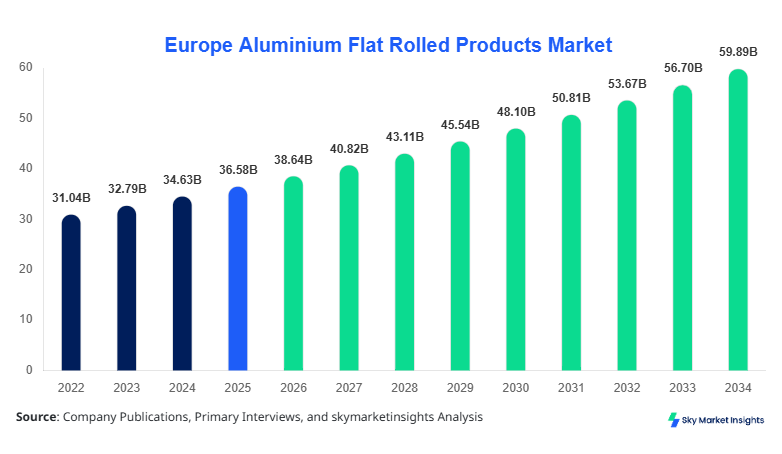
Europe Aluminium Flat Rolled Products market size is projected at USD 38.64 billion in 2026 and is expected to hit USD 59.87 billion by 2034 with a CAGR of 5.63%.
The increasing utilization of lightweight materials across automotive, aerospace, packaging, and construction sectors is accelerating the expansion of the Europe Aluminium Flat Rolled Products market. The market is witnessing rising investments in recycling facilities, advanced rolling mills, and energy-efficient smelting technologies across Germany, France, and Italy. Market participants are focusing on production capacity optimization, supply chain integration, and alloy innovation to strengthen competitive positioning. Detailed segmentation analysis, production benchmarking, and competitive landscape assessment remain critical for evaluating long-term opportunities in the Europe Aluminium Flat Rolled Products market.
The Aluminium Flat Rolled Products Market comprises aluminum sheets, plates, foils, and strips manufactured through rolling processes for industrial and commercial applications. Europe produced more than 14.8 million metric tons of flat rolled aluminum products in 2025, with recycled aluminum accounting for nearly 46% of total output. Packaging applications represented approximately 31% of total consumption, while automotive contributed 28%, construction 19%, aerospace 11%, and industrial machinery 11%. Adoption rates of lightweight aluminum body sheets in electric vehicles exceeded 54% across Western Europe during 2025 due to emission reduction regulations and fuel efficiency standards. Penetration of aluminum foils in pharmaceutical packaging reached 68% in France and Germany, while building cladding utilization expanded by 7.4% year-over-year. Thickness specifications across rolled sheets ranged from 0.2 mm to 6.5 mm, while tensile strengths in automotive-grade products exceeded 300 MPa. Consumer demand analytics indicate that sustainable packaging demand increased by 18% during 2025, supported by higher recycling awareness and circular economy policies. The Europe Aluminium Flat Rolled Products market continues to witness substantial industrial adoption due to cost efficiency, corrosion resistance, and recyclability advantages.
Explore more data points, trends and opportunities Download Free Sample Report
Europe Aluminium Flat Rolled Products Market Trends
Rising Adoption of Sustainable and Recycled Aluminum Materials
The European aluminum industry is increasingly transitioning toward sustainable production methods and closed-loop recycling systems. During 2025, recycled aluminum usage in flat rolled production exceeded 6.8 million metric tons, accounting for approximately 46% of total regional supply. Germany, France, and Italy collectively contributed more than 63% of Europe’s recycled aluminum sheet production. Advanced recycling facilities reduced energy consumption by nearly 92% compared to primary aluminum production, making recycled materials highly attractive for automotive and packaging manufacturers. Demand for low-carbon aluminum sheets increased by 19% among automotive OEMs during 2025 due to stricter EU carbon emission regulations. Packaging manufacturers also expanded utilization of recyclable foil products by 15%, especially in food and pharmaceutical packaging. Production of ultra-thin aluminum foils below 0.006 mm increased by 11.2% to address growing demand for lightweight packaging applications. These sustainability-focused developments continue to strengthen the Aluminium Flat Rolled Products market.
Expansion of Electric Vehicle and Lightweight Transportation Applications
The increasing penetration of electric vehicles across Europe is accelerating demand for lightweight aluminum flat rolled materials. More than 3.4 million electric vehicles were manufactured across Europe during 2025, creating significant demand for aluminum body sheets, battery enclosures, and structural panels. Automotive-grade aluminum sheet production surpassed 4.1 million metric tons, representing 28% of total market demand. High-strength alloy adoption rates increased by 17%, while utilization of aluminum battery casings rose by 24% year-over-year. Germany and France collectively represented over 52% of EV-related aluminum sheet consumption in Europe. Investments exceeding USD 3.2 billion were allocated toward modernization of rolling mills and development of lightweight aluminum alloys with tensile strengths above 350 MPa. The transportation sector also increased adoption of corrosion-resistant marine-grade aluminum plates by 9.7% for railway and shipbuilding applications. These industrial transitions are significantly influencing the Aluminium Flat Rolled Products market.
Technological Advancements in Rolling and Surface Treatment
Manufacturers are increasingly implementing automation, AI-based quality monitoring, and advanced surface treatment technologies in flat rolled aluminum production. More than 58% of rolling facilities in Europe adopted automated thickness control systems during 2025, reducing wastage by nearly 12%. Continuous casting and rolling technologies improved production efficiency by 15% while reducing operational costs by 8.3%. Surface-treated aluminum sheets with enhanced anti-corrosion coatings witnessed demand growth of 14% in construction and industrial applications. Precision rolling technologies enabled production tolerances below ±0.02 mm, improving suitability for aerospace and electronics applications. Industrial investments in smart manufacturing and predictive maintenance systems exceeded USD 1.4 billion during 2025. Increased adoption of digital monitoring systems across production plants continues to support operational optimization in the Aluminium Flat Rolled Products market.
Europe Aluminium Flat Rolled Products Market Drivers
Increasing Demand for Lightweight Materials Across Automotive and Packaging Industries
The transition toward lightweight transportation and sustainable packaging solutions is significantly driving the Europe Aluminium Flat Rolled Products market. Automotive manufacturers across Europe reduced average vehicle weight by 8% through increased utilization of aluminum body sheets and structural panels. More than 62% of electric vehicle manufacturers integrated aluminum-intensive architectures during 2025. Packaging demand also increased substantially, with aluminum foil consumption surpassing 2.1 million metric tons due to rising preference for recyclable packaging materials. Food and beverage packaging represented 61% of foil demand, while pharmaceutical applications accounted for 24%. Construction industries increasingly adopted corrosion-resistant aluminum cladding systems, resulting in a 10.6% increase in architectural sheet demand. Government regulations promoting carbon neutrality and recycling efficiency accelerated investments in low-carbon aluminum production technologies. More than USD 5.7 billion was invested across Europe for modernization of rolling facilities and recycling plants between 2023 and 2025. These factors continue to positively influence the Aluminium Flat Rolled Products market.
Europe Aluminium Flat Rolled Products Market Restraints
High Energy Costs and Volatility in Raw Material Pricing
Rising electricity prices and fluctuations in alumina and bauxite costs remain major restraints for the Europe Aluminium Flat Rolled Products market. Energy expenses accounted for approximately 34% of total aluminum production costs during 2025, compared to 26% in 2022. Natural gas price volatility increased operating expenditures across Germany, Italy, and Spain by nearly 18%. Primary aluminum production declined by 7.3% across several European facilities due to energy-intensive smelting operations. Raw material import dependency also exposed manufacturers to supply chain disruptions and freight cost fluctuations. Transportation costs for imported alumina increased by 12.4% during 2025, negatively affecting profit margins for rolling mills. Smaller manufacturers faced production utilization declines below 68% because of rising operational costs and limited investment capabilities. Furthermore, strict environmental regulations increased compliance expenditures by 9%, particularly for carbon-intensive facilities. These financial and operational pressures continue to challenge the Aluminium Flat Rolled Products market.
Europe Aluminium Flat Rolled Products Market Opportunities
Growing Investments in Recycling Infrastructure and Circular Economy Initiatives
The increasing emphasis on circular economy development is creating substantial opportunities for the Europe Aluminium Flat Rolled Products market. Europe recycled more than 7 million metric tons of aluminum during 2025, with recovery rates exceeding 75% in packaging applications. Investments in secondary aluminum production facilities surpassed USD 2.8 billion between 2024 and 2025, particularly in France, Germany, and Italy. Automotive manufacturers established closed-loop recycling agreements with aluminum producers to secure sustainable raw material supplies and reduce carbon emissions by nearly 30%. Demand for recycled-content aluminum sheets increased by 22% across consumer goods and transportation industries. Advanced sorting technologies and AI-enabled recycling systems improved material recovery efficiency by 14%. European Union sustainability programs also allocated more than USD 1.1 billion toward green metal processing technologies and low-carbon industrial initiatives. Expansion of recyclable packaging applications and lightweight electric mobility systems continues to generate long-term opportunities in the Aluminium Flat Rolled Products market.
Challenges in Europe Aluminium Flat Rolled Products Market
Supply Chain Disruptions and Capacity Constraints
Supply chain instability and production bottlenecks remain major challenges for the Europe Aluminium Flat Rolled Products market. Import dependency for bauxite and alumina exceeded 65% during 2025, exposing manufacturers to geopolitical tensions and transportation delays. Lead times for industrial-grade aluminum sheets increased from 5 weeks to 9 weeks in several European countries due to logistics disruptions and constrained rolling capacities. Labor shortages across manufacturing facilities reduced operational efficiency by approximately 7%. Semiconductor shortages also affected automotive production volumes, indirectly influencing aluminum sheet demand. More than 18% of regional manufacturers reported inventory imbalances and procurement delays during 2025. Limited smelting capacities in Europe further increased dependency on imported primary aluminum, while shipping costs rose by 11% year-over-year. Environmental compliance requirements additionally slowed capacity expansion projects across multiple countries. These operational constraints continue to affect supply consistency and production planning within the Aluminium Flat Rolled Products market.
Report Scope
| Report Metric | Details |
|---|---|
| Market Size in 2025 | USD 36.58 Billion |
| Market Size in 2026 | USD 38.64 Billion |
| Market Size in 2034 | USD 59.87 Billion |
| CAGR | 5.63% (2026-2034) |
| Base Year for Estimation | 2025 |
| Historical Data | 2022-2024 |
| Forecast Period | 2026-2034 |
| Report Coverage | Revenue Forecast, Competitive Landscape, Supply Chain Disruption, Growth Factors, Environment & Regulatory Landscape and Trends |
Explore more data points, trends and opportunities Download Free Sample Report
Europe Aluminium Flat Rolled Products Market Segmentation
The Aluminium Flat Rolled Products market is segmented by product type and end-use industry. Sheets represented nearly 42% of total market demand during 2025, followed by foils at 33% and plates at 25%. By application, automotive accounted for 28% of total consumption, packaging 31%, and construction 19%. Rising demand for lightweight materials and recyclable packaging continues to support diversified market penetration across Europe.
By Type
Aluminum sheets dominated the market with approximately 42% share during 2025 due to extensive usage in automotive body panels, building facades, and industrial equipment. Production volumes exceeded 6.2 million metric tons across Europe, with Germany and France contributing nearly 48% of total sheet manufacturing. Thickness ranges generally varied between 0.2 mm and 6 mm, while tensile strengths for automotive-grade sheets exceeded 320 MPa. Electric vehicle production significantly accelerated demand for lightweight aluminum sheets, particularly in battery enclosures and chassis components. Utilization rates of heat-treated alloy sheets increased by 13% across automotive applications. Construction sectors increasingly adopted corrosion-resistant aluminum sheets for roofing and cladding, accounting for 21% of total sheet demand. Automated cold rolling systems improved production precision by 14%, reducing wastage and enhancing operational efficiency.
Aluminum plates accounted for nearly 25% of total market consumption during 2025, driven by aerospace, marine, railway, and industrial machinery applications. European production surpassed 3.7 million metric tons, with aerospace-grade plates contributing approximately 19% of total output. Plate thickness typically ranged between 6 mm and 250 mm depending on industrial specifications. High-strength marine-grade aluminum plates witnessed 9.2% growth in shipbuilding and offshore infrastructure projects. Aerospace manufacturers increasingly adopted aluminum-lithium alloy plates to reduce aircraft weight by nearly 15%. Germany and the United Kingdom collectively represented 44% of aerospace-related aluminum plate demand. Advanced heat treatment and rolling technologies improved plate flatness accuracy by 11%, supporting precision engineering applications. Investments in aerospace manufacturing facilities further boosted demand for high-performance aluminum plates.
Aluminum foils represented around 33% of the market due to strong demand from food packaging, pharmaceutical packaging, and insulation applications. Europe produced approximately 4.9 million metric tons of aluminum foil products during 2025. Ultra-thin foil products below 0.006 mm thickness accounted for nearly 28% of total foil production. Food packaging applications represented 61% of foil consumption, while pharmaceutical packaging contributed 24%. Adoption of recyclable foil packaging increased by 17% due to sustainability regulations and rising consumer preference for eco-friendly packaging materials. France and Italy together accounted for over 39% of pharmaceutical foil demand in Europe. Improved barrier protection and moisture resistance technologies enhanced foil durability by 13%, increasing suitability for high-performance packaging solutions.
By Application
The automotive sector represented approximately 28% of total market demand during 2025, supported by rising electric vehicle manufacturing and lightweight material adoption. Automotive-grade aluminum flat rolled product consumption exceeded 4.1 million metric tons across Europe. Body sheets, battery casings, heat exchangers, and structural panels accounted for major applications. Germany, France, and Spain collectively represented nearly 67% of automotive-related aluminum consumption. Electric vehicle manufacturers increased aluminum utilization per vehicle by 18% to improve energy efficiency and driving range. Adoption of high-strength aluminum alloys with tensile strengths above 350 MPa improved crash resistance and reduced vehicle weight by nearly 10%. Investments in lightweight transportation technologies and sustainable vehicle manufacturing continue to expand aluminum usage in the automotive sector.
Packaging remained the largest application segment with approximately 31% market share during 2025. Aluminum foil and sheet consumption in packaging applications exceeded 4.5 million metric tons. Food and beverage packaging accounted for nearly 64% of total packaging demand, followed by pharmaceutical packaging at 22%. Recyclability rates above 75% strengthened adoption of aluminum packaging products across Europe. Flexible packaging solutions utilizing aluminum laminates increased by 14% during 2025 due to demand for extended shelf life and improved barrier protection. Pharmaceutical blister packaging demand rose by 11% in France and Italy. Technological advancements in ultra-thin foil rolling improved production efficiency while reducing material consumption by 9%. Sustainability initiatives continue to support expansion of aluminum packaging applications.
Construction applications accounted for approximately 19% of total market consumption during 2025. Architectural sheets, roofing systems, curtain walls, and insulation materials represented major product categories. Europe consumed nearly 2.8 million metric tons of aluminum flat rolled products within construction activities. Germany, the United Kingdom, and Italy collectively contributed over 58% of regional construction demand. Corrosion-resistant aluminum cladding systems increased adoption rates by 12% in commercial buildings and infrastructure projects. Thermal insulation applications utilizing aluminum foils expanded by 8.7% during 2025 due to stricter energy efficiency standards. Demand for lightweight facade materials and solar reflective roofing systems also increased substantially across urban construction projects.
Europe Aluminium Flat Rolled Products Market Segmentations
Product Type
- Sheets
- Plates
- Foils
End-use Industry
- Automotive
- Packaging
- Construction
Europe Aluminium Flat Rolled Products Regional Market Outlook
United Kingdom
The United Kingdom accounted for approximately 11% of Europe’s aluminum flat rolled product demand during 2025. The country produced nearly 1.6 million metric tons of rolled aluminum products, supported by aerospace, automotive, and packaging industries. Packaging applications represented 33% of domestic consumption, while aerospace contributed 22%. Investments exceeding USD 620 million were directed toward modernization of recycling facilities and advanced rolling technologies. Adoption of lightweight aluminum body sheets in automotive manufacturing increased by 14% during 2025. Sustainable packaging demand also rose significantly due to regulatory emphasis on recyclable materials.
Germany
Germany remained the largest regional contributor with nearly 28% share of the European market during 2025. The country produced more than 4.2 million metric tons of aluminum flat rolled products, supported by strong automotive and industrial sectors. Automotive applications represented approximately 38% of national demand. Germany accounted for nearly 41% of Europe’s electric vehicle production, creating substantial demand for high-strength aluminum sheets and battery casings. Investments in Industry 4.0 manufacturing technologies exceeded USD 1.5 billion. Recycled aluminum utilization rates surpassed 49%, supporting low-carbon manufacturing objectives.
France
France represented around 21% of total regional market revenue during 2025. Production volumes exceeded 2.9 million metric tons, with automotive and packaging sectors accounting for nearly 61% of domestic demand. Pharmaceutical foil production increased by 13% due to expansion of healthcare packaging applications. More than 145 rolling and processing facilities operated across the country. Investments in low-carbon aluminum manufacturing and recycling technologies exceeded USD 780 million between 2024 and 2025. Adoption of AI-enabled quality monitoring systems improved operational efficiency by 12%.
Spain
Spain accounted for approximately 9% of Europe’s market demand during 2025. Production volumes reached nearly 1.3 million metric tons, with packaging applications representing 36% of national consumption. Construction-related aluminum sheet demand increased by 10.2% due to rising infrastructure investments and commercial building activities. Renewable energy projects also boosted demand for aluminum structural materials and solar panel components. Spain expanded recycling capacities by 8.6% during 2025 to reduce dependence on imported primary aluminum.
Italy
Italy contributed nearly 14% of the regional market during 2025, supported by strong packaging, automotive, and industrial machinery sectors. Domestic production exceeded 2 million metric tons of flat rolled aluminum products. Food packaging applications represented approximately 42% of foil demand, while industrial machinery accounted for 18% of plate consumption. Investments in pharmaceutical packaging production facilities increased by 11%. Italy also witnessed rising demand for decorative aluminum sheets in premium architectural applications.
Russia
Russia represented approximately 17% of Europe’s aluminum flat rolled production during 2025 due to abundant raw material availability and large-scale smelting operations. Production exceeded 2.5 million metric tons, with industrial and transportation applications contributing nearly 54% of domestic demand. Export-oriented aluminum sheet production increased by 9% during 2025 despite geopolitical trade challenges. Investments in advanced rolling technologies improved production efficiency by 10%. Russia maintained significant influence in primary aluminum supply across the regional market.
Top players in Europe Aluminium Flat Rolled Products Market
- Novelis Inc.
- Constellium SE
- Hydro Aluminium
- AMAG Austria Metall AG
- Arconic Corporation
- Speira GmbH
- ElvalHalcor SA
- Kaiser Aluminum
- Aleris Corporation
- Hindalco Industries Ltd.
- Norsk Hydro ASA
- JW Aluminum
- UACJ Corporation
- Vimetco Extrusion
- Aluminium Corporation of China Limited
Novelis Inc.
- Novelis Inc. accounted for approximately 17% of the European aluminum flat rolled products industry during 2025.
- The company operates multiple advanced rolling and recycling facilities across Germany, Italy, and the United Kingdom.
- Annual recycled aluminum processing capacity exceeded 2.3 million metric tons.
- Investments of nearly USD 600 million were allocated toward automotive sheet expansion projects and low-carbon aluminum technologies.
- The company strengthened its position through long-term supply agreements with electric vehicle manufacturers and beverage packaging companies.
Constellium SE
- Constellium SE held nearly 13% share of the European market during 2025.
- The company specializes in aerospace-grade plates, automotive sheets, and high-performance packaging materials.
- Production capacity exceeded 1.8 million metric tons annually across France, Germany, and Switzerland.
- Aerospace applications represented approximately 29% of the company’s total revenue contribution.
- Constellium expanded recycling operations and advanced alloy development programs to improve sustainability and lightweight performance capabilities.
Investment Analysis
European investments in aluminum flat rolled production and recycling infrastructure exceeded USD 8.6 billion between 2023 and 2025. Approximately 38% of investments were allocated toward recycling and sustainability projects, while 31% focused on automotive sheet expansion. Packaging-related foil production facilities accounted for 18% of capital expenditure, followed by aerospace manufacturing at 13%. Germany and France together attracted nearly 52% of total industrial investments due to strong automotive and aerospace ecosystems. Investments in smart manufacturing technologies increased by 16%, improving rolling precision and reducing operational costs by 8%.
Mergers, acquisitions, and collaboration agreements increased substantially during 2025 as manufacturers pursued vertical integration and raw material security. More than 27 strategic agreements were recorded across Europe, including recycling partnerships, automotive supply contracts, and low-carbon alloy development programs. Automotive OEMs signed long-term procurement agreements with aluminum producers to secure sustainable material supplies for electric vehicle manufacturing. Cross-border collaborations between recycling companies and rolling mills improved secondary aluminum recovery efficiency by 14%. Packaging manufacturers also increased investments in ultra-thin recyclable foil technologies to address sustainability regulations and growing consumer demand for environmentally friendly packaging solutions.
New Product Developments
Manufacturers introduced several high-strength and low-carbon aluminum flat rolled products during 2025 to address increasing industrial demand. More than 22% of newly launched products focused on automotive lightweighting applications, particularly battery enclosures and structural body panels. High-strength aluminum alloys improved impact resistance by 17% while reducing vehicle weight by approximately 9%. Advanced corrosion-resistant architectural sheets also gained traction across commercial construction projects.
Packaging manufacturers developed ultra-thin aluminum foils with 12% improved barrier performance and enhanced recyclability. Surface-treated aluminum sheets with anti-scratch and anti-corrosion coatings witnessed rising adoption across industrial machinery and transportation applications. Investments in research and development increased by nearly 15% during 2025, supporting innovation in sustainable and high-performance aluminum materials.
Recent Developments in Europe Aluminium Flat Rolled Products
- 2025: Novelis announced expansion of its automotive sheet production facility in Germany, increasing annual production capacity by 18% to support electric vehicle demand. The project involved investments exceeding USD 350 million and incorporated advanced recycling technologies capable of processing more than 400,000 metric tons of recycled aluminum annually. The expansion strengthened regional supply capabilities for lightweight transportation materials.
- 2025: Constellium introduced next-generation aerospace-grade aluminum plates with 14% higher fatigue resistance and improved corrosion protection. Production efficiency increased by 11% through implementation of automated rolling and heat treatment technologies. The development targeted rising aircraft manufacturing demand across France and Germany.
Research Methodology
The Europe Aluminium Flat Rolled Products market report was prepared using a combination of primary and secondary research methodologies to ensure data accuracy and reliability. The research process included extensive analysis of industrial production statistics, trade databases, company annual reports, government publications, and industry association records covering the period from 2022 to 2025. Primary research involved interviews with rolling mill operators, aluminum manufacturers, automotive OEMs, packaging companies, distributors, and industry experts across Germany, France, Italy, Spain, Russia, and the United Kingdom. Secondary research sources included regulatory publications, sustainability reports, customs databases, and investment announcements. Market size estimation was conducted using bottom-up and top-down analytical approaches integrating production volumes, pricing trends, consumption ratios, and application-level demand analysis. Quantitative data modeling included CAGR calculations, regional penetration analysis, and end-use sector benchmarking. Forecasting models considered macroeconomic indicators, industrial production growth, recycling adoption trends, electric vehicle manufacturing expansion, and construction sector investments to provide comprehensive market intelligence for the forecast period through 2034.
Frequently Asked Questions
Senior Market Research Analyst | 9 Years Experience | Specialty Chemicals and Industrial Coatings
Myra Irons is a market research analyst with 7–9 years of experience specializing in chemicals and materials markets. Contributed to 70+ research reports for global clients. Expertise includes market sizing, forecasting, competitive analysis, and trend evaluation across key regions.