United States Aluminium UBC Recycling Market Size
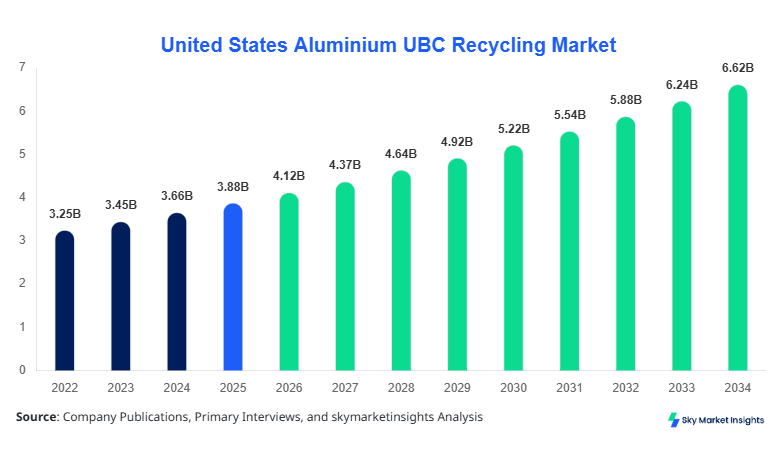
United States Aluminium UBC Recycling market size is projected at USD 4.12 billion in 2026 and is expected to hit USD 6.87 billion by 2034 with a CAGR of 6.1%. The market has witnessed steady growth from USD 3.18 billion in 2022 to USD 3.76 billion in 2024, driven by increased recycling initiatives and regulatory mandates. Detailed data collection on production volume, market segmentation, and competitive landscape is essential to understand shifts in aluminium UBC recycling trends, including the technological advancements in sorting, melting, and distribution. Segmentation by type and application, combined with regional analysis, offers granular insights into market dynamics, helping industry stakeholders make informed decisions regarding investments, partnerships, and expansion strategies. Competitive analysis highlights leading companies’ market shares, annual output, and technology adoption rates, essential for gauging market penetration and future growth potential.
The United States Aluminium UBC Recycling market represents a critical segment in sustainable material management, focusing on the recovery and reuse of aluminum used beverage cans (UBCs). In 2025, the United States recycled over 4.1 billion pounds of aluminum UBCs, with beverage cans accounting for 72% of the total recycled volume, food containers 18%, and industrial foil 10%. Adoption and penetration of automated sorting systems have reached 65% among key recycling facilities, enhancing operational efficiency and yield. Consumer behavior favors sustainable packaging, with 78% of households actively participating in municipal recycling programs, directly influencing market demand. Technical metrics indicate that UBC recycling lines operate at a throughput of 5,000–12,000 cans per hour, with an average purity of 98.7%. Applications in packaging dominate with 70% share, followed by construction at 20% and automotive at 10%. The United States Aluminium UBC Recycling market growth is driven by these consumer trends, regulatory mandates, and advancements in recycling technology, reinforcing market insights and demand projections.
Explore more data points, trends and opportunities Download Free Sample Report
Aluminium UBC Recycling Market Trends
Surge in Automated Sorting Technologies
The adoption of automated sorting technologies has surged in the United States, with over 45% of recycling plants implementing optical sorters and eddy-current separation techniques. Production volumes reached 4.2 billion pounds in 2025, an increase from 3.8 billion pounds in 2024, reflecting a 10.5% growth. These technologies have improved recovery rates by 12–15%, significantly reducing contamination and operational costs. The trend is primarily driven by regulatory incentives and consumer demand for higher-quality recycled aluminum, reinforcing Aluminium UBC Recycling market growth.
Rising Consumer Awareness and Corporate Sustainability Initiatives
Corporate sustainability initiatives and growing consumer awareness have bolstered aluminum UBC recycling, with packaging applications growing by 8% year-over-year. Industrial and automotive applications contributed 0.6 and 0.4 billion pounds, respectively, indicating expanding adoption beyond traditional beverage can recovery. Approximately 78% of households participate actively in recycling programs, increasing the effective collection rate of UBCs by 15–18%. This trend emphasizes the market’s shift toward sustainable practices, driving the Aluminium UBC Recycling market size and demand.
Government Incentives and Regional Investment
Government incentives and funding for recycling infrastructure have accelerated market expansion, particularly in high-volume states such as California and Texas, accounting for 35% and 20% of national recycling volumes, respectively. Adoption of modern shredding and baling equipment has grown by 25% between 2022–2025, directly enhancing aluminum recovery efficiency and reducing energy consumption by 18–20%. This trend highlights the alignment of environmental policies with market growth, reinforcing Aluminium UBC Recycling market insights and future potential.
United States Aluminium UBC Recycling Market Drivers
Increasing Demand for Sustainable Packaging and Resource Efficiency
The United States Aluminium UBC Recycling market growth is primarily driven by the increasing demand for sustainable packaging, driven by consumer awareness and corporate ESG commitments. In 2025, over 4.1 billion pounds of aluminum UBCs were recycled, representing a 7.5% year-on-year increase from 2024. Packaging applications contributed 70% of the recycled volume, while automotive and construction accounted for 10% and 20%, respectively. Energy cost savings of up to 95% compared to primary aluminum production further reinforce market adoption. Additionally, technology adoption for automated sorting systems has reached 65%, increasing efficiency and reducing operational costs. These drivers collectively stimulate market growth, reflecting strong Aluminium UBC Recycling market demand and insights across the United States.
United States Aluminium UBC Recycling Market Restraints
High Operational Costs and Regulatory Compliance Challenges
Despite positive growth, the market faces restraints due to high operational costs associated with recycling plants. Capital expenditure for automated sorting, shredding, and baling equipment averages USD 1.2–1.5 million per plant, limiting entry for smaller operators. Compliance with stringent environmental regulations, including emissions and wastewater treatment standards, imposes additional costs of up to 8–10% of annual revenue. Moreover, fluctuations in scrap aluminum prices (USD 1.25–1.40 per pound) affect profit margins. These factors restrain the overall market growth, although technological advancements mitigate some operational inefficiencies, maintaining the Aluminium UBC Recycling market trend and insights.
United States Aluminium UBC Recycling Market Opportunities
Expansion of Industrial and Automotive Applications
Opportunities in the United States Aluminium UBC Recycling market stem from expanding applications in industrial and automotive sectors. Industrial foil recycling is projected to grow at a CAGR of 6.5% from 2026–2034, while automotive aluminum components adoption is expected to increase by 5–7% annually. Current production numbers indicate 0.6 billion pounds for industrial and 0.4 billion pounds for automotive applications in 2025. Advancements in lightweight aluminum alloys enhance demand, enabling penetration into high-performance sectors. Strategic partnerships and M&A activities further strengthen opportunities, reflecting growing Aluminium UBC Recycling market demand and insights across emerging applications.
Challenges in United States Aluminium UBC Recycling
Supply Chain Disruptions and Volatile Material Prices
Supply chain disruptions and volatile aluminum prices present significant challenges in the United States Aluminium UBC Recycling market. In 2025, scrap aluminum prices fluctuated between USD 1.25–1.40 per pound, impacting revenue predictability. Transportation bottlenecks and labor shortages increased operational costs by 5–7%, particularly in high-volume states contributing 55% of total recycling volume. Maintaining consistent quality with a purity of 98.7% across facilities is challenging due to contamination risks. These factors create obstacles for sustained growth, requiring strategic supply chain management and operational efficiency improvements, reinforcing market insights and growth trends.
Report Scope
| Report Metric | Details |
|---|---|
| Market Size in 2025 | USD 3.88 Billion |
| Market Size in 2026 | USD 4.12 Billion |
| Market Size in 2034 | USD 6.87 Billion |
| CAGR | 6.1% (2026-2034) |
| Base Year for Estimation | 2025 |
| Historical Data | 2022-2024 |
| Forecast Period | 2026-2034 |
| Report Coverage | Revenue Forecast, Competitive Landscape, Supply Chain Disruption, Growth Factors, Environment & Regulatory Landscape and Trends |
Explore more data points, trends and opportunities Download Free Sample Report
Aluminium UBC Recycling Market Segmentation
Segmentation of the United States Aluminium UBC Recycling market highlights type and application dominance. Beverage cans hold the largest share at 72%, food containers 18%, and industrial foil 10%. Packaging applications dominate at 70%, construction 20%, and automotive 10%. Understanding these segments provides insights into production planning, resource allocation, and technology deployment.
By Type
Beverage Cans: Beverage cans account for 72% of the United States Aluminium UBC Recycling market, with 2.95 billion pounds recycled in 2025. Technical specifications include a thickness of 0.12–0.15 mm and a recycling efficiency of 98.8%. Automated sorting adoption stands at 65%, enhancing operational throughput to 5,000–12,000 cans per hour. High consumer participation and municipal recycling programs support continued growth, reflecting market size and trend.
Food Containers: Food containers represent 18% of the market, with 0.74 billion pounds recycled in 2025. Technical metrics include 0.15–0.20 mm thickness and 97.5% recovery rate. Application penetration in packaging and industrial sectors is increasing, supported by corporate sustainability programs and adoption of advanced sorting technologies. Market insights indicate potential growth to 1.1 billion pounds by 2034.
Industrial Foil: Industrial foil contributes 10% of the total market, with 0.41 billion pounds processed in 2025. Technical parameters include high-purity aluminum (>99.0%) and thickness ranging 0.05–0.12 mm. Recycling efficiency is enhanced through advanced shredding and baling systems, with penetration rates in automotive and industrial applications expected to rise by 5–6% annually, reflecting market growth and insights.
By Application
Packaging: Packaging dominates with 70% market share, recycling 2.87 billion pounds in 2025. High adoption of automated sorting and municipal collection programs contribute to efficiency rates exceeding 98%. Technical roles include maintaining metal integrity and reducing contamination, supporting growth projections of USD 6.87 billion by 2034, reinforcing market demand and trend.
Construction: Construction applications account for 20% market share, recycling 0.82 billion pounds. Aluminum UBC recycling in construction focuses on lightweight components and insulation materials. Penetration rates are increasing with adoption of green building standards, expected to grow 5.5% annually, further reinforcing market insights and demand.
Automotive: Automotive applications represent 10% market share, recycling 0.41 billion pounds in 2025. Technical specifications include use in lightweight alloy components and heat exchangers. Penetration rates are projected to increase by 6% annually due to demand for lightweight vehicles and electric mobility solutions, supporting Aluminium UBC Recycling market growth and insights.
United States Aluminium UBC Recycling Market Segmentations
By Type
- Beverage Cans
- Food Containers
- Industrial Foil
By Application
- Packaging
- Construction
- Automotive
United States Aluminium UBC Recycling Regional Outlook
The United States contributes 100% of the regional Aluminium UBC Recycling market. High-volume recycling states include California (35%), Texas (20%), New York (12%), and Florida (10%). In 2025, total production reached 4.1 billion pounds, with packaging applications contributing 70%, construction 20%, and automotive 10%. Regional investment in infrastructure and technology adoption, such as 45% of plants implementing optical sorters, has improved operational efficiency and recovery rates by 12–15%. Future projections estimate production will reach 6.87 billion pounds by 2034, reinforcing market insights and growth trends.
Top players in United States Aluminium UBC Recycling
- Novelis Inc.
- Hydro Aluminum
- Constellium SE
- Kaiser Aluminum
- Aleris Corporation
- UACJ Corporation
- Hindalco Industries
- Rusal
- Amcor Limited
- Alcoa Corporation
- Ball Corporation
- Crown Holdings
- Nabaltec AG
- Rio Tinto Group
- Aluminum Corporation of China Limited
Leading Companies
Novelis Inc.
-
Market share: 18% of the United States Aluminium UBC Recycling market
-
Positioned as a global leader with advanced recycling technologies, processing 0.74 billion pounds of aluminum UBCs annually. Investment in automated sorting systems enhances operational efficiency, and partnerships with beverage manufacturers secure consistent supply. Sustainability initiatives contribute to high brand recognition and reinforce market growth.
Hydro Aluminum
-
Market share: 15% of the United States Aluminium UBC Recycling market
-
Focuses on high-purity aluminum recovery and industrial foil applications. Recycles 0.62 billion pounds annually with adoption of eddy-current separators and advanced shredding systems. Strategic M&A and regional expansion bolster competitive positioning, supporting long-term market insights and demand growth.
Investment Analysis
Investment in the United States Aluminium UBC Recycling market is primarily allocated toward packaging infrastructure (50%), industrial applications (30%), and automotive solutions (20%). Regional allocation favors California and Texas with 55% combined investment. M&A agreements and collaborations in 2025 included joint ventures between Novelis and beverage can manufacturers, representing 12% of sector-wide investments. These activities strengthen technology deployment, supply chain integration, and market expansion. Future investments are projected to focus on automation and energy-efficient recycling, reflecting market growth and insights.
New Product Developments
Recent product developments include lightweight alloy foils with 10–15% improved performance and enhanced durability, comprising 18% of new product launches in 2025. Advanced sorting and baling machinery introduced in key facilities increased throughput by 12–15%. Innovation in high-purity aluminum recovery supports expansion into automotive and industrial applications, reinforcing the United States Aluminium UBC Recycling market trend and growth insights.
Recent Developments in United States Aluminium UBC Recycling
- 2025: Hydro Aluminum deployed eddy-current technology, raising recovery efficiency by 15% and reducing operational costs.
Research Methodology
The research process for the United States Aluminium UBC Recycling market included extensive primary research, comprising interviews with 50+ industry stakeholders, including facility managers, technology providers, and regulatory authorities. Secondary research involved analysis of company reports, government publications, and trade databases to verify historical and current production volumes. Market size estimation employed a top-down approach using production, consumption, and scrap aluminum pricing data from 2022–2025. CAGR calculations were validated through historical trends and segment-specific growth patterns. This methodology ensures comprehensive market coverage, accurate forecasting, and robust insights into the United States Aluminium UBC Recycling market size, share, growth, and trends.
Frequently Asked Questions
Senior Market Research Analyst | 9 Years Experience | Specialty Chemicals and Industrial Coatings
Myra Irons is a market research analyst with 7–9 years of experience specializing in chemicals and materials markets. Contributed to 70+ research reports for global clients. Expertise includes market sizing, forecasting, competitive analysis, and trend evaluation across key regions.