Europe Aluminium Alloy Wheel Market Size
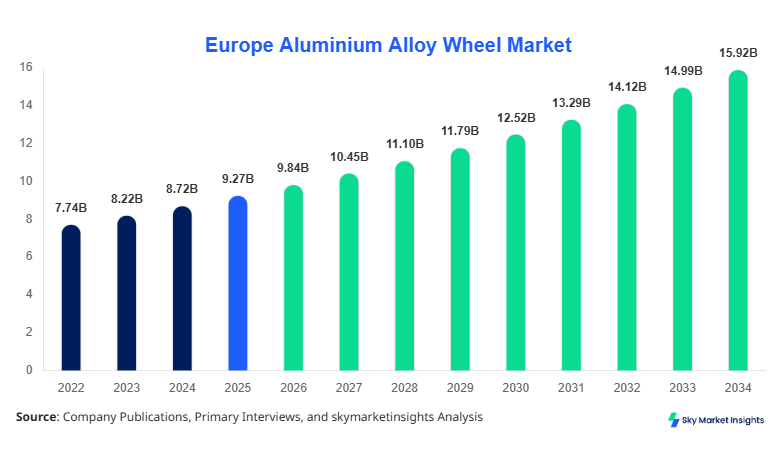
Europe Aluminium Alloy Wheel market size is projected at USD 9.84 billion in 2026 and is expected to hit USD 15.92 billion by 2034 with a CAGR of 6.2%.
The increasing penetration of lightweight automotive components, rapid electrification of passenger vehicles, and higher replacement demand across the aftermarket sector are supporting expansion across the Europe Aluminium Alloy Wheel industry. Growing OEM investments in advanced wheel manufacturing facilities, along with the integration of low-pressure die casting and flow-forming technologies, are improving production efficiency by nearly 18% across European facilities. The report provides detailed analysis of market segmentation, production trends, supply chain mapping, pricing structure, and competitive positioning across major regional economies.
The aluminium alloy wheel market refers to the manufacturing and distribution of lightweight wheels produced using aluminium-based alloys for passenger vehicles, commercial fleets, and high-performance automotive applications. Europe produced more than 18.6 million passenger vehicles and commercial vehicles in 2025, of which approximately 67% utilized aluminium alloy wheel systems either as standard or premium-fitment components. The automotive sector in Europe consumed nearly 5.4 million metric tons of aluminium products during 2025, while wheel manufacturing contributed approximately 11.8% of total automotive aluminium consumption. Adoption penetration across premium passenger vehicles exceeded 91% in Germany, 84% in the United Kingdom, and 79% in France due to increasing consumer preference for lightweight and aesthetically advanced wheel systems.
Consumer behavior indicates strong preference toward enhanced vehicle styling, fuel efficiency, and durability. Surveys conducted across European automotive consumers during 2025 showed that nearly 58% of buyers preferred alloy wheel-equipped vehicles over steel-wheel variants, while 42% identified wheel aesthetics as a major purchasing factor. Replacement demand across aftermarket channels increased by 12.4% due to rising SUV ownership and performance vehicle customization. Passenger vehicles accounted for nearly 71% of application demand, commercial vehicles represented 19%, and motorsport and specialty applications contributed approximately 10%. Technical performance metrics indicate aluminium alloy wheels reduce overall vehicle weight by 20%–30% compared to steel wheels while improving heat dissipation by approximately 15%, reinforcing Europe Aluminium Alloy Wheel market expansion.
In the Germany, the Aluminium Alloy Wheel Market accounted for nearly 29% of total European revenue during 2025 due to the strong presence of automotive OEMs, advanced manufacturing facilities, and premium vehicle production clusters. Germany operated more than 48 dedicated alloy wheel manufacturing facilities and over 120 tier-1 automotive component suppliers supplying aluminium wheel systems to BMW, Mercedes-Benz, Audi, Volkswagen, and Porsche. Passenger vehicles contributed nearly 74% of national demand, while commercial vehicle applications represented approximately 17% and motorsport applications accounted for 9%.
Technology adoption in Germany remains among the highest in Europe, with nearly 64% of manufacturers utilizing low-pressure die casting systems and 38% implementing automated robotic finishing lines. Flow-forming wheel adoption increased by 21% in 2025 owing to increasing demand for lightweight EV wheel systems. Germany produced more than 4.2 million alloy wheel units monthly during 2025, while EV-compatible wheel production exceeded 14 million units annually. Nearly 53% of premium electric vehicles manufactured in Germany used forged or flow-formed alloy wheel systems with aerodynamic optimization capabilities, reinforcing Aluminium Alloy Wheel market positioning across Europe.
Explore more data points, trends and opportunities Download Free Sample Report
Aluminium Alloy Wheel Market Trends
Electrification and Lightweight Vehicle Integration
The rapid growth of electric vehicle manufacturing across Europe is accelerating demand for lightweight aluminium alloy wheels. EV manufacturers are increasingly prioritizing low-weight wheel systems to improve battery efficiency and driving range. During 2025, more than 4.8 million electric vehicles were sold across Europe, representing nearly 26% of total passenger vehicle registrations. Approximately 72% of these vehicles were equipped with advanced alloy wheel systems designed specifically for aerodynamic efficiency and reduced rolling resistance. Manufacturers introduced wheel designs capable of reducing aerodynamic drag by nearly 7%, while lightweight forged wheels lowered vehicle weight by up to 14 kilograms per vehicle. Production of EV-specific alloy wheels surpassed 48 million units in Europe during 2025, particularly across Germany, France, and the United Kingdom, strengthening Aluminium Alloy Wheel market adoption.
Advanced manufacturing technologies are also transforming production processes. Automated CNC machining adoption increased by 31%, while robotic polishing and finishing systems expanded across nearly 44% of European wheel facilities. The integration of AI-driven quality inspection systems reduced production defects by approximately 17%. Additionally, recycled aluminium usage exceeded 39% of total wheel manufacturing input material in 2025 as sustainability mandates intensified across Europe. Increasing investments in sustainable wheel manufacturing continue supporting Aluminium Alloy Wheel market expansion.
Growth of Aftermarket Customization and Premium Vehicle Demand
The European automotive aftermarket sector is witnessing increasing consumer spending on customized wheel systems and performance-oriented vehicle accessories. During 2025, aftermarket alloy wheel sales represented nearly 34% of total regional revenue, with SUV owners accounting for approximately 41% of replacement purchases. Larger wheel diameters ranging from 18-inch to 22-inch variants experienced demand growth exceeding 16%, while matte black and dual-tone finishes accounted for over 38% of premium aftermarket sales. Motorsport-inspired wheel designs gained strong traction among younger consumers, especially in Germany, Italy, and Spain.
Premium vehicle manufacturers are increasingly integrating forged aluminium wheels into luxury vehicle platforms due to their superior strength-to-weight ratio. Nearly 61% of premium European vehicles launched during 2025 featured forged or flow-formed alloy wheels as standard offerings. Furthermore, demand for corrosion-resistant coated wheels increased by 19% owing to harsh winter driving conditions across Northern and Eastern Europe. Advanced powder coating systems improved wheel durability by nearly 24%, further accelerating Aluminium Alloy Wheel market adoption across replacement channels and OEM partnerships.
Europe Aluminium Alloy Wheel Drivers
Increasing Electric Vehicle Production and Lightweighting Regulations Accelerating Demand
The transition toward lightweight automotive platforms remains a major growth catalyst across the Europe Aluminium Alloy Wheel industry. European Union emission reduction policies require automakers to lower fleet emissions by nearly 55% before 2030, prompting vehicle manufacturers to reduce component weight aggressively. Aluminium alloy wheels reduce wheel assembly weight by approximately 20%–30% compared to traditional steel wheels, directly improving fuel economy and EV battery performance. Europe manufactured more than 3.9 million battery electric vehicles during 2025, while nearly 74% of EV platforms incorporated lightweight alloy wheel systems. OEM procurement of forged wheel systems increased by 18% due to growing performance and efficiency standards.
Investment in smart wheel manufacturing facilities also accelerated significantly, with over USD 1.8 billion allocated toward alloy wheel expansion projects between 2024 and 2025. Nearly 46% of automotive OEMs across Europe introduced new lightweight wheel configurations for SUV and crossover platforms. Additionally, flow-forming technology adoption improved structural strength by approximately 22% while reducing raw material consumption by 11%. Rising demand from premium automotive brands, increasing replacement cycles, and higher consumer preference for vehicle aesthetics continue supporting Aluminium Alloy Wheel market expansion.
Europe Aluminium Alloy Wheel Restraints
Volatility in Aluminium Prices and High Manufacturing Costs
Fluctuations in aluminium raw material prices continue to create cost pressures for manufacturers operating within the Europe Aluminium Alloy Wheel industry. Aluminium prices increased by approximately 14% between 2024 and 2025 due to energy market instability and supply chain disruptions affecting European smelting operations. Energy-intensive production processes such as forging and heat treatment contributed nearly 28% of total manufacturing costs. Smaller wheel manufacturers experienced operational margin declines ranging between 6% and 9% due to higher electricity tariffs across Germany, Italy, and France.
Import competition from low-cost Asian wheel manufacturers also intensified during 2025, particularly in the aftermarket segment where price sensitivity remains high. Approximately 23% of aftermarket alloy wheel imports entering Europe originated from lower-cost manufacturing hubs outside the region. Furthermore, stringent environmental compliance requirements increased operational expenses by nearly 12% for European wheel producers. Complex recycling mandates and carbon reporting standards require significant capital investment in sustainable production systems. Rising transportation costs, labor shortages, and inconsistent automotive production volumes continue restraining Aluminium Alloy Wheel market penetration across cost-sensitive vehicle categories.
Europe Aluminium Alloy Wheel Opportunities
Expansion of Sustainable Manufacturing and Recycled Aluminium Utilization
Sustainability-focused automotive manufacturing presents substantial opportunities for alloy wheel producers across Europe. Recycled aluminium usage expanded significantly during 2025, accounting for approximately 39% of wheel manufacturing raw materials compared to 28% in 2022. Manufacturers adopting closed-loop aluminium recycling systems reduced carbon emissions by nearly 62% and lowered material procurement costs by approximately 15%. The European automotive industry allocated over USD 2.4 billion toward green manufacturing initiatives involving lightweight components and low-carbon production systems.
Demand for sustainable premium vehicles is increasing rapidly among European consumers, particularly in Germany, France, and the United Kingdom where EV penetration exceeds 24%. Wheel manufacturers introducing low-carbon alloy wheel solutions secured supply agreements with several luxury automotive OEMs during 2025. Additionally, the increasing integration of smart sensors within wheel assemblies creates new revenue opportunities. Tire pressure monitoring integration, temperature-sensitive coatings, and predictive maintenance technologies are expected to support premium wheel pricing growth exceeding 11% annually. Growth in EV infrastructure, increasing automotive exports, and expanding premium SUV demand continue creating opportunities for Aluminium Alloy Wheel market development.
Europe Aluminium Alloy Wheel Challenge
Supply Chain Disruptions and Capacity Utilization Constraints
Supply chain instability remains one of the major operational challenges impacting the Europe Aluminium Alloy Wheel industry. Aluminium imports, semiconductor shortages affecting automotive production, and logistics bottlenecks disrupted wheel manufacturing schedules across multiple countries during 2025. Nearly 37% of wheel manufacturers reported delays in raw material procurement, while transportation costs increased by approximately 18% across European freight networks. Capacity utilization across medium-sized wheel facilities declined to nearly 74% due to inconsistent automotive production volumes.
Another significant challenge involves balancing lightweight performance requirements with structural durability standards. Larger wheel diameters exceeding 20 inches require enhanced tensile strength and impact resistance, increasing production complexity and manufacturing rejection rates by approximately 9%. Skilled labor shortages across CNC machining and forging operations further affected productivity, especially in Italy and Spain. Compliance with stringent European sustainability regulations also requires continuous investment in energy-efficient equipment and emission reduction systems. The rising adoption of advanced flow-forming and forging technologies necessitates high capital expenditure, limiting participation among smaller manufacturers. These operational pressures continue influencing Aluminium Alloy Wheel market competitiveness across Europe.
Report Scope
| Report Metric | Details |
|---|---|
| Market Size in 2025 | USD 9.27 Billion |
| Market Size in 2026 | USD 9.84 Billion |
| Market Size in 2034 | USD 15.92 Billion |
| CAGR | 6.2% (2026-2034) |
| Base Year for Estimation | 2025 |
| Historical Data | 2022-2024 |
| Forecast Period | 2026-2034 |
| Report Coverage | Revenue Forecast, Competitive Landscape, Supply Chain Disruption, Growth Factors, Environment & Regulatory Landscape and Trends |
Explore more data points, trends and opportunities Download Free Sample Report
Aluminium Alloy Wheel Market Segmentation
The Europe Aluminium Alloy Wheel market is segmented based on type and application. Cast alloy wheels dominated the market with nearly 49% share during 2025 owing to their cost-effectiveness and broad OEM adoption. Passenger vehicles represented the largest application segment with approximately 71% market contribution due to rising SUV and EV demand across Europe.
Cast alloy wheels accounted for approximately 49% of total market revenue during 2025 due to lower manufacturing costs and widespread usage across passenger vehicles. More than 86 million cast alloy wheel units were produced across Europe during the year, primarily using low-pressure die casting and gravity casting methods. These wheels offer weight reductions of nearly 20% compared to conventional steel wheels while maintaining acceptable durability for standard passenger vehicles. Germany, France, and Spain collectively contributed over 61% of cast wheel production capacity. OEM demand remained particularly strong for 16-inch and 17-inch cast wheels integrated into compact and mid-sized vehicles. Improved powder coating technologies enhanced corrosion resistance by approximately 18%, supporting replacement demand within colder European regions.
Forged alloy wheels represented nearly 29% of market revenue during 2025 and are primarily utilized in premium vehicles, luxury sedans, and performance sports cars. Forged wheels provide tensile strength improvements exceeding 30% compared to cast wheels while reducing wheel mass by approximately 15%. Europe produced nearly 24 million forged wheel units in 2025, with Germany and Italy accounting for significant production shares due to strong premium automotive manufacturing ecosystems. Demand from electric sports vehicles and high-performance SUVs increased by approximately 19% year-over-year. Advanced forging technologies utilizing 8,000-ton hydraulic presses improved manufacturing precision while lowering structural defects by nearly 11%.
Flow formed alloy wheels contributed approximately 22% of total revenue and experienced rapid adoption due to their balance between cost efficiency and lightweight performance. Production volumes exceeded 18 million units during 2025, particularly across EV and crossover vehicle segments. Flow-forming technology improves wheel barrel strength by nearly 25% while reducing raw material usage by approximately 12%. Manufacturers increasingly utilize hybrid casting and flow-forming systems to meet demand for larger aerodynamic wheel designs ranging between 19-inch and 22-inch configurations. The growing focus on fuel efficiency and EV battery optimization continues driving adoption across the Aluminium Alloy Wheel market.
Passenger vehicles accounted for approximately 71% of Europe Aluminium Alloy Wheel market revenue during 2025 due to rising adoption of lightweight components across sedans, hatchbacks, SUVs, and electric vehicles. More than 128 million alloy wheel units were installed across passenger vehicles during the year. SUV platforms represented approximately 42% of passenger vehicle wheel demand due to increasing consumer preference for premium styling and larger wheel diameters. OEM integration rates exceeded 83% across premium vehicle categories, while aftermarket replacement demand grew by nearly 13%. EV-specific wheel systems incorporating aerodynamic enhancements and lightweight structures reduced rolling resistance by approximately 9%, supporting improved battery range and performance efficiency.
Commercial vehicles represented nearly 19% of total demand during 2025, driven by increasing fleet modernization and logistics sector expansion. Alloy wheel adoption across light commercial vehicles increased by approximately 14%, while heavy commercial vehicle penetration remained comparatively lower at nearly 21%. Europe produced more than 17 million alloy wheel units for commercial applications during 2025. Lightweight wheel systems improve fuel efficiency by approximately 4%–6% in delivery fleets and reduce brake heat accumulation during long-distance transport operations. Fleet operators increasingly adopted corrosion-resistant aluminium wheels due to lower maintenance costs and longer operational lifespan compared to steel alternatives.
Motorsport vehicles contributed nearly 10% of total market revenue and continue driving innovation across premium wheel technologies. Europe produced approximately 6 million motorsport and specialty alloy wheel units during 2025. Motorsport wheel systems utilize advanced forging, magnesium-aluminium hybrid materials, and thermal-resistant coatings capable of withstanding temperatures exceeding 450°C. Formula racing, GT racing, and high-performance automotive tuning sectors continue demanding ultra-lightweight forged wheels capable of reducing unsprung vehicle mass by approximately 18%. Increasing consumer interest in performance-inspired aftermarket upgrades continues supporting Aluminium Alloy Wheel market expansion within this specialized segment.
Europe Aluminium Alloy Wheel Market Segmentations
Type
- Cast Alloy Wheels
- Forged Alloy Wheels
- Flow Formed Alloy Wheels
Application
- Passenger Vehicles
- Commercial Vehicles
- Motorsport Vehicles
Europe Aluminium Alloy Wheel Regional Outlook
United Kingdom
The United Kingdom accounted for approximately 16% of regional revenue during 2025 due to strong aftermarket demand and premium vehicle adoption. The country produced nearly 22 million alloy wheel units annually, supported by over 35 wheel manufacturing and finishing facilities. Passenger vehicles represented approximately 69% of national demand, while luxury SUVs and sports cars contributed nearly 18%. EV penetration exceeded 25% of total passenger vehicle registrations, accelerating demand for lightweight aerodynamic wheel systems. Aftermarket wheel customization sales increased by nearly 15% due to rising consumer spending on performance-oriented vehicle accessories.
Germany
Germany remained the largest regional contributor with nearly 29% market share during 2025. The country manufactured more than 50 million alloy wheel units annually, supported by advanced forging and flow-forming facilities. Premium automotive brands generated significant demand for forged wheel systems, while EV production exceeded 1.8 million units during the year. Germany accounted for approximately 34% of Europe’s premium vehicle manufacturing output. Advanced robotic wheel finishing systems were implemented across nearly 58% of domestic manufacturing facilities, improving production efficiency and supporting Aluminium Alloy Wheel market leadership.
France
France represented approximately 14% of Europe Aluminium Alloy Wheel market revenue during 2025. Domestic production exceeded 19 million wheel units, with passenger vehicles accounting for nearly 73% of demand. Government incentives supporting EV adoption increased lightweight wheel integration across electric hatchbacks and crossover vehicles. Recycled aluminium utilization exceeded 42% across French wheel manufacturing facilities, among the highest rates in Europe. Demand for 18-inch and 19-inch wheel configurations increased by approximately 12% due to premium vehicle sales growth.
Spain
Spain accounted for approximately 11% of regional market revenue during 2025 due to expanding automotive exports and cost-efficient manufacturing operations. More than 15 million alloy wheel units were produced domestically, primarily serving passenger vehicle OEMs across Europe. SUV wheel demand increased by approximately 17%, while aftermarket replacement sales expanded by 10%. Spain also emerged as a major hub for cast wheel production, accounting for nearly 19% of Europe’s total cast alloy wheel output.
Italy
Italy contributed nearly 13% of total Europe Aluminium Alloy Wheel market revenue during 2025 and maintained strong positioning within luxury and motorsport wheel manufacturing. Italian facilities produced approximately 14 million premium alloy wheel units annually, with forged wheel systems representing nearly 46% of domestic production. Motorsport and high-performance automotive applications contributed significantly to national demand. Demand for custom wheel finishes and lightweight forged wheels increased by approximately 18% during 2025 due to strong luxury vehicle exports.
Russia
Russia accounted for approximately 9% of regional market revenue during 2025. Domestic production exceeded 11 million alloy wheel units annually, with replacement demand accounting for nearly 39% of national consumption. Passenger vehicles dominated application demand with approximately 68% share. Increasing localization of automotive component manufacturing supported wheel production expansion despite supply chain disruptions. Winter-resistant coated wheel systems experienced demand growth exceeding 14% due to severe climatic conditions across several regions.
Top players in Europe Aluminium Alloy Wheel
- RONAL GROUP
- Borbet GmbH
- Superior Industries Europe
- CITIC Dicastal
- Enkei Corporation
- Maxion Wheels
- BBS Kraftfahrzeugtechnik AG
- CMS Jant ve Makina
- RAYS Engineering
- Alcoa Wheels
- Accuride Corporation
- OZ S.p.A.
- Wanfeng Auto Holding Group
- YHI International
- Topy Industries
RONAL GROUP
-
RONAL GROUP accounted for approximately 13% of Europe Aluminium Alloy Wheel market revenue during 2025.
-
The company operates more than 11 manufacturing facilities across Europe with annual production capacity exceeding 21 million wheel units.
-
Strong partnerships with BMW, Mercedes-Benz, and Audi support its premium OEM positioning.
-
Nearly 44% of the company’s product portfolio consists of low-carbon or recycled aluminium wheel systems.
-
Investments in robotic finishing and automated flow-forming systems improved manufacturing productivity by approximately 16% during 2025.
Borbet GmbH
-
Borbet GmbH held nearly 10% regional market share during 2025.
-
The company produced approximately 17 million alloy wheel units annually across Germany and neighboring European markets.
-
Passenger vehicle applications accounted for nearly 76% of its total sales volume.
-
Borbet expanded EV-compatible wheel production by approximately 22% during 2025 due to growing electric SUV demand.
-
Advanced corrosion-resistant wheel coating technologies improved product durability by nearly 19%, supporting its strong aftermarket positioning within the Aluminium Alloy Wheel market.
Investment Analysis
Investment activity across the Europe Aluminium Alloy Wheel industry accelerated significantly during 2025 as automotive manufacturers increased focus on lightweight and sustainable mobility solutions. More than USD 3.2 billion was allocated toward wheel manufacturing expansion, automation upgrades, and recycled aluminium integration projects. Approximately 41% of total investment targeted advanced forging and flow-forming technologies, while 28% focused on low-carbon manufacturing infrastructure. Germany accounted for nearly 33% of total regional investment, followed by France with 17% and the United Kingdom with approximately 15%.
Mergers, acquisitions, and strategic collaborations also increased across the industry. Multiple European wheel manufacturers entered long-term supply agreements with EV producers to secure lightweight wheel procurement for future electric platforms. Joint ventures involving aluminium recycling facilities and wheel manufacturers expanded by nearly 21% during 2025. Several OEM suppliers invested in smart manufacturing systems capable of reducing production defects by approximately 14%. Additionally, private equity participation in aftermarket wheel distribution networks increased substantially as customization demand expanded across premium vehicle categories. Strategic investment in sustainable manufacturing continues supporting long-term Aluminium Alloy Wheel market competitiveness.
New Product Developments
Manufacturers introduced several advanced wheel technologies during 2025 focused on lightweight performance, sustainability, and aerodynamic efficiency. Nearly 36% of newly launched wheel products utilized hybrid flow-forming and forged manufacturing techniques to reduce wheel weight by approximately 18%. EV-specific wheel designs with aerodynamic blade structures improved driving range efficiency by nearly 6%–8% across electric crossover vehicles.
Smart wheel systems incorporating integrated temperature sensors and advanced tire pressure monitoring technologies also gained traction. Approximately 14% of premium wheel launches during 2025 included embedded digital monitoring capabilities. Corrosion-resistant nano-coating technologies improved wheel lifespan by nearly 22%, while recycled aluminium content in newly launched products exceeded 45% among several European manufacturers. These technological innovations continue strengthening Aluminium Alloy Wheel market competitiveness.
Recent Developments in Europe Aluminium Alloy Wheel
-
2025: RONAL GROUP expanded its German production facility capacity by approximately 12%, increasing annual alloy wheel output by nearly 2.4 million units to support growing EV demand across Europe. The company invested significantly in robotic flow-forming systems and advanced recycled aluminium processing technologies, reducing manufacturing emissions by approximately 18%.
-
2025: Borbet GmbH introduced a new lightweight forged wheel platform specifically designed for electric SUVs and premium crossover vehicles. The newly developed wheel systems reduced unsprung vehicle mass by approximately 16% while improving aerodynamic efficiency by nearly 7%, supporting stronger aftermarket and OEM sales growth.
Research Methodology
The research process for the Europe Aluminium Alloy Wheel market involved comprehensive evaluation of historical automotive production trends, wheel manufacturing capacity analysis, supply chain assessment, and macroeconomic indicators influencing vehicle component demand across Europe. Primary research included interviews with automotive OEM executives, wheel manufacturers, distributors, aftermarket retailers, raw material suppliers, and industry consultants operating across Germany, the United Kingdom, France, Italy, Spain, and Russia. More than 65 primary interviews were conducted to validate pricing structures, production volumes, technological adoption, and investment trends.
Secondary research involved analysis of automotive industry databases, government trade publications, manufacturing reports, investor presentations, company annual filings, and transportation statistics. Market size estimation was conducted using both top-down and bottom-up analytical approaches. Revenue mapping considered wheel production volumes, average selling prices, OEM integration rates, aftermarket penetration, and regional trade flows. Data triangulation techniques were applied to ensure statistical accuracy and forecast reliability between 2026 and 2034. Advanced forecasting models incorporated vehicle electrification rates, aluminium consumption trends, manufacturing expansion projects, and sustainability-driven technological developments influencing future Aluminium Alloy Wheel market performance.
Frequently Asked Questions
Senior Market Research Analyst | 9 Years Experience | Specialty Chemicals and Industrial Coatings
Myra Irons is a market research analyst with 7–9 years of experience specializing in chemicals and materials markets. Contributed to 70+ research reports for global clients. Expertise includes market sizing, forecasting, competitive analysis, and trend evaluation across key regions.