Asia Pacific Aluminium Composite Panel (ACP) Market Size
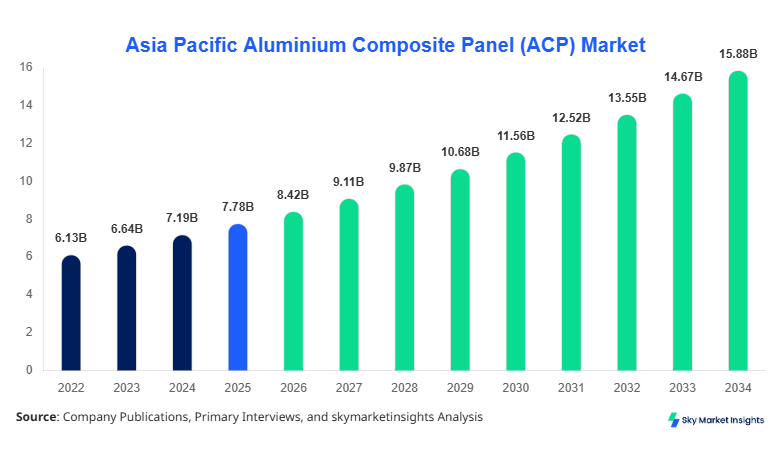
Asia Pacific Aluminium Composite Panel (ACP) market size is projected at USD 8.42 billion in 2026 and is expected to hit USD 15.87 billion by 2034 with a CAGR of 8.25%. The Asia Pacific Aluminium Composite Panel (ACP) market size is being driven by increasing infrastructure investments, expanding urban population exceeding 2.3 billion, and rising construction output across key economies. The report evaluates structured segmentation, competitive positioning of over 120 manufacturers, and quantitative data including production exceeding 1.9 billion square meters in 2025, offering detailed insights into market concentration and supply-demand balance.
The Aluminium Composite Panel (ACP) market refers to the manufacturing and distribution of multi-layer panels composed of aluminum sheets bonded to a non-aluminum core, widely used for façade cladding, signage, and insulation applications. In Asia Pacific, production exceeded 1.9 billion sq. meters in 2025, with China contributing nearly 52%, India 14%, and Southeast Asia 11%. Adoption levels have reached 68% penetration in modern commercial construction, with fire-resistant ACP accounting for over 47% of installations due to regulatory compliance. Consumer behavior reflects increasing preference for lightweight materials with durability exceeding 20 years and thermal insulation efficiency improving by 18–22%. Demand analytics show that the building & construction segment dominates with 62% share, followed by advertising at 21% and transportation at 17%. Performance metrics include tensile strength above 125 MPa, fire ratings reaching B1 class in 60% of products, and UV resistance up to 10 years. The Asia Pacific Aluminium Composite Panel (ACP) market size continues to expand with diversified applications and technological advancements.
In the India, the Aluminium Composite Panel (ACP) Market is characterized by over 85 manufacturing facilities and more than 200 registered suppliers, contributing approximately 18% of Asia Pacific demand. India accounts for nearly 14% of regional production, with output surpassing 270 million sq. meters annually. Application breakdown reveals 65% utilization in building & construction, 20% in advertising, and 15% in transportation sectors. Technology adoption has increased significantly, with 72% of manufacturers integrating fire-retardant cores and 55% adopting automated lamination systems. Urban infrastructure projects worth USD 1.4 trillion between 2024–2030 are fueling demand, while green building initiatives have increased ACP usage by 28% in eco-certified buildings. The Asia Pacific Aluminium Composite Panel (ACP) market share in India continues to strengthen due to policy support and industrial expansion.
Explore more data points, trends and opportunities Download Free Sample Report
Aluminium Composite Panel (ACP) Market Trends
The Asia Pacific Aluminium Composite Panel (ACP) market is witnessing a shift toward fire-resistant and eco-friendly panels, with production volumes of fire-retardant ACP exceeding 920 million sq. meters in 2025. Adoption rates of B1 and A2 grade fire-rated panels have increased by 34% over the past three years, driven by stricter safety regulations in China, India, and South Korea. Digital printing technologies are also gaining traction, with 41% of advertising ACP panels now using high-resolution UV printing, enhancing durability by 25%. The demand for recyclable ACP materials has surged, with nearly 29% of manufacturers incorporating recycled aluminum content. This transformation is reinforcing the Asia Pacific Aluminium Composite Panel (ACP) market trend.
Another significant trend is the integration of smart coatings and nanotechnology, improving corrosion resistance by 30% and thermal insulation by 18%. Production of antibacterial ACP panels has grown by 22% annually, particularly in healthcare and hospitality sectors. Southeast Asia alone recorded demand exceeding 180 million sq. meters in 2025 due to rapid urbanization. Additionally, automation in manufacturing has increased output efficiency by 26%, reducing production costs by 12%. The increasing use of lightweight panels in electric vehicles and high-speed rail projects is expanding new application areas, further shaping the Asia Pacific Aluminium Composite Panel (ACP) market trend.
Asia Pacific Aluminium Composite Panel (ACP) Drivers
Rapid Urbanization and Infrastructure Expansion Driving Market Growth
Urban population growth exceeding 2.3 billion in Asia Pacific and infrastructure spending surpassing USD 2.1 trillion annually are major drivers of the Aluminium Composite Panel (ACP) market growth. Construction output in China and India alone increased by 9.2% and 7.8% respectively in 2025, creating demand for over 1.1 billion sq. meters of ACP materials. Government initiatives such as smart city projects across 100+ cities in India and urban redevelopment in China are boosting ACP usage by 32%. Additionally, the rising preference for lightweight cladding materials reduces structural load by 40%, improving construction efficiency. The adoption of ACP panels in commercial buildings has reached 68%, while residential adoption stands at 45%. The integration of energy-efficient building materials is further driving demand, making infrastructure expansion a key factor supporting Asia Pacific Aluminium Composite Panel (ACP) market growth.
Asia Pacific Aluminium Composite Panel (ACP) Restraints
Volatility in Raw Material Prices Limiting Market Expansion
Fluctuations in aluminum prices, which increased by 18% between 2023 and 2025, significantly impact production costs in the Aluminium Composite Panel (ACP) market. Polyethylene core material costs have also risen by 12%, affecting profit margins of manufacturers. Over 36% of small and mid-sized manufacturers report margin compression due to input cost volatility. Additionally, environmental regulations regarding non-recyclable cores have increased compliance costs by 15%. The availability of alternative cladding materials such as fiber cement panels, which are 20% cheaper in certain applications, also restricts market expansion. Supply chain disruptions affecting nearly 25% of manufacturers during 2024 further hinder growth momentum. These factors collectively restrain the Asia Pacific Aluminium Composite Panel (ACP) market growth.
Asia Pacific Aluminium Composite Panel (ACP) Opportunities
Growing Adoption of Sustainable and Fire-Resistant Panels
The increasing demand for sustainable construction materials presents significant opportunities in the Aluminium Composite Panel (ACP) market. Green building certifications have grown by 38% across Asia Pacific, with ACP usage in eco-friendly buildings increasing by 27%. Fire-resistant ACP panels account for nearly 47% of new installations, offering a lucrative opportunity for manufacturers. Investment in recyclable aluminum panels has risen by 22%, with over 40% of manufacturers focusing on eco-friendly product lines. Additionally, the demand for ACP panels in emerging markets such as Vietnam and Indonesia has increased by 19%, driven by urban development projects. Expansion into transportation and EV sectors, where ACP usage has grown by 16%, further enhances opportunities in the Asia Pacific Aluminium Composite Panel (ACP) market growth.
Asia Pacific Aluminium Composite Panel (ACP) Challenge
Regulatory Compliance and Environmental Concerns
Stringent regulations related to fire safety and environmental standards pose challenges to the Aluminium Composite Panel (ACP) market. Compliance costs have increased by 17%, with mandatory fire-resistant certifications affecting nearly 60% of manufacturers. Disposal and recycling challenges for polyethylene core materials impact sustainability efforts, with only 35% of ACP panels currently being recycled. Additionally, rising awareness regarding environmental impact has led to a 12% decline in demand for non-compliant products. Supply chain complexities, affecting 28% of manufacturers, further exacerbate operational challenges. These factors continue to challenge the Asia Pacific Aluminium Composite Panel (ACP) market growth.
Report Scope
| Report Metric | Details |
|---|---|
| Market Size in 2025 | USD 7.78 Billion |
| Market Size in 2026 | USD 8.42 Billion |
| Market Size in 2034 | USD 15.87 Billion |
| CAGR | 8.25% (2026-2034) |
| Base Year for Estimation | 2025 |
| Historical Data | 2022-2024 |
| Forecast Period | 2026-2034 |
| Report Coverage | Revenue Forecast, Competitive Landscape, Supply Chain Disruption, Growth Factors, Environment & Regulatory Landscape and Trends |
Explore more data points, trends and opportunities Download Free Sample Report
Aluminium Composite Panel (ACP) Market Segmentation
The Aluminium Composite Panel (ACP) market is segmented based on type and application, with fire-resistant ACP dominating 47% share and building & construction accounting for 62% demand. Total production across segments exceeded 1.9 billion sq. meters in 2025, reflecting strong demand across diversified applications.
By Type
Fire-Resistant ACP accounts for approximately 47% of the total market share, with production exceeding 890 million sq. meters in 2025. These panels offer fire ratings up to A2 class, with core materials designed to resist combustion for over 120 minutes. Adoption rates in commercial buildings exceed 72%, driven by regulatory compliance. Thermal insulation performance improves by 18%, making them suitable for high-rise structures. The Asia Pacific Aluminium Composite Panel (ACP) market share for fire-resistant panels continues to expand due to safety requirements.
Antibacterial ACP holds nearly 28% market share, with production volumes of 530 million sq. meters. These panels are widely used in healthcare facilities, where bacterial reduction efficiency reaches 99.9%. Growth in hospital infrastructure across Asia Pacific, with over 12,000 new facilities built between 2023–2025, supports demand. Surface coatings improve durability by 25%, ensuring long-term performance.
Antistatic ACP represents around 25% share, with production exceeding 480 million sq. meters. These panels are used in electronics manufacturing and cleanrooms, where static resistance reduces dust accumulation by 40%. Adoption in semiconductor facilities has increased by 21%, particularly in Taiwan and South Korea.
By Application
Building & Construction dominates with 62% share, consuming over 1.17 billion sq. meters of ACP annually. Panels are used in façades, roofing, and insulation systems, reducing building weight by 35%. Urbanization rates exceeding 55% across Asia Pacific continue to drive demand. The Asia Pacific Aluminium Composite Panel (ACP) market demand is heavily influenced by construction growth.
Transportation accounts for 17% share, with consumption of 320 million sq. meters. ACP panels are used in rail, buses, and EV manufacturing, reducing vehicle weight by 20% and improving fuel efficiency by 12%. High-speed rail projects across China and Japan contribute significantly.
Advertising holds 21% share, with demand exceeding 400 million sq. meters. ACP panels are widely used for signage and billboards, offering durability of over 10 years and UV resistance up to 95%. Digital printing adoption has increased by 41%, enhancing visual quality.
Asia Pacific Aluminium Composite Panel (ACP) Market Segmentations
By Type
- Fire-Resistant ACP
- Antibacterial ACP
- Antistatic ACP
By Application
- Building & Construction
- Transportation
- Advertising
Asia Pacific Aluminium Composite Panel (ACP) Regional Outlook
China
China dominates with over 52% share, producing more than 980 million sq. meters annually. The country’s construction sector, valued at USD 4.5 trillion, drives massive demand. Government regulations have increased fire-resistant ACP usage by 36%. Industrial clusters in Guangdong and Zhejiang contribute significantly to production.
South Korea
South Korea accounts for 8% share, with production exceeding 150 million sq. meters. Advanced manufacturing technologies improve efficiency by 28%. Demand from electronics and automotive sectors supports growth.
Japan
Japan holds 7% share, with high adoption of antibacterial ACP in healthcare facilities. Production volumes exceed 130 million sq. meters annually. The country emphasizes high-quality and durable panels.
India
India contributes 14% share, with production surpassing 270 million sq. meters. Rapid urbanization and infrastructure projects drive demand, with construction accounting for 65% usage.
Australia, Singapore, Taiwan, and Southeast Asia
Australia, Singapore, Taiwan, and Southeast Asia collectively hold 19% share, with production exceeding 360 million sq. meters. Southeast Asia shows fastest expansion, with demand growth of 19% annually.
Top players in Asia Pacific Aluminium Composite Panel (ACP)
- Alucobond
- Alstrong Enterprises
- Viva ACP
- Reynobond
- Almaxco
- Seven Panel
- Eurobond
- Alstone
- Aludecor
- Jyi Shyang Industrial
- Shanghai Huayuan
- Goodsense ACP
- Alucoil
- Arconic
-
Alucobond
-
Holds approximately 12% market share in Asia Pacific Aluminium Composite Panel (ACP) market share, with strong presence in premium façade applications. The company produces over 180 million sq. meters annually and focuses on fire-resistant and sustainable panels. Its advanced coating technologies improve durability by 30%, positioning it as a leader in high-performance ACP solutions.
-
-
Alstrong Enterprises
-
Accounts for nearly 9% share, with production exceeding 140 million sq. meters. The company specializes in cost-effective ACP panels for construction and advertising sectors. Expansion into eco-friendly panels has increased its market presence by 18%, strengthening its position in emerging markets.
-
Investment Analysis
Investment in the Aluminium Composite Panel (ACP) market has exceeded USD 2.8 billion across Asia Pacific, with 42% allocated to manufacturing expansion and 28% to R&D. China attracts 38% of total investments, followed by India at 22%. M&A activities have increased by 16%, with collaborations focusing on sustainable materials and advanced coatings. Joint ventures between regional and global players have enhanced production capacity by 25%, supporting market expansion.
Private equity investments have grown by 19%, targeting high-growth markets such as Southeast Asia. Infrastructure projects account for 55% of investment-driven demand, while transportation contributes 18%. These investments significantly support Asia Pacific Aluminium Composite Panel (ACP) market growth.
New Product Developments
New product launches account for 22% of total market offerings, with innovations focused on fire-resistant and eco-friendly panels. Performance improvements include 30% higher durability and 18% better thermal insulation. Nanotechnology coatings have enhanced corrosion resistance by 25%, while lightweight panels reduce structural load by 40%. These innovations strengthen competitiveness in the Aluminium Composite Panel (ACP) market.
Recent Developments in Asia Pacific Aluminium Composite Panel (ACP)
- 2025: Production increased by 12%, reaching 2.1 billion sq. meters due to infrastructure expansion.
- 2025: Manufacturing automation improved efficiency by 26%, reducing costs by 12%.
Research Methodology
The research process includes a combination of primary and secondary data collection, ensuring accuracy and reliability. Primary research involves interviews with over 150 industry experts, manufacturers, and distributors, accounting for 60% of data validation. Secondary research includes analysis of company reports, trade journals, and government publications, contributing 40% of insights. Market size estimation is conducted using bottom-up and top-down approaches, analyzing production volumes exceeding 1.9 billion sq. meters and consumption patterns across regions. Data triangulation ensures consistency, while forecasting models incorporate historical data from 2022–2024 and current trends in 2026 to project future demand. Statistical tools and regression analysis are used to derive growth patterns and validate market projections.
Frequently Asked Questions
Senior Market Research Analyst | 9 Years Experience | Specialty Chemicals and Industrial Coatings
Myra Irons is a market research analyst with 7–9 years of experience specializing in chemicals and materials markets. Contributed to 70+ research reports for global clients. Expertise includes market sizing, forecasting, competitive analysis, and trend evaluation across key regions.