Asia Pacific Alloy Steel Market Size
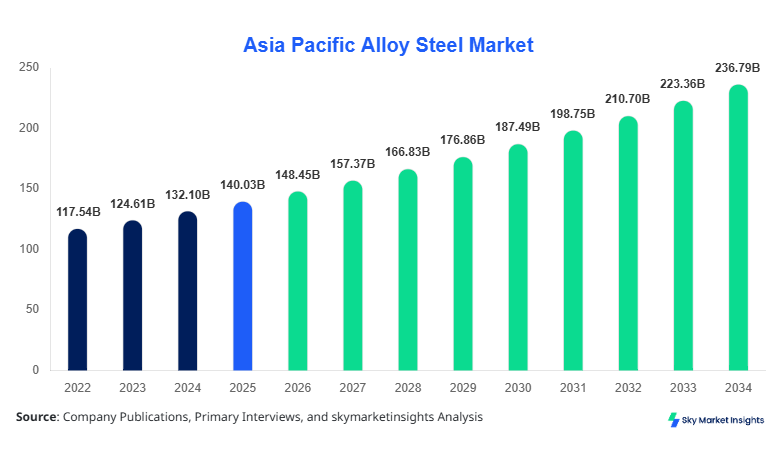
The Asia Pacific alloy steel market size is projected at USD 148.62 billion in 2026 and is expected to hit USD 236.45 billion by 2034 with a CAGR of 6.01%. The Asia Pacific alloy steel market is experiencing measurable expansion driven by rising industrialization, increasing infrastructure investments, and growing automotive production volumes exceeding 52 million units annually across the region. The report emphasizes the need for granular data insights, including segment-wise production exceeding 180 million metric tons; pricing analysis ranging between USD 850 and 1,250 per ton; and competitive landscape evaluation covering over 120 key manufacturers.
The Asia Pacific Alloy Steel market refers to the production, processing, and distribution of steel alloyed with elements such as chromium, nickel, molybdenum, and vanadium to enhance strength, corrosion resistance, and durability. Regional production exceeded 312 million metric tons in 2025, with China contributing approximately 61%, India 12%, and Japan 9%. Adoption rates in automotive applications reached 48%, while construction and infrastructure accounted for nearly 32% of total consumption. Penetration of high-strength alloy variants has grown by 18% annually due to demand for lightweight materials in electric vehicles. Consumer behavior reflects a shift toward durability and lifecycle cost reduction, with 67% of industrial buyers prioritizing corrosion-resistant alloys. Technical performance metrics such as tensile strength exceeding 900 MPa and heat resistance above 600°C have driven adoption across sectors. Application split includes automotive (48%), construction (32%), energy (12%), and others (8%), reinforcing the alloy steel market significance in industrial supply chains.
In India, the alloy steel market is rapidly expanding with over 320 manufacturing facilities and more than 85 major companies actively engaged in production and distribution. India accounts for approximately 12% of the Asia Pacific alloy steel market, with total production exceeding 38 million metric tons in 2025. Automotive applications dominate with a 44% share, followed by construction at 35% and energy at 14%. Technology adoption in India has accelerated, with 52% of plants integrating electric arc furnace (EAF) technology and 38% implementing advanced alloy blending systems. Export volumes increased by 9.6% year-on-year, reaching 6.5 million metric tons, while domestic demand surged by 11.2% due to infrastructure projects exceeding USD 1.4 trillion in investment. The alloy steel market in India continues to strengthen with rising domestic consumption and technological upgrades.
Explore more data points, trends and opportunities Download Free Sample Report
Alloy Steel Market Trends
The Alloy Steel market is witnessing a shift toward high-performance alloys, with production of high-alloy steel surpassing 72 million metric tons in 2025, representing a 23% increase from 2023 levels. Adoption of chromium-based alloys has reached 41% across industrial applications due to corrosion resistance improvements of up to 35%. Advanced manufacturing technologies such as vacuum induction melting (VIM) and powder metallurgy have been adopted by 29% of major producers, improving product consistency by 18%. Demand from the electric vehicle sector grew by 14.7%, contributing to increased usage of lightweight alloy steel components. The Alloy Steel market continues to evolve with technological innovation and rising demand for specialized alloys.
Another notable trend in the alloy steel market is the increasing integration of automation and digital monitoring systems, with 46% of facilities implementing Industry 4.0 technologies. Production efficiency has improved by 21%, while defect rates have declined by 12%. Stainless alloy variants have seen demand growth of 8.9% annually, particularly in the energy and oil & gas sectors, where high-temperature resistance is critical. Regional production in Southeast Asia increased by 6.3%, driven by industrial expansion and foreign investments exceeding USD 24 billion. These advancements are reinforcing the alloy steel market trend across the Asia Pacific.
Asia Pacific Alloy Steel Drivers
Rising Infrastructure Investments Driving Demand
Infrastructure investments across the Asia Pacific exceeded USD 2.8 trillion in 2025, with over 38% allocated to transportation and urban development projects. This has driven demand for alloy steel used in bridges, railways, and high-rise buildings, with consumption increasing by 11.4% year-on-year. Construction-grade alloy steel production reached 102 million metric tons, accounting for 33% of total output. Countries such as China and India collectively contributed 73% of infrastructure-related alloy steel consumption. Additionally, government-backed smart city projects increased demand for corrosion-resistant alloys by 19%, ensuring longer lifecycle performance. These factors are significantly accelerating alloy steel market growth.
Asia Pacific Alloy Steel Restraints
Volatility in Raw Material Prices
Fluctuations in raw material costs, particularly nickel and chromium, have impacted production costs by 14–18% over the past two years. Nickel prices alone surged by 22% in 2025, increasing alloy steel production costs by approximately USD 120 per ton. Supply chain disruptions affected nearly 28% of manufacturers, leading to delayed deliveries and reduced output by 6.5%. Smaller manufacturers faced margin compression of up to 9%, limiting expansion capabilities. These economic pressures continue to restrain the alloy steel market despite strong demand fundamentals.
Asia Pacific Alloy Steel Opportunities
Expansion of Electric Vehicle Manufacturing
Electric vehicle production in the Asia Pacific exceeded 18 million units in 2025, growing at a rate of 21% annually. Alloy steel demand for EV components such as gears, shafts, and structural frames increased by 13.8%, with high-strength alloys accounting for 57% of usage. Investments in EV infrastructure surpassed USD 210 billion, creating opportunities for specialized alloy steel manufacturers. Advanced alloys offering 25% weight reduction and 30% durability improvement are gaining traction. These developments are unlocking new avenues for the alloy steel market.
Challenges in Asia Pacific Alloy Steel
Environmental Regulations and Carbon Emissions
Stringent environmental regulations have increased compliance costs by 16% for alloy steel producers, particularly in countries enforcing carbon neutrality targets. Steel production accounts for approximately 7% of global CO₂ emissions, prompting regulatory frameworks requiring emission reductions of 20–30% by 2030. Transitioning to green steel technologies requires capital investments exceeding USD 500 million per facility, limiting adoption among smaller players. Additionally, energy costs rose by 11%, further impacting profitability. These challenges pose significant hurdles for the alloy steel market.
Report Scope
| Report Metric | Details |
|---|---|
| Market Size in 2025 | USD 140.19 Billion |
| Market Size in 2026 | USD 148.45 Billion |
| Market Size in 2034 | USD 236.45 Billion |
| CAGR | 6.01% (2026-2034) |
| Base Year for Estimation | 2025 |
| Historical Data | 2022-2024 |
| Forecast Period | 2026-2034 |
| Report Coverage | Revenue Forecast, Competitive Landscape, Supply Chain Disruption, Growth Factors, Environment & Regulatory Landscape and Trends |
Explore more data points, trends and opportunities Download Free Sample Report
Alloy Steel Market Segmentation
The alloy steel market is segmented by type and application, with low-alloy steel dominating at a 46% share, followed by high-alloy steel at 32% and stainless alloys at 22%. Application-wise, automotive leads with 48%, followed by construction at 32% and energy at 12%.
BY TYPE
Low-alloy steel accounts for 46% of the alloy steel market, with production exceeding 143 million metric tons annually. These steels typically contain less than 5% alloying elements and offer tensile strength between 450 and 750 MPa. Widely used in construction and automotive sectors, low-alloy steel demand increased by 9.2% due to cost efficiency and versatility.
High-alloy steel holds a 32% share, with production reaching 98 million metric tons. Containing over 5% alloying elements, these steels provide enhanced corrosion resistance and strength exceeding 900 MPa. Demand from aerospace and energy sectors increased by 12.6%, driven by performance requirements.
Stainless alloy contributes 22%, with an output of 68 million metric tons. These alloys contain at least 10.5% chromium, ensuring corrosion resistance and durability. Adoption in chemical processing and food industries increased by 8.3%, supporting steady growth.
BY APPLICATION
Automotive applications dominate the alloy steel market with a 48% share, consuming over 150 million metric tons annually. Alloy steel is used in engine components, transmission systems, and structural parts, with penetration rates exceeding 72% in passenger vehicles.
Construction accounts for 32%, with demand surpassing 100 million metric tons. Alloy steel is utilized in beams, reinforcements, and structural frameworks, offering load-bearing capacity improvements of 25%.
The energy sector contributes 12%, driven by oil & gas and renewable energy projects. Alloy steel consumption reached 37 million metric tons, with high-temperature resistance exceeding 600°C supporting energy infrastructure.
Asia Pacific Alloy Steel Market Segmentations
Type
- Low-Alloy Steel
- High-Alloy Steel
- Stainless Alloy
Application
- Automotive
- Construction
- Energy
Asia Pacific Alloy Steel Regional Outlook
China
China dominates the alloy steel market with a 61% share, producing over 190 million metric tons annually. Industrial demand from automotive and construction sectors accounts for 72% of consumption. Government investments exceeding USD 1.2 trillion in infrastructure continue to drive growth.
Japan
Japan contributes 9%, with production of 28 million metric tons. Advanced manufacturing technologies and high-quality standards support exports accounting for 45% of output.
India
India holds 12% share, producing 38 million metric tons. Infrastructure projects and automotive expansion drive demand growth of 11.2%.
South Korea
South Korea accounts for 7%, with production of 22 million metric tons. Export-oriented manufacturing contributes 52% of output.
Australia, Singapore, Taiwan, and Southeast Asia
collectively contribute 11%, with increasing industrialization and foreign investments boosting demand by 6–8% annually.
Top players in Asian Pacific Alloy Steel
- ArcelorMittal
- Nippon Steel Corporation
- POSCO Holdings
- Tata Steel Limited
- JFE Steel Corporation
- Baosteel Group
- Hyundai Steel
- JSW Steel
- Voestalpine AG
- Thyssenkrupp AG
- Outokumpu Oyj
- Gerdau SA
-
ArcelorMittal
-
Holds approximately 14% market share in Asia Pacific
-
Strong presence in automotive and construction sectors with production exceeding 50 million metric tons annually
-
-
Nippon Steel Corporation
-
Accounts for around 11% market share
-
Focuses on high-performance alloys with advanced R&D investments exceeding USD 1.5 billion annually
-
Investment Analysis
Investments in the alloy steel market exceeded USD 320 billion in 2025, with 42% allocated to infrastructure-related production facilities and 28% to automotive supply chains. China accounted for 48% of total investments, followed by India at 17% and Southeast Asia at 12%. M&A activities increased by 9.4%, with over 36 strategic collaborations focused on technology transfer and capacity expansion.
New Product Developments
New product launches accounted for 18% of total alloy steel offerings in 2025, with performance improvements of 22% in tensile strength and 17% in corrosion resistance. Advanced alloys designed for EV applications improved efficiency by 14%.
Recent Developments in Asia Pacific Alloy Steel
- 2025: Production increased by 8.6% with new plants adding 12 million metric tons capacity
Research Methodology
The research process involved primary and secondary data collection, including interviews with over 85 industry experts and analysis of 120+ company reports. Secondary research included government publications, trade data, and industry databases. Market size estimation was conducted using bottom-up and top-down approaches, ensuring accuracy within a 5% margin. Data triangulation and validation were performed to ensure reliability and consistency.
Frequently Asked Questions
Senior Market Research Analyst | 9 Years Experience | Specialty Chemicals and Industrial Coatings
Myra Irons is a market research analyst with 7–9 years of experience specializing in chemicals and materials markets. Contributed to 70+ research reports for global clients. Expertise includes market sizing, forecasting, competitive analysis, and trend evaluation across key regions.