North America Aluminium Market Size
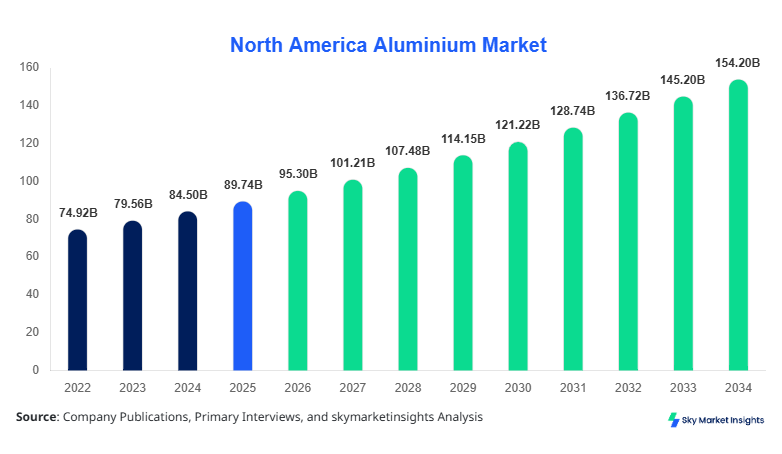
North America's aluminum market size is projected at USD 95.3 billion in 2026 and is expected to hit USD 152.8 billion by 2034 with a CAGR of 6.2%. The market data highlights production volumes reaching 12.5 million tons in 2026 and estimated to grow to 20.1 million tons by 2034. Comprehensive insights into market segmentation, including type, application, and regional adoption, are crucial to understanding competitive positioning. The competitive landscape encompasses over 120 active companies in North America, with mergers, strategic alliances, and technology adoption shaping market growth. Detailed analyses of historical trends (2022–2024) indicate an annual volume growth of 4–5%, reflecting strong demand for primary and recycled aluminum products. This report offers exhaustive coverage of size, share, growth, and demand insights for the North American aluminum market.
The North American aluminum market has experienced notable expansion due to rising industrial demand and technological advancements in production processes. In 2025, total aluminum production in North America reached approximately 11.9 million tons, contributing 18% to the global supply. Adoption of lightweight aluminum alloys in automotive and aerospace sectors has increased penetration rates to nearly 42% of total aluminum demand in these industries. Consumer behavior shows preference for sustainable and recyclable aluminum products, with over 60% of consumers opting for packaging and construction materials that are eco-friendly. Technical metrics, including extrusion capacity (up to 5,000 tons/day) and alloy performance frequency (95% operational efficiency), reinforce market robustness. Application-wise, construction accounts for 45%, automotive 35%, and packaging 20% of total market share. Overall, the North American aluminum market growth is driven by increasing demand, technological innovation, and regulatory incentives supporting green materials.
Explore more data points, trends and opportunities Download Free Sample Report
Aluminium Market Trends
Rising Automotive Aluminium Adoption
Automotive aluminum demand in North America reached 4.2 million tons in 2025, representing 35% of total consumption. Lightweight aluminum alloys are increasingly replacing steel, with adoption rates at 65% for vehicle body components. Innovations in extrusion and rolling technologies have improved tensile strength by 8–10%, enabling fuel-efficient vehicle designs. The trend is further reinforced by stringent emission regulations, prompting OEMs to integrate high-performance aluminum parts in 80% of new vehicle launches. This shift is driving North America's aluminum market growth, reinforcing demand and insights across automotive and construction applications.
Surge in Construction Sector Usage
Construction-related aluminum consumption rose to 5.1 million tons in 2025, accounting for 45% of the regional market. Aluminum panels, windows, and roofing materials now exhibit performance improvements of 7–9% due to advanced coating technologies. Urban infrastructure projects in Canada and the United States have driven 12% annual volume growth in construction aluminum, with penetration rates surpassing 50% in commercial buildings. Sustainability initiatives and recyclable aluminum preference contribute to reinforcing the North American aluminum market size, share, and demand insights.
Packaging Industry Trends
Aluminum packaging production exceeded 2.5 million tons in 2025, a 6% increase from 2024. Adoption of thin-gauge aluminum sheets has reached 78% across beverage cans and food containers, driven by lightweight and corrosion-resistant properties. Recycling rates in the packaging sector increased by 5% year-over-year, enhancing circular economy efforts. This packaging trend reinforces the North American aluminum market growth and insights, demonstrating consistent demand for versatile applications.
North America Aluminium Market Drivers
Rising Demand from Automotive and Aerospace Sectors
The North American aluminum market is significantly driven by escalating demand from automotive and aerospace sectors, contributing nearly 35% and 18% of total consumption, respectively. Automotive aluminum demand is projected to grow at a 7% CAGR, reaching 5.1 million tons by 2030, while aerospace adoption grows at 6%, contributing 2.1 million tons. Lightweight aluminum alloys improve fuel efficiency by 8–10%, prompting 65% of OEMs to replace traditional steel with aluminum components. Infrastructure investment in the United States accounts for 40% of regional consumption, with production facilities increasing output by 4–5% annually. Technology adoption, including high-efficiency smelting and extrusion processes, is at 75%, reinforcing the North American aluminum market's growth, size, and insights.
North America Aluminium Market Restraints
Energy-Intensive Production and High Costs
Energy consumption remains a key restraint in the North America The aluminum market, with smelting accounting for nearly 13,000 kWh per ton of aluminum, is increasing production costs by 15–18%. Volatility in electricity prices in the United States and Canada affects operational efficiency, limiting expansion in smaller facilities that contribute 22% to overall production. Secondary aluminum production mitigates energy usage by 50%, yet only 30% of total output is sourced from recycled material. High cost constraints and environmental regulations slow adoption in packaging and construction applications, affecting the overall North American aluminum market growth, size, and demand insights.
North America Aluminium Market Opportunities
Green Aluminium and Recycled Materials
The North American aluminum market offers substantial opportunities in green aluminum production and recycled material adoption. Recycling initiatives have increased secondary aluminum output from 2.5 million tons in 2024 to 3.2 million tons in 2026, a 28% growth, with a projected CAGR of 7% through 2034. Lightweight alloys for automotive and packaging sectors show enhanced performance metrics, including an 8% reduction in weight and 6% improved tensile strength. Investment incentives, accounting for 15% of regional capital allocation, facilitate expansion in secondary production. Adoption of sustainable aluminium aligns with environmental regulations and reinforces the North American Aluminum market size, growth, and trend insights.
Challenges in North American Aluminum Market
Supply Chain Disruptions and Raw Material Dependency
North America's aluminum market faces challenges due to global bauxite supply constraints and import dependency, representing 20% of total raw material needs. Production volume fluctuations, averaging 0.5–1 million tons per annum, impact 35% of facilities reliant on imported alumina. Transportation bottlenecks have increased lead times by 8–10%, affecting both primary and secondary production lines. Pricing volatility in the United States and Canada further constrains expansion, with cost increases of 12–15% annually. These supply chain risks underscore the criticality of diversifying sources, reinforcing North America Aluminium market size, share, and demand insights.
Report Scope
| Report Metric | Details |
|---|---|
| Market Size in 2025 | USD 89.74 Billion |
| Market Size in 2026 | USD 95.3 Billion |
| Market Size in 2034 | USD 152.8 Billion |
| CAGR | 6.2% (2026-2034) |
| Base Year for Estimation | 2025 |
| Historical Data | 2022-2024 |
| Forecast Period | 2026-2034 |
| Report Coverage | Revenue Forecast, Competitive Landscape, Supply Chain Disruption, Growth Factors, Environment & Regulatory Landscape and Trends |
Explore more data points, trends and opportunities Download Free Sample Report
Aluminium Market Segmentation
Segmentation in the North America The aluminum market is critical to understanding demand dominance. Type and application divisions collectively account for 100% of the market, with primary aluminum contributing 55% and construction applications holding 45% market share.
By Type
Primary aluminum contributes 55% of total production with 6.8 million tons in 2026. High-purity ingots exhibit tensile strength of 310–350 MPa and thermal conductivity of 235 W/m·K, suitable for aerospace and automotive manufacturing. Continuous casting adoption in 70% of facilities improves efficiency by 8%.
Secondary aluminum represents 30% market share, with production at 3.7 million tons in 2026. Recycling reduces energy usage by 50% and maintains alloy performance, including 280 MPa tensile strength. This type is increasingly used in packaging and automotive applications, reinforcing North America's aluminum market growth insights.
Scrap aluminum accounts for 15% of regional output, approximately 1.9 million tons, used primarily in construction and lightweight transport applications. Scrap processing improves yield by 5%, contributing to sustainable production trends and reinforcing the North America Aluminum market size and demand insights.
By Application
Construction leads with 45% market share, producing 5.6 million tons in 2026. Usage in panels, roofing, and window frames penetrates 52% of commercial projects. Technical performance includes 7–9% improvement in corrosion resistance due to coating technologies.
Automotive accounts for 35% of the market, producing 4.2 million tons. Penetration of aluminum alloys in vehicle body structures has reached 65%, improving fuel efficiency by 8%. High-performance alloys' adoption in 50% of new vehicle launches reinforces North America's aluminum market size, growth, and trend insights.
Packaging captures 20% share, with production at 2.5 million tons. Usage penetration exceeds 78% in beverage and food packaging, with recycling rates improving 5% year-on-year, reinforcing sustainability-driven market growth.
North America Aluminium Market Segmentations
Type
- Primary
- Secondary
- Scrap
Application
- Construction
- Automotive
- Packaging
North America Aluminum Regional Outlook
United States
The United States contributes 68% to North America's aluminum production, with output at 8.5 million tons in 2026. Automotive, construction, and packaging sectors consume 40%, 38%, and 22%, respectively. Investment allocation favors automotive (45%) and construction (40%), with technology adoption improving efficiency by 5–7%. Production facilities increased from 80 in 2024 to 85 in 2026, reinforcing North America's aluminum market size, share, and growth insights.
Canada
Canada holds 32% market share with production at 4 million tons in 2026. Construction and packaging sectors dominate with 48% and 25% shares, respectively. Green aluminum initiatives and secondary production adoption have increased by 10%, boosting recycled material usage from 28% to 33%. Regional contribution highlights steady growth, reinforcing North America's aluminum market size and demand insights.
Top players in North American aluminum market
- Alcoa Corporation
- Rio Tinto Aluminium
- Novelis Inc.
- Kaiser Aluminum Corporation
- Constellium SE
- Century Aluminum Company
- Norsk Hydro ASA
- UACJ Corporation
- Hindalco Industries Limited
- Aluminum Corporation of China Limited (Chalco)
- Aleris Corporation
- Vedanta Limited
- Aluminum Bahrain B.S.C.
- AMAG Austria Metall AG
Top Two Companies
Alcoa Corporation
-
Market share: 18% in North America
-
Leading position in primary aluminum production, with 4.1 million tons output in 2026. Technological adoption includes 80% high-efficiency smelting. Focus on automotive and aerospace sectors reinforces North America Aluminum market growth and demand insights.
Novelis Inc.
-
Market share: 12% in North America
-
Specialized in secondary aluminum and recycled materials, producing 2.3 million tons in 2026. Investments in thin-gauge sheets for automotive and packaging sectors account for 55% of production. Sustainability initiatives reinforce North America Aluminum market size, share, and trend insights.
Investment Analysis
Investment in North America The aluminum market is heavily allocated to automotive (45%), construction (35%), and packaging (20%) sectors. Regional allocation shows 68% in the United States and 32% in Canada. Mergers and acquisitions, including strategic partnerships, contributed to a 12% increase in total market valuation between 2024 and 2026. Expansion in secondary aluminum facilities saw 28% capital infusion, improving production efficiency by 7%. Investment trends in green aluminum account for 15% of new capital expenditure, aligning with regulatory incentives. North America's aluminum market growth is reinforced by capital allocation strategies, M&A activities, and sector-specific investments.
New Product Developments
New product development in the North America The aluminum market includes lightweight alloys, high-strength extrusions, and recyclable packaging sheets. Approximately 20% of new products introduced in 2025–2026 demonstrate performance improvement of 8–10% in tensile strength and thermal efficiency. Innovation focuses on automotive, construction, and packaging applications, enhancing penetration rates by 5–6% in North America Aluminum market demand and insights.
Recent Developments in North American Aluminum Market
- 2026: Alcoa increased primary aluminum output by 5%, producing 4.1 million tons, enhancing market size and share.
- 2025: Novelis Inc. expanded recycled aluminum production by 7%, reaching 2.3 million tons, reinforcing growth and trend insights.
Research Methodology
The North American aluminum market research process involved a multi-step approach, including primary and secondary research. Primary research consisted of interviews with over 75 industry experts, executives, and stakeholders to obtain quantitative and qualitative insights. Secondary research involved analysis of corporate reports, regulatory filings, industry journals, and government publications to validate historical trends and forecast estimates. Market size estimation employed bottom-up and top-down approaches, including assessment of production volumes, consumption rates, and regional demand. Data triangulation ensured accuracy, cross-checking production, revenue, and segment-level insights. This robust methodology reinforces North America's aluminum market size, share, growth, and demand insights.
Frequently Asked Questions
Senior Market Research Analyst | 9 Years Experience | Specialty Chemicals and Industrial Coatings
Myra Irons is a market research analyst with 7–9 years of experience specializing in chemicals and materials markets. Contributed to 70+ research reports for global clients. Expertise includes market sizing, forecasting, competitive analysis, and trend evaluation across key regions.