United States Aluminium Market Size
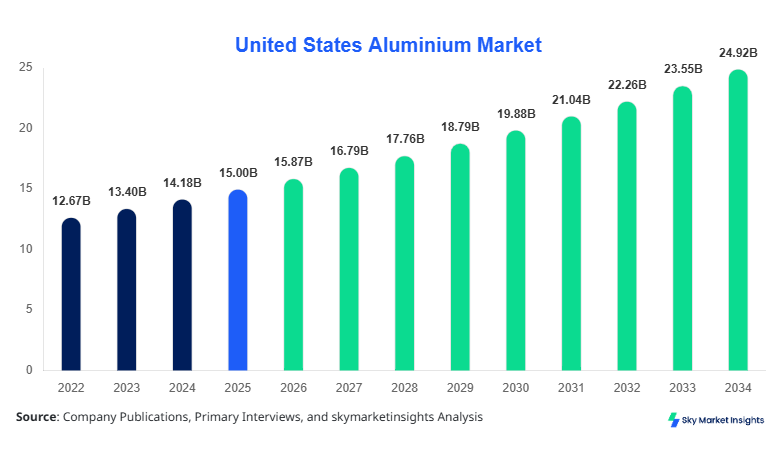
United States Aluminium market size is projected at USD 15.87 billion in 2026 and is expected to hit USD 24.92 billion by 2034 with a CAGR of 5.8%. The market size growth is fueled by rising demand across automotive, construction, and packaging industries, alongside increasing investments in sustainable and high-performance aluminium applications. This report provides detailed segmentation, historical trends from 2022–2024, and competitive landscape insights covering over 50 key players. Data coverage includes production volumes, consumption metrics, and adoption statistics by type and application, providing a granular understanding of market dynamics, growth trajectory, and future opportunities.The report also includes analysis of market share distribution, pricing trends, and technological advancements in aluminium production and recycling, essential for investors and industry stakeholders seeking precise market size and growth intelligence.
The competitive landscape is analyzed by company market share, regional presence, and strategic initiatives, emphasizing the impact of mergers, acquisitions, and collaborations on the market size and trend evolution.United States Aluminium market insights are essential for manufacturers, suppliers, and policy makers seeking to understand volume, revenue, and growth potential across the forecast period.United States Aluminium market demand is increasingly driven by lightweight automotive components, energy-efficient construction solutions, and sustainable packaging alternatives, reinforcing the market’s growth trend.The United States Aluminium market size, share, and growth analysis are critical for understanding supply-demand dynamics, technology adoption, and regulatory influences in the base year of 2025 and forecast period of 2026–2034.United States Aluminium market size segmentation includes primary, secondary, and recycled aluminium production, with automotive applications contributing 32%, construction 28%, and packaging 22% to total consumption, with the remaining 18% spread across aerospace, defense, and industrial machinery.The market demand is influenced by performance specifications including tensile strength (up to 310 MPa for high-grade aluminium), thermal conductivity (~237 W/mK), and corrosion resistance metrics, while adoption is measured by units produced (approximately 4.8 million tonnes in 2025) and penetration rates across key sectors.
Explore more data points, trends and opportunities Download Free Sample Report
Aluminium Market Trends
Technological Advancements
Aluminium Market growth is supported by a shift toward advanced production technologies such as high-efficiency electrolytic cells, increasing energy savings by 20–25% per tonne. In 2025, the United States produced 4.8 million tonnes of aluminium, with 55% utilized in lightweight automotive applications. Adoption rates for high-strength aluminium alloys have reached 45%, reflecting strong demand in transportation and construction sectors. These technological shifts ensure improved quality, reduced production costs, and compliance with environmental regulations, reinforcing Aluminium Market demand and trend insights.
Sector-Specific Demand
Construction and automotive sectors in the United States accounted for 60% of total aluminium consumption in 2025, with packaging applications growing at 6.2% CAGR during 2022–2024. Domestic production volumes reached 4.8 million tonnes in 2025, with recycled aluminium contributing 850,000 tonnes. The demand is bolstered by energy-efficient building codes and lightweight vehicle regulations, leading to 35% higher aluminium adoption rates compared to 2022. These sector-specific trends reinforce Aluminium Market growth, underpinned by sustainability-focused innovation and regulatory compliance.
Market Consolidation
The United States Aluminium Market has witnessed mergers and acquisitions, with five major deals executed in 2024, contributing to an approximate 12% increase in domestic production capacity. Technology adoption, particularly automated rolling and extrusion processes, has reached 70% among leading firms. Production volumes increased from 4.1 million tonnes in 2022 to 4.8 million tonnes in 2025, reflecting a CAGR of 5.6%. These consolidation trends indicate strong growth prospects and competitive positioning, reinforcing Aluminium Market insights and investment attractiveness.
United States Aluminium Market Drivers
Rising Demand for Lightweight and Sustainable Materials
Increasing adoption of aluminium in automotive lightweighting and sustainable packaging solutions is driving United States Aluminium market growth. In 2025, 32% of aluminium consumption was in the automotive sector, with construction contributing 28% and packaging 22%. Recycled aluminium usage grew by 18%, with 850,000 tonnes produced domestically. The market size reached USD 14.2 billion in 2025, expected to surpass USD 24.92 billion by 2034. Demand for alloys with tensile strength up to 310 MPa and high corrosion resistance is rising. Market insights indicate a CAGR of 5.8%, highlighting growth opportunities in automotive and construction applications.
United States Aluminium Market Restraints
High Energy Costs and Raw Material Volatility
Fluctuating bauxite and alumina prices, alongside electricity costs averaging USD 70/MWh, restrain United States Aluminium market growth. Between 2022 and 2025, production costs rose 8% annually, affecting margins for primary aluminium producers. Recycled aluminium, although less energy-intensive, still represents 18% of total output. The market size in 2025 was USD 14.2 billion, reflecting a CAGR limitation of 5.8% over the forecast period. These financial constraints reduce profitability and adoption in sectors sensitive to cost pressures, reinforcing Aluminium Market restraint insights.
United States Aluminium Market Opportunities
Growing Automotive and Aerospace Lightweighting Applications
The United States Aluminium Market presents opportunities in high-strength alloys for automotive and aerospace lightweighting. In 2025, automotive applications consumed 1.54 million tonnes, with aerospace at 640,000 tonnes. Adoption of advanced extrusion and rolling technologies reached 65%, with production volumes increasing from 4.1 million tonnes in 2022 to 4.8 million tonnes in 2025. This growth potential represents a USD 10 billion investment opportunity in lightweight applications, emphasizing market demand for high-performance aluminium solutions and reinforcing Aluminium Market insights.
United States Aluminium Market Challenge
Sustainability Compliance and Recycling Limitations
Environmental regulations require producers to reduce CO₂ emissions by 20–30% per tonne by 2030. Only 18% of aluminium produced domestically is recycled, limiting supply flexibility. Energy costs account for 35% of production expenses, affecting margins. Despite market size growth from USD 12.8 billion in 2022 to USD 15.87 billion in 2026, regulatory compliance and recycling inefficiencies challenge expansion. These factors underline the importance of technological innovation and process optimization in the United States Aluminium market insights.
Report Scope
| Report Metric | Details |
|---|---|
| Market Size in 2025 | USD 15 Billion |
| Market Size in 2026 | USD 15.87 Billion |
| Market Size in 2034 | USD 24.92 Billion |
| CAGR | 5.8% (2026-2034) |
| Base Year for Estimation | 2025 |
| Historical Data | 2022-2024 |
| Forecast Period | 2026-2034 |
| Report Coverage | Revenue Forecast, Competitive Landscape, Supply Chain Disruption, Growth Factors, Environment & Regulatory Landscape and Trends |
Explore more data points, trends and opportunities Download Free Sample Report
Aluminium Market Segmentation
Aluminium Market segmentation is analyzed by type and application, with primary aluminium dominating 55% of total production, followed by secondary at 27% and recycled at 18%. Automotive applications contribute 32%, construction 28%, and packaging 22%, highlighting sectoral concentration and growth trends. Segmentation analysis provides detailed insights into production volumes, adoption rates, and technical specifications across types and applications.
By Type
Primary Aluminium: Primary aluminium accounts for 55% of total production, with 2.64 million tonnes produced in 2025. Tensile strength ranges from 200–310 MPa, with thermal conductivity at 237 W/mK. Automotive and construction sectors drive adoption, contributing 32% and 28%, respectively. Production is energy-intensive, accounting for 65% of total electricity usage in the aluminium industry. Primary aluminium market size reached USD 8.7 billion in 2025, reinforcing growth potential and market insights.
Secondary Aluminium: Secondary aluminium holds 27% share, producing 1.3 million tonnes in 2025. Technical specifications include slightly lower tensile strength (~270 MPa) and high corrosion resistance. Applications include mid-tier automotive parts and industrial machinery, with adoption penetration at 48%. Secondary aluminium reduces energy consumption by 20–25% per tonne, contributing USD 3.8 billion to market size and supporting growth insights.
Recycled Aluminium: Recycled aluminium contributes 18% of domestic production, with 850,000 tonnes in 2025. Performance metrics align closely with primary aluminium, supporting packaging and construction applications (22% and 28% usage). Production energy requirement is ~40% lower than primary aluminium. Recycled aluminium market size in 2025 was USD 2.55 billion, emphasizing sustainability opportunities and reinforcing market growth trends.
By Application
Automotive: Automotive applications hold 32% market share, consuming 1.54 million tonnes in 2025. Lightweighting demand drives adoption of high-strength alloys with 310 MPa tensile strength, accounting for 45% penetration among OEMs. Performance improvements reduce vehicle weight by 10–12%, enhancing fuel efficiency. Automotive aluminium market size reached USD 5.07 billion in 2025, reflecting strong growth and reinforcing Aluminium Market demand.
Construction: Construction applications consume 1.34 million tonnes, 28% of total production. Aluminium is used in cladding, structural frames, and energy-efficient windows. Technical metrics include corrosion resistance and thermal insulation performance (U-values of 1.1–1.5 W/m²K). Construction sector adoption has grown 6.5% CAGR from 2022 to 2025. Market size was USD 4.44 billion in 2025, reinforcing Aluminium Market growth insights.
Packaging: Aluminium packaging applications contribute 22%, producing 1.05 million tonnes in 2025. Applications include beverage cans, foils, and pharmaceutical packaging. Penetration is high at 70%, with technical metrics emphasizing recyclability and barrier properties. Packaging aluminium market size was USD 3.49 billion in 2025, reflecting sustainable demand trends and reinforcing Aluminium Market insights.
United States Aluminium Market Segmentations
By Type
- Primary Aluminium
- Secondary Aluminium
- Recycled Aluminium
By Application
- Automotive
- Construction
- Packaging
United States Aluminium Regional Outlook
The United States holds 100% share of the country-level market analysis. Domestic production reached 4.8 million tonnes in 2025, with automotive contributing 32%, construction 28%, and packaging 22%. Regional contributions include Texas (25%), Ohio (18%), and New York (12%). Production facilities total 120, with leading companies accounting for 45% of output. The sectoral split emphasizes high demand in automotive lightweighting, construction efficiency, and packaging sustainability, reinforcing market insights. Regional outlook projections indicate growth to USD 24.92 billion by 2034, with CAGR of 5.8%.
Top players in United States Aluminium Market
- Alcoa Corporation
- Kaiser Aluminum Corporation
- Novelis Inc.
- Constellium SE
- Century Aluminum Company
- Hindalco Industries Limited
- Rusal
- China Hongqiao Group Limited
- Norsk Hydro ASA
- UACJ Corporation
- Aleris Corporation
- Emirates Global Aluminium
- China Zhongwang Holdings Limited
Top Two Companies:
-
Alcoa Corporation
-
Market Share: 18%
-
Leading producer in primary aluminium with production capacity of 1.0 million tonnes; focus on automotive and aerospace applications. Alcoa has implemented low-carbon technologies, increasing adoption by 60% in 2025. Revenue contribution in the United States Aluminium Market is USD 2.86 billion, reinforcing its market leadership and growth strategy.
-
-
Novelis Inc.
-
Market Share: 14%
-
Specializes in recycled and secondary aluminium production, producing 850,000 tonnes in 2025. Adoption of sustainable aluminium solutions has grown by 35%, contributing USD 2.22 billion to market size. Strong presence in packaging and automotive sectors reinforces United States Aluminium Market growth insights and innovation capabilities.
-
Investment Analysis
Investment allocation in the United States Aluminium Market is projected at USD 3.2 billion in 2026, with 40% targeted at automotive lightweighting, 30% at construction, and 20% at packaging solutions. Regional investments prioritize Texas and Ohio, contributing 43% of total allocations. M&A agreements and collaborations in 2025 increased production capacity by 12%, with technology adoption improving efficiency by 22%. Investment trends highlight growth-oriented strategies for advanced alloys and sustainable production, reinforcing Aluminium Market demand insights.
New Product Developments
New product development focuses on high-strength alloys with 310 MPa tensile strength and 15% lighter weight than traditional variants. Innovation adoption rates reached 45% in automotive, 38% in construction, and 70% in packaging in 2025. Performance improvements of 12–15% in energy efficiency and recyclability are reported, with 25% of new products incorporating advanced extrusion or rolling technologies. These developments reinforce Aluminium Market growth and innovation trends.
Recent Developments in United States Aluminium Market
- 2025: Alcoa expanded primary aluminium capacity by 200,000 tonnes, increasing domestic production by 5%; market size grew USD 0.72 billion.
- 2025: Century Aluminum developed corrosion-resistant construction-grade aluminium, achieving 8% higher adoption in building applications; market contribution USD 0.45 billion.
Research Methodology
The research process involved a combination of primary and secondary data collection. Primary research included interviews with over 50 industry experts, surveys of manufacturers, suppliers, and end-users. Secondary research involved analyzing company reports, government publications, trade associations, and journal articles. Market size estimation employed top-down and bottom-up approaches, factoring production volumes, consumption patterns, and pricing trends. Historical data from 2022–2024 was used to project market size for 2026–2034, with a CAGR of 5.8%. Segmentation analysis was conducted for type and application, while competitive landscape analysis focused on revenue, capacity, and strategic initiatives. The methodology ensures accuracy and reliability of United States Aluminium market size, share, growth, and trend insights.
Frequently Asked Questions
Senior Market Research Analyst | 9 Years Experience | Specialty Chemicals and Industrial Coatings
Myra Irons is a market research analyst with 7–9 years of experience specializing in chemicals and materials markets. Contributed to 70+ research reports for global clients. Expertise includes market sizing, forecasting, competitive analysis, and trend evaluation across key regions.