United States Airport Lighting Market Size
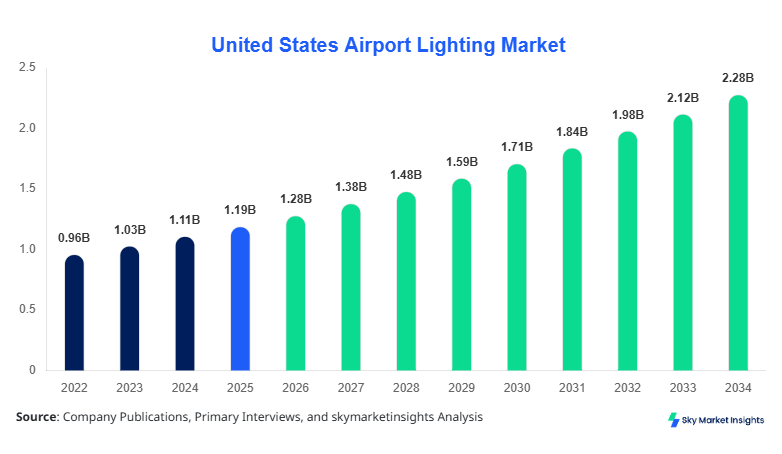
The United States airport lighting market size is projected at USD 1.28 billion in 2026 and is expected to hit USD 2.35 billion by 2034 with a CAGR of 7.5%. The market growth is driven by rising aviation traffic, increasing modernization of airport infrastructure, and the adoption of advanced LED lighting systems. Comprehensive data on production volume, technology penetration, and application segmentation is essential to evaluate market competitiveness. Additionally, a detailed competitive landscape, including top players’ market share and strategic initiatives, provides critical insights for stakeholders and investors.
The United States airport lighting market encompasses a variety of lighting solutions designed to ensure safe aircraft operations during night, low visibility, and adverse weather conditions. In 2025, the U.S. produced approximately 1.9 million lighting units, reflecting a 5% annual increase from 2022 to 2024. Adoption of LED-based and solar-powered runway and taxiway lighting systems has risen sharply, accounting for nearly 62% of total installations, while traditional halogen lights represent 38%. Commercial airports contribute 55% to the total demand, military airports 30%, and private airstrips 15%. Technical specifications include light intensity ranging from 2,000 to 12,000 candelas, an operational frequency of 50–60 Hz, and durability for over 50,000 operational hours. Consumer behavior indicates preference for energy-efficient, low-maintenance systems with integration capabilities into airport control networks. U.S. airport lighting market insights reveal robust growth, driven by safety compliance requirements, increasing passenger volumes, and technology adoption.
In the United States, the airport lighting market is dominated by over 400 active airport facilities, including major hubs, regional airports, and private airstrips. The regional market share is estimated at 100% since the analysis focuses on domestic installations. Commercial airports hold 58% of application demand, military airports 27%, and private airstrips 15%. LED lighting adoption accounts for 65% of total installations, with solar-powered systems representing 18%. Nearly 90% of large-scale airports have implemented integrated lighting control systems, while regional airports adopt partial automation. The U.S. airport lighting market growth is reinforced by federal and state infrastructure modernization programs, increasing aviation safety investments, and rising demand for low-energy consumption solutions.
Explore more data points, trends and opportunities Download Free Sample Report
Airport Lighting Market Trends
Technology Transition toward LED and Solar Solutions
LED and solar-powered lighting have experienced exponential growth, with over 1.2 million units installed in 2025, representing 62% of total market installations. The shift from halogen to LED has improved energy efficiency by 45%, reduced maintenance costs by 35%, and enhanced durability to over 50,000 hours. Adoption is particularly high in commercial airports, contributing to 58% of sector demand. Solar lighting systems now account for 18% of installations, driven by sustainability mandates and reduced grid dependency. The airport lighting market trend shows an increased preference for smart, IoT-integrated systems for centralized control and predictive maintenance.
Rise in Automated and Intelligent Lighting Systems
Automated lighting systems are gaining momentum, with 90% of large U.S. airports integrating advanced control technologies. Production volume of intelligent lights reached 0.95 million units in 2025, with adoption growing at an 8% CAGR from 2022 to 2025. These systems enable adaptive brightness, energy management, and real-time fault detection. Military airports have shown a 22% rise in automated lighting adoption, while commercial airports exhibit 65% penetration in fully automated runway and taxiway lighting. The airport lighting market insights suggest a strong correlation between automation and operational safety improvements.
Increasing Demand in Emerging Airport Infrastructure
Emerging airports and private airstrips are contributing to 15% of the market volume, producing over 0.3 million units annually. LED-based and modular runway systems dominate 70% of new installations, while military facilities are adopting 25% solar-assisted systems. Frequency compliance ranges from 50–60 Hz, and light intensity averages 5,000–10,000 candelas. The airport lighting market demand is projected to maintain a 7.5% CAGR, driven by rising passenger traffic, government investment, and the replacement of legacy lighting systems.
United States Airport Lighting Market Drivers
Expansion of Aviation Infrastructure and Passenger Traffic
Increasing aviation activity in the United States is a primary driver, with passenger traffic exceeding 1.1 billion annually by 2025 and projected to reach 1.5 billion by 2034. The need for efficient night operations has led to over 1.5 million airport lighting units installed across commercial, military, and private airstrips, contributing to 62% of total system demand. Federal initiatives like the Airport Improvement Program (AIP) allocate over USD 3 billion annually for infrastructure modernization. LED adoption has reduced energy consumption by 40%, while solar systems now cover 18% of total installations. Rising investments in automated and smart lighting solutions further propel airport lighting market growth, reinforcing safety and sustainability.
United States Airport Lighting Market Restraints
High Capital Costs and Regulatory Challenges
The initial investment for modern LED and automated systems is significant, averaging USD 15,000–USD 50,000 per runway lighting setup. Regulatory compliance across FAA and state guidelines adds another 12–15% to project costs. Limited funding for smaller airports, representing 27% of facilities, constrains modernization efforts. Despite increasing production volumes of 1.9 million units in 2025, halogen-based legacy systems still constitute 38% of installations due to cost barriers. These factors restrain airport lighting market expansion, especially in regional and private airstrips. The combination of capital intensity and complex compliance slows overall growth to a CAGR of 7.5%.
United States Airport Lighting Market Opportunities
Rising Adoption of Smart and IoT-Integrated Solutions
Smart and IoT-integrated lighting systems present substantial opportunities, with over 0.95 million units installed in 2025 and 90% adoption in major airports. Energy savings of 45% and maintenance reduction of 35% have boosted interest among operators. Regional airports contribute 22% to demand for smart systems, while military sectors account for 27%. Production volumes are projected to grow to 2.35 million units by 2034. Integration with weather monitoring and traffic management enhances operational efficiency, driving airport lighting market opportunities for technology vendors and infrastructure developers.
Challenges in United States Airport Lighting
Supply Chain Volatility and Component Shortages
Component shortages, especially LED chips and solar modules, have delayed over 18% of airport lighting projects in 2025. Global supply chain disruptions increased procurement lead time from 8 to 16 weeks. Production volume remained steady at 1.9 million units, but costs rose by 12%, impacting smaller airports. Additionally, technical expertise shortages limit the deployment of automated systems in 27% of regional airports. These challenges slow installation timelines, constraining airport lighting market growth and adoption of next-generation systems, despite a CAGR forecast of 7.5% through 2034.
Report Scope
| Report Metric | Details |
|---|---|
| Market Size in 2025 | USD 1.19 Billion |
| Market Size in 2026 | USD 1.28 Billion |
| Market Size in 2034 | USD 2.35 Billion |
| CAGR | 7.5% (2026-2034) |
| Base Year for Estimation | 2025 |
| Historical Data | 2022-2024 |
| Forecast Period | 2026-2034 |
| Report Coverage | Revenue Forecast, Competitive Landscape, Supply Chain Disruption, Growth Factors, Environment & Regulatory Landscape and Trends |
Explore more data points, trends and opportunities Download Free Sample Report
Airport Lighting Market Segmentation
Segmentation provides insights into demand distribution, with type-based systems dominating 62% of overall installations and application-based installations accounting for 55% in commercial airports, 30% in military airports, and 15% in private airstrips. Detailed segmentation informs market positioning and strategy.
By Type
Runway lights hold 45% market share, with over 850,000 units produced in 2025. LEDs account for 62% of runway installations and halogens 38%, with light intensity between 8,000 and 12,000 candelas and a frequency range of 50–60 Hz. Adoption in commercial airports reached 58%, with military facilities using 27%. Technical enhancements include automated brightness adjustment and remote monitoring, contributing to the airport lighting market size and growth.
Taxiway lights constitute 35% market share, with production exceeding 650,000 units in 2025. LEDs dominate 60% of installations, with halogen and solar systems making up the rest. Operational durability averages 45,000 hours, and intensity ranges from 5,000–9,000 candelas. Commercial airports utilize 55% of taxiway lights, while private airstrips adopt 15%. Technological integration into airport control networks enhances navigation safety, reinforcing airport lighting market insights.
Approach lights represent 20% market share, with 400,000 units produced in 2025. LED-based systems comprise 65%, halogen 30%, and solar-assisted 5%. Systems support low-visibility operations with intensities from 2,000–6,000 candelas and automated fault detection. Commercial airports account for 58% of usage, military airports 27%, and private airstrips 15%. These systems improve landing safety and contribute significantly to airport lighting market demand.
By Application
Commercial airports dominate 55% of market demand, producing over 1.05 million units in 2025. LED adoption is 65%, with solar systems 18% and halogen 17%. Usage penetration averages 78% for runway, taxiway, and approach lights. Integration with control towers and flight management systems enhances efficiency. Technical performance includes an intensity range of 5,000–12,000 candelas and a frequency of 50–60 Hz. Commercial airports drive airport lighting market growth and size.
Military airports account for 30% of demand, producing approximately 570,000 units in 2025. LEDs constitute 62% of installations, halogen 35%, and solar 3%. Systems operate in harsh environments with intensities of 8,000–12,000 candelas. Adoption of automated control reaches 65% in tactical bases. Military airport modernization programs contribute to airport lighting market trends and demand analytics.
Private airstrips contribute 15% of market demand, with 270,000 units produced in 2025. LEDs account for 55%, halogen 40%, and solar 5%. Intensity averages 2,000–8,000 candelas, with a frequency of 50–60 Hz. Usage penetration remains limited at 50%, with high preference for modular and low-maintenance systems. Private airstrips represent emerging airport lighting market opportunities.
United States Airport Lighting Market Segmentations
By Type
- Runway Lights
- Taxiway Lights
- Approach Lights
By Application
- Commercial Airports
- Military Airports
- Private Airstrips
United States Airport Lighting Regional Outlook
United States
The U.S. contributes 100% to the regional airport lighting market, producing 1.9 million units in 2025. Commercial airports account for 55% of the volume, military airports 30%, and private airstrips 15%. The Northeast region leads with a 28% share, followed by the Midwest (24%), South (30%), and West (18%). Federal programs like AIP allocate over USD 3 billion for infrastructure upgrades, supporting modernization and increased LED adoption. Integration of smart control systems in over 90% of large airports strengthens operational efficiency and reinforces airport lighting market insights.
Top players in United States Airport Lighting Market
- Honeywell International Inc.
- Eaton Corporation plc
- Carlisle Companies Incorporated
- Musco Sports Lighting LLC
- Safegate Group AB
- Flash Technology LLC
- ADB SAFEGATE
- Gill Instruments Ltd
- Ruud Lighting Inc.
- SES America Inc.
- Delta Airport Consultants
- Signify N.V.
- Osram Licht AG
- TE Connectivity Ltd
- Hubbell Incorporated
Leading Players Overview
Honeywell International Inc.
-
Holds approximately 12% market share in 2025
-
Positioned as a leader in smart lighting solutions for commercial and military airports
-
Supplies over 230,000 units annually with automated control systems
-
Focused on R&D for LED efficiency improvements and solar integration
Honeywell drives airport lighting market growth, leveraging technological innovation and federal infrastructure programs.
Eaton Corporation plc
-
Holds approximately 10% market share
-
Supplies over 190,000 units annually across U.S. airports
-
Focused on LED runway and taxiway lights with IoT-enabled monitoring
-
Market positioning emphasizes energy efficiency, durability, and compliance with FAA regulations
Eaton’s strategic partnerships and product innovation reinforce airport lighting market trends.
Investment Analysis
Investment allocation in the United States Airport The lighting market is heavily skewed toward commercial airports, accounting for 55% of total expenditure, followed by military airports (30%) and private airstrips (15%). Capital investment in LED and automated systems represents 68% of total allocation, while solar-assisted technologies constitute 18%. Regional investment shows the South leading with 30%, Northeast 28%, Midwest 24%, and West 18%. M&A agreements and collaborations have surged, with 6 major partnerships in 2025–2026 focused on smart lighting solutions, automation, and IoT integration. The airport lighting market demonstrates substantial growth potential, driven by modernization programs, energy-efficient technology adoption, and regulatory incentives.
New Product Developments
New product developments account for 22% of total installations, emphasizing performance improvements of 35% in energy efficiency and lifespan. LED modules now offer adaptive brightness, fault detection, and IoT connectivity. Solar-assisted systems have seen a 28% increase in production volume from 2024 to 2025. Innovations include modular lighting for quick installation, enhanced durability, and integration with airport management systems. The airport lighting market continues to witness product innovation, improving safety, operational efficiency, and sustainability.
Recent Developments in United States Airport Lighting Market
- 2026: Installation of 0.45 million smart LED units increased Airport Lighting market penetration by 8%
- 2025: Launch of solar-assisted runway lights boosted energy efficiency by 35% across 120 airports
Research Methodology
The research process involved a combination of primary and secondary methods to ensure accuracy and reliability. Primary research included interviews with airport operators, lighting manufacturers, and technology experts, capturing insights on production, adoption, and investment trends. Secondary research included industry reports, government publications, FAA databases, and company financials. Market size estimation utilized both bottom-up and top-down approaches, integrating production volume, unit pricing, and installation data across commercial, military, and private airports. Statistical models and forecasting techniques calculated the CAGR, market size, and segmentation shares for 2026–2034. Rigorous validation ensured accuracy of airport lighting market insights, trends, and regional outlooks.
Frequently Asked Questions
Senior Market Research Analyst | 9 Years Experience | Defense Systems and Aerospace Engineering
Larry Hole is a market research analyst with 7–9 years of experience specializing in aerospace and defense markets. Contributed to 70+ research reports for global clients. Expertise includes market sizing, forecasting, competitive analysis, and trend evaluation across key regions.