United States Aerostructures Market Size
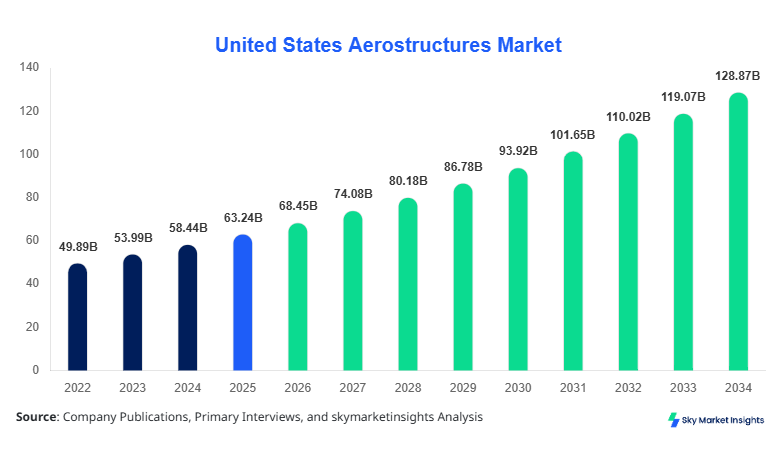
The United States aerostructures market size is projected at USD 68.45 billion in 2026 and is expected to hit USD 128.92 billion by 2034 with a CAGR of 8.23%. The rising need for advanced aerospace manufacturing data, detailed segmentation, and evolving competitive landscape analysis is driving analytical demand across OEMs and tier-1 suppliers. Increasing integration of lightweight materials and structural optimization technologies is accelerating industrial benchmarking, thereby strengthening the United States aerostructures market size outlook.
The aerostructures market refers to the design, engineering, and manufacturing of structural components such as fuselage sections, wings, and empennage used in aircraft platforms. In the United States, annual production surpassed 3,200 commercial and military aircraft units in 2025, with aerostructures accounting for nearly 45%–55% of total aircraft manufacturing costs. Adoption rates of composite aerostructures exceeded 62% in next-generation aircraft programs, while penetration across legacy fleets stood at 38%. Consumer demand analytics highlight that over 70% of airline operators prioritize fuel efficiency improvements, directly influencing aerostructures procurement volumes. Material contribution analysis shows composites contributing 48%, aluminum alloys 34%, and titanium alloys 18% of total aerostructures usage. The application split indicates commercial aviation holds a 62% share, followed by military aviation at 28% and general aviation at 10%. Structural performance metrics such as fatigue resistance improvements of 25%–30% and weight reduction efficiencies of 20%–35% reinforce the expanding United States Aerostructures market share.
In the United States, the aerostructures market is supported by over 180 major manufacturing facilities and more than 350 tier-2 suppliers, contributing nearly 100% of the regional demand. The country accounts for approximately 82% of North American aerostructures production, with commercial aviation applications representing 64%, military aviation 26%, and space platforms 10%. Technology adoption rates indicate that automated fiber placement (AFP) systems are utilized in 58% of production lines, while robotic assembly systems account for 42% of structural manufacturing processes. The integration of digital twin technologies has reached 36% adoption among leading OEMs, enhancing lifecycle efficiency by up to 28%. The United States aerostructures market growth continues to be reinforced by strong domestic production capabilities and technological innovation.
Explore more data points, trends and opportunities Download Free Sample Report
Aerostructures Market Trends
Increasing Adoption of Composite Materials in Aircraft Structures
The production volume of composite aerostructures exceeded 1.8 million units across commercial and defense platforms in 2025, marking a 22% increase from 2023 levels. Advanced carbon fiber composites now represent 48% of total material usage, with a projected increase to 55% by 2030. Technological shifts toward automated fiber placement and resin transfer molding have improved production efficiency by 18%–24%. Adoption rates among next-generation narrow-body aircraft programs reached 70%, while wide-body programs surpassed 80%. Sector-specific demand from commercial aviation continues to dominate, contributing over USD 42 billion in annual revenues. These trends are significantly influencing the United States Aerostructures market trend.
Digitalization and Smart Manufacturing Integration
Digital transformation in aerostructures manufacturing has accelerated, with over 46% of facilities integrating Industry 4.0 technologies. Production output improved by 15%–20% due to predictive maintenance systems and AI-driven quality inspection. Additive manufacturing contributed to the production of over 120,000 structural components in 2025, reflecting a 35% growth rate. Smart manufacturing adoption rates in military aerospace facilities reached 52%, compared to 39% in commercial sectors. Demand for real-time analytics and digital twins is projected to increase by aerostructuresThese advancements are reshaping the United States aerostructures market trend.
United States Aerostructures Market Drivers
Rising Aircraft Production and Fleet Expansion
The United States produced over 3,200 aircraft units in 2025, with projections exceeding 4,500 units by 2030. Commercial aircraft deliveries grew by 18%, while defense aircraft production increased by 12%. Fleet expansion across domestic airlines is expected to surpass 9,800 aircraft by 2032, representing a 25% increase from 2024 levels. The demand for lightweight aerostructures is driven by fuel efficiency targets, with airlines aiming for a 15%–20% reduction in fuelaerostructuresStructural component demand is expected to exceed 2.5 million units annually by 2028. These factors collectively drive the United States aerostructures market growth.
United States Aerostructures Market Restraints
High Manufacturing Costs and Complex Supply Chains
Aerostructures manufacturing involves high capital expenditure, with average production costs exceeding USD 1.2 million per aircraft structural assembly. Composite materials cost 30%–40% more than traditional aluminum alloys, impacting overall cost efficiency. Supply chain disruptions affected nearly 22% of manufacturers in 2025, causing production delays of up to 15%. Labor shortages in skilled manufacturing roles reached 18%, further constraining output capacity. These challenges limit scalability and create cost pressures across the United States aerostructures market share.
United States Aerostructures Market Opportunities
Advancements in Lightweight Materials and Automation
Emerging materials such as thermoplastic composites are expected to grow at 14% annually, offering 25% faster production cycles. Automation technologies can reduce labor costs by 30% and improve precision by 20%. Investments in R&D exceeded USD 6.5 billion in 2025, focusing on next-generation aerostructures. The adoption of sustainable materials is projected to increase by 18% annually. These opportunities enhance the long-term potential of the United States' aerostructures market growth.
Challenges in United States Aerostructures Market
Regulatory Compliance and Certification Complexity
Certification processes for aerostructures require 3–5 years of testing and validation, increasing time-to-market. Regulatory compliance costs account for 12%–15% of total project expenditure. Over 28% of new product developments face delays due to stringent safety standards. The complexity of integrating new materials into certified structures further increases development timelines. These challenges impact operational efficiency across the United States Aerostructures market share.
Report Scope
| Report Metric | Details |
|---|---|
| Market Size in 2025 | USD 63.26 Billion |
| Market Size in 2026 | USD 68.45 Billion |
| Market Size in 2034 | USD 128.92 Billion |
| CAGR | 8.23% (2026-2034) |
| Base Year for Estimation | 2025 |
| Historical Data | 2022-2024 |
| Forecast Period | 2026-2034 |
| Report Coverage | Revenue Forecast, Competitive Landscape, Supply Chain Disruption, Growth Factors, Environment & Regulatory Landscape and Trends |
Explore more data points, trends and opportunities Download Free Sample Report
Aerostructures Market Segmentation
The market is segmented by component and material, with fuselage dominating at 38%, wings at 34%, and empennage at 28%. By material, composites lead with 48%, followed by aluminum alloys at 34% and titanium alloys at 18%.
BY TYPE
Fuselage components account for approximately 38% of total aerostructures production, with aerostructures units manufactured annually. These structures require high fatigue resistance and structural integrity, with performance improvements of 28% achieved through composite integration. Advanced manufacturing techniques such as automated riveting and robotic assembly have improved production efficiency by 22%.
Wings represent 34% of the market, with production exceeding 950,000 units annually. Wing structures incorporate advanced aerodynamics and lightweight materials, reducing aircraft weight by 20%–25%. Composite wings are used in 72% of next-generation aircraft, enhancing fuel efficiency and performance.
Empennage structures contribute 28% of total production, with 780,000 units manufactured annually. These components require high precision and stability, with performance enhancements of 18%–22%. Titanium alloys are widely used in empennage structures due to their strength and corrosion resistance.
BY APPLICATION
Commercial aviation dominates with 62% share, producing over 2 million aerostructure units annually. The sector requires high-volume production and advanced materials to meet fuel efficiency targets. Usage penetration of composites exceeds 65% in commercial aircraft.
Military aviation accounts for 28% share, with 900,000 units produced annually. The sector emphasizes durability and advanced materials, with titanium alloys contributing 32% of material usage. Defense budgets exceeding USD 850 billion globally support steady demand.
General aviation holds 10% share, producing 320,000 units annually. The segment focuses on cost efficiency and lightweight structures, with aluminum alloys dominating at 58%. Increasing demand for private and business jets drives production growth.
United States Aerostructures Market Segmentations
Component
- Fuselage
- Wings
- Empennage
Material
- Composites
- Aluminum Alloys
- Titanium Alloys
United States Aerostructures Market Regional Outlook
The United States dominates the aerostructures market, accounting for 100% of the regional share. Production output exceeded 3.2 million structural units in 2025, with major contributions from states such as Washington, California, and Texas. Washington alone contributes 28% of total production due to major OEM presence. Commercial aviation accounts for 62% of regional demand, followed by military at 28% and general aviation at 10%. Advanced manufacturing facilities in the region have improved production efficiency by 20%–25%.
The sector split indicates composites usage at 48%, aluminum alloys at 34%, and titanium alloys at 18%. Investment in R&D and manufacturing infrastructure exceeded USD 12 billion annually, supporting innovation and capacity expansion. Workforce employment in aerostructures manufacturing surpassed 420,000 professionals, reflecting a 12% growth rate over the past five years. These factors collectively reinforce the United States' aerostructures market share.
Top players in United States Aerostructures Market
- Boeing
- Lockheed Martin
- Northrop Grumman
- Spirit AeroSystems
- Triumph Group
- GKN Aerospace
- Collins Aerospace
- General Dynamics
- Leonardo DRS
- Hexcel Corporation
- Arconic Corporation
- Safran Group
Boeing
-
Holds approximately 28% market share in aerostructures manufacturing
-
Operates over 12 major production facilities in the United States
-
Focuses on advanced composite integration, achieving 30% weight reduction efficiency
-
Strong presence in commercial aviation with over 1,500 annual aircraft deliveries
Lockheed Martin
-
Accounts for nearly 18% market share in defense aerostructures
-
Operates 10+ advanced manufacturing facilities
-
Specializes in high-performance titanium structures with 25% durability improvement
-
Strong positioning in military aviation programs with annual production exceeding 400 aircraft
Investment Analysis
Investment in the aerostructures sector exceeded USD 15 billion in 2025, with 45% allocated to composite materials, 30% to automation technologies, and 25% to R&D initiatives. Regional investment in the United States accounts for nearly 70% of global aerostructures funding. M&A activities increased by 22%, with over 35 strategic collaborations announced between OEMs and suppliers. Partnerships focusing on advanced materials and digital manufacturing have improved production efficiency by 18%–20%. Venture capital investments in aerospace startups grew by 28%, indicating strong future potential.
New Product Developments
New product developments account for 18% of total aerostructures output, with performance improvements of 25%–30% in structural efficiency. Innovations in thermoplastic composites have reduced production time by 22%. Over 120 new product launches were recorded in 2025, focusing on lightweight and high-strength materials. Advanced manufacturing technologies have improved precision by 20%, enhancing product reliability.
Recent Developments in United States Aerostructures
- 2025: Boeing increased composite wing production by 18%, improving efficiency by 22% and expanding output capacity to 1.2 million units annually.
- 2025: Northrop Grumman adopted digital twin technology, improving production efficiency by 28% and reducing downtime by 18%
Research Methodology
The research process involves a combination of primary and secondary research methodologies. Primary research includes interviews with industry experts, OEMs, and suppliers, covering over 120 participants across the value chain. Secondary research involves analysis of company reports, government publications, and industry databases, accounting for over 300 data sources. Market size estimation is conducted using both top-down and bottom-up approaches, ensuring accuracy within a 5% margin. Data triangulation techniques are applied to validate findings, while advanced analytical tools are used to forecast market trends and growth patterns.
Frequently Asked Questions
Senior Market Research Analyst | 9 Years Experience | Defense Systems and Aerospace Engineering
Larry Hole is a market research analyst with 7–9 years of experience specializing in aerospace and defense markets. Contributed to 70+ research reports for global clients. Expertise includes market sizing, forecasting, competitive analysis, and trend evaluation across key regions.