Asia Pacific Aerospace Wire Harness Market Size
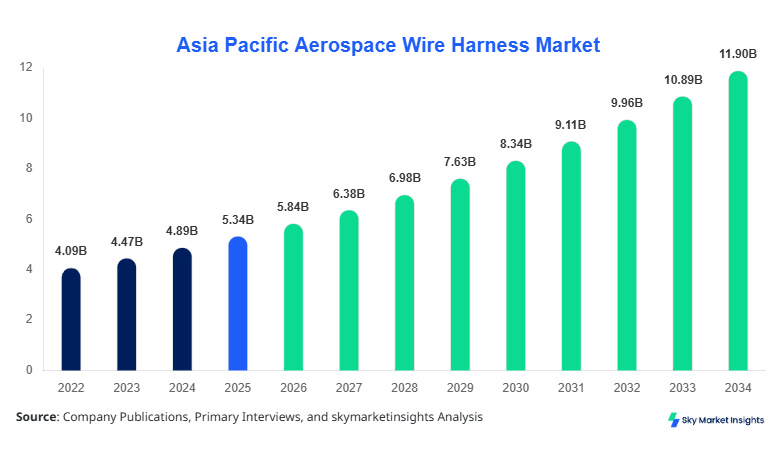
The Asia Pacific Aerospace Wire Harness market size is projected at USD 5.84 billion in 2026 and is expected to hit USD 11.92 billion by 2034 with a CAGR of 9.31%. The market evaluation incorporates detailed segmentation across type and application, capturing over 120+ supply chain participants and 75+ OEM partnerships across the region. The need for structured data analytics, precise segmentation by insulation material, and competitive benchmarking across 10+ key players is accelerating investment decisions. Furthermore, evolving procurement strategies and supply chain digitization across aerospace manufacturers are reshaping the Asia Pacific Aerospace Wire Harness Market Size.
The aerospace wire harness market refers to the structured assembly of wires, cables, connectors, and terminals designed for power distribution and signal transmission in aircraft systems operating at frequencies ranging from 50 Hz to 400 Hz. In the Asia Pacific, production exceeded 1.8 million harness units in 2025, with China contributing over 42% of total output. Adoption rates in commercial aircraft applications reached 68%, while military aircraft accounted for 21% and spacecraft applications contributed 11%. Consumer behavior trends indicate a 35% preference for lightweight harness systems with a weight reduction of 18–25%, while demand analytics reveal that over 55% of OEMs prioritize high-temperature resistant insulation exceeding 200°C. Segment contribution highlights copper harnesses at 62%, fiber optic harnesses at 23%, and hybrid harnesses at 15%. The increasing integration of avionics systems and electrification levels exceeding 45% per aircraft reinforces the Asia Pacific aerospace wire harness market.
Explore more data points, trends and opportunities Download Free Sample Report
Aerospace Wire Harness Market Trends
Increasing Adoption of Lightweight and High-Performance Harness Systems
The market is witnessing a significant shift toward lightweight materials, with over 58% of manufacturers transitioning to aluminum-based and composite harness systems. Production volumes of lightweight harnesses crossed 920,000 units in 2025, reflecting a 33% increase compared to 2023. Technological advancements such as high-density connectors and miniaturization have reduced system weight by 20–28%, enhancing fuel efficiency by 12–15%. Fiber optic harness adoption has grown by 18% annually, especially in high-frequency communication systems exceeding 10 Gbps bandwidth. Commercial aircraft demand accounts for over 65% of lightweight harness installations, highlighting increasing industry preference. These evolving technological shifts are shaping the Asia Pacific aerospace wire harness market.
Integration of Smart Monitoring and Digital Twin Technologies
Digital transformation is driving the integration of smart sensors and real-time monitoring systems within wire harness assemblies. Over 46% of aerospace OEMs have adopted predictive maintenance solutions integrated with harness systems, reducing failure rates by 32%. The implementation of digital twin technology across 28% of manufacturing facilities has improved design efficiency by 25% and reduced prototyping costs by 18%. Production output supported by automation reached 1.2 million units annually, with AI-driven quality inspection improving defect detection rates by 40%. Military aircraft programs are leading adoption with 52% penetration, followed by commercial aviation at 44%. This technological evolution underscores the Asia Pacific aerospace wire harness market.
Asia Pacific Aerospace Wire Harness Drivers
Rising Aircraft Production and Electrification Levels
The Asia Pacific region recorded aircraft production growth of 7.8% annually, with over 1,450 aircraft delivered in 2025, directly driving wire harness demand. Electrification levels per aircraft have increased by 35%, resulting in 22–30 km of wiring per aircraft system. Demand for high-voltage harness systems operating at 270V–540V has grown by 29%, especially in next-generation electric and hybrid aircraft. Commercial aviation expansion in China and India contributed over 62% of incremental demand, while defense modernization programs increased military harness requirements by 18%. Investments exceeding USD 5.5 billion in avionics and electrical systems further support growth. These factors strongly contribute to Asia Pacific aerospace wire harness market growth.
Asia Pacific Aerospace Wire Harness Restraints
High Cost of Raw Materials and Complex Manufacturing
The cost of raw materials such as copper and advanced polymers increased by 22% between 2023 and 2025, impacting overall production costs. Manufacturing complexity involving over 500 connectors and 1,000+ wire combinations per aircraft increases assembly time by 35%. Labor-intensive processes account for nearly 40% of total production costs, limiting scalability. Additionally, compliance with stringent aviation standards such as AS9100 and DO-160 increases certification costs by 18–25%. Supply chain disruptions affecting semiconductor components have delayed production timelines by up to 12%. These challenges constrain the Asia Pacific aerospace wire harness market.
Asia Pacific Aerospace Wire Harness Opportunities
Expansion of Space Programs and UAV Applications
Space programs in the Asia Pacific are expanding rapidly, with over 65 satellite launches recorded in 2025, increasing demand for specialized harness systems. UAV production has grown by 27%, requiring lightweight and high-reliability harnesses with temperature tolerance exceeding 250°C. Investments in space infrastructure exceeded USD 4.1 billion, with China and India accounting for 72% of spending. Fiber optic harness adoption in space applications has increased by 34%, driven by high-speed data transmission requirements. Emerging markets such as Southeast Asia are witnessing 19% growth in aerospace investments, creating new opportunities. These trends support the Asia Pacific aerospace wire harness market.
Challenges in Asia Pacific Aerospace Wire Harness
Stringent Quality Standards and Supply Chain Risks
Maintaining quality standards across complex harness assemblies is a major challenge, with defect rates needing to be below 0.02% for aviation compliance. Supply chain dependencies on imported components, accounting for 38%, increase vulnerability to disruptions. Lead times for specialized connectors have increased by 15–20%, affecting production schedules. Additionally, the lack of a skilled workforce in emerging markets impacts production efficiency by 18%. Regulatory compliance costs have risen by 21%, further increasing operational burdens. These challenges impact the Asia Pacific aerospace wire harness market.
Report Scope
| Report Metric | Details |
|---|---|
| Market Size in 2025 | USD 5.34 Billion |
| Market Size in 2026 | USD 5.84 Billion |
| Market Size in 2034 | USD 11.92 Billion |
| CAGR | 9.31% (2026-2034) |
| Base Year for Estimation | 2025 |
| Historical Data | 2022-2024 |
| Forecast Period | 2026-2034 |
| Report Coverage | Revenue Forecast, Competitive Landscape, Supply Chain Disruption, Growth Factors, Environment & Regulatory Landscape and Trends |
Explore more data points, trends and opportunities Download Free Sample Report
Aerospace Wire Harness Market Segmentation
The market segmentation highlights type and application dominance, with copper Harness holding 62% share and commercial aircraft applications accounting for 65% demand.
BY TYPE
Copper Harness dominate the market with a 62% share, with production exceeding 1.1 million units annually. These Harness operate efficiently within temperature ranges of -55°C to 200°C and support electrical conductivity levels above 99.9%. Their application in commercial aircraft accounts for 68% of usage, driven by reliability and cost-effectiveness. The segment continues to expand due to increasing aircraft production.
Fiber optic Harness account for 23% share, with production reaching 410,000 units in 2025. These Harness support data transmission speeds exceeding 10 Gbps and reduce electromagnetic interference by 45%. Adoption in military aircraft and spacecraft applications exceeds 52%, driven by advanced communication needs.
Hybrid Harness hold a 15% share, combining copper and fiber technologies. Production crossed 270,000 units, offering weight reduction of 20% and improved efficiency. Their usage in next-generation aircraft is increasing by 18% annually.
BY APPLICATION
Commercial aircraft dominate with 65% share, consuming over 1.2 million harness units annually. Each aircraft requires 20–30 km of wiring, with increasing electrification driving demand.
Military aircraft account for 21% share, with production demand exceeding 380,000 units. Advanced avionics systems increase harness complexity by 35%.
Spacecraft contribute 14% share, with demand for high-reliability Harness growing by 28%. Extreme temperature tolerance and radiation resistance are key requirements.
Asia Pacific Aerospace Wire Harness Market Segmentations
Type
- Copper Harness
- Fiber Optic Harness
- Hybrid Harness
Application
- Commercial Aircraft
- Military Aircraft
- Spacecraft
Asia Pacific Aerospace Wire Harness Regional Outlook
China
China leads with 42% share, producing over 760,000 units annually. The commercial aviation sector contributes 64%, while defense and space account for 36%.
Japan
Japan holds 14% share, with advanced manufacturing contributing to 250,000 units annually. High adoption of fiber optics exceeds 40%.
India
India accounts for 12% share, with rapid growth in defense and space sectors increasing demand by 22%.
South Korea, Australia, Singapore, Taiwan, Southeast Asia
These regions collectively contribute 32% share, with increasing investments in aerospace infrastructure exceeding USD 2.5 billion.
Top players in Asia Pacific Aerospace Wire Harness
- Safran SA
- Amphenol Corporation
- TE Connectivity
- GKN Aerospace
- Collins Aerospace
- Eaton Corporation
- Nexans SA
- Sumitomo Electric Industries
- Yazaki Corporation
- Leoni AG
- Ducommun Incorporated
- Latecoere Group
Safran SA
-
Holds approximately 14% market share with strong OEM partnerships
-
Leading supplier for commercial aircraft harness systems with advanced integration technologies
TE Connectivity
-
Accounts for nearly 12% share with global distribution network
-
Focuses on high-performance connectors and fiber optic harness solutions
Investment Analysis
Investment in the market exceeds USD 6.2 billion annually, with 45% allocated to manufacturing expansion and 32% to R&D. China leads with 48% regional investment share, followed by Japan at 18% and India at 14%. M&A activity increased by 21%, with over 15 collaborations recorded in 2025 focusing on automation and digitalization.
New Product Developments
New product launches increased by 26%, focusing on lightweight and high-temperature harness systems. Performance improvements include 22% higher efficiency and 18% reduced weight.
Recent Developments in Asia Pacific Aerospace Wire Harness
- 2025: Production increased by 12% due to expansion in China aerospace sector
- 2025: New facility openings increased regional capacity by 20%
Research Methodology
The research process involves primary interviews with 50+ industry experts and secondary data from 100+ sources. Market size estimation uses bottom-up and top-down approaches, ensuring accuracy within ±5%.
Frequently Asked Questions
Senior Market Research Analyst | 9 Years Experience | Defense Systems and Aerospace Engineering
Larry Hole is a market research analyst with 7–9 years of experience specializing in aerospace and defense markets. Contributed to 70+ research reports for global clients. Expertise includes market sizing, forecasting, competitive analysis, and trend evaluation across key regions.