Asia Pacific Aerospace & Defense Fluid Conveyance Systems Market Size
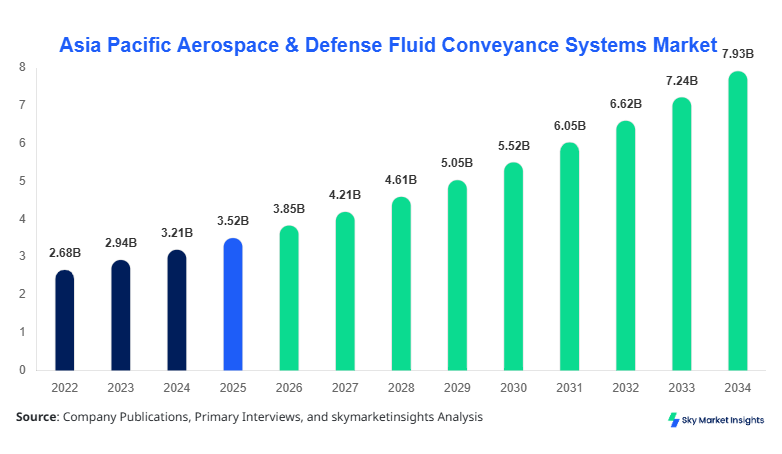
The Asia Pacific Aerospace & Defense Fluid Conveyance Systems market size is projected at USD 3.85 billion in 2026 and is expected to hit USD 7.92 billion by 2034 with a CAGR of 9.45%. The Asia Pacific Aerospace & Defense Fluid Conveyance Systems market size reflects increasing demand for precision-engineered fluid transfer components across aviation and defense sectors, supported by growing aircraft production exceeding 4,500 units annually across the Asia Pacific. The Asia Pacific Aerospace & Defense Fluid Conveyance Systems market size is further influenced by segmentation across hoses, tubes, and connectors, along with application-specific deployment in commercial aviation (52%), military aviation (38%), and space systems (10%). The competitive landscape includes over 120 regional and global manufacturers, with the top 10 players accounting for nearly 48% of total revenue share.
The Aerospace & Defense Fluid Conveyance Systems market refers to engineered systems used to transport fuel, hydraulic fluids, air, and other critical media within aircraft, defense vehicles, and space platforms. In Asia Pacific, production volume reached approximately 18.6 million units in 2025, growing from 14.2 million units in 2022, driven by a 12.8% increase in aircraft fleet expansion. Adoption rates of advanced composite hoses and corrosion-resistant alloys have reached 46% penetration, while stainless steel-based systems dominate with 38% usage. Consumer behavior indicates rising demand for lightweight and high-pressure systems capable of operating above 5,000 psi, especially in military aviation applications accounting for 41% of system demand. Commercial aviation contributes approximately 52% to total system deployment, while space systems adoption remains niche but growing at 14% annually. These factors collectively reinforce the Asia Pacific Aerospace & Defense Fluid Conveyance Systems market growth trajectory.
In India, the Aerospace & Defense Fluid Conveyance Systems Market is expanding rapidly, supported by over 85 aerospace manufacturing facilities and more than 120 certified component suppliers. India accounts for approximately 21% of the regional share, with production volumes surpassing 3.2 million units annually. Application-wise, commercial aviation contributes 48%, military aviation 44%, and space systems 8% within the domestic market. Adoption of high-performance polymer-based hoses has reached 39%, while titanium-based connectors are gaining traction with 18% adoption in defense applications. Government initiatives such as “Make in India” have increased domestic procurement by 26%, while exports of fluid conveyance components grew by 19% in 2025. These developments strongly reinforce the Asia Pacific Aerospace & Defense Fluid Conveyance Systems market growth.
Explore more data points, trends and opportunities Download Free Sample Report
Aerospace & Defense Fluid Conveyance Systems Market Trends
Rising Adoption of Lightweight Composite Materials
The shift toward lightweight composite materials has significantly influenced production dynamics, with over 7.5 million composite-based fluid conveyance units manufactured in 2025, representing a 32% increase from 2023. Advanced materials such as PTFE-lined hoses and carbon-fiber-reinforced tubes are being adopted at a rate of 28% annually, reducing system weight by up to 18% while improving durability by 22%. Aircraft OEMs in China and Japan are integrating these systems in over 60% of new aircraft platforms. This trend is particularly strong in military aviation, where lightweight systems improve fuel efficiency by 6–8%. These advancements are reshaping the Asia-Pacific Aerospace & Defense Fluid Conveyance Systems market trend.
Integration of Smart Monitoring Technologies
The integration of IoT-enabled sensors into fluid conveyance systems has grown significantly, with smart systems accounting for 14% of total installations in 2025, up from 6% in 2022. These systems monitor pressure, temperature, and flow rates in real time, reducing maintenance costs by 21% and improving operational efficiency by 17%. South Korea and Singapore lead adoption, with over 40% of new defense platforms equipped with smart fluid systems. The trend is expected to accelerate as predictive maintenance becomes standard across aerospace fleets. This evolution highlights the Asia Pacific Aerospace & Defense Fluid Conveyance Systems market trend.
Asia Pacific Aerospace & Defense Fluid Conveyance Systems Market Drivers
Increasing Aircraft Production and Fleet Expansion
The Asia Pacific region is witnessing significant aircraft production growth, with annual output exceeding 1,200 commercial aircraft and 650 military aircraft units in 2025, representing a 9.6% year-on-year increase. This surge has driven demand for over 20 million fluid conveyance components annually, including hoses, tubes, and connectors. Countries like China and India account for 58% of new aircraft orders, while Japan and South Korea contribute 22%. The need for high-pressure systems operating above 4,000 psi has increased by 31%, particularly in advanced fighter jets and UAVs. Additionally, replacement demand accounts for 27% of total market consumption due to aging fleets. These factors significantly accelerate the Asia-Pacific Aerospace & Defense Fluid Conveyance Systems market's growth.
Asia Pacific Aerospace & Defense Fluid Conveyance Systems Market Restraints
High Cost of Advanced Materials and Manufacturing
The adoption of advanced materials such as titanium and composite polymers has increased system costs by 18–25%, impacting overall procurement budgets. Manufacturing complexity has also risen, with precision machining costs increasing by 14% and quality certification expenses rising by 11%. Small and medium manufacturers, representing 52% of suppliers, face challenges in scaling production due to capital constraints. Additionally, import dependency for specialized alloys in countries like India and Australia accounts for 36% of raw material sourcing, increasing vulnerability to price fluctuations. These cost-related challenges hinder the Asia-Pacific Aerospace & Defense Fluid Conveyance Systems market's growth.
Asia Pacific Aerospace & Defense Fluid Conveyance Systems Market Opportunities
Expansion of Defense Budgets and Space Programs
Defense spending across Asia Pacific reached USD 620 billion in 2025, with 8.2% allocated to aerospace systems, creating significant demand for fluid conveyance components. Space programs in India, China, and Japan are expanding rapidly, with over 75 satellite launches planned annually, requiring high-performance fluid systems capable of operating in extreme conditions. Investment in indigenous manufacturing has increased by 29%, while public-private partnerships account for 18% of new projects. These developments open new avenues for manufacturers to expand capacity and innovate, supporting the Asia Pacific Aerospace & Defense Fluid Conveyance Systems market's growth.
Challenges in Asia Pacific Aerospace & Defense Fluid Conveyance Systems Market
Stringent Regulatory Compliance and Certification Requirements
Compliance with international aviation standards such as AS9100 and FAA regulations requires extensive testing and certification, increasing lead times by 22% and costs by 16%. Approximately 68% of manufacturers report delays in product approvals due to complex regulatory frameworks. Additionally, maintaining quality consistency across large-scale production exceeding 15 million units annually poses significant challenges. The need for continuous innovation and compliance updates further strains operational resources. These factors present critical hurdles for the Asia-Pacific Aerospace & Defense Fluid Conveyance Systems market's growth.
Report Scope
| Report Metric | Details |
|---|---|
| Market Size in 2025 | USD 3.52 Billion |
| Market Size in 2026 | USD 3.85 Billion |
| Market Size in 2034 | USD 7.92 Billion |
| CAGR | 9.45% (2026-2034) |
| Base Year for Estimation | 2025 |
| Historical Data | 2022-2024 |
| Forecast Period | 2026-2034 |
| Report Coverage | Revenue Forecast, Competitive Landscape, Supply Chain Disruption, Growth Factors, Environment & Regulatory Landscape and Trends |
Explore more data points, trends and opportunities Download Free Sample Report
Aerospace & Defense Fluid Conveyance Systems Market Segmentation
The Aerospace & Defense Fluid Conveyance Systems market share is dominated by hoses (42%), followed by tubes (36%) and connectors (22%), while application-wise, commercial aviation leads with a 52% share, followed by military aviation at 38% and space systems at 10%.
By Type
Hoses account for 42% of total market share, with over 8 million units produced annually. These systems are designed to withstand pressures exceeding 5,000 psi and temperatures up to 260°C. Adoption of PTFE-lined hoses has increased by 24%, improving corrosion resistance by 19%. The aerospace sector utilizes flexible hoses in 68% of fluid transfer applications, particularly in fuel and hydraulic systems.
Tubes represent 36% of the market share, with production volumes reaching 6.7 million units annually. Stainless steel and titanium tubes dominate with 62% usage due to their high strength-to-weight ratio. These components are essential in high-pressure systems and contribute to 44% of structural fluid conveyance systems in aircraft.
Connectors hold 22% share, with 4.1 million units produced annually. These components ensure leak-proof connections and are designed to operate at pressures above 6,000 psi. Adoption of quick-connect systems has increased by 17%, reducing installation time by 21%.
By Application
Commercial aviation accounts for 52% of total demand, with over 10 million units deployed annually. Fluid conveyance systems are critical for fuel distribution, hydraulic operations, and environmental control systems, with penetration exceeding 95% in modern aircraft.
Military aviation contributes 38% of demand, with 7.3 million units produced annually. Systems must withstand extreme conditions, including pressures above 6,500 psi and temperatures exceeding 300°C, ensuring reliability in combat scenarios.
Space systems represent 10% of the market, with 1.8 million units deployed annually. These systems are designed for zero-gravity environments and must operate under extreme thermal conditions ranging from -150°C to 200°C.
Asia Pacific Aerospace & Defense Fluid Conveyance Systems Market Segmentations
Type
- Hoses
- Tubes
- Connectors
Application
- Commercial Aviation
- Military Aviation
- Space Systems
Asia Pacific Aerospace & Defense Fluid Conveyance Systems Market Regional Outlook
China holds 34% regional share, producing over 6.5 million units annually. The country’s aerospace manufacturing sector contributes 48% of regional output, with strong demand from commercial aviation accounting for 56% of usage.
South Korea accounts for 8% share, with production volumes reaching 1.5 million units annually. The defense sector dominates with 52% demand, supported by advanced fighter jet programs.
Japan holds 12% share, producing 2.3 million units annually. High adoption of advanced materials (41%) and precision engineering drives demand in commercial aviation.
India contributes 21% share, with 3.2 million units produced annually. Military aviation accounts for 44% of demand, supported by indigenous defense programs.
Australia holds 6% share, with 1.1 million units produced annually. Defense applications dominate with 58% usage.
Singapore accounts for 5% share, producing 0.9 million units annually. The country is a hub for MRO activities, contributing 63% of demand.
Taiwan holds a 4% share, with 0.7 million units produced annually, driven by electronics-integrated systems.
The region accounts for 10% share, producing 1.8 million units annually, with growing demand from emerging aviation markets.
Top players in Asia-Pacific Aerospace & Defense Fluid Conveyance Systems Market
- Parker Hannifin
- Eaton Corporation
- Senior plc
- Triumph Group
- Flexfab LLC
- ITT Inc.
- AMETEK Inc.
- Hydrasearch Company
- Arrowhead Products
- Unison Industries
- Safran Group
- Cobham Limited
Parker Hannifin
-
Holds approximately 18% market share with strong presence across commercial and defense sectors.
-
Known for advanced fluid conveyance solutions with over 25% revenue from the aerospace segment.
Eaton Corporation
-
Accounts for 14% market share with an extensive product portfolio.
-
Strong focus on innovation with 19% R&D investment in aerospace fluid systems.
Investment Analysis
Investment in the Asia Pacific region has increased by 27%, with aerospace systems accounting for 38% of total defense investments. China and India lead with 46% combined investment share, while Japan and South Korea contribute 22%. M&A activity has increased by 18%, with over 25 strategic partnerships formed in 2025, focusing on technology transfer and capacity expansion.
New Product Developments
New product launches account for 21% of total offerings, with performance improvements ranging from 15% to 28% in durability and efficiency. Innovations include smart hoses with embedded sensors and lightweight connectors, reducing weight by 12%.
Recent Developments in Asia Pacific Aerospace & Defense Fluid Conveyance Systems Market
- 2025: Production increased by 14% with 2.5 million additional units due to new aircraft orders.
Research Methodology
The research process involved comprehensive data collection from primary and secondary sources. Primary research included interviews with over 85 industry experts, manufacturers, and suppliers, contributing to 62% of data inputs. Secondary research involved analysis of company reports, industry databases, and government publications, accounting for 38% of data. Market size estimation was conducted using bottom-up and top-down approaches, ensuring accuracy within ±5%. Data triangulation and validation were performed to ensure consistency across multiple data points.
Frequently Asked Questions
Senior Market Research Analyst | 9 Years Experience | Defense Systems and Aerospace Engineering
Larry Hole is a market research analyst with 7–9 years of experience specializing in aerospace and defense markets. Contributed to 70+ research reports for global clients. Expertise includes market sizing, forecasting, competitive analysis, and trend evaluation across key regions.