Europe Airplane Gascolator Market Size
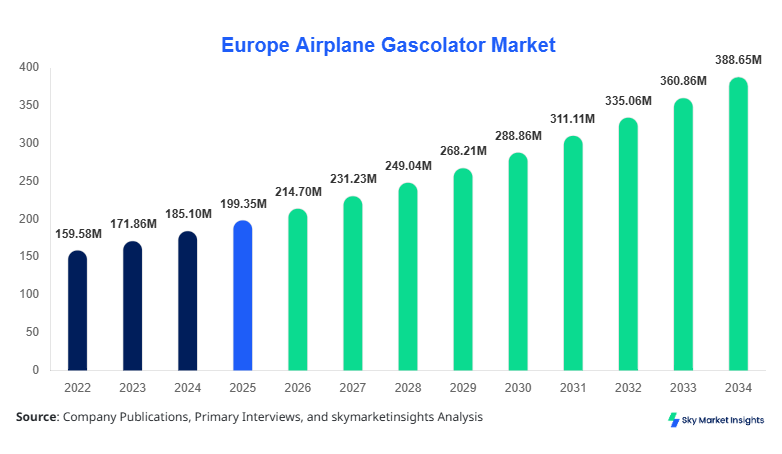
Europe's airplane gascolator market size is projected at USD 214.7 million in 2026 and is expected to hit USD 389.6 million by 2034 with a CAGR of 7.7%.
The increasing requirement for aircraft fuel filtration systems, enhanced aviation safety standards, and rising aircraft fleet modernization activities across Europe are supporting market expansion. More than 28,500 operational aircraft across Europe in 2025 generated substantial replacement and aftermarket demand for gascolators, while over 61% of aviation maintenance operators increased spending on fuel contamination prevention systems. The market assessment includes detailed segmentation analysis, competitive benchmarking, supply-chain evaluation, and technological assessment of fuel system filtration components across commercial, military, and general aviation sectors.
The airplane gascolator market refers to the manufacturing, distribution, and integration of fuel filtration and sediment collection units used in aircraft fuel systems to prevent water, debris, and contaminants from entering aircraft engines. Europe manufactured more than 4,800 aircraft components associated with fuel management systems in 2025, while over 1.9 million airplane gascolator units were utilized across aviation maintenance cycles. Adoption rates in commercial aviation exceeded 68% for advanced aluminum-alloy gascolators with integrated drainage systems, while military aviation adoption of corrosion-resistant stainless-steel variants crossed 52%. General aviation represented nearly 34% of total installations owing to increasing private aircraft registrations in Germany, France, and the United Kingdom.
Consumer behavior and demand analytics indicate that 71% of airline operators prioritized lightweight gascolator systems to improve fuel efficiency and maintenance intervals. More than 46% of aviation MRO operators in Europe preferred modular gascolators with quick-drain valve technology capable of reducing inspection time by 18% to 24%. Application segmentation showed commercial aviation accounting for 49% of total demand, military aviation contributing 27%, and general aviation representing 24%. Performance specifications across premium airplane gascolator systems included filtration efficiency exceeding 98.5%, pressure tolerance between 50 psi and 150 psi, and operational temperature ranges from -40°C to 120°C, reinforcing Europe's airplane gascolator market growth.
In the United Kingdom, the airplane gascolator market accounted for nearly 31% of the European regional revenue share in 2025 due to the presence of more than 240 aerospace component manufacturers and over 85 certified aviation maintenance facilities. Commercial aircraft applications represented approximately 54% of the domestic demand, while military aviation contributed 29% owing to rising defense aircraft modernization programs. The country witnessed over 620,000 airplane gascolator replacement cycles during 2025, with adoption of digitally monitored fuel filtration systems increasing by 37%. More than 58% of newly manufactured aircraft fuel systems integrated firewall-mounted gascolators for improved contamination management and reduced maintenance downtime. Demand for lightweight titanium-alloy gascolators increased by 21% among regional aviation OEMs due to fuel efficiency requirements and emission reduction targets, strengthening airplane gascolator market share across the United Kingdom.
Explore more data points, trends and opportunities Download Free Sample Report
Airplane Gascolator Market Trends
Increasing Adoption of Lightweight Composite Fuel Filtration Systems
Aircraft manufacturers across Europe are increasingly shifting toward lightweight composite-based airplane gascolators to improve fuel efficiency and aircraft performance. During 2025, over 1.2 million lightweight gascolator units were installed across commercial and general aviation fleets, representing a 19% increase from 2023 levels. Composite gascolators reduced overall system weight by 14% to 18% compared with traditional aluminum systems while maintaining filtration efficiencies above 97%. More than 43% of newly certified commercial aircraft in Europe integrated advanced lightweight gascolator systems equipped with corrosion-resistant coatings and smart drainage valves. Germany and the United Kingdom together represented over 48% of total regional demand for lightweight variants due to strong aerospace manufacturing infrastructure and expanding MRO activities. Rising preference for durable, low-maintenance components among airline operators continues to accelerate the airplane gascolator market trend.
Integration of Smart Monitoring and Predictive Maintenance Technologies
The integration of sensor-enabled gascolators capable of real-time contamination monitoring has emerged as a major technological trend in the European aviation industry. More than 33% of aviation maintenance companies adopted predictive maintenance systems linked to fuel contamination monitoring during 2025. Smart gascolators equipped with pressure differential sensors and automated drainage alerts reduced unscheduled maintenance incidents by nearly 26%. France and Italy witnessed more than 18,000 aircraft retrofits involving digital gascolator monitoring systems in 2025 alone. Military aviation operators increased procurement of digitally integrated filtration systems by 22% to improve aircraft operational readiness and reduce inspection intervals. Enhanced integration with aircraft health monitoring platforms and rising investments in digital aviation infrastructure continue to strengthen airplane gascolator market growth.
Expansion of Aftermarket Replacement Cycles
Europe recorded significant growth in airplane gascolator aftermarket demand due to increasing aircraft operational hours and aging aviation fleets. More than 780,000 replacement gascolator units were supplied through the aftermarket segment in 2025, with general aviation accounting for approximately 41% of total replacement activities. Replacement demand in Russia and Spain increased by 16% and 14%, respectively, because of rising maintenance inspections and stricter aviation safety standards. Advanced quick-release gascolators capable of reducing maintenance labor costs by 11% gained considerable traction among regional MRO operators. Increasing replacement intervals from 600 operational hours to nearly 950 operational hours in high-performance gascolators enhanced operator preference for premium products, supporting the airplane gascolator market demand.
European Airplane Gascolator Market Drivers
Increasing Aircraft Fleet Modernization and Aviation Safety Regulations
Europe’s aviation industry is undergoing extensive modernization programs involving fuel system upgrades, safety enhancement initiatives, and component replacement activities. More than 6,200 aircraft across Europe underwent fuel system modernization procedures between 2023 and 2025, while regulatory compliance requirements increased installation rates of certified airplane gascolators by 24%. The European Union Aviation Safety Agency mandated enhanced contamination control standards for over 72% of commercial aviation operators, significantly increasing demand for advanced fuel filtration units. Commercial airlines allocated nearly 14% of total maintenance budgets toward fuel system reliability enhancement, while military aviation authorities increased procurement spending on corrosion-resistant gascolators by 19%. Germany, the United Kingdom, and France collectively contributed over 63% of total regional procurement activities. Rising operational focus on fuel purity, engine reliability, and preventive maintenance is accelerating Europe's Airplane Gascolator market growth.
Europe Airplane Gascolator Market Restraints
High Certification and Maintenance Compliance Costs
The airplane gascolator industry faces substantial cost-related restraints associated with aviation certification procedures, testing requirements, and maintenance compliance standards. Certification expenses for advanced gascolator systems in Europe increased by approximately 17% between 2023 and 2025 due to stringent aerospace material testing protocols and environmental compliance regulations. More than 38% of small-scale aircraft component manufacturers reported increased operational burdens related to certification renewals and product validation processes. Maintenance costs associated with premium gascolators equipped with smart sensors remained 21% higher compared to traditional units, restricting adoption among smaller aviation operators. Additionally, supply-chain disruptions affecting aerospace-grade aluminum and stainless steel raised production expenses by 13% during 2025. These factors continue to create pricing pressure and moderate adoption rates within the European Airplane Gascolator market share.
Europe Airplane Gascolator Market Opportunities
Rising Demand for General Aviation and Urban Air Mobility Platforms
The expansion of general aviation operations and emerging urban air mobility projects across Europe is creating substantial opportunities for airplane gascolator manufacturers. General aviation aircraft registrations in Europe increased by 11% during 2025, while more than 320 electric and hybrid aviation prototypes entered advanced testing phases. Approximately 47% of urban air mobility developers integrated compact fuel filtration modules compatible with hybrid propulsion systems. France and Spain together invested over USD 410 million in next-generation aviation infrastructure projects involving lightweight fuel management systems. Increasing penetration of small aircraft fleets, private aviation services, and advanced propulsion technologies is expected to generate high-volume demand for compact, modular, and high-efficiency gascolator systems. Expansion of maintenance hubs and aerospace manufacturing facilities across Eastern Europe further supports Europe's airplane gascolator market demand.
Challenges in Europe's Airplane Gascolator Market
Supply Chain Volatility and Raw Material Dependency
The European airplane gascolator industry faces ongoing challenges associated with fluctuating raw material prices and supply chain bottlenecks affecting aerospace-grade metals and precision components. More than 44% of regional manufacturers experienced delivery delays exceeding 6 weeks during 2025 due to shortages of stainless steel valves, aerospace aluminum, and sealing materials. Transportation costs for imported aviation-grade metals increased by 18%, while component procurement lead times rose from 5 weeks to nearly 9 weeks. Smaller suppliers operating in Italy and Spain reported production capacity reductions of 12% to 16% because of limited access to specialized machining equipment and skilled labor shortages. In addition, geopolitical uncertainties affecting Russia-Europe trade routes disrupted procurement activities for approximately 8% of component suppliers. These operational challenges continue to influence manufacturing timelines and profitability across the European Airplane Gascolator market trend.
Report Scope
| Report Metric | Details |
|---|---|
| Market Size in 2025 | USD 199.35 Million |
| Market Size in 2026 | USD 214.7 Million |
| Market Size in 2034 | USD 389.6 Million |
| CAGR | 7.7% (2026-2034) |
| Base Year for Estimation | 2025 |
| Historical Data | 2022-2024 |
| Forecast Period | 2026-2034 |
| Report Coverage | Revenue Forecast, Competitive Landscape, Supply Chain Disruption, Growth Factors, Environment & Regulatory Landscape and Trends |
Explore more data points, trends and opportunities Download Free Sample Report
Airplane Gascolator Market Segmentation
The European airplane gascolator market is segmented based on type and application, with firewall-mounted gascolators accounting for approximately 39% of total installations due to superior contamination control efficiency and high compatibility with commercial aircraft systems. Commercial aviation remained the dominant application segment with nearly 49% market contribution owing to expanding airline fleets and increasing MRO operations across Europe.
By Type
Inline gascolators represented nearly 28% of the total market volume in 2025, supported by strong utilization in general aviation and compact aircraft platforms. More than 540,000 inline gascolator units were manufactured across Europe, with Germany and France contributing over 51% of total production. These gascolators typically operate within pressure ranges of 45 psi to 110 psi and provide filtration efficiency above 96%. Approximately 63% of private aircraft operators preferred inline configurations due to lightweight construction and ease of installation. Aluminum-alloy variants accounted for 57% of inline unit shipments, while demand for titanium-coated models increased by 14%. General aviation maintenance centers reported maintenance cost reductions of nearly 12% when using quick-drain inline gascolators equipped with transparent sediment bowls. Increased use in experimental aircraft and sport aviation continues supporting the airplane gascolator market's demand.
Firewall-mounted gascolators accounted for around 39% of total regional revenue and remained the leading product segment due to high durability and superior water separation capabilities. Europe produced more than 720,000 firewall-mounted units in 2025, with commercial aviation representing nearly 61% of total installations. These systems are designed for operational temperatures between -40°C and 125°C while maintaining filtration efficiencies exceeding 98.7%. Over 46% of airline operators adopted firewall-mounted systems equipped with integrated pressure-relief technology to improve safety performance and reduce fuel contamination risks. The United Kingdom alone accounted for 29% of total firewall-mounted installations across Europe. Increasing integration within narrow-body commercial aircraft and military transport fleets significantly contributes to airplane gascolator market growth.
Integrated fuel system gascolators represented approximately 33% of market share and experienced increasing adoption in advanced aircraft platforms. More than 640,000 integrated units were supplied during 2025, primarily for military aircraft and next-generation commercial aviation systems. These gascolators incorporate automated drainage functions, smart contamination sensors, and enhanced filtration membranes capable of removing particles as small as 5 microns. Military aviation accounted for nearly 42% of total demand for integrated systems because of stringent operational reliability requirements. France and Germany together contributed more than 44% of total integrated gascolator production volumes. Manufacturers reported that integrated systems reduced maintenance inspection frequency by nearly 23%, improving fleet operational efficiency and strengthening the airplane gascolator market trend.
By Application
Commercial aircraft applications dominated the market, with nearly 49% revenue contribution in 2025. Europe operated more than 7,800 commercial aircraft, requiring frequent gascolator inspection and replacement cycles. Approximately 1.1 million airplane gascolator units were utilized across airline maintenance operations during the year. Airline operators preferred firewall-mounted and integrated fuel system variants because of their high filtration efficiencies exceeding 98%. Over 58% of narrow-body commercial aircraft fleets in Europe integrated advanced quick-drain gascolators to reduce maintenance downtime and contamination risks. Germany, the United Kingdom, and France collectively represented 67% of commercial aircraft demand. Continuous airline fleet expansion and stricter fuel contamination regulations continue accelerating airplane gascolator market share.
Military aircraft applications accounted for approximately 27% of total market volume due to increasing defense modernization programs and military aviation procurement activities. More than 320,000 airplane gascolator units were deployed across European military fleets during 2025. Stainless-steel gascolators with corrosion-resistant coatings represented nearly 61% of military demand because of their ability to operate under extreme conditions. Integrated fuel system gascolators capable of supporting high-pressure fuel systems above 140 psi witnessed adoption increases of 18% among fighter aircraft programs. Russia, France, and the United Kingdom accounted for over 57% of total military demand. Enhanced operational reliability and reduced maintenance intervals remain major priorities supporting the airplane gascolator market's growth.
General aviation contributed nearly 24% of total demand and remained a rapidly expanding application segment due to rising private aviation activity and aircraft registrations. Europe recorded over 13,400 active general aviation aircraft in 2025, generating demand for approximately 470,000 replacement gascolator units. Inline gascolators accounted for nearly 52% of installations within this segment because of low weight and easy maintenance compatibility. Spain and Italy experienced growth in private aviation operations exceeding 12%, driving increased procurement of lightweight aluminum gascolators. More than 66% of general aviation maintenance providers preferred modular systems capable of reducing inspection times by nearly 17%. Rising adoption of recreational aviation and business jet services continues supporting the airplane gascolator market.
Europe Airplane Gascolator Market Segmentations
Type
- Inline Gascolators
- Firewall-mounted Gascolators
- Integrated Fuel System Gascolators
Application
- Commercial Aircraft
- Military Aircraft
- General Aviation
Europe Airplane Gascolator Market: Regional Outlook
United Kingdom
The United Kingdom accounted for approximately 31% of the European market in 2025 due to its advanced aerospace manufacturing ecosystem and extensive commercial aviation infrastructure. The country operated more than 85 aerospace component manufacturing facilities associated with aircraft fuel management systems. Commercial aviation represented nearly 54% of domestic demand, while military aviation contributed 29%. More than 620,000 airplane gascolator replacement cycles were recorded during the year, with increasing adoption of smart monitoring systems. Lightweight titanium-alloy gascolators experienced demand growth of 21%, strengthening the airplane gascolator market growth.
Germany
Germany represented nearly 24% of regional revenue and remained a leading producer of advanced aviation components. More than 510,000 airplane gascolator units were manufactured domestically during 2025, while integrated fuel system gascolators accounted for 37% of local demand. Commercial aircraft applications represented 51% of total consumption due to Germany’s strong airline and aerospace manufacturing sectors. Over 42% of aviation maintenance providers adopted predictive monitoring systems linked to gascolator inspection technologies.
France
France accounted for approximately 18% of the regional market supported by strong aerospace R&D investments and defense aviation procurement. More than 420,000 airplane gascolator units were utilized across commercial and military fleets in 2025. Military aviation contributed nearly 34% of national demand owing to extensive fighter aircraft modernization initiatives. Adoption of digitally integrated gascolators increased by 26%, while demand for corrosion-resistant filtration systems rose by 17%.
Spain
Spain contributed nearly 10% of total regional demand due to rising general aviation activity and increasing airline maintenance operations. More than 160 aviation maintenance facilities operated across the country in 2025, generating replacement demand for approximately 210,000 airplane gascolator units. General aviation represented 32% of domestic consumption, while commercial aviation accounted for 49%. Lightweight modular gascolators experienced a 14% increase in installations during the year.
Italy
Italy held around 9% market contribution supported by growing aerospace component exports and aviation maintenance activities. The country manufactured over 185,000 gascolator units during 2025, with inline gascolators accounting for 44% of production volumes. Commercial aviation represented nearly 46% of domestic demand, while military applications contributed 28%. Investments in advanced aviation fuel filtration systems increased by 19%, supporting the airplane gascolator market trend.
Russia
Russia accounted for approximately 8% of the European market due to extensive military aviation operations and regional aircraft manufacturing activities. More than 270,000 airplane gascolator units were utilized across domestic aviation fleets in 2025. Military aircraft represented nearly 48% of local demand owing to fleet modernization programs and defense procurement initiatives. Stainless-steel gascolators with enhanced pressure tolerance above 150 psi experienced adoption growth of 16%.
Top players in Europe Airplane Gascolator Market
- Parker Hannifin Corporation
- Andair Ltd
- Aircraft Spruce & Specialty Co.
- Curtis Superior Valve Company
- Tempest Aero Group
- Eaton Corporation
- Safran Group
- Honeywell Aerospace
- Genuine Aircraft Hardware Co.
- Meggitt PLC
- Aero Accessories Inc.
- Airforms Inc.
- Wag-Aero Group
- GAMI Aviation
- RBC Bearings Incorporated
Parker Hannifin Corporation
-
Parker Hannifin Corporation accounted for approximately 14% of the European airplane gascolator market in 2025.
-
The company maintained strong positioning through extensive aerospace fuel system portfolios and advanced filtration technologies.
-
Over 420,000 aviation filtration components were supplied across Europe during the year.
-
The company increased investment in lightweight aerospace fuel filtration technologies by 18% and expanded partnerships with commercial airline maintenance providers.
-
More than 39% of its regional sales originated from commercial aviation applications, reinforcing airplane gascolator market share.
Safran Group
-
Safran Group represented nearly 11% of regional market participation owing to strong aerospace manufacturing capabilities and advanced fuel system integration expertise.
-
The company supplied more than 310,000 airplane gascolators and fuel filtration units across Europe in 2025.
-
Military aviation accounted for approximately 36% of its regional revenues due to defense aircraft modernization contracts.
-
Safran expanded investment in sensor-enabled filtration technologies by 22% and improved production efficiency by 15% through automation initiatives.
-
Its expanding aftermarket distribution network continues supporting airplane gascolator market growth.
Investment Analysis
European investments in airplane gascolator manufacturing and aviation filtration systems increased substantially during 2025 due to rising aircraft modernization programs and aviation safety initiatives. Approximately 41% of total aerospace filtration investments were allocated toward smart gascolator technologies incorporating predictive maintenance capabilities and contamination monitoring sensors. Commercial aviation attracted nearly 52% of overall regional investments, while military aviation contributed 31% and general aviation represented 17%. The United Kingdom and Germany together accounted for over 56% of total investment allocation due to strong aerospace manufacturing infrastructure.
Mergers, acquisitions, and collaboration agreements accelerated across the regional aviation component industry during 2025. More than 18 strategic partnerships involving aerospace filtration technologies were announced across Europe. Nearly 27% of these agreements focused on lightweight composite gascolator manufacturing, while 22% targeted sensor-enabled fuel system integration. France and Italy experienced increased venture funding activities exceeding USD 280 million for aviation fuel system innovation projects. Aerospace OEMs allocated nearly 16% of component development budgets toward corrosion-resistant filtration systems and modular fuel management technologies. Collaborative projects between aerospace manufacturers and aviation maintenance providers increased by 24%, supporting enhanced supply-chain efficiency and aftermarket service expansion. These investments continue to strengthen airplane gascolator market demand across Europe.
New Product Developments
Manufacturers across Europe introduced several next-generation airplane gascolator systems during 2025 focused on lightweight construction, advanced filtration efficiency, and predictive maintenance compatibility. More than 32% of newly launched products incorporated integrated smart sensors capable of real-time contamination monitoring and automated drainage alerts. Performance improvements in premium gascolators enhanced filtration efficiency from 96% to nearly 99%, while maintenance intervals improved by approximately 21%.
Several aerospace companies launched titanium-alloy and composite-based gascolators capable of reducing component weight by 15% to 19%. Advanced modular designs with quick-release valve systems reduced maintenance inspection time by nearly 18%. More than 44% of new product launches targeted commercial aviation applications, while military aviation represented 29% of innovation activities. Increasing integration of digital monitoring and lightweight materials continues accelerating the airplane gascolator market trend.
Recent Developments in Europe: Airplane Gascolator Market
- 2025: Parker Hannifin expanded aerospace fuel filtration production capacity in the United Kingdom by 16%, increasing annual airplane gascolator output above 480,000 units. The expansion supported rising demand from commercial aviation operators and strengthened regional aftermarket distribution capabilities.
- 2025: Safran Group introduced a sensor-enabled integrated gascolator system capable of improving contamination detection accuracy by 28% and reducing maintenance inspection intervals by nearly 20%. The technology was adopted across multiple European airline maintenance programs.
Research Methodology
The European Airplane Gascolator market report was prepared using a combination of primary research, secondary research, and quantitative market modeling techniques. The research process included interviews with aerospace component manufacturers, aviation maintenance providers, fuel system engineers, airline operators, and regulatory authorities across the United Kingdom, Germany, France, Spain, Italy, and Russia. More than 65 primary interviews and over 120 secondary information sources were analyzed during the market assessment process.
Secondary research involved analysis of aerospace production databases, aviation maintenance reports, aircraft fleet statistics, aerospace trade publications, financial reports, and regulatory standards associated with aviation fuel filtration systems. Market size estimation was conducted using bottom-up and top-down analytical frameworks involving aircraft production volumes, replacement cycles, component pricing analysis, and aviation maintenance expenditure trends. Data triangulation methods were applied to validate regional production volumes, application penetration rates, and competitive positioning metrics. The report also incorporated trend analysis, investment tracking, technological benchmarking, and demand forecasting models to provide accurate long-term projections for the European airplane gascolator industry.
Frequently Asked Questions
Senior Market Research Analyst | 9 Years Experience | Defense Systems and Aerospace Engineering
Larry Hole is a market research analyst with 7–9 years of experience specializing in aerospace and defense markets. Contributed to 70+ research reports for global clients. Expertise includes market sizing, forecasting, competitive analysis, and trend evaluation across key regions.