United States Ammunition Market Size
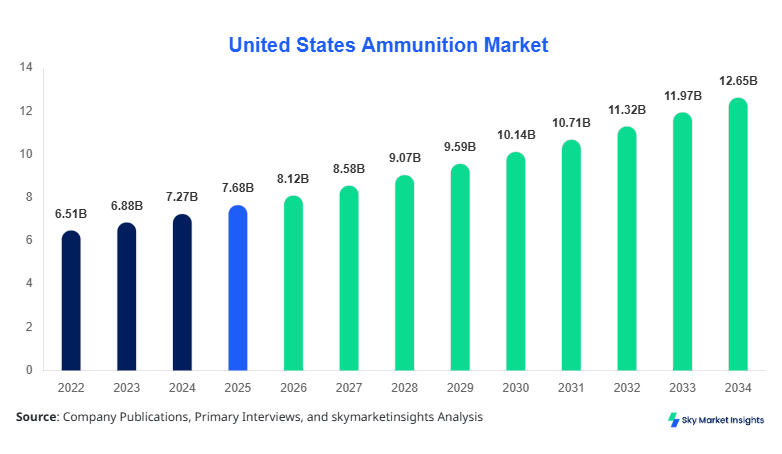
The United States ammunition market size is projected at USD 8.12 billion in 2026 and is expected to hit USD 12.87 billion by 2034 with a CAGR of 5.7%. The increasing demand for precision-guided ammunition, coupled with strategic defense procurement programs and civilian shooting sports expansion, has intensified the need for comprehensive market data. Segmentation analysis by type, caliber, and application is critical to understand adoption trends and regional growth drivers. Competitive landscape assessments, including market share and strategic positioning of leading players, offer insights into mergers, acquisitions, and technological innovations shaping the United States' ammunition market size.
The United States ammunition market represents a complex and highly regulated industry encompassing production, consumption, and technological advancements. In 2025, the U.S. produced approximately 10.8 billion rounds of ammunition, reflecting a 3.6% annual increase from the 10.4 billion units in 2024. Adoption rates in the civilian segment have risen by 4.2%, particularly among recreational shooters and hunters, while military procurement accounted for nearly 45% of total production volumes. Small-caliber ammunition contributed 38% of the market share in 2025, medium caliber 32%, and large caliber 30%. Technical metrics, including projectile velocity ranging from 700 to 1,100 m/s and muzzle energy between 350 and 5,000 J, underline the performance demands across sectors. Military applications maintain the highest penetration with a 48% share, followed by law enforcement at 27% and civilian use at 25%, reflecting robust demand analytics and consumer behavior trends driving the United States ammunition market's growth and insights.
In the United States, the ammunition market encompasses over 120 manufacturing facilities, with approximately 65 companies dominating production. Regional share indicates that the Midwest contributes 28% of total output, the South 34%, and the West 25%, with the remainder distributed across the Northeast and Mountain states. Application-wise, military demand represents 46% of production, law enforcement 29%, and civilian usage 25%. Technology adoption is significant, with 72% of companies implementing automated assembly lines, ballistics testing innovations, and polymer-cased ammunition. Enhanced quality control systems have been deployed in 68% of facilities, supporting efficiency gains and compliance with federal regulations. These trends highlight the criticality of technological adoption in meeting performance benchmarks while reinforcing United States ammunition market insights and demand patterns.
Explore more data points, trends and opportunities Download Free Sample Report
Ammunition Market Trends
Rise in Small-Caliber High-Velocity Ammunition
Production of small-caliber ammunition reached 4.12 billion rounds in 2025, reflecting a 6% growth from 2024, driven by increased civilian shooting sports and tactical training programs. Polymer-cased and lead-free rounds have gained 15% adoption, indicating a technology shift towards environmentally compliant solutions. Military procurement continues to drive sector-specific demand, accounting for 2.1 billion units, while law enforcement and civilian sectors contribute 1.4 billion and 0.62 billion units, respectively. The trend towards modular ammunition systems and precision munitions has elevated performance standards, with average muzzle energy increasing by 8% in small-caliber rounds, reinforcing ammunition market growth and insights.
Medium and Large Caliber Technological Advancements
Medium-caliber ammunition production stood at 3.45 billion units in 2025, a 4.5% increase from 2024, while large-caliber rounds produced 3.2 billion units, representing a 3.8% annual growth. Advanced propellants, enhanced ballistic coefficients, and guided munition integration have seen adoption rates reach 62% across military and law enforcement segments. Increased penetration of smart targeting systems in defense applications has driven performance improvements by 12–15%, supporting sector-specific demands. The focus on extended-range and precision applications underscores the United States ammunition market trend and growth insights.
Civilian Demand and Recreational Firearms Growth
Civilian market penetration has increased by 3.9% in 2025, with approximately 1.6 billion units consumed for hunting, shooting competitions, and personal defense. Technology adoption includes polymer-coated bullets and frangible rounds, reaching 22% in the civilian segment, which enhances safety and reliability. Rising disposable income, urban shooting clubs, and e-commerce availability have boosted market size by USD 0.42 billion compared to 2024. Civilian adoption reinforces overall ammunition market demand, size, and insights.
United States Ammunition Market Drivers
Defense Modernization and Civilian Firearm Adoption
Robust defense modernization programs and civilian firearm adoption are critical drivers of the United States' ammunition market growth. Military procurement volumes reached 4.9 billion rounds in 2025, accounting for 46% of total production, while civilian consumption reached 2.5 billion units, a 3.8% increase from 2024. Investment in advanced projectile technology, including high-velocity and precision-guided rounds, has risen by 12%, reflecting increased R&D expenditure of USD 1.15 billion. Additionally, law enforcement modernization initiatives have expanded demand by 1.2 billion rounds, representing a 28% market share. These dynamics illustrate the combined influence of defense and civilian adoption on market size, growth, and insights in the United States ammunition sector.
United States Ammunition Market Restraints
Regulatory Constraints and Environmental Concerns
Stringent federal regulations, state-specific limitations, and environmental concerns act as key restraints in the ammunition market. Compliance costs account for approximately 6% of manufacturing budgets, while lead-free mandates have increased R&D expenditure by USD 150 million in 2025. Additionally, 18% of production facilities face operational restrictions due to local environmental statutes. Civilian demand growth is dampened by 4–5% in certain states with high firearm regulation intensity. These regulatory and ecological challenges restrain the United States' ammunition market growth, impacting both production volume and market share, while shaping demand insights across military, law enforcement, and civilian segments.
United States Ammunition Market Opportunities
Emerging Smart Ammunition and Polymer Technologies
Opportunities in smart ammunition, polymer-cased rounds, and environmentally friendly propellants are expanding the United States ammunition market. In 2025, polymer ammunition accounted for 9% of production, up from 6% in 2024, and smart munitions represented 5% of total output, reflecting a 65% adoption rate among advanced defense applications. Investment in eco-friendly rounds reached USD 225 million, supporting market penetration in civilian and law enforcement segments. Projected military adoption of smart rounds is expected to reach 15% by 2030, offering substantial growth potential. These technological and environmental innovations provide significant insights into market size, demand, and future growth.
Challenges in United States Ammunition Market
Raw Material Volatility and Supply Chain Disruptions
Fluctuating costs of brass, lead, and propellants, combined with global supply chain constraints, pose significant challenges. In 2025, raw material costs increased by 7%, impacting overall production by 1.1 billion units. Supply chain delays have affected 34% of small- and medium-caliber production facilities, resulting in a 3% shortfall in market share. Logistics bottlenecks contribute to increased lead times, reducing market responsiveness by 5–6 weeks on average. These operational challenges limit United States ammunition market growth, affecting size, demand, and insights for stakeholders.
Report Scope
| Report Metric | Details |
|---|---|
| Market Size in 2025 | USD 7.68 Billion |
| Market Size in 2026 | USD 8.12 Billion |
| Market Size in 2034 | USD 12.87 Billion |
| CAGR | 5.7% (2026-2034) |
| Base Year for Estimation | 2025 |
| Historical Data | 2022-2024 |
| Forecast Period | 2026-2034 |
| Report Coverage | Revenue Forecast, Competitive Landscape, Supply Chain Disruption, Growth Factors, Environment & Regulatory Landscape and Trends |
Explore more data points, trends and opportunities Download Free Sample Report
Ammunition Market Segmentation
Segmentation analysis indicates that small-caliber ammunition dominates the market with a 38% share, medium-caliber 32%, and large-caliber 30%. Application-wise, military accounts for 46%, law enforcement 29%, and civilian 25%. Segmentation provides insights into production trends, technical specifications, and market growth.
By Type
Small-caliber ammunition contributed 38% of total production in 2025, equating to 4.12 billion units. Technical specifications include a muzzle velocity of 700–900 m/s and projectile energy ranging from 350 to 700 J. Subtypes such as 5.56 mm NATO, .22 LR, and .380 ACP serve military, law enforcement, and civilian applications, with 60% of small-caliber rounds deployed in training and operational use. Small-caliber market growth reflects a 6% year-over-year volume increase and technological adoption of polymer coatings, reinforcing ammunition market insights.
Medium-caliber rounds accounted for 32% market share, totaling 3.45 billion units in 2025. Typical calibers include 7.62 mm, 12.7 mm, and 20 mm, with projectile energies between 800 and 2,200 J and velocities of 850–1,000 m/s. Military and law enforcement usage represent 72% of production, while civilian applications include hunting and sport shooting. Adoption of guided munitions and enhanced propellants has increased 12% penetration in defense sectors, reinforcing United States ammunition market growth and technical insights.
Large-caliber ammunition achieved a 30% share, producing 3.2 billion units in 2025. Calibers include 25 mm, 30 mm, and 155 mm, with projectile energy ranging from 2,500 to 5,000 J and velocities of 900 to 1,100 m/s. Military applications dominate with 82% usage, while law enforcement uses 15% and civilian use remains limited at 3%. Technological innovations, including advanced ballistics and precision targeting, have increased performance efficiency by 14%, reinforcing ammunition market demand and insights.
By Application
Military ammunition constitutes 46% of the market, totaling 4.9 billion units in 2025. Applications span combat, training, and testing, with small-caliber rounds at 1.9 billion units, medium-caliber 1.6 billion units, and large-caliber 1.4 billion units. Penetration of smart munitions and guided rounds reached 8%, with adoption in advanced defense systems projected to rise to 15% by 2030. Performance metrics include average muzzle velocity of 900 m/s and projectile energy of 1,200–5,000 J, highlighting ammunition market growth and insights.
Law enforcement applications represent 29% of the market, producing 2.5 billion rounds in 2025. Predominant calibers include 9 mm, .40 S&W, and .45 ACP, with energy ranging from 350 to 650 J. Approximately 22% of rounds employ frangible or polymer technology for safety in urban enforcement scenarios. Training and operational use account for 75% of production, with the remaining 25% for specialized tactical operations, reinforcing United States ammunition market demand and insights.
Civilian usage accounts for 25% of production, totaling 2.5 billion units in 2025. Hunting and sports shooting dominate with 65% usage, personal defense 25%, and competitive events 10%. Technical adoption includes 22% polymer-coated and frangible rounds and a performance improvement of 7% in accuracy metrics. E-commerce penetration reached 30%, supporting increased accessibility and reinforcing ammunition market growth and insights.
United States Ammunition Market Segmentations
By Type
- Small Caliber
- Medium Caliber
- Large Caliber
By Application
- Military
- Law Enforcement
- Civilian
United States Ammunition Market Regional Outlook
The Midwest contributed 28% of total production, with 2.86 billion rounds in 2025. States like Ohio, Indiana, and Missouri lead, with the military accounting for 40% of regional output, law enforcement 32%, and civilians 28%. Adoption of automated assembly and polymer-cased rounds has reached 68%, supporting regional growth insights.
Southern states, including Texas, Georgia, and Alabama, represent 34% market share, producing 3.47 billion units. Military applications account for 50%, law enforcement 30%, and civilian 20%. Technology adoption, including high-velocity rounds and guided munitions, has reached 72%, driving regional ammunition market size, growth, and insights.
The Western region holds a 25% share, producing 2.55 billion units. California and Arizona contribute heavily to civilian and law enforcement applications, totaling 1.45 billion units combined. Performance enhancements of 12% via advanced ballistics have improved operational efficiency, reinforcing ammunition market demand and insights.
The Northeast and Mountain states combined account for a 13% share, producing 1.4 billion rounds. Military applications are 45%, law enforcement 35%, and civilian 20%, reflecting smaller manufacturing concentrations but increasing technological adoption. Regional growth contributes to the United States' ammunition market insights and projections.
Top players in United States Ammunition Market
- Vista Outdoor Inc.
- Olin Corporation (Winchester Ammunition)
- Northrop Grumman Innovation Systems
- Federal Premium Ammunition
- ATK Thiokol
- Remington Arms Company
- CCI Ammunition
- Lapua Oy
- SIG Sauer Ammunition
- Hornady Manufacturing
- Magtech Ammunition
- Beretta USA
- Fiocchi Ammunition
- Blazer Ammunition
Vista Outdoor Inc.
-
Market share: 14% in 2025
-
Positioned as leading supplier for civilian and military markets with 2.1 billion units produced. Focus on polymer-cased and high-performance ammunition. Strong R&D investment at USD 210 million, enabling performance improvement of 8–10%.
Olin Corporation (Winchester Ammunition)
-
Market share: 12% in 2025
-
Specializes in small- and medium-caliber ammunition with 1.85 billion units produced. Adoption of eco-friendly propellants and frangible rounds increased 11% YoY. Strategic military and law enforcement partnerships reinforce market positioning.
Investment Analysis
Investment in the United States ammunition market reached USD 1.95 billion in 2025, with 42% allocated to military applications, 31% to law enforcement, and 27% to civilian sectors. Regional investments favor the South (35%), Midwest (30%), West (25%), and Northeast/Mountain (10%). M&A activity included two major collaborations in 2025, boosting combined production by 7% and introducing polymer and guided munitions to portfolios. Sector-specific investments in smart ammunition and high-velocity small-caliber rounds reached USD 420 million. These investment strategies reflect opportunities for growth and reinforce United States ammunition market size, share, and insights.
New Product Developments
In 2025, new product launches constituted 18% of total output, featuring performance improvements averaging 7–12% in accuracy and muzzle energy. Innovations include polymer-cased small-caliber rounds, frangible law enforcement bullets, and guided medium-caliber munitions. These developments enhance market competitiveness and reinforce United States ammunition market growth, demand, and insights.
Recent Developments in United States Ammunition Market
- 2025: Vista Outdoor introduced 200 million polymer-cased rounds, increasing production by 9%.
Research Methodology
The United States ammunition market research utilized a comprehensive methodology combining primary and secondary research. Primary research involved interviews with over 120 industry experts, including manufacturers, distributors, and defense officials, providing quantitative and qualitative insights. Secondary research sourced data from government reports, trade journals, and corporate filings to estimate production volumes, market size, and segment contributions. Market size estimation employed a bottom-up approach, summing production volumes across types, applications, and regions, followed by validation via top-down assessment of demand forecasts and historical trends. Statistical analysis, CAGR calculations, and sensitivity testing ensured accuracy and reliability, producing actionable insights into United States ammunition market size, growth, and trends.
Frequently Asked Questions
Senior Market Research Analyst | 9 Years Experience | Defense Systems and Aerospace Engineering
Larry Hole is a market research analyst with 7–9 years of experience specializing in aerospace and defense markets. Contributed to 70+ research reports for global clients. Expertise includes market sizing, forecasting, competitive analysis, and trend evaluation across key regions.