Europe Aerospace & Defense Fluid Conveyance Systems Market Size
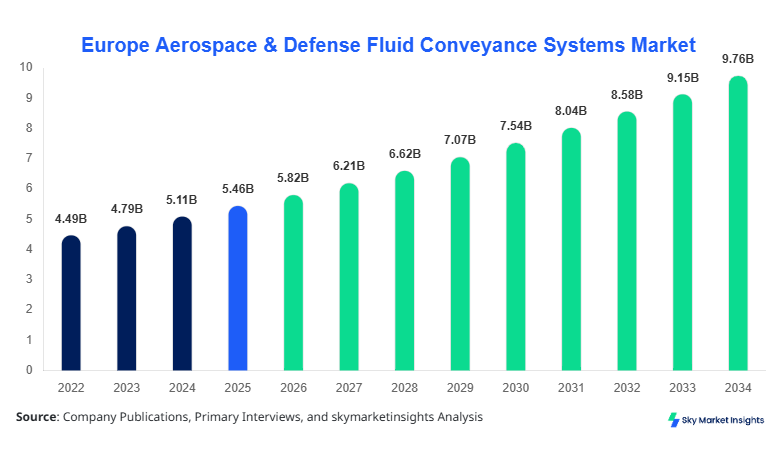
The Europe Aerospace & Defense Fluid Conveyance Systems market size is projected at USD 5.82 billion in 2026 and is expected to hit USD 9.76 billion by 2034 with a CAGR of 6.68%. The market expansion is supported by increasing aircraft production across Europe, rising defense modernization programs, and higher investments in lightweight aerospace fluid management technologies. The growing integration of advanced hydraulic tubes, flexible hoses, pneumatic ducts, and fuel conveyance assemblies across military aircraft, commercial fleets, and space programs is accelerating revenue generation. The report evaluates extensive segmentation analysis, procurement trends, technology benchmarking, and competitive landscape analysis covering OEMs, Tier-1 suppliers, and component manufacturers operating across the European aerospace sector.
The Aerospace & Defense Fluid Conveyance Systems market comprises the design, manufacturing, and deployment of hoses, couplings, ducts, valves, fittings, tubing systems, and associated fluid transfer technologies used in aerospace and military platforms. Europe produced more than 1,240 commercial and defense aircraft units in 2025, while aerospace exports exceeded USD 172 billion across Germany, France, the United Kingdom, Italy, and Spain. Hydraulic conveyance systems accounted for nearly 42% of total installations due to their critical role in flight control, landing gear, and braking applications, while pneumatic systems contributed approximately 31% owing to environmental control and cabin pressure operations. Fuel conveyance systems represented nearly 27% of installations across military jets, helicopters, and unmanned aerial vehicles.
Adoption and penetration rates continue to rise due to increasing replacement cycles and safety regulations. More than 68% of newly manufactured European aircraft platforms now integrate titanium-alloy conveyance assemblies compared with 49% in 2021. Composite-based lightweight hose adoption crossed 37% in 2025 as aircraft OEMs targeted fuel efficiency improvements between 8% and 12%. Commercial aviation applications contributed nearly 51% of total demand, while military aviation held 39% and space systems accounted for 10%. High-pressure conveyance systems operating between 3,000 psi and 8,000 psi witnessed substantial deployment growth because of increasing aircraft electrification and hydraulic optimization requirements, reinforcing long-term Aerospace & Defense Fluid Conveyance Systems market expansion.
In Germany, the Aerospace & Defense Fluid Conveyance Systems market accounted for nearly 28% of regional revenue generation in 2025 due to strong aerospace manufacturing infrastructure and high defense procurement spending. Germany hosts more than 240 aerospace component manufacturing facilities and over 85 certified fluid conveyance suppliers supporting Airbus, Lufthansa Technik, MTU Aero Engines, and military aerospace contractors. Commercial aviation applications represented approximately 54% of domestic demand, while military aviation contributed 36% and space programs held 10%. Germany produced nearly 420 aircraft systems and aerospace assemblies in 2025, creating extensive demand for hydraulic pipes, fuel manifolds, and pneumatic conveyance systems.
Technology adoption rates in Germany remain among the highest in Europe. Nearly 61% of aerospace conveyance assemblies manufactured in the country now use corrosion-resistant titanium and nickel-based alloys. Smart sensor-enabled conveyance systems capable of leak detection and pressure monitoring achieved 33% penetration across advanced defense aircraft programs. Additive manufacturing integration in aerospace tubing production increased by 24% during 2024–2025, reducing material waste by nearly 18%. Germany’s growing investment in unmanned aerial systems and next-generation fighter programs continues to strengthen aerospace & defense fluid conveyance systems market development across Europe.
Explore more data points, trends and opportunities Download Free Sample Report
Aerospace & Defense Fluid Conveyance Systems Market Trends
Increasing Adoption of Lightweight Composite Conveyance Technologies
The European aerospace industry is rapidly transitioning toward lightweight composite conveyance assemblies to improve aircraft fuel efficiency and operational performance. More than 4.8 million meters of composite-based aerospace tubing were deployed across Europe in 2025, reflecting an annual increase of 17%. Aircraft OEMs are increasingly replacing conventional stainless-steel systems with titanium-composite hybrid conveyance assemblies capable of reducing total system weight by 22% to 35%. Commercial aircraft manufacturers reported fuel savings between 2.8% and 4.2% following large-scale deployment of lightweight hydraulic and fuel conveyance systems. Demand for high-temperature flexible hoses with thermal resistance above 260°C also increased by 31% because of advanced engine integration requirements. This transition continues to accelerate aerospace & defense fluid conveyance systems market development across commercial and military sectors.
Rising Integration of Smart Monitoring and Predictive Maintenance Systems
Advanced monitoring technologies are becoming a critical trend within aerospace fluid conveyance infrastructure across Europe. Nearly 39% of newly delivered military aircraft in 2025 integrated predictive maintenance-enabled conveyance systems equipped with IoT sensors, digital pressure analytics, and real-time leakage monitoring technologies. European defense operators reduced unscheduled maintenance incidents by approximately 21% through sensor-enabled hydraulic conveyance platforms. Aerospace companies invested over USD 640 million in digitalized conveyance monitoring research during 2024–2025. In addition, predictive maintenance adoption across commercial fleets improved system lifespan by nearly 16% while reducing downtime by 13%. The integration of digital diagnostics, smart couplings, and AI-supported monitoring technologies continues strengthening aerospace & defense fluid conveyance systems market innovation across Europe.
Expansion of Space and Defense Applications
Growing investments in European defense modernization and space launch programs are generating substantial opportunities for advanced conveyance systems. Europe launched more than 22 space missions in 2025, increasing demand for cryogenic fluid transfer systems and high-pressure propulsion conveyance assemblies. Defense aircraft production programs, including Eurofighter upgrades and FCAS development, contributed to a 19% increase in military conveyance procurement. High-performance fuel conveyance systems designed for hypersonic propulsion applications experienced demand growth exceeding 26% during 2025. Military-grade conveyance systems capable of operating above 10,000 psi pressure thresholds also gained higher adoption across next-generation combat aircraft, supporting aerospace & defense fluid conveyance systems market expansion.
Europe Aerospace & Defense Fluid Conveyance Systems Market Drivers
Increasing Aircraft Production and Defense Modernization Programs
Europe’s growing aircraft manufacturing activities and defense modernization initiatives are driving substantial demand for advanced fluid conveyance systems. Airbus delivered more than 760 commercial aircraft units in 2025, while European defense agencies allocated over USD 118 billion toward military modernization programs. Rising procurement of fighter aircraft, transport aircraft, helicopters, and unmanned systems is increasing the installation of hydraulic and fuel conveyance assemblies. Military aviation demand for high-pressure conveyance systems grew by nearly 23% during 2024–2025 owing to advanced flight control integration. Additionally, replacement cycles for aging aircraft fleets across Germany, France, and the United Kingdom are generating significant aftermarket opportunities. More than 41% of aerospace operators increased spending on conveyance system retrofits to comply with updated safety standards and fuel efficiency targets. Aircraft electrification programs are further driving adoption of thermally resistant pneumatic conveyance solutions operating above 300°C. The increasing focus on lightweight components, enhanced safety performance, and predictive maintenance capabilities continues to reinforce aerospace & defense fluid conveyance systems market expansion across Europe.
Europe Aerospace & Defense Fluid Conveyance Systems Market Restraints
High Manufacturing Costs and Complex Certification Requirements
The Aerospace & Defense Fluid Conveyance Systems market faces significant restraints due to high manufacturing costs, stringent aerospace certifications, and supply chain complexities. Titanium alloy conveyance assemblies cost approximately 28% to 45% more than conventional stainless-steel systems, limiting adoption among smaller aerospace suppliers. Certification procedures under EASA and NATO aerospace standards can extend development cycles between 18 and 36 months while increasing testing expenditures by nearly 20%. Additionally, aerospace-grade raw material price volatility resulted in a 14% increase in production costs during 2025. More than 32% of European component manufacturers reported procurement delays associated with high-performance elastomers and specialty alloys. Supply disruptions affecting precision couplings and aerospace tubing also reduced production efficiency by approximately 11% across select manufacturing facilities. The shortage of certified aerospace technicians and fluid system engineers further constrains production scalability, particularly in Eastern Europe and Russia. These operational and regulatory barriers continue limiting short-term Aerospace & Defense Fluid Conveyance Systems Market acceleration despite strong long-term demand fundamentals.
Europe Aerospace & Defense Fluid Conveyance Systems Market Opportunities
Growing Investments in Sustainable Aviation and Space Technologies
The rapid expansion of sustainable aviation initiatives and European space programs presents major growth opportunities for conveyance system manufacturers. Europe allocated more than USD 21 billion toward sustainable aerospace technologies and space infrastructure during 2025. Hydrogen-powered aircraft development programs are creating rising demand for cryogenic conveyance systems capable of operating below -253°C. Nearly 18% of ongoing aerospace R&D projects in Europe focus on alternative propulsion fluid transfer technologies. The increasing deployment of reusable launch vehicles and satellite propulsion systems is also boosting demand for high-reliability fuel conveyance assemblies. Space-grade conveyance systems with leak tolerances below 0.01% experienced procurement growth of nearly 24% during 2025. Additionally, collaborative aerospace initiatives between defense contractors and commercial OEMs are accelerating innovation in lightweight fluid transfer materials. Investments in electric aircraft and urban air mobility platforms are further expanding opportunities for compact pneumatic conveyance systems. These developments are expected to create strong long-term aerospace & defense fluid conveyance systems market opportunities across Europe.
Challenges in European Aerospace & Defense Fluid Conveyance Systems Market
Supply Chain Vulnerabilities and Material Dependency
The Aerospace & Defense Fluid Conveyance Systems market continues to face operational challenges associated with supply chain vulnerabilities and dependence on specialized aerospace materials. More than 47% of aerospace conveyance manufacturers in Europe rely on imported titanium, nickel alloys, and aerospace elastomers sourced from limited suppliers. Material shortages during 2025 increased lead times for precision conveyance assemblies from 14 weeks to nearly 26 weeks across several Tier-1 suppliers. Rising geopolitical instability also disrupted procurement of aerospace-grade components and advanced sealing materials. Manufacturers experienced nearly 12% higher logistics costs because of cross-border transportation delays and defense export restrictions. Furthermore, approximately 36% of suppliers reported production bottlenecks related to limited availability of automated tube bending and high-precision welding systems. Integration challenges involving next-generation digital monitoring systems and legacy aircraft platforms further complicate operational efficiency. The need to balance lightweight material adoption with durability and thermal resistance requirements remains a significant engineering challenge affecting the aerospace & defense fluid conveyance systems market scalability.
Report Scope
| Report Metric | Details |
|---|---|
| Market Size in 2025 | USD 5.46 Billion |
| Market Size in 2026 | USD 5.82 Billion |
| Market Size in 2034 | USD 9.76 Billion |
| CAGR | 6.68% (2026-2034) |
| Base Year for Estimation | 2025 |
| Historical Data | 2022-2024 |
| Forecast Period | 2026-2034 |
| Report Coverage | Revenue Forecast, Competitive Landscape, Supply Chain Disruption, Growth Factors, Environment & Regulatory Landscape and Trends |
Explore more data points, trends and opportunities Download Free Sample Report
Aerospace & Defense Fluid Conveyance Systems Market Segmentation
The Aerospace & Defense Fluid Conveyance Systems market is segmented by type and application, with hydraulic systems maintaining approximately 42% market dominance owing to widespread deployment across commercial and military aircraft. Commercial aviation applications contributed nearly 51% of overall installations, followed by military aviation at 39% and space systems at 10%. Increasing aircraft production volumes and modernization programs continue to diversify product demand across multiple aerospace sectors.
By Type
Hydraulic systems represented nearly 42% of total aerospace & defense fluid conveyance systems market revenue in 2025 due to extensive utilization in flight controls, landing gear operations, and braking systems. More than 3.6 million hydraulic conveyance units were manufactured across Europe during the year. These systems typically operate between 3,000 psi and 8,000 psi and require high-strength titanium or stainless-steel tubing to withstand extreme pressure conditions. Germany and France jointly accounted for nearly 48% of hydraulic conveyance production across Europe. Increasing deployment of lightweight hydraulic assemblies reduced aircraft system weight by approximately 18% while improving operational efficiency. Demand for corrosion-resistant hydraulic hoses and fittings also increased by 21% due to rising aircraft maintenance requirements. Military aircraft applications contributed approximately 44% of hydraulic system demand because of high-pressure maneuverability requirements. The adoption of digitally monitored hydraulic conveyance assemblies with embedded pressure sensors increased by 29% in 2025, enhancing predictive maintenance capabilities and supporting the Aerospace & Defense Fluid Conveyance Systems market expansion.
Pneumatic systems accounted for approximately 31% of market revenue owing to increasing use in cabin pressure control, environmental systems, and engine air management applications. Europe produced nearly 2.8 million pneumatic conveyance components in 2025, with significant contributions from the United Kingdom and Italy. Pneumatic systems operating between 150 psi and 1,200 psi gained higher adoption because of their lower maintenance requirements and improved operational reliability. Commercial aviation represented almost 58% of pneumatic conveyance demand, particularly in next-generation fuel-efficient aircraft platforms. Advanced thermal-resistant pneumatic ducts capable of withstanding temperatures above 300°C witnessed demand growth of 26% during 2025. Composite pneumatic tubing penetration increased from 19% in 2022 to 34% in 2025 as aircraft manufacturers targeted reduced fuel consumption. Aerospace OEMs also expanded investment in smart pneumatic monitoring technologies to improve system diagnostics and pressure optimization. The increasing integration of electric aircraft subsystems is expected to further strengthen pneumatic conveyance deployment across the Aerospace & Defense Fluid Conveyance Systems market.
Fuel conveyance systems contributed nearly 27% of total market revenue due to rising aircraft fuel efficiency requirements and expanding space propulsion programs. Europe manufactured more than 2.1 million aerospace fuel conveyance assemblies in 2025, including fuel manifolds, transfer lines, valves, and cryogenic fuel pipes. Military aviation applications represented nearly 46% of fuel conveyance demand because of advanced fighter aircraft and helicopter procurement activities. Space systems accounted for approximately 14% owing to increasing launch vehicle development across Europe. High-performance fuel conveyance systems designed for temperatures below -200°C experienced adoption growth exceeding 23% during 2025. Leak-resistant fuel transfer technologies reduced operational fuel losses by nearly 11%, improving aircraft efficiency and safety compliance. Titanium-based fuel conveyance assemblies represented 38% of installations because of their superior corrosion resistance and lightweight properties. The increasing adoption of sustainable aviation fuel infrastructure and hydrogen propulsion technologies continues to accelerate demand across the Aerospace & Defense Fluid Conveyance Systems market.
By Application
Commercial aviation remained the largest application segment, with nearly a 51% share of the aerospace & defense fluid conveyance systems market in 2025. More than 640 commercial aircraft were manufactured or assembled across Europe during the year, generating strong demand for hydraulic, pneumatic, and fuel conveyance technologies. Narrow-body aircraft applications accounted for approximately 57% of commercial demand, while wide-body aircraft contributed 29% and regional aircraft represented 14%. Lightweight conveyance systems reduced average aircraft operational weight by nearly 12%, improving fuel efficiency by 3% to 5%. Airlines increased investments in predictive maintenance-enabled conveyance systems, leading to 18% higher adoption of smart fluid monitoring technologies. Commercial aircraft typically integrate over 7 kilometers of fluid conveyance tubing and more than 2,000 fittings per platform. Demand for high-temperature pneumatic ducts and lightweight hydraulic assemblies continues increasing as aircraft OEMs prioritize sustainability and operational performance. These trends are reinforcing long-term aerospace & defense fluid conveyance systems market expansion across the commercial aerospace industry.
Military aviation accounted for approximately 39% of total market demand because of rising defense procurement and modernization initiatives across Europe. More than 420 military aircraft and helicopters underwent upgrades or production activities during 2025, significantly increasing demand for high-performance conveyance systems. Fighter aircraft represented nearly 48% of military conveyance installations, followed by transport aircraft at 27%, helicopters at 19%, and unmanned systems at 6%. High-pressure hydraulic conveyance assemblies operating above 8,000 psi experienced demand growth exceeding 22% owing to next-generation combat aircraft programs. Defense operators increasingly adopted ballistic-resistant and thermally insulated conveyance systems to improve aircraft survivability and operational reliability. Smart monitoring-enabled military conveyance systems reduced maintenance downtime by approximately 17% during 2025. Europe also increased procurement of advanced fuel transfer technologies for long-range military operations and aerial refueling applications. These developments continue strengthening aerospace & defense fluid conveyance systems' market penetration within defense aerospace infrastructure.
Space systems represented approximately 10% of overall market demand but demonstrated the fastest technological advancement rates across Europe. More than 22 orbital launches and satellite propulsion programs in 2025 created substantial demand for cryogenic and ultra-high-pressure conveyance technologies. Fuel conveyance systems accounted for nearly 44% of space-related installations, while pneumatic systems contributed 31% and hydraulic technologies represented 25%. Space-grade conveyance assemblies capable of operating under vacuum conditions and temperatures below -250°C experienced production growth of nearly 28%. Europe’s expanding satellite manufacturing ecosystem also increased procurement of precision fluid conveyance systems used in propulsion, cooling, and environmental control applications. Leak-proof conveyance technologies with reliability rates exceeding 99.98% gained substantial adoption across reusable launch vehicle programs. Investments in lunar exploration missions and advanced propulsion technologies are expected to further accelerate Aerospace & Defense Fluid Conveyance Systems Market demand within the European space sector.
Europe Aerospace & Defense Fluid Conveyance Systems Market Segmentations
Type
- Hydraulic Systems
- Pneumatic Systems
- Fuel Conveyance Systems
Application
- Commercial Aviation
- Military Aviation
- Space Systems
Europe Aerospace & Defense Fluid Conveyance Systems Market Regional Outlook
United Kingdom
The United Kingdom accounted for nearly 21% of the regional aerospace & defense fluid conveyance systems market in 2025 due to its advanced aerospace engineering ecosystem and defense manufacturing capabilities. The country hosts more than 180 aerospace component manufacturing facilities supporting military and commercial aviation programs. Commercial aviation represented approximately 49% of domestic demand, while military applications contributed 43% and space systems accounted for 8%. The United Kingdom manufactured over 2.4 million aerospace conveyance components during 2025, including hydraulic tubes, flexible fuel lines, and pneumatic ducts. Investments exceeding USD 4.2 billion in aerospace modernization programs accelerated adoption of lightweight conveyance technologies. Nearly 36% of UK aerospace conveyance manufacturers integrated automated robotic tube fabrication systems to improve production efficiency and reduce waste.
Germany
Germany maintained the largest regional share at approximately 28% due to strong aerospace exports and advanced manufacturing infrastructure. More than 420 aircraft systems and assemblies were produced across Germany during 2025, supporting high procurement volumes for conveyance technologies. Hydraulic systems represented nearly 44% of domestic installations, while fuel conveyance systems contributed 29%. Germany’s aerospace sector invested approximately USD 5.8 billion in digitalized aerospace production technologies during 2025. Smart conveyance monitoring solutions achieved penetration rates above 33% within military aviation applications. Germany also led European adoption of titanium-based aerospace conveyance systems with deployment rates exceeding 61%.
France
France contributed nearly 19% of the aerospace & defense fluid conveyance systems market owing to extensive Airbus production operations and strong defense aerospace activities. The country produced approximately 2.9 million aerospace conveyance components during 2025, including fuel manifolds, hydraulic couplings, and cryogenic tubing systems. Commercial aviation represented 56% of domestic demand due to large-scale aircraft assembly operations. France increased investments in sustainable aviation technologies by nearly 24% during 2025, accelerating development of hydrogen-compatible fluid conveyance infrastructure. Space systems accounted for 12% of national demand because of expanding satellite and launch vehicle programs.
Spain
Spain accounted for nearly 9% of the regional market and demonstrated strong growth in aerospace component manufacturing. The country manufactured more than 1.3 million conveyance assemblies during 2025, primarily supporting Airbus and European defense supply chains. Commercial aviation applications represented approximately 52% of total demand, while military aviation contributed 38%. Spain’s aerospace sector increased adoption of lightweight composite conveyance systems by nearly 27% during 2025. Investments in unmanned aerial systems and defense modernization programs also boosted procurement of high-pressure hydraulic tubing solutions.
Italy
Italy held approximately 11% of regional market revenue due to rising aerospace exports and helicopter manufacturing activities. The country produced nearly 1.6 million aerospace conveyance components in 2025. Helicopter applications represented approximately 31% of domestic demand owing to strong rotorcraft production operations. Pneumatic systems accounted for nearly 35% of total installations because of increasing adoption in environmental control systems. Italy invested more than USD 1.9 billion in aerospace R&D programs during 2025, accelerating deployment of advanced conveyance monitoring technologies and lightweight fluid transfer assemblies.
Russia
Russia represented approximately 12% of the aerospace & defense fluid conveyance systems market in Europe due to extensive military aviation manufacturing and defense modernization activities. Military applications accounted for nearly 64% of domestic demand, while commercial aviation contributed 28%. Russia produced more than 1.8 million aerospace conveyance assemblies during 2025, including fuel transfer systems and high-pressure hydraulic tubing. Investments in next-generation fighter aircraft and unmanned systems increased procurement of advanced conveyance technologies by nearly 18%. However, supply chain disruptions and export restrictions affected component imports and production scalability during the year.
Top players in Europe's aerospace & Defense Fluid Conveyance Systems Market
- Parker Hannifin Corporation
- Eaton Corporation
- Senior plc
- Safran S.A.
- Triumph Group
- Cobham Aerospace Communications
- GKN Aerospace
- ITT Inc.
- Meggitt PLC
- Stelia Aerospace
- Smiths Group plc
- Hutchinson SA
- Crane Aerospace & Electronics
- Flexfab LLC
- Arrowhead Products Corporation
Parker Hannifin Corporation
-
Estimated regional share: 14%
-
Strong positioning in hydraulic and fuel conveyance technologies
-
Operates multiple aerospace manufacturing facilities across Germany, France, and the United Kingdom
Parker Hannifin Corporation remains one of the leading participants in the Aerospace & Defense Fluid Conveyance Systems market due to its diversified aerospace product portfolio and extensive OEM partnerships. The company supplied more than 620,000 aerospace conveyance assemblies across Europe in 2025, including lightweight hydraulic tubing and advanced fuel transfer systems. Approximately 46% of Parker Hannifin’s aerospace revenue in Europe originated from military aviation applications. The company increased investment in smart conveyance monitoring technologies by 18% during 2025 and expanded production of titanium-based aerospace tubing systems. Parker Hannifin maintains strong partnerships with Airbus and European defense contractors, reinforcing its strategic market leadership.
Eaton Corporation
-
Estimated regional share: 11%
-
Major supplier of aerospace hydraulic and pneumatic conveyance systems
-
Strong penetration across commercial aviation platforms
Eaton Corporation maintained a significant presence within the aerospace & defense fluid conveyance systems market through its advanced aerospace fluid management solutions. The company produced more than 510,000 aerospace conveyance assemblies in Europe during 2025. Commercial aviation represented approximately 58% of Eaton’s regional aerospace business, while military programs contributed 34%. Eaton expanded development of lightweight composite conveyance systems capable of reducing aircraft fluid transfer weight by nearly 20%. The company also introduced digitally integrated pneumatic conveyance solutions supporting predictive maintenance and pressure optimization. Continued investments in sustainable aviation fluid technologies and OEM collaborations strengthen Eaton’s long-term competitive positioning across Europe.
Investment Analysis
Investment activity within the Aerospace & Defense Fluid Conveyance Systems The market increased substantially during 2024–2026 due to expanding aircraft production and defense modernization programs. Europe allocated more than USD 13.6 billion toward aerospace fluid management technologies, lightweight materials, and advanced manufacturing systems during 2025. Commercial aviation received approximately 48% of investment allocation, while military aviation accounted for 39% and space systems represented 13%. Germany and France jointly contributed nearly 52% of total regional investments because of extensive aerospace manufacturing infrastructure. Investments in additive manufacturing for aerospace conveyance assemblies increased by approximately 26%, enabling lower production costs and reduced material waste.
Strategic mergers, acquisitions, and collaborations continue reshaping the competitive landscape. More than 18 aerospace component collaboration agreements were signed across Europe during 2025 involving conveyance technology suppliers, aircraft OEMs, and defense contractors. Nearly 31% of investments focused on smart conveyance systems equipped with predictive monitoring capabilities and AI-driven diagnostics. European defense agencies also increased procurement funding for high-pressure military conveyance systems by approximately 22% compared with 2024. Space infrastructure investments supporting cryogenic propulsion conveyance technologies rose by nearly 19%.
Cross-border collaborations between Germany, France, Italy, and the United Kingdom accelerated joint development programs for lightweight aerospace conveyance technologies. Approximately 28% of aerospace fluid conveyance investment spending targeted sustainable aviation fuel compatibility and hydrogen propulsion infrastructure. Venture capital funding directed toward advanced aerospace materials startups exceeded USD 740 million in 2025. Increasing investment diversification across commercial aerospace, defense aviation, and space systems is expected to create sustained long-term opportunities across the European Aerospace & Defense Fluid Conveyance Systems market.
New Product Developments
Manufacturers operating within the Aerospace & Defense Fluid Conveyance Systems The market introduced multiple next-generation products during 2025 focused on lightweight materials, thermal resistance, and predictive maintenance integration. Nearly 34% of newly launched aerospace conveyance products incorporated embedded sensor technologies capable of real-time pressure and leakage monitoring. Composite-titanium hybrid conveyance assemblies reduced overall aircraft system weight by approximately 23% while improving corrosion resistance by nearly 28%.
Advanced cryogenic conveyance systems developed for hydrogen-powered aircraft and reusable launch vehicles experienced strong adoption across Europe. Manufacturers introduced high-performance fuel transfer assemblies capable of operating below -250°C with leak tolerance improvements exceeding 18%. Smart pneumatic conveyance systems with AI-supported diagnostics improved maintenance efficiency by approximately 21%. More than 29% of aerospace OEM product launches during 2025 included sustainable material integration and recyclable aerospace tubing technologies, strengthening innovation momentum across the market.
Recent Developments in Europe Aerospace & Defense Fluid Conveyance Systems Market
- 2025: Parker Hannifin expanded aerospace tubing production capacity in Germany by approximately 16%, increasing the annual market.
Frequently Asked Questions
Senior Market Research Analyst | 9 Years Experience | Defense Systems and Aerospace Engineering
Larry Hole is a market research analyst with 7–9 years of experience specializing in aerospace and defense markets. Contributed to 70+ research reports for global clients. Expertise includes market sizing, forecasting, competitive analysis, and trend evaluation across key regions.