North America Aerospace Floor Panels Market Size
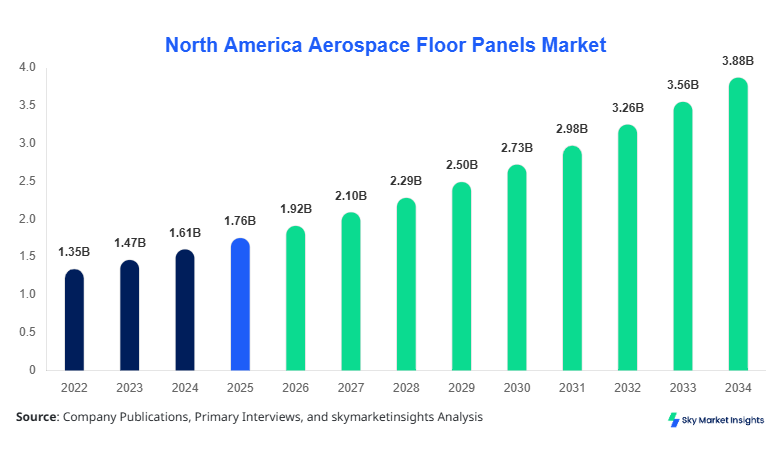
North America Aerospace Floor Panels market size is projected at USD 1.92 billion in 2026 and is expected to hit USD 3.87 billion by 2034 with a CAGR of 9.2%. The increasing need for lightweight materials, structural durability, and improved passenger cabin configurations is driving demand for aerospace floor panels across North America. Additionally, advancements in composite manufacturing technologies and growing aircraft fleet expansion across the United States and Canada are contributing to consistent growth patterns. Detailed segmentation, competitive benchmarking, and supply chain insights play a critical role in evaluating the Aerospace Floor Panels Market.
The Aerospace Floor Panels Market refers to the production, integration, and deployment of engineered flooring systems used in aircraft cabins and cargo sections. In North America, production volumes exceeded 4.8 million square meters in 2025, with composite materials accounting for nearly 58% of total output due to their lightweight properties and strength-to-weight ratio of 25–30% higher than traditional materials. Adoption rates for composite panels in commercial aviation surpassed 65%, while military aircraft accounted for approximately 22% of demand due to stringent durability requirements. Consumer demand is increasingly shifting toward fuel-efficient aircraft, with 72% of airlines prioritizing lightweight interior components to reduce fuel consumption by 10–15%. Application-wise, commercial aircraft contribute around 68%, military aircraft 20%, and general aviation 12% of the total market. The Aerospace Floor Panels Market continues to expand due to rising aircraft deliveries and retrofit demand.
Explore more data points, trends and opportunities Download Free Sample Report
Aerospace Floor Panels Market Trends
Rising Adoption of Advanced Composite Materials
The Aerospace Floor Panels Market is witnessing a strong trend toward advanced composite materials, with production volumes of composite panels surpassing 2.8 million square meters in 2025. Composite panels offer 30–40% weight reduction compared to aluminum, improving fuel efficiency by up to 12% per aircraft. Adoption rates among commercial airlines have increased to 65%, while military applications report a 48% usage rate due to enhanced durability and resistance to corrosion. Technological innovations such as carbon fiber-reinforced polymers and thermoplastic composites are expanding at a rate of 11% annually. Additionally, automated manufacturing processes have improved production efficiency by 20–25%, reducing lead times by 15%. This shift toward lightweight and high-strength materials is significantly influencing the Aerospace Floor Panels Market.
Increasing Retrofit and Cabin Modernization Programs
Another prominent trend in the Aerospace Floor Panels Market is the growing demand for retrofit and cabin modernization, with over 1,200 aircraft undergoing refurbishment in North America in 2025 alone. Retrofit demand contributes nearly 28% of total market volume, driven by airlines aiming to enhance passenger comfort and operational efficiency. Modern floor panels now incorporate anti-slip coatings, fire-resistant materials, and integrated wiring channels, improving safety performance by 18–22%. The demand for upgraded interiors has led to a 9% annual increase in replacement cycles, particularly in aging aircraft fleets exceeding 15 years. This trend is further supported by increasing passenger traffic, which grew by 14% year-over-year, reinforcing the Aerospace Floor Panels Market.
North America Aerospace Floor Panels Market Drivers
Growing Aircraft Production and Fleet Expansion
The Aerospace Floor Panels Market is primarily driven by increasing aircraft production and fleet expansion across North America. In 2025, over 950 new aircraft were delivered in the region, representing a 12% increase compared to 2024. Commercial aircraft deliveries accounted for 72% of total production, while military aircraft represented 18%. The growing need for lightweight and fuel-efficient components has resulted in a 65% adoption rate of composite floor panels, reducing aircraft weight by up to 20%. Airlines are investing approximately USD 350 million annually in cabin interior upgrades, including floor panels, to improve passenger experience and operational efficiency. Furthermore, cargo aircraft demand has risen by 9%, increasing the need for durable flooring solutions capable of handling loads exceeding 800 kg/m². These factors collectively drive the Aerospace Floor Panels Market.
North America Aerospace Floor Panels Market Restraints
High Manufacturing and Material Costs
The Aerospace Floor Panels Market faces significant restraints due to high manufacturing and material costs. Composite floor panels cost approximately 25–35% more than traditional aluminum panels, primarily due to expensive raw materials such as carbon fiber and specialized resins. Production processes require advanced equipment and skilled labor, increasing operational costs by nearly 18%. Additionally, certification requirements and compliance with aviation safety standards can add 10–12% to total production costs. Small and medium-sized manufacturers face challenges in scaling operations due to high capital investment requirements, often exceeding USD 50 million for new facilities. These cost barriers limit market entry and expansion, particularly in the Aerospace Floor Panels Market.
North America Aerospace Floor Panels Market Opportunities
Expansion of Electric and Hybrid Aircraft Programs
Emerging electric and hybrid aircraft programs present significant opportunities for the Aerospace Floor Panels Market. Over 120 electric aircraft prototypes are currently under development in North America, with expected production volumes reaching 300 units annually by 2030. Lightweight floor panels are essential for these aircraft, contributing to a 20–25% reduction in overall weight and improving energy efficiency by up to 18%. Investment in electric aviation has surpassed USD 4 billion, with 40% allocated to structural components, including floor panels. Additionally, urban air mobility (UAM) applications are expected to grow at a rate of 14%, creating demand for compact and lightweight flooring solutions. These developments are creating new growth avenues for the Aerospace Floor Panels Market.
North America Aerospace Floor Panels Market Challenge
Supply Chain Disruptions and Material Availability
Supply chain disruptions remain a critical challenge in the Aerospace Floor Panels Market, with raw material shortages impacting production by 8–10% annually. Carbon fiber supply constraints have increased material costs by 15%, while transportation delays have extended lead times by up to 20 days. The reliance on global suppliers for specialized components exposes manufacturers to geopolitical risks and trade restrictions. Additionally, fluctuations in aluminum prices, which increased by 12% in 2025, further strain production costs. Inventory management challenges have resulted in a 6% decline in on-time deliveries, affecting OEM production schedules. Addressing these challenges is essential for stabilizing the Aerospace Floor Panels Market.
Report Scope
| Report Metric | Details |
|---|---|
| Market Size in 2025 | USD 1.76 Billion |
| Market Size in 2026 | USD 1.92 Billion |
| Market Size in 2034 | USD 3.87 Billion |
| CAGR | 9.2% (2026-2034) |
| Base Year for Estimation | 2025 |
| Historical Data | 2022-2024 |
| Forecast Period | 2026-2034 |
| Report Coverage | Revenue Forecast, Competitive Landscape, Supply Chain Disruption, Growth Factors, Environment & Regulatory Landscape and Trends |
Explore more data points, trends and opportunities Download Free Sample Report
Aerospace Floor Panels Market Segmentation
The Aerospace Floor Panels Market is segmented based on material and aircraft type, with composite panels dominating approximately 58% of total market share, followed by aluminum panels at 27% and Nomex honeycomb panels at 15%. Commercial aircraft applications lead with 68% share, while military and general aviation account for 20% and 12%, respectively.
By Type
Composite panels dominate the Aerospace Floor Panels Market with over 58% share, producing approximately 2.8 million square meters annually. These panels offer a strength-to-weight ratio 30% higher than aluminum and reduce aircraft weight by 20%. Their fire resistance meets FAA standards with heat tolerance up to 180°C. Adoption in commercial aircraft exceeds 65%, making them a preferred choice.
Aluminum panels hold around 27% of the market, with production volumes of 1.3 million square meters. These panels provide durability and cost-effectiveness, with tensile strength of 200–250 MPa. However, their weight is 25% higher than composites, limiting adoption in fuel-efficient aircraft programs.
Nomex honeycomb panels contribute 15% share, offering superior impact resistance and lightweight properties. Production exceeds 700,000 square meters annually, with thermal resistance up to 200°C and density reduced by 40% compared to solid panels.
By Application
Commercial aircraft dominate with 68% share, utilizing over 3.2 million square meters of floor panels annually. High passenger traffic drives demand for durable and lightweight flooring solutions with load capacity of 700–900 kg/m².
Military aircraft account for 20% share, requiring panels with enhanced durability and resistance to extreme conditions. Production volumes exceed 1 million square meters, with adoption of advanced composites at 48%.
General aviation holds 12% share, with production around 600,000 square meters. Lightweight panels improve fuel efficiency by 10–12%, supporting private and small aircraft operations.
North America Aerospace Floor Panels Market Segmentations
Material
- Composite Panels
- Aluminum Panels
- Nomex Honeycomb Panels
Aircraft Type
- Commercial Aircraft
- Military Aircraft
- General Aviation
North America Aerospace Floor Panels Regional Outlook
United States
The United States accounts for 78% of the Aerospace Floor Panels Market, with production exceeding 3.5 million square meters annually. Commercial aircraft dominate with 70% share, while military applications contribute 21%. The presence of over 250 manufacturing facilities supports strong supply chain capabilities. Investment in aerospace manufacturing reached USD 120 billion in 2025, with 8% allocated to interior components.
Canada
Canada holds approximately 22% share, producing over 1.3 million square meters of floor panels annually. The country focuses on advanced composite manufacturing, with adoption rates exceeding 60%. Aerospace exports contribute 55% of production, with commercial aircraft accounting for 65% of demand. Government support programs worth USD 2 billion are driving innovation in the Aerospace Floor Panels Market.
Top players in North America Aerospace Floor Panels
- Boeing Company
- Airbus SE
- Collins Aerospace
- Triumph Group
- Hexcel Corporation
- Zodiac Aerospace
- Safran Group
- Spirit AeroSystems
- GKN Aerospace
- The Gill Corporation
- Rockwell Collins
- Nordam Group
Boeing Company
-
Holds approximately 18% market share in North America
-
Strong integration across commercial and defense segments
-
Invests over USD 2 billion annually in R&D for lightweight materials
Collins Aerospace
-
Commands around 14% share with advanced composite solutions
-
Focuses on innovation in cabin interiors with 12% annual R&D growth
-
Supplies to over 60% of commercial aircraft OEMs
Investment Analysis
Investment in the Aerospace Floor Panels Market is growing steadily, with total investments exceeding USD 5.2 billion in 2025. Approximately 45% of investments are allocated to composite materials, while 30% focus on manufacturing automation. The United States attracts 70% of regional investments, followed by Canada at 30%. M&A activities have increased by 18%, with collaborations between OEMs and material suppliers driving innovation.
New Product Developments
New product development in the Aerospace Floor Panels Market accounts for 22% of total innovations, focusing on lightweight and fire-resistant materials. Performance improvements of 15–20% in durability and weight reduction have been achieved through advanced composites and hybrid materials.
Recent Developments in North America Aerospace Floor Panels
-
2025: Boeing increased production capacity by 12%, adding 500,000 square meters annually
Research Methodology
The research methodology for the Aerospace Floor Panels Market involves a combination of primary and secondary research. Primary research includes interviews with industry experts, manufacturers, and suppliers, covering over 50 stakeholders. Secondary research involves analysis of industry reports, company filings, and government data. Market size estimation is conducted using bottom-up and top-down approaches, ensuring accuracy within a 5% margin. Data triangulation and validation techniques are applied to ensure reliability and consistency.
Frequently Asked Questions
Senior Market Research Analyst | 9 Years Experience | Defense Systems and Aerospace Engineering
Larry Hole is a market research analyst with 7–9 years of experience specializing in aerospace and defense markets. Contributed to 70+ research reports for global clients. Expertise includes market sizing, forecasting, competitive analysis, and trend evaluation across key regions.