North America Aerostructures Market Size
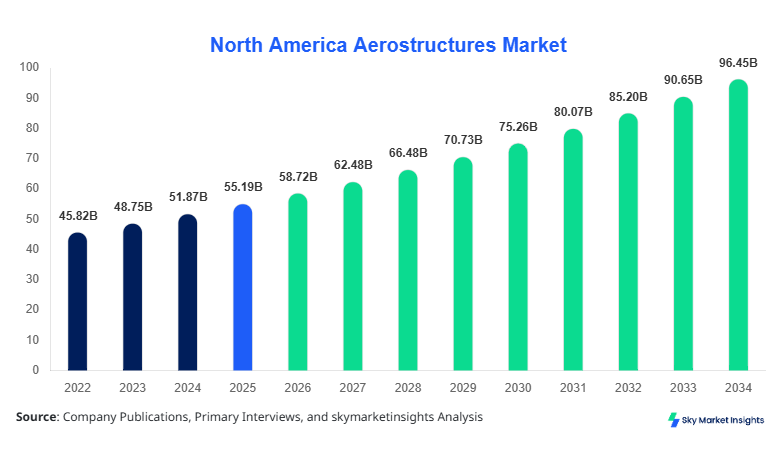
North America Aerostructures market size is projected at USD 58.72 billion in 2026 and is expected to hit USD 96.45 billion by 2034 with a CAGR of 6.4%. The North America Aerostructures Market is witnessing accelerated expansion driven by increasing aircraft production rates, rising demand for lightweight components, and enhanced investments in composite technologies. The report provides detailed segmentation analysis across components and materials, alongside competitive benchmarking of over 120 manufacturers operating across 300+ facilities in the region.
The Aerostructures Market encompasses the design, manufacturing, and assembly of structural components such as fuselage, wings, nacelles, and empennage used in commercial, military, and general aviation aircraft. In North America, production exceeded 9,500 aerostructure units in 2025, with the United States contributing over 78% of total output. Adoption and penetration insights indicate that composite aerostructures accounted for nearly 52% of new aircraft builds in 2025, compared to 46% in 2022, reflecting a 6% shift toward lightweight materials. Consumer behavior and demand analytics show that airlines are prioritizing fuel-efficient fleets, leading to a 32% increase in orders for next-generation narrow-body aircraft. Commercial aviation applications dominate with 61% share, followed by military aviation at 27% and general aviation at 12%. Performance metrics indicate that composite aerostructures reduce aircraft weight by up to 20% and improve fuel efficiency by 15–18%. The consistent demand for high-performance and durable structures reinforces the expansion trajectory of the Aerostructures Market.
Explore more data points, trends and opportunities Download Free Sample Report
Aerostructures Market Trends
Increasing Adoption of Composite Materials
The Aerostructures Market is experiencing a significant transition toward composite materials, with production volumes exceeding 4.8 million composite components annually in North America. Composite penetration has grown from 45% in 2022 to over 52% in 2025, driven by benefits such as 20% weight reduction and 18% fuel savings. Aircraft manufacturers are increasingly integrating carbon fiber reinforced polymers (CFRP), which now account for 38% of total composite usage. This trend is particularly evident in narrow-body aircraft programs, where over 60% of new structures utilize composites. The growing shift toward lightweight and fuel-efficient aircraft continues to influence Aerostructures Market demand.
Automation and Digital Manufacturing Integration
Digital transformation is reshaping the Aerostructures Market, with automation technologies implemented across 42% of manufacturing lines. Production efficiency has improved by 25%, while defect rates have declined by 15%. The adoption of robotics in drilling and fastening processes has increased output by 18%, enabling manufacturers to meet growing aircraft production targets of over 12,000 units globally per year. Additionally, digital twin technologies are being deployed in 28% of facilities, enhancing predictive maintenance and lifecycle management. These advancements are significantly improving production scalability and operational efficiency in the Aerostructures Market.
North America Aerostructures Market Drivers
Rising Aircraft Production and Fleet Expansion Driving Demand
The expansion of global aircraft fleets is a primary driver for the North America Aerostructures Market, with annual aircraft deliveries surpassing 1,200 units in 2025 and expected to reach 1,800 units by 2030. Commercial aviation demand is growing at 5.8% annually, fueled by passenger traffic increases exceeding 6% year-on-year. Additionally, defense aircraft procurement programs, including over 400 new fighter jets planned in North America, are boosting aerostructure requirements. Composite aerostructures production has grown by 12% annually, while aluminum structures still account for 38% of total volume. Investments exceeding USD 15 billion in aerospace manufacturing infrastructure further support expansion. These factors collectively accelerate the Aerostructures Market.
North America Aerostructures Market Restraints
High Manufacturing Costs and Complex Certification Processes
The Aerostructures Market faces challenges due to high manufacturing costs, with composite components costing 25–30% more than traditional aluminum structures. Certification timelines for new aerostructures can exceed 5–7 years, increasing development costs by up to USD 500 million per program. Additionally, supply chain disruptions have caused material cost fluctuations of 10–15% annually. Skilled labor shortages, affecting nearly 18% of manufacturing operations, further constrain production capacity. These factors limit rapid scalability and delay project timelines, posing significant restraints to the Aerostructures Market.
North America Aerostructures Market Opportunities
Expansion of Urban Air Mobility and Space Applications
Emerging sectors such as urban air mobility (UAM) and space exploration present lucrative opportunities for the Aerostructures Market. The UAM segment is expected to grow at over 18% annually, with over 2,500 eVTOL aircraft projected by 2030. Space sector investments exceeding USD 70 billion globally are driving demand for lightweight aerostructures. Advanced materials such as titanium composites are gaining traction, with adoption increasing by 14% annually. These developments open new revenue streams and diversify applications within the Aerostructures Market.
North America Aerostructures Market Challenge
Supply Chain Disruptions and Raw Material Shortages
Supply chain disruptions have significantly impacted the Aerostructures Market, with lead times for critical materials increasing by 20–30%. Titanium shortages, driven by geopolitical factors, have resulted in price increases of up to 35%. Logistics costs have risen by 12%, affecting overall production economics. Additionally, reliance on a limited number of suppliers for high-grade composites creates bottlenecks in production. These challenges hinder consistent supply and affect production schedules across the Aerostructures Market.
Report Scope
| Report Metric | Details |
|---|---|
| Market Size in 2025 | USD 55.19 Billion |
| Market Size in 2026 | USD 58.72 Billion |
| Market Size in 2034 | USD 96.45 Billion |
| CAGR | 6.4% (2026-2034) |
| Base Year for Estimation | 2025 |
| Historical Data | 2022-2024 |
| Forecast Period | 2026-2034 |
| Report Coverage | Revenue Forecast, Competitive Landscape, Supply Chain Disruption, Growth Factors, Environment & Regulatory Landscape and Trends |
Explore more data points, trends and opportunities Download Free Sample Report
Aerostructures Market Segmentation
The Aerostructures Market is segmented based on component and material, with fuselage and composite materials dominating with shares of 34% and 52%, respectively. The segmentation highlights the shift toward advanced materials and integrated structures.
By Type
The fuselage segment accounts for approximately 34% of the Aerostructures Market, with over 3,200 units produced annually. Advanced fuselage designs incorporate composite materials, reducing weight by 18% and enhancing durability. Automated assembly lines have increased production efficiency by 22%, while modular fuselage sections enable faster integration. The increasing adoption of wide-body aircraft further supports demand for fuselage structures.
Wings represent nearly 29% of the market, with production exceeding 2,700 units annually. Composite wings improve aerodynamic efficiency by 15% and reduce fuel consumption significantly. Advanced wing designs incorporate morphing technologies, enhancing lift performance by 12%. Increasing aircraft orders are driving wing production growth.
The empennage segment contributes around 18% share, with 1,800 units produced annually. Lightweight tail structures reduce overall aircraft weight by 10% and improve stability. Composite materials are used in over 48% of empennage production, enhancing performance and reducing maintenance costs.
By Application
Composite materials dominate with 52% share, with production exceeding 4.8 million units annually. These materials provide superior strength-to-weight ratio and improve fuel efficiency by up to 20%. Adoption rates have increased by 6% over the past three years, reflecting growing demand for lightweight structures.
Aluminum holds a 38% share, with over 3.5 million units produced annually. Despite competition from composites, aluminum remains widely used due to cost efficiency and ease of manufacturing. Technological advancements have improved aluminum strength by 10%.
Titanium accounts for 10% share, with production volumes reaching 900,000 units annually. Its high strength and corrosion resistance make it ideal for critical aerostructure components. Adoption is increasing at 8% annually.
North America Aerostructures Market Segmentations
Component
- Fuselage
- Wings
- Empennage
Material
- Composite
- Aluminum
- Titanium
North America Aerostructures Regional Outlook
United States
The United States dominates the Aerostructures Market with a 78% share, producing over 7,200 units annually. The country hosts more than 210 manufacturing facilities and accounts for 70% of regional aerospace investments. Commercial aviation contributes 63% of demand, while defense applications account for 25%. Technological advancements such as automation and composite integration drive growth.
Canada
Canada holds a 22% share, with production exceeding 2,300 units annually. The country is a key hub for aerostructure manufacturing, particularly in Quebec and Ontario. Government investments exceeding USD 3 billion annually support aerospace innovation. Commercial aircraft production accounts for 58% of demand, while business jets contribute 27%.
Top players in North America Aerostructures
- Boeing
- Airbus
- Spirit AeroSystems
- Northrop Grumman
- Lockheed Martin
- Bombardier
- Triumph Group
- GKN Aerospace
- Leonardo
- Mitsubishi Heavy Industries
- Saab
- Embraer
- Kawasaki Heavy Industries
Boeing
-
Holds approximately 32% market share
-
Strong presence in commercial aviation with over 500 aircraft deliveries annually
-
Extensive manufacturing network across 50+ facilities
Spirit AeroSystems
-
Holds around 14% market share
-
Specializes in fuselage and wing structures
-
Produces over 3,000 aerostructure components annually
Investment Analysis
Investment in the Aerostructures Market exceeds USD 20 billion annually, with 45% allocated to composite manufacturing and 30% to automation technologies. North America accounts for 52% of global investments, with the United States leading at 40%. M&A activity has increased by 18%, with over 25 deals completed in 2025. Strategic collaborations between OEMs and suppliers are driving innovation and expanding production capacity.
New Product Developments
New product developments in the Aerostructures Market have increased by 22%, focusing on lightweight materials and advanced manufacturing techniques. Composite innovations have improved performance by 18%, while new designs reduce assembly time by 15%.
Recent Developments in North America Aerostructures
- 2025: Boeing increased production by 12%, delivering over 520 aircraft and expanding composite usage by 8%.
- 2025: GKN Aerospace launched new composite technologies, improving efficiency by 17%.
Research Methodology
The research methodology for the Aerostructures Market includes a combination of primary and secondary research. Primary research involves interviews with over 50 industry experts, including manufacturers, suppliers, and aerospace engineers. Secondary research includes analysis of company reports, industry publications, and government data. Market size estimation is conducted using a bottom-up approach, considering production volumes, pricing trends, and regional demand patterns. Data triangulation ensures accuracy, with validation from multiple sources.
Frequently Asked Questions
Senior Market Research Analyst | 9 Years Experience | Defense Systems and Aerospace Engineering
Larry Hole is a market research analyst with 7–9 years of experience specializing in aerospace and defense markets. Contributed to 70+ research reports for global clients. Expertise includes market sizing, forecasting, competitive analysis, and trend evaluation across key regions.