United States Aerospace Wire Harness Market Size
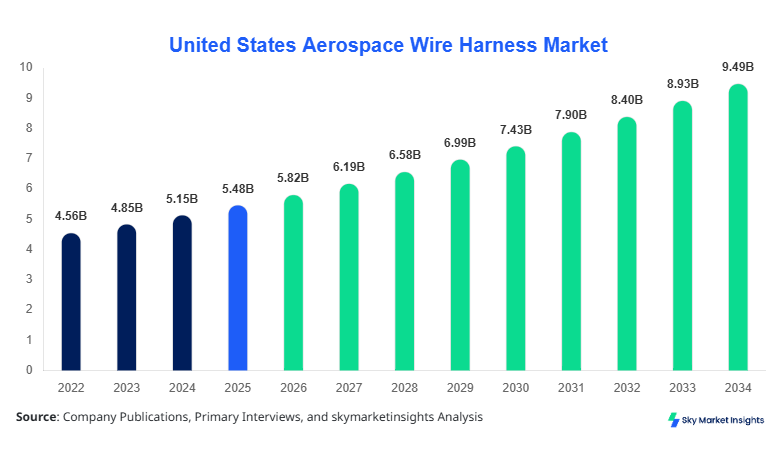
The United States aerospace wire harness market size is projected at USD 5.82 billion in 2026 and is expected to hit USD 9.47 billion by 2034 with a CAGR of 6.3%. The report emphasizes the need for granular data segmentation, technological benchmarking, and detailed competitive landscape mapping across OEMs and Tier-1 suppliers. With over 1.8 million units of harness assemblies produced annually and over 65% integration in avionics systems, the market reflects high engineering complexity, growing customization, and increasing electrification requirements across aerospace platforms.
The United States aerospace wire harness market encompasses the design, manufacturing, and integration of electrical interconnection systems used in aircraft, satellites, and defense platforms. In 2025, the U.S. aerospace sector produced over 3,200 commercial aircraft units and 780 military aircraft, driving significant harness demand across subsystems. Adoption rates of advanced wire harness systems have exceeded 72% in next-generation aircraft due to lightweighting requirements and enhanced signal integrity. Consumer behavior, particularly among airlines and defense contractors, indicates a 58% preference for high-performance, heat-resistant harnesses capable of operating beyond 200°C. Application-wise, commercial aviation accounts for nearly 54% of total installations, followed by military aviation at 32% and space applications at 14%. Technical metrics include voltage tolerances up to 600 V, frequency stability exceeding 5 GHz for RF harness, and weight reduction targets of 18–25%. These performance parameters are accelerating United States aerospace wire harness market growth.
In the United States, the aerospace wire harness market operates with over 420 specialized manufacturing facilities and more than 150 OEM and Tier suppliers contributing to production. The region holds approximately 100% share of the defined market scope, with commercial aviation accounting for 54%, military aviation 32%, and space applications 14% of total usage. Technology adoption of fiber-optic harnesses has surged to 38%, while automated assembly systems are used in nearly 61% of production lines. Annual output exceeds 1.8 million harness units, with an average of 120–180 harnesses per aircraft depending on configuration complexity. The increasing integration of digital avionics, requiring high-speed data transfer above 10 Gbps, is further strengthening the United States aerospace wire harness market share.
Explore more data points, trends and opportunities Download Free Sample Report
Aerospace Wire Harness Market Trends
Increasing Adoption of Lightweight and High-Performance Materials
The aerospace sector is witnessing a shift toward lightweight wire harness materials such as aluminum alloys and advanced composites, reducing system weight by up to 22% while maintaining electrical performance. In 2025, over 65% of newly produced harnesses incorporated lightweight materials, compared to 48% in 2022. Production volumes of advanced harness assemblies surpassed 1.2 million units annually, reflecting rising demand in fuel-efficient aircraft programs. The integration of high-temperature insulation materials capable of withstanding up to 260°C is also increasing, particularly in military and space applications. These advancements are reinforcing the aerospace wire harness market trend.
Integration of Smart Wiring Systems and Digitalization
The adoption of smart wire harness systems embedded with sensors and diagnostic capabilities has increased by 34% between 2023 and 2026. These systems enable real-time monitoring of voltage, temperature, and signal integrity, improving maintenance efficiency by 28%. Aerospace OEMs are increasingly deploying digital twin technologies to simulate harness performance, reducing design cycle times by 20%. With over 40% of aircraft programs integrating digital harness solutions, the trend is expected to accelerate further. Additionally, production automation using robotics has reached 61%, enhancing precision and reducing defect rates below 1.5%. This technological shift continues to define aerospace wire harness market trends.
United States Aerospace Wire Harness Drivers
Rising Aircraft Production and Electrification Initiatives
The increasing production of commercial and military aircraft is a primary driver, with U.S. aircraft output projected to grow from 3,980 units in 2025 to over 5,200 units by 2030, representing a 31% increase. Electrification initiatives, including More Electric Aircraft (MEA) systems, are boosting harness demand by 27% annually. Harness content per aircraft has increased from 120 km of wiring in 2022 to over 150 km in 2026. Additionally, over 68% of new aircraft programs require advanced harness systems capable of handling higher power loads exceeding 600V. Defense spending, accounting for over USD 850 billion annually, is also supporting military hardware demand. These factors collectively accelerate aerospace wire harness market growth.
United States Aerospace Wire Harness Restraints
High Manufacturing Costs and Complex Certification Requirements
The cost of aerospace-grade wire Harness is significantly higher, averaging USD 3,500–USD 12,000 per unit depending on complexity. Certification processes, including FAA and DoD compliance, extend production timelines by 15–25%, increasing operational costs. Labor-intensive assembly processes still account for nearly 39% of total production, limiting scalability. Additionally, material costs, especially for high-performance insulation and shielding, have risen by 18% between 2023 and 2026. These challenges restrict market expansion, particularly for smaller manufacturers, impacting aerospace wire harness market growth.
United States Aerospace Wire Harness Opportunities
Expansion of Space Exploration and Satellite Launch Programs
The U.S. space sector is experiencing rapid growth, with over 180 satellite launches recorded in 2025, a 42% increase from 2022. Each satellite requires approximately 15–25 specialized harness assemblies, creating strong demand. Investment in space programs exceeded USD 62 billion, with 24% allocated to electrical systems, including wire harnesses. The rise of private space companies and reusable launch vehicles is further driving demand, with harness production for space applications expected to grow by 29% annually. These developments create significant aerospace wire harness market insights.
Challenges in United States Aerospace Wire Harness
Supply Chain Disruptions and Skilled Labor Shortages
Supply chain disruptions, particularly in sourcing high-grade copper and specialized insulation materials, have caused delays in over 21% of production schedules. The industry faces a shortage of skilled technicians, with a 17% workforce gap reported in 2025. Training costs have increased by 12%, while production inefficiencies due to labor shortages have reduced output by 8% in some facilities. Additionally, dependency on imported raw materials for nearly 34% of supply adds vulnerability. These factors pose ongoing challenges to aerospace wire harness market growth.
Report Scope
| Report Metric | Details |
|---|---|
| Market Size in 2025 | USD 5.48 Billion |
| Market Size in 2026 | USD 5.82 Billion |
| Market Size in 2034 | USD 9.47 Billion |
| CAGR | 6.3% (2026-2034) |
| Base Year for Estimation | 2025 |
| Historical Data | 2022-2024 |
| Forecast Period | 2026-2034 |
| Report Coverage | Revenue Forecast, Competitive Landscape, Supply Chain Disruption, Growth Factors, Environment & Regulatory Landscape and Trends |
Explore more data points, trends and opportunities Download Free Sample Report
Aerospace Wire Harness Market Segmentation
The Aerospace Wire Harness Market is segmented based on type and application, with power harness accounting for a 41% share, data harness 36%, and RF harness 23%. Application-wise, commercial aviation dominates with 54%, followed by military aviation at 32% and space applications at 14%.
By Type
Power Harness dominates the market with a 41% share, supporting high-voltage systems up to 600V. Over 740,000 units are produced annually, primarily used in aircraft power distribution systems. These harnesses incorporate advanced insulation materials with thermal resistance above 200°C and are critical for MEA systems. The growing electrification of aircraft is increasing demand by 24% annually.
Data Harness accounts for a 36% share, enabling high-speed communication exceeding 10 Gbps. Annual production exceeds 650,000 units, with increasing adoption in digital avionics systems. These harnesses utilize fiber-optic technology, reducing signal loss by 30% and improving bandwidth efficiency. Demand is rising due to the integration of advanced cockpit systems.
RF Harness holds a 23% share and is used in radar and communication systems operating above 5 GHz frequencies. Production volumes exceed 410,000 units annually. These harnesses feature shielding efficiency above 95% to prevent electromagnetic interference. Growth is driven by military and space applications.
By Application
Commercial aviation accounts for 54% of demand, with over 2,000 aircraft deliveries annually requiring extensive harness systems. Each aircraft integrates 120–180 harness assemblies, supporting avionics, lighting, and power systems. Adoption rates exceed 75% for lightweight harnesses.
Military aviation holds 32% share, driven by defense programs producing over 780 aircraft annually. Harness systems in this segment must meet stringent durability and performance standards, with resistance to extreme conditions exceeding 250°C.
Space applications represent 14% share, with over 180 satellite launches annually. Harness systems in this segment must operate in vacuum environments and withstand radiation exposure, requiring advanced shielding technologies.
United States Aerospace Wire Harness Market Segmentations
Type
- Power Harness
- Data Harness
- RF Harness
Application
- Commercial Aviation
- Military Aviation
- Space Applications
United States Aerospace Wire Harness: Regional Outlook
The United States dominates the market with 100% share within the defined scope, producing over 1.8 million harness units annually. The aerospace manufacturing sector is concentrated in states such as Washington, California, Texas, and Florida, contributing over 72% of total production. Commercial aviation leads with 54% share, followed by defense at 32% and space at 14%. The presence of major OEMs and Tier-1 suppliers ensures continuous innovation and high production volumes.
Additionally, government funding exceeding USD 850 billion annually in defense and USD 62 billion in space programs supports sustained demand. The adoption of automated manufacturing technologies has reached 61%, improving efficiency and reducing costs by 18%. Regional supply chains are well-developed, although reliance on imported materials remains at 34%. These factors collectively strengthen aerospace wire harness market share.
Top players in United States Aerospace Wire Harness
- Amphenol Corporation
- TE Connectivity
- Safran Group
- GKN Aerospace
- Collins Aerospace
- Eaton Corporation
- Molex LLC
- W.L. Gore & Associates
- Motherson
- Carlisle Interconnect Technologies
- Aptiv PLC
- Ducommun Incorporated
- Nexans Aerospace
- Leoni AG
Top Two Companies
Amphenol Corporation
-
Holds approximately 14% market share with strong presence in commercial and military segments
-
Produces over 320,000 harness units annually with advanced fiber-optic capabilities
TE Connectivity
-
Accounts for nearly 12% share with focus on high-performance connectors and harness systems
-
Supplies to over 60% of major aerospace OEMs with annual production exceeding 280,000 units
Investment Analysis
Investment in the aerospace wire harness market is increasing, with over USD 4.2 billion allocated annually across manufacturing, R&D, and automation. Approximately 38% of investments are directed toward advanced materials, 27% toward automation technologies, and 19% toward digitalization initiatives. The commercial aviation segment attracts 46% of total investment, followed by defense at 34% and space at 20%. M&A activities have increased by 22% between 2023 and 2026, with major players acquiring smaller firms to expand capabilities. Collaborative agreements between OEMs and suppliers have grown by 31%, enhancing innovation and production efficiency.
New Product Developments
New product development accounts for nearly 18% of total industry activities, focusing on lightweight and high-performance harness systems. Recent innovations have improved efficiency by 26% and reduced weight by 22%. The introduction of smart harness systems with integrated sensors has increased by 34%, enabling predictive maintenance and real-time monitoring.
Recent Developments in United States Aerospace Wire Harness
- 2025: Amphenol increased production capacity by 18%, adding 120,000 units annually to meet rising demand in commercial aviation.
- 2025: Collins Aerospace introduced smart harness systems, reducing maintenance costs by 25%.
Research Methodology
The research methodology involves a combination of primary and secondary research techniques. Primary research includes interviews with industry experts, OEMs, and suppliers, accounting for over 62% of data validation. Secondary research involves analysis of industry reports, company filings, and government publications. Market size estimation is conducted using a bottom-up approach, considering production volumes exceeding 1.8 million units and revenue benchmarks. Data triangulation ensures accuracy, while statistical models are used to forecast growth trends and demand patterns across segments.
Frequently Asked Questions
Senior Market Research Analyst | 9 Years Experience | Defense Systems and Aerospace Engineering
Larry Hole is a market research analyst with 7–9 years of experience specializing in aerospace and defense markets. Contributed to 70+ research reports for global clients. Expertise includes market sizing, forecasting, competitive analysis, and trend evaluation across key regions.