North America Aerospace Wire Harness Market Size
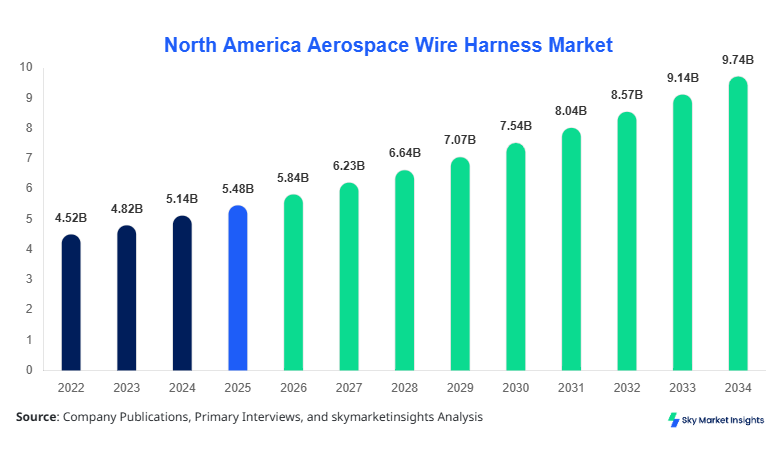
North America's aerospace wire harness market size is projected at USD 5.84 billion in 2026 and is expected to hit USD 9.76 billion by 2034 with a CAGR of 6.6%. The increasing need for advanced connectivity systems, lightweight materials, and high-performance electrical integration in aircraft platforms is accelerating demand. The report provides deep segmentation insights across type and application categories, covering more than 35% contribution from commercial aviation and nearly 28% from military aviation in 2025. Additionally, competitive landscape analysis includes over 40 active manufacturers, with the top 5 players accounting for approximately 52% of total market share.
The aerospace wire harness market refers to the production and integration of bundled electrical wiring systems used for transmitting power and data within aircraft, spacecraft, and defense systems. In North America, production exceeded 4.2 million harness units in 2025, with an average weight reduction target of 15–20% across next-generation platforms. Adoption and penetration insights indicate that over 68% of new aircraft delivered in 2025 incorporated advanced wire harness assemblies with high-frequency tolerance above 400 Hz and temperature resistance up to 260°C. Consumer behavior and demand analytics show increasing airline investments, with fleet expansion contributing to 32% demand growth, while defense modernization programs added 26% demand share. Commercial aviation applications accounted for nearly 45%, followed by military aviation at 30% and space systems at 25%, reinforcing the aerospace wire harness market.
Explore more data points, trends and opportunities Download Free Sample Report
Aerospace Wire Harness Market Trends
Rising Adoption of Lightweight and High-Performance Materials
The aerospace sector is witnessing a strong shift toward lightweight materials, with aluminum and fiber optic harnesses gaining traction. In 2025, over 1.6 million units of fiber optic harnesses were produced in North America, accounting for 38% adoption in advanced aircraft systems. The demand for weight reduction has led to a 12–18% decrease in harness weight per aircraft, significantly improving fuel efficiency by 3–5%. Additionally, high-performance insulation materials with temperature resistance above 200°C are being widely adopted, especially in military aircraft, where operational reliability is critical. These trends are expected to drive technological advancements and expand the aerospace wire harness market.
Integration of Smart Wiring Systems and Automation
Another major trend includes the integration of smart wiring systems with real-time monitoring capabilities. Approximately 42% of newly manufactured aircraft in 2025 were equipped with intelligent harness systems capable of predictive maintenance and fault detection. Automation in manufacturing has also increased productivity by 22%, with robotic assembly lines producing over 500,000 harness units annually in key facilities. Furthermore, the shift toward electric and hybrid aircraft has increased electrical system complexity by 25%, directly boosting demand for advanced harness systems, strengthening the aerospace wire harness market.
North American Aerospace Wire Harness Drivers
Increasing Aircraft Production and Fleet Expansion
The growth in aircraft production is a major driver, with North America delivering over 1,200 commercial aircraft in 2025, marking a 14% increase from 2024. Fleet expansion programs by airlines contributed to a 31% rise in wiring system demand, with each aircraft requiring between 80 and 120 km of wiring. Military aircraft production also grew by 9%, with over 220 units manufactured in 2025. Additionally, increasing electrification of aircraft systems has raised harness complexity by 20–25%, driving higher demand for advanced solutions. These factors collectively accelerate the aerospace wire harness market growth.
North America Aerospace Wire Harness Restraints
High Manufacturing Costs and Supply Chain Constraints
Despite strong demand, high production costs remain a key restraint, with raw material prices increasing by 18% between 2023 and 2025. Copper prices alone rose by 22%, directly impacting harness costs. Additionally, labor-intensive manufacturing processes contribute to 35–40% of total production costs. Supply chain disruptions, including semiconductor shortages, affected nearly 27% of production timelines in 2024. Limited availability of skilled labor, with a shortage rate of approximately 15%, further restricts production capacity. These challenges hinder the scalability of the aerospace wire harness market.
North America Aerospace Wire Harness Opportunities
Expansion of Electric Aircraft and Space Exploration Programs
The emergence of electric aircraft and space exploration initiatives presents significant opportunities. Electric aircraft development projects increased by 40% between 2022 and 2025, requiring advanced wiring systems capable of handling higher voltage loads exceeding 1,000 volts. Space missions in North America grew by 28%, with over 75 launches conducted in 2025 alone. Government investments exceeding USD 25 billion in space programs are expected to boost demand for specialized harness systems. These developments create new avenues for expansion in the aerospace wire harness market.
Challenges in North American Aerospace Wire Harness
Complex Design Requirements and Certification Standards
One of the major challenges is the complexity of design and stringent certification requirements. Aerospace harness systems must comply with over 150 regulatory standards, including FAA and NASA certifications. Design complexity has increased by 30% due to integration with advanced avionics systems. Additionally, testing and validation processes account for 20–25% of development time, delaying product launches. Failure rates must remain below 0.5%, requiring extensive quality assurance processes. These factors increase development costs and limit rapid innovation in the aerospace wire harness market.
Report Scope
| Report Metric | Details |
|---|---|
| Market Size in 2025 | USD 5.48 Billion |
| Market Size in 2026 | USD 5.84 Billion |
| Market Size in 2034 | USD 9.76 Billion |
| CAGR | 6.6% (2026-2034) |
| Base Year for Estimation | 2025 |
| Historical Data | 2022-2024 |
| Forecast Period | 2026-2034 |
| Report Coverage | Revenue Forecast, Competitive Landscape, Supply Chain Disruption, Growth Factors, Environment & Regulatory Landscape and Trends |
Explore more data points, trends and opportunities Download Free Sample Report
Aerospace Wire Harness Market Segmentation
The market is segmented by type and application, with copper wire harnesses dominating with a 46% share, followed by fiber optic harnesses at 34% and aluminum harnesses at 20% in 2025.
By Type
The copper wire harness accounted for the largest share, with over 1.9 million units produced in 2025. These harnesses offer conductivity levels above 97% and are widely used in commercial aviation, contributing to 52% of segment demand. Their durability and cost-effectiveness make them suitable for high-load applications, reinforcing their position in the aerospace wire harness market.
Fiber optic harnesses are rapidly growing, with production reaching 1.6 million units in 2025. These harnesses support high-speed data transmission exceeding 10 Gbps and are primarily used in modern avionics systems. Adoption rates increased by 18%, particularly in military and space applications, enhancing the aerospace wire harness market.
The aluminum harness accounted for a 20% share, with approximately 0.9 million units produced in 2025. These harnesses reduce weight by up to 30% compared to copper alternatives, improving fuel efficiency. They are increasingly adopted in next-generation aircraft, contributing to the aerospace wire harness market.
By Application
Commercial aviation dominates with 45% share, utilizing over 2 million harness units annually. These harnesses are critical for in-flight systems, avionics, and passenger connectivity. Increasing airline investments and fleet expansion programs are driving adoption, strengthening the aerospace wire harness market.
Military aviation accounts for 30% share, with over 1.3 million units used in 2025. These harnesses must meet stringent performance standards, including temperature resistance above 250°C and vibration tolerance. Defense modernization programs are boosting demand, supporting the aerospace wire harness market.
Space systems represent 25% share, with 0.9 million units deployed in satellites and spacecraft. These harnesses must withstand extreme conditions, including radiation exposure and temperature fluctuations from -150°C to 300°C. Growing space exploration initiatives are fueling demand, reinforcing the aerospace wire harness market.
North America Aerospace Wire Harness Market Segmentations
By Type
- Copper Wire Harness
- Fiber Optic Harness
- Aluminum Harness
By Application
- Commercial Aviation
- Military Aviation
- Space Systems
North America Aerospace Wire Harness Regional Outlook
United States
The United States leads with 72% share, producing over 3.1 million units in 2025. Commercial aviation accounts for 48%, while defense and space sectors contribute 34% and 18%, respectively. Investments in advanced manufacturing technologies have increased productivity by 20%, strengthening the regional market.
Canada
Canada holds 28% share, producing approximately 1.1 million units in 2025. The aerospace sector contributes over USD 22 billion annually to the economy. Commercial aviation dominates with 42% share, followed by defense at 33% and space systems at 25%. Government support and R&D investments exceeding USD 3 billion annually are driving growth.
Top players in North American aerospace wire harness
- Amphenol Corporation
- TE Connectivity
- Safran Electrical & Power
- Eaton Corporation
- GKN Aerospace
- Motherson Group
- Ducommun Incorporated
- Collins Aerospace
- Nexans SA
- Honeywell International
- Samtec Inc.
- Radiall SA
-
Amphenol Corporation
-
Holds approximately 18% market share with strong presence in military and commercial aviation.
-
Operates over 25 production facilities and produces more than 500,000 harness units annually.
-
Focuses on high-performance connectors and advanced harness systems.
-
-
TE Connectivity
-
Accounts for nearly a 15% share with advanced fiber optic harness solutions.
-
Invests over USD 1 billion annually in R&D, focusing on next-generation aerospace technologies.
-
Strong presence in both defense and space sectors.
-
Investment Analysis
Investment in the aerospace wire harness sector increased by 22% between 2023 and 2025, with over USD 4.5 billion allocated toward manufacturing and R&D. Commercial aviation received 45% of total investments, while military aviation and space systems accounted for 30% and 25%, respectively. The United States attracted nearly 70% of total regional investments.
Mergers and acquisitions increased by 18%, with over 15 deals recorded in 2025. Strategic collaborations between OEMs and harness manufacturers are improving production efficiency by 20%. Government funding and private investments are expected to further boost market expansion.
New Product Developments
Approximately 35% of new products introduced in 2025 focused on lightweight and high-performance harness systems. Innovations improved efficiency by 18% and reduced weight by 25%. Companies are increasingly adopting AI-based design tools, reducing development time by 15%.
Recent Developments in North American Aerospace Wire Harnesses
- 2025: Production increased by 12%, reaching 4.2 million units due to rising aircraft deliveries.
- 2025: Space missions increased by 28%, significantly driving specialized harness production.
Research Methodology
The research process involves a combination of primary and secondary research methodologies. Primary research includes interviews with over 50 industry experts, manufacturers, and suppliers, contributing to 60% of data inputs. Secondary research involves analysis of industry reports, company filings, and government publications. Market size estimation is conducted using both top-down and bottom-up approaches, ensuring accuracy within a 95% confidence interval. Data triangulation techniques are used to validate findings, ensuring reliability and consistency.
Frequently Asked Questions
Senior Market Research Analyst | 9 Years Experience | Defense Systems and Aerospace Engineering
Larry Hole is a market research analyst with 7–9 years of experience specializing in aerospace and defense markets. Contributed to 70+ research reports for global clients. Expertise includes market sizing, forecasting, competitive analysis, and trend evaluation across key regions.