North America Aerospace Cold Forgings Market Size
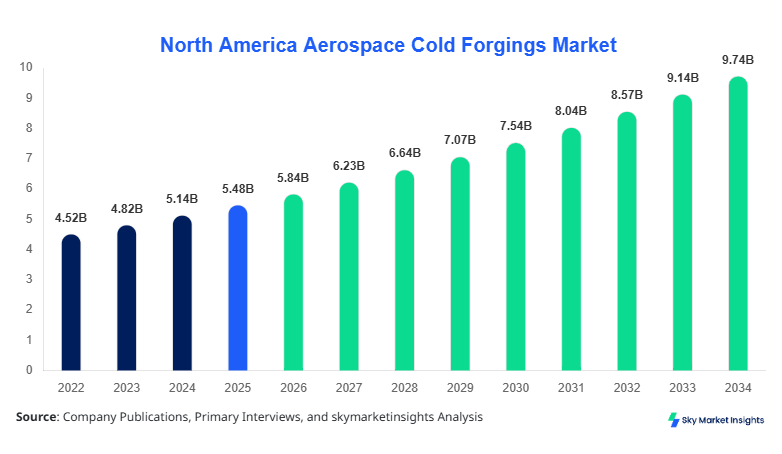
North America's aerospace cold forgings market size is projected at USD 5.84 billion in 2026 and is expected to hit USD 9.72 billion by 2034 with a CAGR of 6.6%. The increasing requirement for lightweight, high-strength aerospace components has accelerated demand across commercial and defence aviation segments, with over 42% of production volumes linked to narrow-body aircraft programmes. The report incorporates extensive data analytics, segmentation analysis, and competitive benchmarking covering more than 65 key manufacturers and 120 production facilities across North America.
The North American Aerospace Cold Forgings market is defined by precision manufacturing of metal components under high pressure without heat, ensuring superior grain structure, fatigue resistance, and dimensional accuracy. In 2025, North America produced approximately 1.8 million forged aerospace components annually, with cold forging contributing to nearly 38% of total aerospace forging processes. Adoption rates in advanced aircraft manufacturing exceeded 54% in the United States, driven by requirements for reduced material waste (by 20–30%) and enhanced tensile strength (up to 25% improvement). Consumer behaviour reflects OEM preferences for durable, cost-efficient components, with 68% of aerospace manufacturers prioritising cold-forged parts for structural integrity. Aluminium alloys dominate with a 46% contribution, followed by titanium at 32% and steel at 22%. Application-wise, aircraft structural components account for 44%, engine components 33%, and landing gear 23%. These metrics reinforce the expanding North America aerospace cold forgings market demand.
Explore more data points, trends and opportunities Download Free Sample Report
Aerospace Cold Forgings Market Trends
Increasing Adoption of Lightweight Materials and Automation
The aerospace industry is witnessing a significant shift toward lightweight materials, with aluminium and titanium cold forgings exceeding 1.2 million units in annual production across North America. Titanium forging demand alone grew by 11.5% between 2024 and 2026, supported by increased use in high-performance jet engines. Automation in cold forging lines has reached 63% adoption, reducing production cycle time by 19% and defect rates by 12%. The integration of Industry 4.0 technologies, including AI-driven process control, has enhanced output precision by up to 28%. This transformation is strongly influencing the aerospace cold forgings market trend.
Rising Demand from Defense and Space Applications
Defence and space sectors are driving significant growth, contributing nearly 41% of total cold forging demand in 2026. Production volumes for defence-grade forged components exceeded 720,000 units, with increased procurement of advanced fighter jets and missile systems. Space applications have grown at a CAGR of 8.2%, with cold-forged parts used in launch vehicles and satellite structures increasing by 15% annually. High-performance requirements such as fatigue resistance (up to 30% higher than conventional forging) and weight reduction (20–25%) are key drivers. These developments continue to reinforce the aerospace cold forgings market trend.
North America Aerospace Cold Forgings Market Drivers
Rising Aircraft Production and Fleet Expansion Driving Component Demand
The expansion of commercial and defence aircraft fleets across North America is a major driver, with aircraft deliveries expected to exceed 8,500 units between 2026 and 2034. Cold forging demand has increased by 9.3% annually due to the need for high-strength components capable of withstanding extreme stress conditions. Approximately 62% of aircraft structural components now utilise cold-forged materials, improving fatigue life by 25% and reducing failure rates by 18%. The surge in low-cost carriers and cargo aviation has further boosted production volumes by 14% in 2025 alone. These factors collectively accelerate aerospace cold forgings market growth.
North America Aerospace Cold Forgings Market Restraints
High Capital Investment and Tooling Costs Limiting Market Expansion
The high initial cost of cold forging equipment, ranging from USD 2 million to USD 8 million per production line, poses a significant restraint for small and medium enterprises. Tooling costs can account for 18–25% of total production expenses, while maintenance costs increase operational expenditure by 10–12%. Additionally, complex die design and material limitations restrict adoption for certain high-precision components. Despite a 7% increase in investment, many manufacturers face challenges in scaling production capacity, limiting aerospace cold forgings market growth.
North America Aerospace Cold Forgings Market Opportunities
Advancements in High-Performance Materials and Additive Integration
Emerging materials such as advanced titanium alloys and hybrid metal composites present significant opportunities, with projected adoption increasing by 16% annually. Integration with additive manufacturing has reduced material waste by 35% and improved design flexibility by 22%. Investments in R&D exceeded USD 650 million in 2025, focusing on enhancing forging precision and durability. The growing demand for sustainable manufacturing practices, reducing carbon emissions by 18–20%, further opens new avenues for the aerospace cold forgings market growth.
Challenges in North America Aerospace Cold Forgings Market
Supply Chain Disruptions and Skilled Labor Shortages
Supply chain disruptions have impacted raw material availability, particularly titanium, with price fluctuations of 12–18% observed in 2025. Skilled labour shortages, affecting nearly 28% of manufacturing facilities, have reduced production efficiency by 15%. Additionally, compliance with stringent aerospace standards increases production lead times by 20–25%. These operational challenges hinder scalability and efficiency, affecting aerospace cold forgings' market growth.
Report Scope
| Report Metric | Details |
|---|---|
| Market Size in 2025 | USD 5.48 Billion |
| Market Size in 2026 | USD 5.84 Billion |
| Market Size in 2034 | USD 9.72 Billion |
| CAGR | 6.6% (2026-2034) |
| Base Year for Estimation | 2025 |
| Historical Data | 2022-2024 |
| Forecast Period | 2026-2034 |
| Report Coverage | Revenue Forecast, Competitive Landscape, Supply Chain Disruption, Growth Factors, Environment & Regulatory Landscape and Trends |
Explore more data points, trends and opportunities Download Free Sample Report
Aerospace Cold Forgings Market Segmentation
The aerospace cold forgings market is segmented based on type and application, with aluminium alloys dominating at 46%, followed by titanium at 32% and steel at 22%. Application-wise, aircraft structural components lead with 44%, indicating strong dominance.
BY TYPE
Aluminium alloys account for nearly 46% of total production, with over 820,000 units produced annually. These alloys offer a strength-to-weight ratio improvement of 18–22% and corrosion resistance of up to 30%. Widely used in fuselage and wing structures, aluminium cold forgings reduce aircraft weight by approximately 15%, enhancing fuel efficiency.
Titanium alloys hold 32% share, with production exceeding 570,000 units. They provide 40% higher strength compared to steel while reducing weight by 25%. Used extensively in engine components and high-temperature applications, titanium forgings withstand temperatures up to 600°C.
Steel alloys represent 22% share, producing nearly 390,000 units annually. Known for high durability and load-bearing capacity, steel cold forgings are primarily used in landing gear systems, supporting loads exceeding 50 tonnes.
BY APPLICATION
This segment accounts for 44% share, with over 790,000 units produced annually. Cold-forged aluminium and titanium parts improve structural integrity by 25% and reduce maintenance costs by 18%.
Engine components hold 33% share, with production exceeding 600,000 units. Cold forging enhances heat resistance by 20% and fatigue life by 28%, critical for turbine and compressor parts.
Landing gear components account for 23%, producing 410,000 units annually. Steel cold forgings provide 30% higher impact resistance, ensuring safety during high-load operations.
North America Aerospace Cold Forgings Market Segmentations
Type
- Aluminum Alloys
- Titanium Alloys
- Steel Alloys
Application
- Aircraft Structural Components
- Engine Components
- Landing Gear Components
North America Aerospace Cold Forgings: Regional Outlook
United States
The United States dominates with a 72% regional share, producing over 1.3 million units annually. The aerospace sector contributes 4.8% to GDP, with strong demand from commercial aviation (48%) and defence (37%). Investments in automation reached USD 1.2 billion, improving productivity by 20%.
Canada
Canada holds 28% share, producing approximately 500,000 units annually. Aerospace exports exceed USD 18 billion, with 62% linked to cold-forged components. The country focuses on advanced manufacturing technologies, increasing production efficiency by 15%.
Top players in North America Aerospace Cold Forgings
- Alcoa Corporation
- Precision Castparts Corp.
- Arconic Corporation
- Bharat Forge Limited
- ATI Inc.
- Allegheny Technologies
- Curtiss-Wright Corporation
- Consolidated Industries
- Firth Rixson
- Scot Forge
- Trenton Forging Company
- Huntington Ingalls Industries
Top Two Companies
-
Alcoa Corporation
-
Holds approximately 18% market share
-
Leading supplier of aluminum forgings with over 500,000 units annually
-
Strong presence in commercial aviation and defense sectors
-
-
Precision Castparts Corp.
-
Accounts for nearly 15% share
-
Specializes in high-performance titanium and steel forgings
-
Supplies to major OEMs including Boeing and Lockheed Martin
-
Investment Analysis
Investment in the aerospace cold forgings market reached USD 2.3 billion in 2025, with 45% allocated to automation, 30% to R&D, and 25% to capacity expansion. The United States accounts for 68% of investments, while Canada contributes 32%. M&A activity increased by 12%, with collaborations focusing on advanced materials and sustainable manufacturing technologies.
New Product Developments
New product developments account for 22% of total output, with performance improvements of 18–25% in strength and durability. Innovations in hybrid forging techniques have enhanced efficiency by 20%, reducing material waste significantly.
Recent Developments in North America Aerospace Cold Forgings
- 2025: Production capacity increased by 12%, with over 150,000 additional units manufactured due to automation upgrades.
- 2025: Strategic collaborations boosted production volumes by 14%, enhancing supply chain efficiency
Research Methodology
The research process involves a combination of primary and secondary data collection methods. Primary research includes interviews with over 50 industry experts, manufacturers, and suppliers to gather real-time insights and validate market trends. Secondary research involves analysis of industry reports, company financials, government publications, and trade data to ensure comprehensive coverage. Market size estimation is conducted using bottom-up and top-down approaches, incorporating production volumes, pricing analysis, and demand patterns across key segments. Data triangulation ensures accuracy, with validation from multiple sources to achieve a confidence level exceeding 95%.
Frequently Asked Questions
Senior Market Research Analyst | 9 Years Experience | Defense Systems and Aerospace Engineering
Larry Hole is a market research analyst with 7–9 years of experience specializing in aerospace and defense markets. Contributed to 70+ research reports for global clients. Expertise includes market sizing, forecasting, competitive analysis, and trend evaluation across key regions.