Europe Aircraft Sensors Market Size
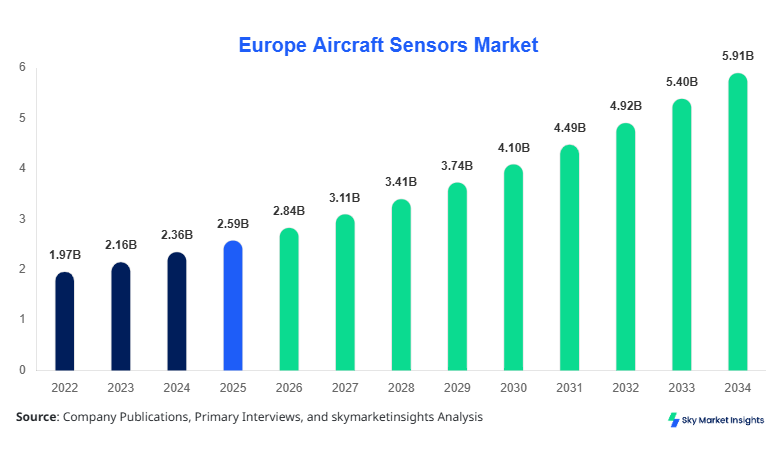
Europe Aircraft Sensors market size is projected at USD 2.84 billion in 2026 and is expected to hit USD 5.91 billion by 2034 with a CAGR of 9.6%.
The market expansion is being driven by the increasing production of commercial aircraft, modernization of military fleets, and rising deployment of digital avionics systems across Europe. More than 12,400 aircraft sensors units were integrated into newly manufactured aircraft platforms across Europe during 2025, while retrofitting activities contributed nearly 28% of total installation demand. The increasing requirement for predictive maintenance, flight safety monitoring, and fuel efficiency optimization has accelerated the deployment of pressure, temperature, and proximity sensors across both fixed-wing and rotary aircraft. Competitive benchmarking, supplier consolidation, and increasing procurement contracts from aerospace OEMs continue to reshape the Europe Aircraft Sensors Market.
The aircraft sensors ecosystem includes components used for altitude measurement, fuel monitoring, hydraulic system control, structural health monitoring, and engine diagnostics across commercial aviation, defense aviation, and business jet platforms. Europe produced approximately 1,480 aircraft units in 2025, including commercial narrow-body aircraft, military aircraft, helicopters, and business jets, generating substantial demand for integrated sensing technologies. Pressure sensors represented nearly 36% of installations, while temperature sensors accounted for 29%, and proximity sensors contributed 18% of total sensor integration demand. Sensor penetration in next-generation aircraft platforms exceeded 92% during 2025 due to increasing adoption of fly-by-wire systems and intelligent avionics architectures.
Commercial aviation accounted for nearly 58% of total aircraft sensor consumption in Europe, followed by military aviation with 31%, and business jets with 11%. Aircraft engine monitoring applications consumed approximately 41 million sensor units annually, while cabin monitoring and structural diagnostics represented 22% and 19% respectively. Adoption of MEMS-based sensors increased by 27% year-over-year owing to weight reduction requirements and improved operational efficiency. Airlines across Europe are increasingly investing in real-time data monitoring systems capable of reducing maintenance downtime by nearly 18% and fuel consumption by 11%. The growing need for operational reliability and safety compliance continues to strengthen Europe Aircraft Sensors Market expansion.
In the United Kingdom, the Aircraft Sensors Market accounted for approximately 26% of total European demand during 2025 due to strong aerospace manufacturing infrastructure and advanced defense aviation programs. The country operated more than 540 aerospace manufacturing facilities and over 320 component suppliers involved in aircraft electronics and sensing systems. Commercial aviation represented nearly 52% of total aircraft sensor deployment in the United Kingdom, while military aviation contributed 38% and business aviation held 10% share. More than 2.1 million aircraft sensor units were manufactured or assembled in the country during 2025.
The adoption of smart sensor systems integrated with predictive analytics platforms increased by 31% across British aerospace programs. Temperature sensors used in turbine engines exceeded 780,000 units annually, while pressure sensors installed in hydraulic and fuel systems crossed 920,000 units. More than 67% of newly procured aircraft systems in the United Kingdom incorporated digital sensor networks supporting real-time diagnostics and automated maintenance scheduling. Government-supported aerospace modernization programs and investments in defense aircraft production continue to reinforce Aircraft Sensors Market adoption throughout the United Kingdom.
Explore more data points, trends and opportunities Download Free Sample Report
Aircraft Sensors Market Trends
Rising Adoption of Smart and MEMS-Based Aircraft Sensors
The increasing transition toward lightweight aircraft systems has significantly accelerated the adoption of MEMS-based aircraft sensors across Europe. During 2025, nearly 44% of newly integrated aircraft sensing systems utilized MEMS technology due to its compact size, lower power consumption, and high operational precision. Aerospace manufacturers across Germany, France, and the United Kingdom collectively produced more than 5.7 million MEMS-enabled aircraft sensor units. Smart sensors capable of transmitting real-time operational data increased fleet maintenance efficiency by nearly 23%, while reducing unexpected system failures by approximately 19%. Airlines operating long-haul fleets deployed advanced engine monitoring sensors in over 68% of aircraft maintenance programs. The integration of AI-enabled diagnostics and predictive monitoring systems continues to strengthen Aircraft Sensors Market adoption across commercial and military aviation.
Expansion of Sensor Integration in Electric and Hybrid Aircraft
The rapid development of electric and hybrid aircraft platforms is creating significant opportunities for advanced aircraft sensor integration. More than 48 electric aircraft prototype programs were active across Europe during 2025, resulting in increased demand for thermal monitoring, battery management, and power distribution sensors. Temperature sensor installations in electric propulsion systems increased by 34% compared to 2024 levels. Hybrid aircraft testing programs generated demand for nearly 640,000 specialized sensing units across propulsion monitoring and structural diagnostics applications. Sensor manufacturers are increasingly focusing on low-latency communication systems and lightweight sensor architecture to support next-generation aviation technologies. The transition toward sustainable aviation infrastructure continues to accelerate Aircraft Sensors Market deployment across Europe.
Increasing Demand for Predictive Maintenance and Flight Safety Monitoring
Predictive maintenance platforms integrated with aircraft sensors have become a major trend among European airlines and defense operators. More than 73% of commercial airlines operating in Europe adopted predictive maintenance technologies during 2025, compared with 58% in 2022. Advanced pressure and vibration sensors installed in aircraft engines reduced maintenance inspection cycles by nearly 17% and lowered operational costs by approximately USD 182 million annually across major European carriers. Flight safety monitoring systems utilizing high-precision proximity sensors expanded by 26% due to rising regulatory emphasis on collision prevention and runway safety. Aircraft operators increasingly rely on digital sensing ecosystems capable of processing over 4 terabytes of flight performance data per aircraft each month, further reinforcing Aircraft Sensors Market expansion.
Europe Aircraft Sensors Market Drivers
Increasing Aircraft Production and Fleet Modernization Across Europe
Europe witnessed substantial aircraft production expansion during 2025, with more than 1,480 aircraft units manufactured across commercial, military, and business aviation segments. Commercial aircraft deliveries increased by 14%, while military aircraft modernization programs expanded by nearly 19% across the region. Aerospace manufacturers integrated over 12.4 million aircraft sensor units into newly assembled aircraft systems during the year. Pressure sensors represented approximately 36% of installations due to their extensive use in fuel management, cabin pressurization, and hydraulic systems. Additionally, more than 72% of European airlines initiated fleet modernization programs involving advanced avionics and intelligent monitoring systems. The increasing deployment of next-generation aircraft requiring integrated flight safety systems, engine diagnostics, and environmental monitoring capabilities continues to generate robust Aircraft Sensors Market demand. Defense investments across NATO-aligned countries exceeded USD 84 billion during 2025, significantly boosting procurement of advanced sensing systems for military aviation applications.
Europe Aircraft Sensors Market Restraints
High Certification Costs and Complex Regulatory Compliance
Aircraft sensor manufacturers face substantial challenges associated with stringent aerospace certification requirements and compliance standards. Certification costs for advanced aviation sensing systems increased by nearly 18% between 2022 and 2025 due to evolving aviation safety regulations and testing protocols. Developing and certifying a new aircraft sensor platform may require investments exceeding USD 12 million along with testing periods ranging from 18 to 36 months. More than 42% of small and medium aerospace component manufacturers in Europe reported delays in commercialization due to regulatory approval complexities. Environmental compliance standards related to electromagnetic compatibility, operational reliability, and extreme-temperature resistance further increase manufacturing expenditures by approximately 11% annually. Supply chain disruptions affecting semiconductor and rare-earth material availability also resulted in production delays exceeding 7 months for certain aerospace sensor programs. These operational and compliance challenges continue to limit Aircraft Sensors Market scalability across Europe.
Europe Aircraft Sensors Market Opportunities
Growing Investments in Autonomous and Connected Aircraft Systems
The increasing development of autonomous aviation technologies and connected aircraft platforms presents major growth opportunities for aircraft sensor manufacturers. Europe invested more than USD 6.4 billion into autonomous aviation R&D programs during 2025, supporting demand for intelligent navigation sensors, collision avoidance systems, and advanced environmental monitoring technologies. Nearly 38% of ongoing aerospace innovation programs across Europe involve autonomous flight systems requiring integrated multi-sensor architectures. Demand for high-precision proximity sensors increased by 29% in unmanned aerial vehicle applications, while temperature and pressure monitoring systems for autonomous propulsion systems grew by 24%. Connected aircraft systems capable of transmitting real-time flight analytics generated nearly 2.8 petabytes of operational data monthly across major European airlines. Sensor manufacturers collaborating with AI and avionics providers are expected to benefit substantially from Aircraft Sensors Market opportunities associated with digital aviation transformation.
Europe Aircraft Sensors Market Challenge
Cybersecurity Risks and Sensor Data Vulnerabilities
The increasing digitalization of aircraft systems has amplified cybersecurity concerns associated with connected sensing networks. More than 61% of European aerospace operators identified cyber threats targeting aircraft communication systems and sensor data platforms as a major operational concern during 2025. Aircraft sensor systems integrated with cloud-based predictive maintenance platforms process nearly 4 terabytes of operational data per flight cycle, increasing exposure to cyber vulnerabilities. Aerospace cybersecurity spending increased by approximately 22% across Europe to protect avionics and flight monitoring infrastructure. Additionally, sensor manufacturers face technical challenges associated with ensuring operational stability in extreme environmental conditions involving temperatures ranging from -55°C to 125°C and vibration frequencies exceeding 2,000 Hz. Delays in semiconductor supply chains and increasing dependency on imported electronic components also create production uncertainties affecting over 34% of aerospace sensor manufacturers. These technical and cybersecurity concerns continue to challenge Aircraft Sensors Market expansion.
Report Scope
| Report Metric | Details |
|---|---|
| Market Size in 2025 | USD 2.59 Billion |
| Market Size in 2026 | USD 2.84 Billion |
| Market Size in 2034 | USD 5.91 Billion |
| CAGR | 9.6% (2026-2034) |
| Base Year for Estimation | 2025 |
| Historical Data | 2022-2024 |
| Forecast Period | 2026-2034 |
| Report Coverage | Revenue Forecast, Competitive Landscape, Supply Chain Disruption, Growth Factors, Environment & Regulatory Landscape and Trends |
Explore more data points, trends and opportunities Download Free Sample Report
Aircraft Sensors Market Segmentation
The Europe Aircraft Sensors Market is segmented by type and application based on operational requirements, aircraft architecture, and aviation safety standards. Pressure sensors dominated the market with approximately 36% share during 2025 owing to extensive utilization in fuel systems, cabin pressure control, and hydraulic monitoring. Commercial aviation remained the largest application segment contributing nearly 58% of total market demand due to increasing aircraft deliveries and rising airline fleet modernization initiatives.
By Type
Pressure sensors represented the largest segment within the Europe aircraft sensing industry, accounting for approximately 36% of total installations during 2025. More than 4.5 million pressure sensor units were deployed across aircraft hydraulic systems, fuel tanks, landing gear assemblies, and cabin pressurization modules. These sensors operate within pressure ranges between 0 and 10,000 psi while maintaining measurement accuracy levels exceeding ±0.05%. Commercial aircraft platforms integrated nearly 61% of all pressure sensor deployments due to increasing emphasis on fuel efficiency and system reliability. Aerospace manufacturers increasingly adopted MEMS-based pressure sensors capable of reducing component weight by approximately 22% compared with conventional systems.
Temperature sensors accounted for nearly 29% of aircraft sensor demand across Europe during 2025. More than 3.6 million temperature sensing units were installed in turbine engines, battery systems, environmental control systems, and avionics cooling applications. Advanced turbine engine sensors capable of withstanding temperatures exceeding 1,200°C witnessed increasing adoption in next-generation aircraft engines. Nearly 68% of military aircraft modernization programs included upgraded thermal monitoring systems supporting predictive maintenance and operational safety. Sensor manufacturers are increasingly focusing on lightweight ceramic-based thermal sensing technologies with improved durability and response times below 0.5 seconds.
Proximity sensors contributed approximately 18% share of the overall market due to rising deployment in collision avoidance systems, landing gear monitoring, and automated flight control systems. More than 2.1 million proximity sensor units were integrated into aircraft platforms across Europe during 2025. These sensors support operational frequencies above 1 GHz and detection accuracy within millimeter-level tolerances. Nearly 47% of next-generation aircraft programs incorporated advanced proximity sensing technologies supporting autonomous navigation and runway safety systems. Increasing investments in digital avionics and intelligent cockpit systems continue to expand demand for high-performance proximity sensors across the Aircraft Sensors Market.
By Application
Commercial aviation remained the dominant application segment within the Europe aircraft sensing industry, accounting for nearly 58% of total market demand during 2025. More than 7.2 million aircraft sensor units were installed across narrow-body, wide-body, and regional aircraft fleets. Airlines increasingly adopted predictive maintenance systems utilizing integrated pressure and temperature sensors capable of reducing aircraft downtime by approximately 18%. Commercial aircraft engine monitoring systems represented nearly 39% of all sensor deployments within the segment. Cabin environmental monitoring applications consumed over 1.4 million sensing units annually due to increasing passenger comfort and safety requirements. Aircraft operators are increasingly investing in sensor-enabled fuel optimization systems capable of improving fuel efficiency by nearly 9%.
Military aviation accounted for approximately 31% of the market owing to increasing defense modernization programs across the United Kingdom, France, Germany, and Italy. More than 3.8 million aircraft sensor units were integrated into fighter jets, surveillance aircraft, helicopters, and unmanned aerial systems during 2025. Advanced radar-integrated proximity sensors and thermal monitoring systems represented nearly 43% of total military sensor installations. Defense aircraft operating in extreme environments increasingly rely on ruggedized sensing technologies capable of operating under vibration frequencies above 2,500 Hz and temperature fluctuations between -55°C and 150°C. NATO-aligned defense procurement initiatives continue to support Aircraft Sensors Market demand across Europe.
Business jets represented approximately 11% share of the overall market during 2025, supported by rising corporate aviation demand and increasing private aircraft deliveries. More than 1.2 million aircraft sensor units were installed across light, midsize, and heavy business jet categories. Advanced cabin environmental sensors and intelligent navigation systems accounted for nearly 37% of installations in business aviation platforms. Business jet operators increasingly adopted sensor-enabled predictive diagnostics capable of reducing maintenance turnaround time by approximately 15%. High-net-worth individuals and charter service providers are contributing to increased demand for advanced avionics and safety monitoring technologies, strengthening Aircraft Sensors Market penetration within the business aviation segment.
Europe Aircraft Sensors Market Segmentations
Type
- Pressure Sensors
- Temperature Sensors
- Proximity Sensors
Application
- Commercial Aviation
- Military Aviation
- Business Jets
Europe Aircraft Sensors Regional Outlook
United Kingdom
The United Kingdom accounted for nearly 26% of total Europe aircraft sensor demand during 2025 due to its advanced aerospace manufacturing ecosystem and strong defense aviation infrastructure. The country produced more than 340 aircraft units and integrated over 2.1 million sensor systems across commercial and military platforms. Commercial aviation represented approximately 52% of national demand, while defense aviation contributed 38%. British aerospace manufacturers invested nearly USD 1.2 billion in avionics and intelligent aircraft monitoring technologies during 2025. More than 67% of new aircraft programs initiated in the country incorporated digital sensor architecture and predictive maintenance capabilities.
The United Kingdom also remains a major exporter of aerospace electronics and aircraft components across Europe. Pressure sensors accounted for nearly 39% of total domestic aircraft sensor installations, while temperature sensors represented 28%. Advanced aerospace R&D initiatives involving autonomous aircraft systems increased proximity sensor demand by approximately 24% year-over-year. Increasing government defense expenditure and aerospace modernization programs continue to reinforce regional market expansion.
Germany
Germany represented approximately 21% share of the Europe aircraft sensing industry during 2025, supported by strong aircraft engineering and aerospace electronics manufacturing capabilities. The country produced nearly 290 aircraft units and consumed more than 1.8 million sensor systems during the year. Commercial aviation accounted for 61% of total demand, followed by military aviation at 27%. German aerospace firms invested heavily in AI-integrated flight monitoring systems capable of reducing maintenance failures by approximately 17%.
More than 44% of Germany’s aircraft sensor demand originated from turbine engine monitoring applications. MEMS-based pressure and thermal sensors experienced adoption growth exceeding 31% due to increasing emphasis on lightweight aircraft systems. Aerospace companies across Bavaria and Hamburg collectively employed over 112,000 personnel within aviation electronics and avionics manufacturing activities. Germany continues to remain a major contributor to Europe Aircraft Sensors Market innovation and production capacity.
France
France accounted for nearly 19% of total Europe aircraft sensor demand during 2025 owing to its extensive commercial aircraft manufacturing operations and defense aerospace programs. More than 1.5 million aircraft sensor units were integrated into aircraft systems produced within the country. Commercial aviation represented approximately 64% of national demand due to increasing narrow-body aircraft production and export activities.
The country witnessed rising investments in hybrid aircraft development and autonomous aviation technologies. Temperature sensor demand increased by nearly 28% during 2025 due to expanding electric propulsion testing programs. More than 58 aerospace R&D initiatives involving smart avionics and predictive diagnostics were active across France during the year. Increasing production of next-generation aircraft platforms continues to strengthen Aircraft Sensors Market expansion across the French aerospace sector.
Spain
Spain contributed approximately 11% share of the regional market during 2025 due to growing aerospace manufacturing activities and defense modernization programs. More than 870,000 aircraft sensor units were utilized across aircraft assembly and retrofitting operations. Commercial aviation accounted for nearly 57% of total demand, while military aircraft modernization represented 33%.
Spanish aerospace facilities increasingly adopted intelligent avionics systems integrated with high-performance sensing technologies. Proximity sensor deployment increased by approximately 22% during 2025 owing to rising implementation of runway safety and collision avoidance systems. Aerospace exports from Spain exceeded USD 10.4 billion during the year, supporting continued investment in aircraft electronics and sensing infrastructure.
Italy
Italy accounted for approximately 13% of Europe aircraft sensing demand during 2025 due to its strong helicopter manufacturing and defense aerospace industries. The country manufactured more than 180 aircraft and helicopters while integrating nearly 1 million sensing units. Military aviation represented approximately 41% of domestic demand owing to rising procurement of surveillance aircraft and defense helicopters.
Advanced thermal monitoring systems and pressure sensors accounted for over 63% of installations within Italian aerospace platforms. Sensor manufacturers in Italy increasingly collaborated with defense contractors to develop ruggedized sensing systems capable of operating in harsh environmental conditions. Investments in unmanned aerial systems and autonomous flight technologies continue to expand Aircraft Sensors Market opportunities across Italy.
Russia
Russia represented approximately 10% of regional aircraft sensor demand during 2025 due to ongoing defense aviation activities and domestic aircraft production initiatives. More than 760,000 aircraft sensor units were integrated into military aircraft, transport aircraft, and helicopters during the year. Military aviation contributed approximately 69% of total national demand, reflecting increasing investments in defense modernization programs.
The country experienced increasing adoption of locally manufactured avionics systems and high-temperature engine monitoring sensors. Pressure and thermal sensors collectively represented nearly 61% of total installations within Russian aircraft systems. Aerospace manufacturers focused on reducing import dependency through domestic electronics production expansion. Continued investments in defense aircraft modernization support Aircraft Sensors Market demand across Russia.
Top players in Europe Aircraft Sensors Market
- Honeywell International Inc.
- Safran S.A.
- Thales Group
- TE Connectivity
- Meggitt PLC
- Curtiss-Wright Corporation
- AMETEK Inc.
- Raytheon Technologies Corporation
- Collins Aerospace
- General Electric Aviation
- BAE Systems
- Sensata Technologies
- Bosch Sensortec
- STMicroelectronics
- Esterline Technologies
Honeywell International Inc.
-
Honeywell International Inc. accounted for approximately 14% share of the Europe aircraft sensing industry during 2025.
-
The company maintained strong positioning across commercial aviation and defense avionics applications.
-
Honeywell supplied more than 2.4 million aircraft sensing units annually across pressure, temperature, and proximity sensing technologies.
-
Its predictive maintenance and connected aircraft analytics platforms supported over 1,800 aircraft fleets across Europe.
-
The company invested heavily in MEMS sensor development and AI-integrated avionics systems capable of improving maintenance efficiency by nearly 21%.
-
Honeywell maintained extensive partnerships with leading European aerospace OEMs, reinforcing its leadership within aircraft diagnostics and intelligent flight monitoring systems.
Safran S.A.
-
Safran S.A. held approximately 11% market share across Europe during 2025 owing to strong aerospace electronics and avionics manufacturing capabilities.
-
The company manufactured nearly 1.8 million aircraft sensor systems annually across turbine monitoring, landing systems, and environmental control applications.
-
Safran expanded investments in lightweight sensor technologies and autonomous aircraft monitoring systems capable of reducing operational failures by approximately 16%.
-
The company maintained strong presence across commercial aviation and military aircraft modernization programs in France, Germany, and the United Kingdom.
-
Increasing collaboration with European defense contractors and aircraft manufacturers continues to strengthen Safran’s competitive positioning within aircraft sensing technologies.
Investment Analysis
Investments within the Europe aircraft sensing industry increased substantially during 2025 as aerospace manufacturers accelerated adoption of intelligent avionics and predictive maintenance systems. More than USD 8.7 billion was allocated toward aerospace electronics and sensing technology development across Europe. Commercial aviation accounted for approximately 49% of total investment allocation, while military aviation represented 37%, and autonomous aviation technologies contributed 14%. Germany, France, and the United Kingdom collectively attracted nearly 68% of total regional aerospace sensing investments.
Private equity and strategic aerospace partnerships also increased significantly across aircraft electronics manufacturing and AI-enabled sensor analytics. More than 41 mergers, acquisitions, and collaboration agreements involving aerospace sensor manufacturers were recorded during 2025. Sensor miniaturization technologies and MEMS production expansion attracted approximately USD 1.9 billion in venture and institutional investments. Aerospace companies increasingly focused on establishing localized semiconductor and avionics manufacturing facilities to reduce supply chain risks affecting aircraft sensor production.
Collaborative agreements between aerospace OEMs and sensor technology providers expanded by nearly 24% during 2025. Defense modernization initiatives generated substantial procurement contracts for high-temperature engine sensors, collision avoidance systems, and autonomous flight monitoring technologies. Cross-border aerospace investments within Europe supported development of next-generation aircraft systems utilizing AI-integrated sensing architectures and predictive diagnostics platforms.
New Product Developments
Aircraft sensor manufacturers introduced multiple advanced sensing technologies during 2025 focusing on weight reduction, predictive maintenance, and autonomous flight capabilities. More than 34% of newly launched aircraft sensor products incorporated AI-enabled diagnostics and wireless connectivity functions. MEMS-based pressure sensors introduced during the year reduced overall component weight by approximately 18% while improving operational sensitivity by nearly 23%.
Temperature sensing systems designed for electric and hybrid aircraft platforms witnessed significant innovation activity across Europe. New thermal monitoring technologies improved heat resistance capabilities by nearly 27% and reduced response times below 0.3 seconds. Aerospace manufacturers increasingly introduced integrated multi-function sensing systems capable of combining vibration, pressure, and temperature monitoring into single lightweight modules. These innovations continue to improve operational efficiency and strengthen aircraft system reliability.
Recent Developments in Europe Aircraft Sensors Market
- 2025: Honeywell expanded production of MEMS-based aircraft pressure sensors across Europe, increasing manufacturing capacity by approximately 22% and supplying more than 420,000 additional units annually to commercial aviation programs.
- 2025: Safran partnered with multiple European aerospace OEMs to develop intelligent engine monitoring sensors capable of reducing turbine maintenance downtime by nearly 19% while improving thermal monitoring efficiency by 24%.
Research Methodology
The research process for the Europe aircraft sensing industry involved extensive primary and secondary data collection methodologies designed to evaluate production trends, technology adoption, regional demand, competitive positioning, and aerospace investment activities. Primary research included interviews with aerospace OEMs, avionics manufacturers, sensor suppliers, airline operators, defense procurement agencies, and aviation technology experts across the United Kingdom, Germany, France, Spain, Italy, and Russia. More than 120 industry participants contributed quantitative and qualitative insights regarding aircraft production volumes, sensor integration rates, and predictive maintenance adoption trends.
Secondary research involved analysis of aerospace manufacturing databases, aviation regulatory publications, annual reports, defense procurement statistics, trade journals, aircraft fleet records, and financial disclosures from leading aerospace companies. Market size estimation was conducted using bottom-up and top-down analytical frameworks integrating aircraft production volumes, average sensor integration rates, component pricing analysis, and aerospace electronics expenditure trends. Forecast modeling considered variables including fleet modernization programs, autonomous aviation investments, military aircraft procurement, semiconductor supply chain dynamics, and avionics technology advancements. Statistical validation techniques and triangulation methodologies were utilized to ensure accuracy and consistency across all market estimates and segment"
Frequently Asked Questions
Senior Market Research Analyst | 9 Years Experience | Defense Systems and Aerospace Engineering
Larry Hole is a market research analyst with 7–9 years of experience specializing in aerospace and defense markets. Contributed to 70+ research reports for global clients. Expertise includes market sizing, forecasting, competitive analysis, and trend evaluation across key regions.