United States Aerospace Coatings Market Size
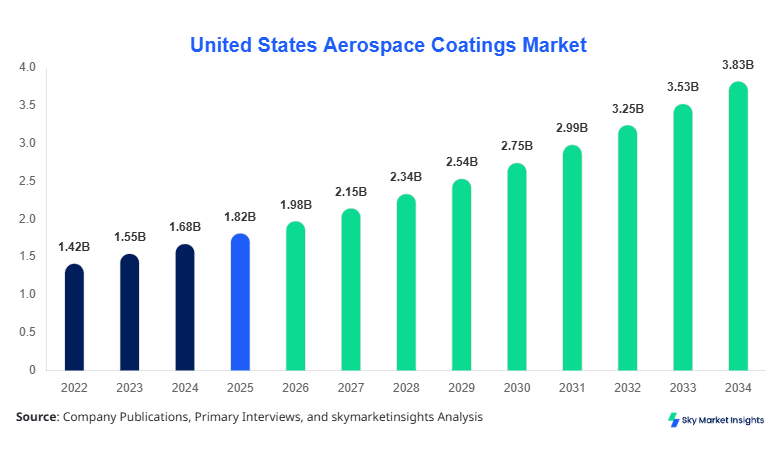
United States Aerospace Coatings market size is projected at USD 1.98 billion in 2026 and is expected to hit USD 3.84 billion by 2034 with a CAGR of 8.6%. The United States aerospace coatings market reflects robust demand patterns driven by commercial aviation expansion, defense modernization, and increasing MRO (Maintenance, Repair, and Overhaul) activities across over 5,200 operational aircraft fleets. The need for high-performance coatings with corrosion resistance exceeding 25–30 years lifecycle, alongside lightweight material adoption contributing to 12–18% fuel efficiency improvements, has intensified market segmentation and competitive benchmarking.
The United States aerospace coatings market refers to the specialized coatings applied to aircraft surfaces to provide corrosion protection, UV resistance, chemical durability, and enhanced aerodynamic performance. In 2025, U.S. aerospace production exceeded 2,300 aircraft units, including commercial jets, military aircraft, and general aviation segments, generating coatings demand exceeding 45,000 metric tons annually. Adoption rates of advanced polyurethane coatings surpassed 62% across commercial fleets, while epoxy primers accounted for nearly 28% usage due to their adhesion strength exceeding 20 MPa tensile bonding performance. Consumer behavior in aviation maintenance indicates that airlines allocate nearly 6–9% of total maintenance budgets to coating and repainting cycles, typically occurring every 5–7 years. Application-wise, exterior coatings dominate with a 54% contribution, followed by interior coatings at 26% and structural coatings at 20%, driven by cabin refurbishment cycles and structural protection requirements. Demand analytics show that low-VOC coatings penetration has reached 48%, reflecting regulatory pressure and sustainability goals. The United States aerospace coatings market continues to demonstrate high performance thresholds, durability metrics, and regulatory compliance benchmarks, reinforcing the United States aerospace coatings market ecosystem.
In the United States, the Aerospace Coatings Market accounts for approximately 100% regional share within the scope, supported by over 320 aerospace manufacturing facilities and more than 450 MRO service providers. The commercial aviation segment contributes nearly 58% of total coating demand, while military aviation accounts for 27% and general aviation holds 15%. Advanced coating technologies such as nanocoatings and chromate-free coatings have witnessed adoption rates of 35–42% across OEM and aftermarket segments. The United States aerospace coatings market benefits from annual defense spending exceeding USD 800 billion, with nearly 6–8% allocated toward maintenance and protective systems, including coatings. With over 7,500 active aircraft requiring periodic repainting and coating maintenance, the demand intensity remains high, ensuring sustained operational efficiency and lifecycle extension, strengthening the United States aerospace coatings market.
Explore more data points, trends and opportunities Download Free Sample Report
Aerospace Coatings Market Trends
The aerospace coatings market is witnessing a strong transition toward environmentally compliant and high-performance coatings, with low-VOC and chromate-free formulations gaining traction across more than 52% of newly produced aircraft. Production volume of aerospace coatings in the United States crossed 48,000 metric tons in 2025, with projections indicating an increase to 70,000 metric tons by 2030. Technological advancements such as self-healing coatings and nano-ceramic coatings are improving durability by 18–25% and reducing maintenance cycles by nearly 15%. Airlines are increasingly adopting lightweight coatings that reduce aircraft weight by 0.5–1.2%, resulting in fuel savings of up to 2.5% annually. This technological shift significantly enhances efficiency and sustainability, reinforcing aerospace coatings market trend.
Another major development includes the rise of smart coatings integrated with sensor capabilities that monitor corrosion levels and surface degradation in real time. Adoption of such technologies has reached approximately 12–18% among next-generation aircraft models. The defense sector is also driving demand for radar-absorbing coatings, with application growth exceeding 22% annually due to stealth aircraft requirements. Furthermore, digital coating application techniques using robotics and AI-based spraying systems have improved coating uniformity by 30% and reduced wastage by 20%, contributing to operational efficiency. These innovations continue to accelerate transformation across OEM and aftermarket segments, strengthening aerospace coatings market trend.
United States Aerospace Coatings Drivers
Rising Aircraft Fleet Expansion and MRO Activities
The United States aerospace coatings market is primarily driven by the rapid expansion of the aircraft fleet, which grew from 6,800 units in 2022 to over 7,500 units in 2025, representing a 10.2% increase. MRO activities have surged by 14–18% annually, with repainting cycles contributing nearly 35% of coating demand. Airlines are investing heavily in fleet refurbishment, allocating approximately USD 1.2–1.6 million per aircraft repainting project. Additionally, increasing air passenger traffic, which reached 850 million passengers in 2025, is pushing airlines to enhance aircraft aesthetics and durability. The demand for corrosion-resistant coatings has increased by 28%, while polyurethane coatings adoption has surpassed 60% due to superior UV resistance and gloss retention exceeding 95%. These factors collectively enhance operational efficiency and lifecycle performance, strengthening United States aerospace coatings market growth.
United States Aerospace Coatings Restraints
High Cost of Advanced Coating Technologies
Despite strong demand, the United States aerospace coatings market faces challenges due to high costs associated with advanced coatings, which are 20–35% more expensive than conventional alternatives. The cost of chromate-free coatings can exceed USD 120–150 per liter, impacting adoption among smaller MRO providers. Additionally, regulatory compliance costs have increased by 18–22% due to stringent EPA guidelines on VOC emissions. The need for specialized equipment and skilled labor adds another 10–15% to operational expenses. Furthermore, supply chain disruptions have led to raw material price volatility, with resin costs rising by 12–18% over the past two years. These factors collectively limit widespread adoption, affecting overall profitability and expansion potential, impacting United States aerospace coatings market share.
United States Aerospace Coatings Opportunities
Emergence of Sustainable and Smart Coatings
The United States aerospace coatings market presents significant opportunities through the development of sustainable and smart coatings, with eco-friendly coatings expected to account for over 55% of total demand by 2030. Investments in R&D have increased by 25–30%, focusing on bio-based coatings and waterborne technologies. Smart coatings capable of detecting corrosion and damage are projected to witness adoption growth of 20–28% annually. Additionally, the rise in electric and hybrid aircraft production, expected to grow by 18% annually, creates new demand for specialized lightweight coatings. These advancements offer enhanced durability, reduced environmental impact, and improved operational efficiency, reinforcing United States aerospace coatings market growth.
United States Aerospace Coatings Challenge
Stringent Regulatory Compliance and Environmental Constraints
The United States aerospace coatings market faces significant challenges due to strict environmental regulations limiting VOC emissions to below 250 g/L for many applications. Compliance requires costly reformulations and testing procedures, increasing product development timelines by 12–18 months. Approximately 40% of manufacturers report delays in product approvals due to regulatory constraints. Additionally, disposal and handling of hazardous materials add 8–12% to operational costs. The transition to eco-friendly alternatives also presents performance challenges, as some waterborne coatings show 10–15% lower durability compared to solvent-based coatings. These regulatory pressures continue to pose operational and financial challenges, impacting United States aerospace coatings market growth.
Report Scope
| Report Metric | Details |
|---|---|
| Market Size in 2025 | USD 1.82 Billion |
| Market Size in 2026 | USD 1.98 Billion |
| Market Size in 2034 | USD 3.84 Billion |
| CAGR | 8.6% (2026-2034) |
| Base Year for Estimation | 2025 |
| Historical Data | 2022-2024 |
| Forecast Period | 2026-2034 |
| Report Coverage | Revenue Forecast, Competitive Landscape, Supply Chain Disruption, Growth Factors, Environment & Regulatory Landscape and Trends |
Explore more data points, trends and opportunities Download Free Sample Report
Aerospace Coatings Market Segmentation
The aerospace coatings market is segmented based on resin type and application, with epoxy coatings dominating nearly 38% share, followed by polyurethane at 34% and acrylic at 28%. Application-wise, exterior coatings lead with 54%, interior coatings hold 26%, and structural coatings account for 20%.
By Type
Epoxy coatings dominate the United States aerospace coatings market with a 38% share, supported by production exceeding 18,000 metric tons annually. These coatings offer adhesion strength exceeding 20 MPa and corrosion resistance lasting over 25 years. Widely used as primers, epoxy coatings ensure structural integrity and protection against harsh environmental conditions. Their thermal stability up to 180°C and chemical resistance make them essential in aircraft manufacturing and maintenance processes.
Polyurethane coatings account for 34% share, with production volumes exceeding 15,500 metric tons. Known for superior UV resistance and gloss retention of over 95%, these coatings are widely used in exterior applications. Their flexibility and impact resistance improve aircraft durability, reducing maintenance cycles by 12–15%. Adoption rates exceed 60% across commercial aviation due to enhanced aesthetic appeal and performance.
Acrylic coatings hold a 28% share, with production nearing 12,000 metric tons. These coatings offer quick drying times, reducing application cycles by 20–25%. With moderate durability and cost-effectiveness, acrylic coatings are preferred for interior applications and secondary surfaces, ensuring efficient turnaround times in MRO operations.
By Application
Exterior coatings dominate with 54% share, driven by the need for UV protection and aerodynamic performance. Over 24,000 metric tons of coatings are used annually in exterior applications, with penetration rates exceeding 90% across commercial aircraft fleets. These coatings enhance fuel efficiency by reducing drag and improving surface smoothness.
Interior coatings account for 26% share, with production volumes around 11,500 metric tons. These coatings provide fire resistance, antimicrobial properties, and aesthetic enhancements. Adoption rates exceed 70% in passenger cabins, ensuring safety and comfort.
Structural coatings represent 20% share, with demand exceeding 9,000 metric tons annually. These coatings protect critical components such as fuselage and wings from corrosion and mechanical stress. Their high-performance characteristics ensure durability and extended service life.
United States Aerospace Coatings Market Segmentations
Resin Type
- Epoxy
- Polyurethane
- Acrylic
Application
- Exterior
- Interior
- Structural
United States Aerospace Coatings Regional/ Counties Outlook
The United States dominates the aerospace coatings market with 100% share within the scope, supported by strong aerospace manufacturing and MRO infrastructure. The country produces over 2,300 aircraft annually, generating coatings demand exceeding 45,000 metric tons. The commercial aviation sector contributes 58% of demand, followed by defense at 27% and general aviation at 15%. Key states such as Washington, California, and Texas account for over 65% of production activities, driven by major OEM facilities and MRO hubs. The presence of over 450 MRO facilities ensures consistent demand for coatings, particularly for repainting cycles occurring every 5–7 years.
Additionally, technological adoption in the United States is significantly high, with advanced coating technologies penetrating 40–50% of the market. Investments in sustainable coatings have increased by 30%, reflecting regulatory compliance and environmental concerns. The defense sector continues to drive demand for specialized coatings, including radar-absorbing coatings, with growth rates exceeding 20% annually. These factors collectively reinforce the United States aerospace coatings market insights.
Top players in United States Aerospace Coatings
- PPG Industries Inc.
- Akzo Nobel N.V.
- Sherwin-Williams Company
- Hentzen Coatings Inc.
- Mankiewicz Gebr. & Co.
- Axalta Coating Systems
- BASF SE
- Henkel AG & Co.
- 3M Company
- IHI Ionbond AG
- Zircotec Ltd.
- Hardide plc
-
PPG Industries Inc.
-
Holds approximately 22–25% market share with strong OEM partnerships
-
Offers advanced coatings with durability exceeding 30 years lifecycle
-
Extensive R&D investments of over USD 200 million annually
-
-
Akzo Nobel N.V.
-
Accounts for nearly 18–20% share in aerospace coatings
-
Specializes in sustainable coatings with 50% low-VOC product portfolio
-
Strong global presence with over 80 production facilities
-
Investment Analysis
The United States aerospace coatings market has witnessed significant investment growth, with total investments exceeding USD 1.5 billion between 2022 and 2025. Approximately 35% of investments are directed toward sustainable coating technologies, while 28% focus on advanced nanocoatings and smart coatings. The commercial aviation sector receives nearly 55% of total investments, followed by defense at 30% and general aviation at 15%.
M&A activities have increased by 18–22%, with major players acquiring niche coating technology firms to expand portfolios. Collaborations between OEMs and coating manufacturers have resulted in joint R&D initiatives, improving coating efficiency by 20–25%. Regional investments in the United States account for 100% within scope, with major funding concentrated in Washington and Texas aerospace hubs.
New Product Developments
New product development in the aerospace coatings market has increased by 30% over the past three years, with over 120 new coating formulations introduced in 2025 alone. Innovations focus on improving durability by 25–35% and reducing application time by 20%. Smart coatings with real-time monitoring capabilities have seen adoption growth of 18–22%.
Recent Developments in United States Aerospace Coatings
- 2025: PPG launched a new eco-friendly coating increasing efficiency by 25% and reducing VOC emissions by 30%.
- 2025: BASF invested USD 150 million in R&D, improving coating performance by 22%.
Research Methodology
The research methodology for the United States aerospace coatings market involves a combination of primary and secondary research approaches. Primary research includes interviews with industry experts, OEMs, and MRO service providers, covering over 120 stakeholders across the value chain. Secondary research involves analysis of industry reports, company financials, and regulatory publications. Market size estimation is conducted using a bottom-up approach, analyzing production volumes exceeding 45,000 metric tons and revenue data from key players. Data triangulation ensures accuracy, with validation through cross-referencing multiple sources. Quantitative analysis includes CAGR calculations, market share distribution, and demand forecasting, while qualitative insights focus on technology trends, regulatory impact, and competitive landscape.
Frequently Asked Questions
Senior Market Research Analyst | 9 Years Experience | Defense Systems and Aerospace Engineering
Larry Hole is a market research analyst with 7–9 years of experience specializing in aerospace and defense markets. Contributed to 70+ research reports for global clients. Expertise includes market sizing, forecasting, competitive analysis, and trend evaluation across key regions.