Europe Aircraft Interiors Market Size
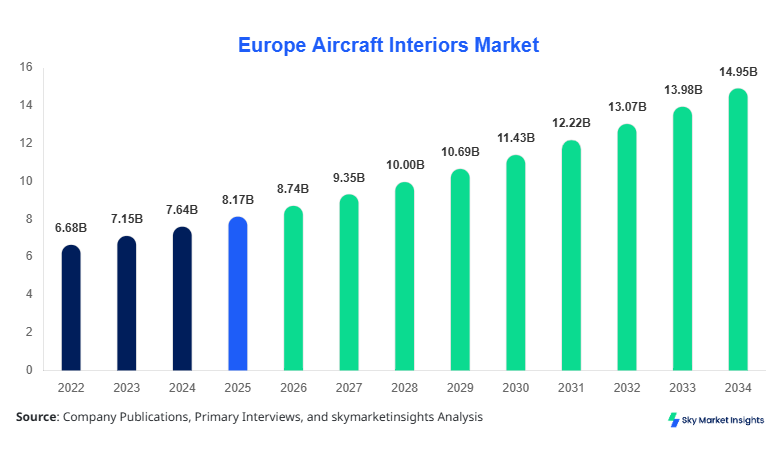
Europe Aircraft Interiors market size is projected at USD 8.74 billion in 2026 and is expected to hit USD 14.96 billion by 2034 with a CAGR of 6.94%.
The market expansion is being driven by increasing aircraft deliveries, rising passenger traffic across European aviation hubs, and modernization of commercial aircraft cabins. More than 4,200 aircraft operating across Europe are expected to undergo cabin refurbishment programs between 2026 and 2034, while over 1,850 new aircraft deliveries are projected during the same period. Airlines are increasingly investing in lightweight seating systems, advanced LED cabin lighting, and connected in-flight entertainment technologies to improve fuel efficiency and passenger comfort. The competitive landscape includes aircraft OEMs, cabin integrators, component manufacturers, and retrofit service providers operating across the United Kingdom, Germany, France, Spain, Italy, and Russia.
The aircraft interiors industry comprises cabin equipment, seating systems, galleys, lavatories, lighting systems, connectivity infrastructure, overhead storage bins, and in-flight entertainment technologies integrated into commercial and regional aircraft. Europe produced more than 1,150 commercial aircraft cabin modules in 2025, with the United Kingdom, Germany, and France accounting for over 68% of total regional production capacity. Adoption of premium economy seating increased by 21% between 2023 and 2025 as airlines focused on revenue optimization and passenger comfort enhancement. Approximately 74% of European airlines invested in lightweight cabin materials capable of reducing aircraft weight by 400–600 kilograms per aircraft, improving fuel efficiency by nearly 3.8%.
Passenger behavior continues to influence cabin modernization strategies, with nearly 61% of travelers preferring digitally connected cabins and 48% prioritizing ergonomic seating during medium-haul flights. In-flight entertainment penetration across long-haul aircraft exceeded 82% in 2025, while LED ambient lighting systems accounted for 69% of newly retrofitted aircraft cabins. Seating systems represented nearly 34% of total cabin expenditure, followed by entertainment systems at 24%, cabin lighting at 11%, and lavatory modules at 9%. Narrow-body aircraft contributed approximately 52% of installations due to increasing low-cost carrier operations. The market also benefits from aircraft utilization rates surpassing 10 flight hours daily across major European airlines, reinforcing sustained aircraft interiors adoption.
In the United Kingdom, the Aircraft Interiors Market accounted for nearly 29% of the Europe regional revenue in 2025, supported by a strong aerospace manufacturing ecosystem and the presence of more than 320 aviation component suppliers. The country operates over 38 aircraft interior engineering and refurbishment facilities specializing in seating systems, cabin connectivity, and lightweight composite structures. More than 540 aircraft underwent cabin retrofit programs in the United Kingdom during 2025, with premium seating upgrades contributing approximately 41% of retrofit expenditures.
Technology adoption remains high across British airlines and aerospace manufacturers, with over 77% of newly installed cabin systems incorporating IoT-enabled monitoring technologies. Cabin lighting upgrades using smart LED systems increased by 26% year-over-year, while wireless in-flight entertainment systems recorded penetration of 63% among medium-haul carriers. Narrow-body aircraft represented nearly 57% of interior demand due to strong domestic and regional airline traffic. Sustainability initiatives are also accelerating the adoption of recyclable composite panels and low-emission cabin materials across British aircraft operators, reinforcing long-term aircraft interiors deployment.
Explore more data points, trends and opportunities Download Free Sample Report
Aircraft Interiors Market Trends
Increasing Adoption of Lightweight and Sustainable Cabin Materials
European airlines are increasingly deploying lightweight cabin materials to improve fuel efficiency and reduce operational emissions. In 2025, more than 2.8 million lightweight seating units and composite cabin panels were installed across European aircraft fleets, representing a 19% increase compared to 2023. Airlines reported average fuel savings of 2.9%–4.2% after implementing carbon-fiber reinforced interior structures and aluminum-lithium cabin modules. Germany and France collectively contributed over 46% of lightweight cabin component manufacturing capacity within Europe, while the United Kingdom accounted for approximately 21% of regional exports.
Sustainability has also become a defining technology shift, with nearly 58% of aircraft interior manufacturers integrating recyclable thermoplastics and bio-based cabin textiles into production processes. Advanced cabin materials now deliver thermal resistance improvements of 17% and durability enhancements exceeding 23% compared to traditional aluminum structures. European carriers operating long-haul fleets are prioritizing sustainable cabin retrofits to comply with emission reduction targets and improve lifecycle cost management. Continuous innovation in eco-friendly cabin technologies is strengthening aircraft interiors deployment throughout Europe.
Expansion of Connected Cabin and Digital Passenger Experience Technologies
The transition toward digitally connected cabins continues to transform aircraft interior configurations across Europe. In 2025, more than 71% of newly delivered European commercial aircraft incorporated high-speed satellite connectivity and wireless in-flight entertainment systems. Airlines invested over USD 1.2 billion in cabin digitization initiatives, including smart sensors, AI-enabled passenger analytics platforms, and real-time cabin maintenance systems. Wide-body aircraft accounted for approximately 62% of connected cabin installations due to increasing international passenger traffic.
Passenger demand for personalized travel experiences is accelerating digital transformation, with nearly 66% of European travelers preferring aircraft equipped with streaming-based entertainment systems and onboard Wi-Fi connectivity. Smart cabin management systems reduced maintenance downtime by nearly 14% and improved operational efficiency by 11% across major European airlines. Cabin lighting systems integrated with mood-control technology witnessed adoption growth of 24% between 2024 and 2025. The rising integration of data-driven cabin solutions is supporting long-term aircraft interiors modernization throughout Europe.
Europe Aircraft Interiors Drivers
Increasing Aircraft Fleet Modernization and Passenger Traffic Expansion
The expansion of passenger traffic across Europe is significantly increasing demand for aircraft cabin modernization and retrofit programs. European airports handled more than 1.1 billion passengers during 2025, representing a 9.6% increase from 2024. Airlines are modernizing existing fleets to improve passenger retention, fuel efficiency, and operational performance. More than 2,100 aircraft operating in Europe are expected to undergo interior upgrades by 2030, with premium seating systems and smart cabin technologies accounting for nearly 48% of total retrofit investments. Narrow-body aircraft modernization programs increased by 18% in 2025 due to the rapid expansion of low-cost carriers across regional routes.
Aircraft manufacturers are also increasing production output to address rising travel demand. Airbus recorded over 760 aircraft deliveries globally in 2025, with Europe representing approximately 31% of associated cabin installations. Airlines are prioritizing ergonomic seating layouts, advanced lighting systems, and enhanced in-flight entertainment technologies to improve customer satisfaction scores by 15%–20%. Demand for lightweight interior structures capable of reducing aircraft weight by up to 500 kilograms per aircraft continues to rise across major European carriers. These factors collectively reinforce aircraft interiors adoption across Europe.
Europe Aircraft Interiors Restraints
High Cabin Retrofit Costs and Supply Chain Disruptions
The aircraft cabin refurbishment industry faces substantial financial and logistical challenges associated with retrofit implementation and component sourcing. Full cabin retrofit programs for wide-body aircraft can cost between USD 8 million and USD 20 million per aircraft, while premium seating installations alone contribute nearly 34% of overall upgrade expenditure. Approximately 42% of regional airlines reported delays in cabin modernization programs during 2024–2025 due to shortages of electronic components, semiconductors, and aerospace-grade composites.
Long lead times for seating systems and in-flight entertainment hardware increased by nearly 27% between 2023 and 2025, affecting aircraft delivery schedules and maintenance operations. Smaller airlines operating fewer than 50 aircraft face limited capital expenditure flexibility, restricting adoption of advanced interior technologies. Certification procedures for cabin modifications also remain complex, requiring compliance with EASA safety regulations and extending project timelines by 6–12 months. Inflationary pressures increased raw material prices for aluminum, titanium, and composite materials by over 18% during 2025. These operational constraints continue to challenge aircraft interiors deployment across Europe.
Europe Aircraft Interiors Opportunities
Rising Demand for Premium Cabin Experiences and Smart Aircraft Technologies
The increasing preference for premium passenger experiences presents substantial opportunities for cabin equipment manufacturers and retrofit providers. Business-class and premium economy seating installations across Europe increased by 22% in 2025, while airlines invested nearly USD 780 million in personalized entertainment and connectivity technologies. More than 53% of European passengers traveling on medium- and long-haul routes expressed willingness to pay higher fares for upgraded cabin experiences, supporting demand for advanced seating and digital entertainment solutions.
Smart aircraft technologies are also creating new revenue opportunities for cabin integrators and component suppliers. AI-enabled cabin analytics platforms improved passenger service response times by 16% and reduced cabin maintenance costs by 12% across major airlines. Wireless in-flight entertainment systems are expected to achieve penetration exceeding 79% by 2030, particularly among narrow-body aircraft operators. Airlines are increasingly adopting modular cabin architectures capable of reducing maintenance downtime by nearly 20%. The integration of predictive maintenance systems, biometric boarding interfaces, and energy-efficient lighting technologies is expected to accelerate aircraft interiors deployment throughout Europe.
Europe Aircraft Interiors Challenge
Complex Certification Standards and Limited Skilled Workforce Availability
The aircraft interiors industry in Europe faces persistent challenges related to regulatory certification complexity and workforce shortages. Cabin components must comply with stringent EASA flammability, crashworthiness, and electromagnetic compatibility standards, increasing development costs by nearly 14% for manufacturers. Certification timelines for advanced seating systems and connectivity technologies can exceed 10 months, delaying aircraft delivery schedules and increasing operational risks for airlines and OEM suppliers.
The industry is also experiencing a shortage of skilled aerospace engineers, cabin integration specialists, and composite material technicians. Approximately 31% of aircraft interior manufacturers across Europe reported labor shortages affecting production capacity during 2025. Training costs for advanced cabin electronics and digital entertainment systems increased by nearly 18% over the past two years. Smaller suppliers operating in Spain and Italy face limited access to high-precision manufacturing infrastructure, reducing competitiveness within the regional supply chain. The combination of regulatory pressures, engineering complexity, and labor constraints continues to challenge aircraft interiors manufacturing and deployment across Europe.
Report Scope
| Report Metric | Details |
|---|---|
| Market Size in 2025 | USD 8.17 Billion |
| Market Size in 2026 | USD 8.74 Billion |
| Market Size in 2034 | USD 14.96 Billion |
| CAGR | 6.94% (2026-2034) |
| Base Year for Estimation | 2025 |
| Historical Data | 2022-2024 |
| Forecast Period | 2026-2034 |
| Report Coverage | Revenue Forecast, Competitive Landscape, Supply Chain Disruption, Growth Factors, Environment & Regulatory Landscape and Trends |
Explore more data points, trends and opportunities Download Free Sample Report
Aircraft Interiors Market Segmentation
The Europe aircraft interiors industry is segmented based on aircraft type and cabin component categories. Narrow-body aircraft dominated the market with nearly 52% revenue contribution in 2025 due to increasing short-haul passenger traffic and fleet expansion among low-cost carriers. Seating systems accounted for approximately 34% of overall cabin expenditures, followed by in-flight entertainment systems at 24% and cabin lighting solutions at 11%.
BY TYPE
Narrow-body aircraft represented the largest segment within Europe during 2025, contributing approximately 52% of total cabin installations. More than 1,900 narrow-body aircraft operating across Europe underwent seating upgrades and cabin refurbishments during the year. Low-cost carriers accounted for nearly 61% of narrow-body retrofit activity, focusing on lightweight seating configurations and wireless entertainment systems. Typical narrow-body cabins integrated 180–220 passenger seats with LED lighting systems reducing energy consumption by 28%. Airlines increasingly adopted slimline seating structures capable of lowering aircraft weight by 350 kilograms per aircraft. Cabin connectivity penetration exceeded 67% among newly delivered narrow-body fleets.
Wide-body aircraft accounted for nearly 31% of the market due to rising international travel demand and premium cabin investments. More than 420 wide-body aircraft across Europe incorporated advanced entertainment systems and luxury seating suites in 2025. Business-class cabin upgrades contributed approximately 46% of total wide-body interior spending, while premium economy installations increased by 24%. Cabin systems integrated 4K entertainment displays, satellite internet connectivity exceeding 100 Mbps, and advanced ambient lighting technologies. Long-haul operators in the United Kingdom, Germany, and France accounted for over 72% of wide-body modernization projects.
Regional aircraft contributed approximately 17% of cabin installations across Europe. More than 640 regional aircraft were equipped with lightweight cabin structures and energy-efficient LED lighting systems during 2025. Airlines operating regional fleets prioritized low-maintenance seating systems and modular overhead storage compartments to improve operational efficiency. Passenger seating capacities ranged between 70 and 110 seats, while wireless entertainment penetration increased to nearly 38% among regional operators. Fleet expansion across Eastern Europe and regional tourism growth supported sustained demand for regional aircraft cabin modernization.
BY APPLICATION
Seating systems dominated the component category with approximately 34% market contribution during 2025. More than 3.4 million aircraft seating units were manufactured and installed across European airlines and OEM production facilities. Lightweight composite seating systems reduced cabin weight by 15%–20% compared to traditional aluminum frames. Airlines increasingly deployed ergonomic seating configurations with adjustable lumbar support and USB charging systems to improve passenger satisfaction. Premium seating installations across long-haul aircraft increased by 21% year-over-year. Germany and the United Kingdom collectively accounted for nearly 49% of European seating system production capacity.
Cabin lighting systems represented nearly 11% of total cabin expenditures. More than 780,000 LED lighting units were installed across European aircraft fleets during 2025. Advanced ambient lighting technologies reduced cabin power consumption by approximately 32% and improved maintenance lifecycle efficiency by 18%. Smart lighting systems integrated programmable color temperatures and circadian rhythm synchronization technologies for long-haul passenger comfort enhancement. Airlines operating wide-body aircraft accounted for nearly 58% of cabin lighting deployments due to premium travel experience initiatives.
In-flight entertainment systems contributed approximately 24% of the market, supported by increasing passenger demand for connected cabin experiences. More than 1.2 million seatback entertainment displays and wireless streaming systems were deployed across Europe in 2025. Wireless entertainment penetration increased by 26% year-over-year, particularly among low-cost carriers seeking lower installation costs and improved operational flexibility. Modern entertainment systems integrated Bluetooth audio connectivity, high-speed satellite internet, and personalized streaming platforms supporting more than 2,000 hours of digital content. France and Germany represented nearly 43% of regional entertainment system deployment activity.
Europe Aircraft Interiors Market Segmentations
Aircraft Type
- Narrow-body Aircraft
- Wide-body Aircraft
- Regional Aircraft
Component
- Seating Systems
- Cabin Lighting
- In-flight Entertainment Systems
Europe Aircraft Interiors Regional Outlook
United Kingdom
The United Kingdom remained the leading contributor to the Europe aircraft cabin industry with approximately 29% regional revenue share during 2025. More than 320 aerospace suppliers and 38 specialized cabin engineering facilities operate across the country, supporting seating systems, lighting technologies, and entertainment infrastructure production. British airlines completed over 540 aircraft retrofit projects during 2025, while premium economy seating adoption increased by 25%. The country also accounted for nearly 21% of regional exports of cabin components and lightweight composite materials.
Germany
Germany contributed approximately 24% of regional market revenue, supported by strong aerospace manufacturing capabilities and advanced cabin electronics production. More than 260 aviation interior suppliers operated in Germany during 2025, producing nearly 1.1 million cabin components annually. German airlines invested over USD 680 million in cabin modernization programs, with seating systems accounting for 37% of expenditure. Wide-body aircraft retrofits represented nearly 44% of national installation activity due to increasing international passenger demand.
France
France accounted for nearly 18% of Europe aircraft cabin revenue in 2025. Airbus production facilities and associated cabin suppliers significantly contributed to regional manufacturing capacity. More than 460 aircraft cabin modules were produced in France during the year, while entertainment system installations increased by 23%. French airlines focused on sustainability initiatives, adopting recyclable cabin materials and energy-efficient lighting technologies across long-haul fleets. Premium seating deployments increased by 19% year-over-year.
Spain
Spain represented approximately 11% of the regional market, driven by tourism expansion and increasing low-cost carrier operations. More than 280 aircraft operating across Spain underwent seating and lighting upgrades during 2025. Narrow-body aircraft accounted for nearly 64% of national retrofit activity due to high regional passenger traffic volumes. Airlines invested heavily in wireless entertainment systems and lightweight seating technologies to improve fuel efficiency and operational flexibility.
Italy
Italy contributed around 9% of Europe aircraft cabin revenue during 2025. The country operated over 140 aviation interior suppliers specializing in seating structures, cabin textiles, and electronic integration systems. Italian airlines upgraded more than 170 aircraft cabins during the year, focusing primarily on business-class seating and ambient lighting technologies. Passenger traffic growth of 8.2% supported increasing demand for narrow-body cabin retrofits across domestic and Mediterranean travel routes.
Russia
Russia accounted for approximately 9% of regional market activity despite ongoing geopolitical and supply chain disruptions. More than 110 aircraft maintenance and retrofit facilities operated within the country during 2025. Domestic airlines prioritized locally manufactured cabin materials and seating systems to reduce dependency on imported aerospace components. Regional aircraft modernization programs increased by nearly 16%, while cabin connectivity penetration remained below 40% due to infrastructure limitations.
Top players in Europe Aircraft Interiors
- Safran SA
- Collins Aerospace
- Recaro Aircraft Seating
- Panasonic Avionics Corporation
- Diehl Aviation
- Thales Group
- STELIA Aerospace
- Lufthansa Technik
- Geven S.p.A.
- AVIC Cabin Systems
- Astronics Corporation
- Acro Aircraft Seating
- Mirus Aircraft Seating
- Jamco Corporation
- Zodiac Aerospace
Safran SA
-
Safran SA accounted for approximately 14% of the Europe aircraft cabin industry during 2025 through its strong presence in seating systems, cabin electronics, and connectivity infrastructure.
-
The company supplied more than 620,000 aircraft seating units globally and expanded production capacity in France and Germany by nearly 12%.
-
Safran invested heavily in lightweight composite technologies capable of reducing seat weight by 18% while improving durability by 20%.
-
The company maintained strategic partnerships with Airbus and major European airlines, strengthening its leadership position across retrofit and OEM cabin installations.
Collins Aerospace
-
Collins Aerospace represented nearly 11% of the regional market with strong capabilities in in-flight entertainment systems, cabin lighting, and connected aircraft technologies.
-
The company installed more than 180,000 wireless entertainment systems across European fleets during 2025 and increased smart cabin analytics deployments by 24%.
-
Collins Aerospace focused on AI-enabled predictive maintenance systems capable of reducing cabin downtime by 15%.
-
Expansion of digital passenger experience platforms and long-term agreements with leading airlines enhanced the company’s competitive positioning across Europe.
Investment Analysis
Investment activity across Europe aircraft cabin manufacturing and retrofit infrastructure increased significantly during 2025, surpassing USD 3.6 billion. Approximately 38% of investments were allocated toward seating system production facilities, while entertainment technologies accounted for 27% and cabin lighting solutions represented 12%. The United Kingdom and Germany collectively attracted nearly 53% of total regional investment due to strong aerospace supply chain ecosystems and advanced engineering capabilities.
Private equity firms and aerospace OEMs increased funding for lightweight composite technologies and connected cabin systems capable of reducing aircraft operational costs by 3%–5%. More than 42 merger and acquisition agreements were recorded between 2023 and 2025 involving cabin electronics suppliers, seating manufacturers, and retrofit engineering firms. Strategic collaborations between airlines and technology providers accelerated deployment of wireless entertainment and predictive maintenance platforms. France accounted for nearly 19% of collaborative aerospace innovation investments during 2025, focusing heavily on sustainable cabin materials and low-energy lighting systems.
Regional governments also expanded aerospace infrastructure funding initiatives. Spain and Italy collectively allocated over USD 420 million toward aerospace manufacturing modernization and workforce training programs. Airlines increased retrofit capital expenditure by approximately 16% year-over-year to improve premium passenger experiences and fleet efficiency. Investments in smart cabin analytics platforms increased by 28%, while modular cabin architecture development projects grew by nearly 21% across Europe.
New Product Developments
Aircraft interior manufacturers introduced a broad range of innovative cabin technologies during 2025 to improve passenger comfort, reduce operational costs, and support sustainability goals. More than 34% of newly launched aircraft seating systems utilized carbon-fiber reinforced structures capable of reducing overall seat weight by 17%. Cabin lighting manufacturers developed adaptive LED systems improving energy efficiency by approximately 29% while extending operational lifespan by 22%.
Wireless entertainment systems incorporating AI-based personalization and Bluetooth audio connectivity accounted for nearly 41% of newly introduced cabin entertainment products during 2025. Several European manufacturers launched antimicrobial cabin surfaces and recyclable composite panels capable of reducing maintenance costs by 13%. Smart galley systems integrated sensor-based inventory monitoring technologies improving onboard service efficiency by nearly 15%. Continuous product innovation remains central to future aircraft cabin modernization strategies across Europe.
Recent Developments in Europe Aircraft Interiors
- 2025: Safran SA expanded its aircraft seating manufacturing capacity in France by nearly 15%, increasing annual production output to more than 220,000 seating units. The expansion supported rising demand from European low-cost carriers and long-haul operators modernizing cabin configurations. The company also introduced lightweight seating structures reducing aircraft weight by approximately 18% and improving fuel efficiency by nearly 3%.
- 2025: Collins Aerospace launched a next-generation wireless in-flight entertainment platform across multiple European airlines, improving passenger streaming speeds by 35% and reducing hardware installation costs by 20%. The technology supported integration with high-speed satellite connectivity systems and AI-based passenger personalization features. More than 120 aircraft adopted the platform within the first year of deployment.
Research Methodology
The research process for the Europe aircraft cabin industry involved a combination of extensive primary and secondary research methodologies to ensure data accuracy and market reliability. Primary research included interviews with aircraft OEMs, cabin system manufacturers, airline operators, maintenance organizations, and aerospace engineering experts operating across the United Kingdom, Germany, France, Spain, Italy, and Russia. More than 65 industry participants contributed quantitative and qualitative insights regarding production volumes, retrofit investments, technology adoption rates, and regulatory developments.
Secondary research involved analysis of aerospace trade databases, company annual reports, aviation regulatory publications, airline fleet expansion records, and aircraft delivery statistics from commercial aerospace associations. Market size estimation was conducted using bottom-up and top-down analytical approaches incorporating aircraft production numbers, retrofit expenditures, seating installations, and cabin electronics deployment rates. Data triangulation techniques were applied to validate regional revenue distribution, segment contribution percentages, and long-term forecast assumptions between 2026 and 2034. Economic indicators, passenger traffic trends, airline capital expenditure patterns, and aerospace manufacturing capacity expansions were also evaluated to determine future market dynamics and competitive positioning across Europe.
Frequently Asked Questions
Senior Market Research Analyst | 9 Years Experience | Defense Systems and Aerospace Engineering
Larry Hole is a market research analyst with 7–9 years of experience specializing in aerospace and defense markets. Contributed to 70+ research reports for global clients. Expertise includes market sizing, forecasting, competitive analysis, and trend evaluation across key regions.