Europe Aircraft Fuel Management System Market Size
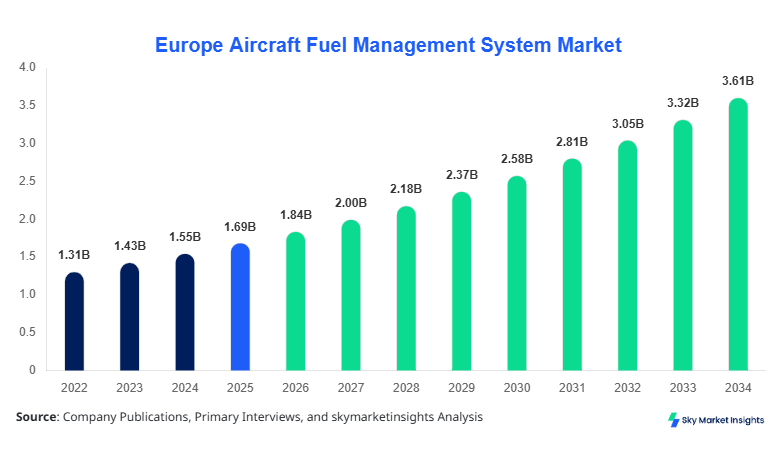
The European aircraft fuel management system market size is projected at USD 1.84 billion in 2026 and is expected to hit USD 3.62 billion by 2034 with a CAGR of 8.8%. The regional aviation sector is witnessing increasing investments in fuel optimization technologies, aircraft efficiency systems, and digital fuel analytics across both commercial and defense aviation fleets. More than 7,200 aircraft operating across Europe are expected to integrate upgraded fuel management architectures by 2030, while over 64% of airline operators are prioritizing automated fuel monitoring systems to reduce operational expenditure and carbon emissions.
The report evaluates detailed market segmentation, technology penetration, supply chain analysis, and competitive benchmarking across Europe. It further analyzes aircraft fleet modernization activities, component-level demand, airline procurement strategies, and evolving aviation sustainability mandates influencing the aircraft fuel management system market.
The aircraft fuel management system industry comprises integrated hardware and software technologies designed to monitor, measure, control, and optimize fuel distribution and consumption in aircraft. These systems include fuel gauging units, sensors, valves, pumps, digital processors, and centralized monitoring software. Europe manufactured more than 1,250 commercial and military aircraft units during 2025, with France, Germany, and the United Kingdom accounting for nearly 68% of total aerospace production volume. Increasing aviation fuel costs, which averaged USD 910 per metric ton in Europe during 2025, are accelerating deployment of intelligent fuel management technologies capable of improving fuel efficiency by 4%–8%.
Adoption and penetration levels continue expanding across next-generation narrow-body and wide-body aircraft. Nearly 71% of newly delivered aircraft in Europe during 2025 incorporated advanced digital fuel gauging systems integrated with predictive maintenance modules. Commercial aircraft represented approximately 59% of total installations, followed by military aviation with 28% and business aviation with 13%. Airline operators are increasingly demanding systems with less than 0.5% fuel quantity deviation accuracy and real-time data transmission frequencies exceeding 10 Hz to improve operational reliability.
Consumer behavior and airline demand analytics indicate that fleet operators are increasingly emphasizing sustainability and operational cost reduction. More than 62% of European airlines identified fuel optimization as a primary investment area in 2025, while 47% planned upgrades to centralized fuel monitoring systems over the next three years. Aircraft OEMs are focusing on lightweight fuel sensors capable of reducing system weight by 12%–18%, directly impacting fuel burn efficiency. Growing integration of AI-enabled analytics and IoT-based diagnostics is further reinforcing aircraft fuel management system market adoption across Europe.
In France, the Aircraft Fuel Management System market accounted for nearly 24% of the European regional revenue contribution during 2025, supported by the country’s strong aerospace manufacturing ecosystem and large commercial aircraft assembly operations. France hosts more than 320 aerospace component manufacturing facilities and over 110 aviation technology companies directly involved in fuel system engineering, avionics integration, and aircraft digitalization. Commercial aircraft applications contributed approximately 61% of total domestic installations, while military aviation represented 26%, and business jets accounted for 13%.
Technology adoption rates in France remain among the highest in Europe, with over 74% of newly manufactured aircraft integrating smart fuel gauging systems and predictive monitoring modules. More than 1,400 advanced fuel sensors were deployed across French aerospace programs during 2025 alone. The defense sector is increasingly investing in automated fuel balancing technologies capable of reducing fuel transfer time by 18% and improving flight endurance by 7%. The increasing implementation of SAF-compatible fuel monitoring systems and digital twin analytics is strengthening aircraft fuel management system market expansion across France.
Explore more data points, trends and opportunities Download Free Sample Report
Aircraft Fuel Management System Market Trends
The European aviation industry is increasingly shifting toward digitalized and AI-driven fuel management architectures. During 2025, more than 5.8 million fuel monitoring modules and components were shipped across European aerospace supply chains, reflecting rising modernization activities. Aircraft manufacturers are deploying cloud-connected fuel analytics platforms capable of reducing unplanned maintenance incidents by 21% and improving fuel measurement precision by 15%. Approximately 67% of commercial aircraft delivered during 2025 included integrated smart fuel gauging systems with automated diagnostics and predictive maintenance capabilities. The expansion of connected aircraft ecosystems and digital aviation platforms continues driving aircraft fuel management system market development.
Another major trend involves the increasing adoption of lightweight composite-compatible fuel management hardware. European aerospace manufacturers reduced average fuel system component weight by nearly 14% between 2022 and 2025 through advanced material engineering and miniaturized sensor integration. More than 43% of regional aircraft OEMs are deploying fiber-optic fuel sensors capable of operating at temperature tolerances ranging from -55°C to 125°C. Military aviation demand is also accelerating, with over 390 defense aircraft modernization projects involving digital fuel transfer and balancing systems. Rising pressure to comply with EU aviation emission reduction targets is supporting aircraft fuel management system market transformation.
The growing penetration of Sustainable Aviation Fuel (SAF) compatibility solutions is another defining industry development. Nearly 48% of European airline operators initiated SAF integration programs in 2025, requiring upgraded fuel monitoring and contamination detection systems. Advanced fuel management platforms capable of supporting multi-fuel compatibility improved operational flexibility by 19% while reducing fuel wastage by 11%. Additionally, real-time aircraft telemetry and blockchain-based fuel tracking solutions are gaining traction among airline operators seeking improved transparency and operational optimization. These technological advancements continue accelerating aircraft fuel management system market adoption across Europe.
Europe Aircraft Fuel Management System Drivers
Rising Aircraft Fleet Modernization and Fuel Efficiency Priorities
European airlines and defense operators are increasingly investing in fleet modernization programs to enhance fuel efficiency, reduce carbon emissions, and improve operational performance. During 2025, Europe recorded more than 820 aircraft retrofit projects involving advanced fuel management technologies. Fuel costs represented approximately 31% of airline operating expenses, encouraging carriers to deploy systems capable of reducing fuel consumption by 5%–9%. More than 72% of commercial airlines operating narrow-body fleets initiated digital fuel monitoring upgrades during the last two years. In parallel, defense aviation agencies across Europe allocated nearly USD 1.2 billion toward avionics and fuel optimization modernization projects. The adoption of AI-powered fuel balancing technologies reduced in-flight fuel imbalance incidents by 17% while improving route optimization accuracy by 13%. Aircraft manufacturers are also integrating centralized fuel processors with predictive analytics platforms capable of processing over 1,500 operational data points per flight cycle. Regulatory mandates associated with aviation sustainability and carbon neutrality targets are further reinforcing aircraft fuel management system market expansion.
Europe Aircraft Fuel Management System Restraints
High Installation and Maintenance Costs of Advanced Fuel Systems
Despite increasing adoption, the high capital expenditure associated with aircraft fuel management systems remains a significant challenge across Europe. Advanced digital fuel gauging systems integrated with predictive analytics software can increase aircraft integration costs by 8%–14% depending on aircraft type and configuration. Maintenance expenses for sophisticated sensors, control valves, and centralized processors also increased by approximately 11% during 2025 due to semiconductor shortages and aerospace-grade component inflation. Small and mid-sized regional airline operators continue facing financial limitations in adopting next-generation fuel optimization technologies. Additionally, certification and regulatory compliance requirements increase deployment timelines by 12–18 months on average. More than 39% of regional maintenance providers identified software integration complexity as a major operational challenge. Legacy aircraft fleets operating across Eastern Europe also encounter compatibility limitations with modern digital fuel management architectures. These cost and integration barriers are slowing aircraft fuel management system market penetration among budget carriers and older fleet operators.
Europe Aircraft Fuel Management System Opportunities
Expansion of Sustainable Aviation Fuel and Smart Aviation Ecosystems
The rapid expansion of sustainable aviation fuel infrastructure and connected aviation ecosystems presents substantial opportunities for industry participants. Europe aims to increase SAF utilization to more than 20% of total aviation fuel consumption by 2035, creating demand for advanced contamination detection, fuel compatibility monitoring, and automated balancing systems. Nearly 56% of aircraft OEMs are developing next-generation fuel management platforms capable of supporting hybrid propulsion and multi-fuel configurations. Airlines implementing AI-driven fuel analytics reported operational savings exceeding USD 3.4 million annually per fleet. Smart airport ecosystems integrating fuel logistics, predictive maintenance, and aircraft telemetry are expected to expand by over 18% annually through 2030. Defense modernization initiatives across NATO-aligned countries are also generating opportunities for autonomous fuel balancing systems and mission-adaptive fuel optimization technologies. The integration of digital twins and cloud-based monitoring infrastructure is expected to unlock new aircraft fuel management system market opportunities across Europe.
Challenges in Europe's Aircraft Fuel Management System
Cybersecurity Risks and Integration Complexity in Connected Aviation Platforms
As aircraft become increasingly connected, cybersecurity and software integration challenges are emerging as critical concerns for aviation operators. More than 61% of European aerospace companies identified cybersecurity vulnerabilities as a major operational risk in connected fuel management platforms during 2025. Aircraft fuel systems now process thousands of operational data points in real time, increasing exposure to potential cyberattacks targeting avionics communication networks. Integration of AI-based analytics with legacy onboard systems often requires extensive software reconfiguration and testing procedures, increasing deployment complexity by approximately 22%. Regulatory authorities across Europe introduced stricter cybersecurity compliance requirements for aircraft digital systems, extending certification cycles and increasing engineering expenditure. Additionally, interoperability challenges between OEM platforms and third-party maintenance software continue affecting system efficiency. Smaller operators with limited IT infrastructure struggle to manage cloud-based aviation analytics ecosystems. These technological and operational barriers continue challenging aircraft fuel management system market expansion across Europe.
Report Scope
| Report Metric | Details |
|---|---|
| Market Size in 2025 | USD 1.69 Billion |
| Market Size in 2026 | USD 1.84 Billion |
| Market Size in 2034 | USD 3.62 Billion |
| CAGR | 8.8% (2026-2034) |
| Base Year for Estimation | 2025 |
| Historical Data | 2022-2024 |
| Forecast Period | 2026-2034 |
| Report Coverage | Revenue Forecast, Competitive Landscape, Supply Chain Disruption, Growth Factors, Environment & Regulatory Landscape and Trends |
Explore more data points, trends and opportunities Download Free Sample Report
Aircraft Fuel Management System Market Segmentation
The aircraft fuel management system market is segmented based on component and aircraft type. Commercial aircraft applications dominate the market with approximately 59% revenue contribution due to expanding airline fleets and fuel efficiency mandates. Sensors account for nearly 38% of component demand owing to increasing integration of digital monitoring technologies and predictive maintenance architectures.
By Type
Fuel sensors represented approximately 38% of total component installations across Europe during 2025. More than 3.2 million fuel monitoring sensors were supplied to commercial and defense aircraft programs throughout the year. Advanced capacitive and fiber-optic sensors capable of achieving fuel quantity accuracy within ±0.3% are increasingly replacing traditional analog technologies. Sensor manufacturers are also introducing lightweight units, reducing aircraft system weight by 9%–12%. Commercial aviation applications contributed nearly 64% of sensor demand, while military aviation represented 24%. Increasing adoption of IoT-connected sensor networks and predictive diagnostics continues strengthening the aircraft fuel management system market penetration.
Fuel gauging units accounted for nearly 34% of total market demand during 2025. More than 1.7 million digital fuel gauging systems were integrated into European aircraft fleets, particularly within next-generation narrow-body aircraft programs. These units provide centralized fuel quantity monitoring, automated balancing, and contamination detection functions. Modern digital gauging systems process operational frequencies exceeding 20 Hz and support real-time telemetry integration. Approximately 69% of newly manufactured commercial aircraft integrated advanced digital fuel gauging units with predictive maintenance capability. Increasing regulatory emphasis on flight safety and operational precision is driving the aircraft fuel management system market expansion in this segment.
Control valves represented nearly 28% of component-level installations in 2025. More than 920,000 aerospace-grade control valves were deployed across European aircraft manufacturing and retrofit programs. These systems regulate fuel transfer pressure, fuel balancing, and emergency shutoff functions. Modern electronically controlled valves improve fuel transfer efficiency by nearly 16% while reducing leakage incidents by 11%. Military aircraft applications accounted for approximately 31% of total control valve demand due to increasing defense modernization projects. Lightweight titanium-alloy valve assemblies capable of operating above 5,000 psi are gaining strong adoption across advanced aviation platforms, supporting aircraft fuel management system market development.
By Application
Commercial aircraft represented approximately 59% of total market demand during 2025. More than 4,800 commercial aircraft operating across Europe incorporated advanced fuel monitoring and balancing systems. Airline operators increasingly deploy AI-driven fuel analytics capable of improving route optimization efficiency by 14% and reducing fuel wastage by 10%. Narrow-body aircraft accounted for nearly 63% of commercial installations due to rising intra-European air traffic demand. Digital fuel gauging systems integrated with centralized avionics platforms are becoming standard across new-generation aircraft fleets, supporting aircraft fuel management system market expansion.
Military aircraft contributed approximately 28% of total installations across Europe during 2025. Defense modernization programs across France, Germany, and the United Kingdom generated strong demand for autonomous fuel balancing and mission-adaptive fuel optimization systems. More than 390 military aircraft retrofit projects involving advanced fuel management systems were completed during the year. Modern defense fuel systems support rapid fuel transfer rates exceeding 1,200 liters per minute while improving mission endurance by 8%–12%. NATO interoperability initiatives and increasing defense expenditure continue reinforcing aircraft fuel management system market growth.
Business jets accounted for nearly 13% of total market demand during 2025. Europe operated more than 3,400 active business jets equipped with advanced fuel monitoring technologies. Corporate aviation operators increasingly prioritize lightweight digital fuel systems capable of reducing operational fuel consumption by 6%–8%. Approximately 54% of newly delivered business jets integrated cloud-connected fuel analytics and predictive maintenance modules. Demand for long-range business aviation operations is driving adoption of automated fuel balancing and contamination detection systems, contributing to aircraft fuel management system market expansion.
Europe Aircraft Fuel Management System Market Segmentations
Component
- Sensors
- Fuel Gauging Units
- Control Valves
Aircraft Type
- Commercial Aircraft
- Military Aircraft
- Business Jets
Europe Aircraft Fuel Management System: Regional Outlook
United Kingdom
The United Kingdom accounted for approximately 21% of the regional market during 2025. The country hosts more than 240 aerospace manufacturing and avionics facilities supporting commercial and defense aviation programs. Commercial aircraft applications contributed nearly 58% of domestic demand, while defense aviation represented 30%. More than 1,100 aircraft operating within the UK integrated upgraded fuel monitoring systems during 2025. The country’s emphasis on sustainable aviation initiatives and advanced aerospace R&D continues accelerating deployment of AI-driven fuel optimization technologies.
Germany
Germany represented nearly 23% of the European market in 2025 due to its strong aerospace engineering ecosystem and aircraft component manufacturing base. More than 290 aviation technology companies are actively involved in fuel system engineering and digital avionics integration. Commercial aircraft production contributed approximately 61% of domestic installations, while business aviation represented 15%. Germany deployed more than 1.5 million advanced fuel sensors and gauging units during 2025. Increasing investments in smart manufacturing and connected aviation infrastructure are supporting regional adoption.
France
France maintained approximately 24% share of the European market during 2025, making it the largest contributor across the region. More than 320 aerospace facilities and over 110 aircraft technology firms operate across the country. Commercial aviation contributed nearly 61% of installations, while military aircraft represented 26%. France manufactured over 420 aircraft units during 2025, with strong demand for predictive fuel analytics and lightweight digital gauging systems. The country’s aggressive sustainability initiatives and aerospace modernization programs continue driving market expansion.
Spain
Spain accounted for nearly 11% of regional demand during 2025. The country operates more than 90 aerospace component manufacturing facilities and several aircraft maintenance hubs supporting commercial aviation. Approximately 66% of installations were associated with commercial aircraft operations. Spain recorded over 340 retrofit projects involving fuel monitoring systems and predictive maintenance technologies during 2025. Growing tourism-related air traffic and increasing airline fleet modernization activities are supporting regional demand for digital fuel management platforms.
Italy
Italy contributed approximately 10% of total regional revenue during 2025. The country’s aerospace industry includes over 180 aviation component suppliers specializing in avionics, sensors, and aircraft fuel systems. Military aviation applications represented nearly 33% of domestic demand due to expanding defense modernization programs. More than 580 advanced fuel gauging systems were integrated into aircraft operating within Italy during 2025. Increasing collaboration between aerospace OEMs and defense agencies is strengthening fuel system innovation and deployment activities.
Russia
Russia represented nearly 11% of the regional market during 2025 despite supply chain disruptions and geopolitical challenges. The country continued investing in domestic aircraft manufacturing and defense aviation modernization programs. Military aircraft contributed approximately 47% of domestic installations, while commercial aviation represented 41%. Russia manufactured over 160 military aircraft units during 2025, supporting demand for high-capacity fuel transfer and balancing systems. Investments in indigenous aerospace technologies and autonomous fuel management solutions continue influencing regional market development.
Top players in Europe's aircraft fuel management system
- Honeywell International Inc.
- Safran S.A.
- Parker Hannifin Corporation
- Eaton Corporation
- Collins Aerospace
- Meggitt PLC
- Cobham Limited
- Woodward Inc.
- Liebherr Aerospace
- Thales Group
- GKN Aerospace
- GE Aerospace
- Ametek Inc.
- Crane Aerospace & Electronics
- Moog Inc.
Honeywell International Inc.
-
Honeywell International Inc. accounted for approximately 16% of the regional market during 2025.
-
The company maintains strong positioning across commercial and military aviation platforms.
-
Honeywell deployed more than 780,000 fuel management components across Europe during 2025.
-
Its digital fuel gauging systems support predictive maintenance analytics capable of reducing fuel monitoring errors by 19%.
-
The company continues investing in AI-enabled aviation analytics and cloud-connected aircraft monitoring infrastructure.
-
Strong OEM partnerships with major aircraft manufacturers continue strengthening its regional presence.
Safran S.A.
-
Safran S.A. represented nearly 14% of the European market during 2025.
-
The company operates multiple aerospace manufacturing and R&D facilities across France and Germany.
-
Safran integrated advanced fuel transfer and balancing systems into more than 320 aircraft programs during the year.
-
Its lightweight digital fuel monitoring technologies reduced component weight by approximately 13%.
-
The company focuses heavily on SAF-compatible fuel system architectures and next-generation avionics integration.
-
Expanding defense aviation collaborations continue supporting long-term regional positioning.
Investment Analysis
European aerospace investments in aircraft fuel optimization technologies increased by approximately 18% during 2025, surpassing USD 2.8 billion across commercial and defense aviation sectors. Commercial aviation accounted for nearly 57% of total investment allocation, while military aviation represented 31%, and business aviation contributed 12%. France, Germany, and the United Kingdom collectively attracted more than 68% of regional aerospace investment activities. More than 140 aviation modernization programs initiated during 2025 included fuel analytics, predictive maintenance platforms, and digital fuel gauging technologies.
Mergers, acquisitions, and strategic collaborations continue shaping the competitive landscape. Aerospace OEMs increasingly collaborate with avionics software providers and AI analytics firms to develop connected fuel management ecosystems. More than 42 partnership agreements involving digital aviation platforms were announced across Europe during 2025. Several defense agencies entered multi-year modernization contracts focusing on autonomous fuel balancing technologies and predictive fuel optimization systems. Venture capital investments in aviation analytics startups increased by approximately 24%, while R&D spending associated with fuel efficiency innovations rose by 16%.
The growing focus on sustainability and emission reduction strategies is accelerating capital inflows toward SAF-compatible aviation technologies. More than 38% of aerospace investment funds allocated during 2025 targeted digital monitoring and environmental compliance solutions. Airlines implementing advanced fuel optimization technologies reported annual operational savings ranging between USD 2 million and USD 5 million per fleet. Continued expansion of smart airport infrastructure and connected aviation ecosystems is expected to support long-term investment momentum across Europe.
New Product Developments
Aircraft fuel management manufacturers are increasingly launching AI-enabled and cloud-connected solutions capable of improving fuel monitoring precision and operational efficiency. During 2025, more than 31% of newly introduced aviation fuel system products incorporated machine learning algorithms and predictive diagnostics modules. Advanced fiber-optic fuel sensors improved response accuracy by 22% and reduced maintenance requirements by nearly 17%. Aerospace OEMs also introduced lightweight titanium-alloy valve systems, reducing aircraft fuel system weight by 11%–15%.
Several companies launched multi-fuel-compatible monitoring platforms designed to support sustainable aviation fuel integration. These systems improved contamination detection sensitivity by approximately 28% and enhanced fuel transfer efficiency by 14%. Additionally, new centralized fuel analytics software capable of processing over 2,000 operational data points per flight cycle gained strong adoption among European airline operators. Continuous innovation in digital avionics and connected aviation platforms is expected to accelerate product commercialization activities through 2034.
Recent Developments in European Aircraft Fuel Management
- 2025: Honeywell International expanded production capacity for digital fuel monitoring modules across Europe by 18%, enabling annual output exceeding 1.2 million aerospace sensor units. The expansion focused on predictive analytics integration and AI-driven fuel balancing systems designed for next-generation commercial aircraft fleets.
- 2025: Safran S.A. launched a next-generation lightweight fuel gauging architecture, reducing system weight by approximately 14% while improving monitoring precision by 21%. The company integrated the technology into multiple European narrow-body aircraft programs to support aviation sustainability initiatives.
Research Methodology
The research methodology for the European Aircraft Fuel Management System market combines extensive primary and secondary research approaches to ensure accurate market forecasting and competitive analysis. The research process involved collecting operational data from aircraft OEMs, aerospace suppliers, airline operators, defense agencies, and avionics manufacturers across Europe. Primary research included interviews with more than 85 industry executives, procurement managers, aviation engineers, and technology specialists involved in aircraft fuel system deployment and modernization activities.
Secondary research involved evaluation of aerospace trade journals, regulatory databases, aviation associations, annual reports, company presentations, aircraft delivery statistics, and government aerospace publications. Market size estimation was conducted using both top-down and bottom-up analytical frameworks, integrating aircraft production volume, retrofit activity, component shipment analysis, and pricing trends. Quantitative modeling evaluated installation rates, fleet modernization investments, and technology adoption patterns across commercial, military, and business aviation segments. Data triangulation and validation techniques were used to minimize forecasting deviation and ensure the reliability of long-term projections for the European aviation industry.
Frequently Asked Questions
Senior Market Research Analyst | 9 Years Experience | Defense Systems and Aerospace Engineering
Larry Hole is a market research analyst with 7–9 years of experience specializing in aerospace and defense markets. Contributed to 70+ research reports for global clients. Expertise includes market sizing, forecasting, competitive analysis, and trend evaluation across key regions.