Asia Pacific Aircraft Fuel Management System Market Size
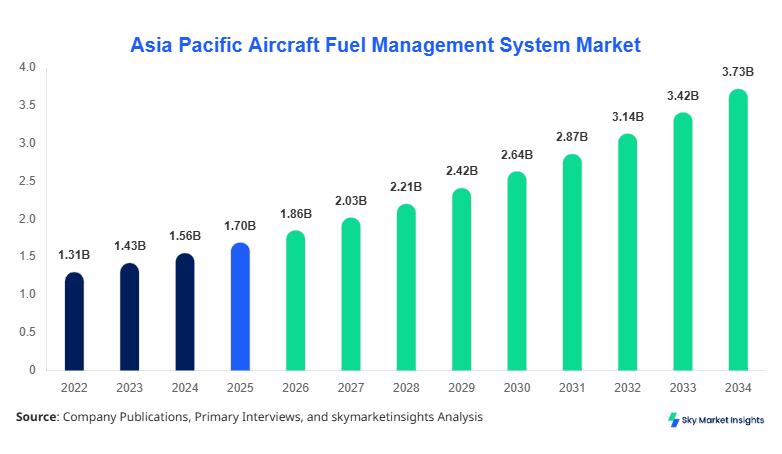
The Asia Pacific Aircraft Fuel Management System market size is projected at USD 1.86 billion in 2026 and is expected to hit USD 3.74 billion by 2034 with a CAGR of 9.1%. The Asia Pacific Aircraft Fuel Management System market demonstrates strong expansion driven by increasing aircraft deliveries exceeding 2,800 units between 2026 and 2030 and fuel optimization demand rising by over 35% across regional airlines. Growing integration of advanced avionics and digital fuel monitoring systems across over 65% of newly manufactured aircraft supports detailed segmentation analysis and competitive benchmarking. The Asia Pacific Aircraft Fuel Management System market size is reinforced by OEM partnerships, fleet modernization programs, and regulatory mandates requiring fuel efficiency improvements of 12–18% across aviation fleets.
The aircraft fuel management system market refers to integrated systems used in aircraft for monitoring, controlling, and optimizing fuel consumption, storage, and distribution with precision levels exceeding ±1.5% accuracy and flow rates reaching 1,200 liters per minute. In the Asia Pacific, aircraft production reached approximately 1,450 units in 2025, with Japan, China, and India contributing over 68% of regional output. Adoption rates for digital fuel monitoring solutions surpassed 58% across commercial fleets, while military aviation recorded 72% penetration of advanced inerting systems. Consumer behavior reflects rising airline preference for fuel-efficient operations, with over 82% of carriers prioritizing cost optimization and sustainability, reducing fuel consumption by 8–12% per flight cycle. Application-wise, commercial aviation dominates with 64%, followed by military aviation at 23% and business aviation at 13%. Technical advancements include automated fuel balancing, predictive analytics, and IoT-enabled sensors operating at frequencies of 400–800 Hz. The aircraft fuel management system market remains critical for enhancing operational efficiency and reducing emissions.
In Japan, the Aircraft Fuel Management System market accounts for approximately 27% of the Asia Pacific region, supported by over 120 aerospace manufacturing facilities and 45 key avionics companies. Japan’s aircraft production reached nearly 210 units in 2025, with fuel management system integration exceeding 78% across new aircraft platforms. Commercial aviation applications represent 61%, military aviation 26%, and business aviation 13% of total system usage. Advanced technology adoption, including digital fuel monitoring and automated flow control systems, has surpassed 70%, with system accuracy improvements of 15–20% over legacy systems. Japan continues to drive innovation through R&D investments exceeding USD 480 million annually, reinforcing the aircraft fuel management system market.
Explore more data points, trends and opportunities Download Free Sample Report
Aircraft Fuel Management System Market Trends
Increasing Adoption of Digital Fuel Monitoring Systems
The aircraft fuel management system market is witnessing significant transformation with digitalization trends, as over 62% of aircraft delivered in 2026 incorporate real-time fuel monitoring systems capable of processing 500–1,000 data points per second. Production volumes of digital sensors reached approximately 3.2 million units annually, driven by demand for predictive analytics and fuel efficiency optimization. Airlines reported fuel savings of 10–14% through digital fuel management solutions, while integration of AI-based monitoring systems grew by 28% year-over-year. Additionally, system upgrades across existing fleets increased by 22%, reflecting a strong retrofit demand. The aircraft fuel management system market trend highlights the shift toward smart aviation technologies.
Growth in Fuel Inerting Systems for Safety Compliance
Safety-driven regulations have accelerated adoption of fuel inerting systems, with penetration reaching 55% across commercial aircraft and over 80% in military fleets. Annual production of inerting modules exceeded 420,000 units, supporting enhanced safety protocols and explosion risk reduction by up to 90%. Technological advancements include nitrogen generation systems operating at efficiency rates above 95%, reducing oxygen concentration in fuel tanks below 12%. Regional aviation authorities mandate compliance rates exceeding 75% by 2028, further driving adoption. Increased aircraft deliveries and retrofitting programs contribute to system demand rising by 18% annually. The aircraft fuel management system market trend reflects regulatory compliance and safety enhancements.
Asia Pacific Aircraft Fuel Management System Market Drivers
Rising Aircraft Fleet Expansion and Fuel Efficiency Requirements
The expansion of the Asia Pacific aircraft fleet, projected to grow by over 45% between 2026 and 2034, is a primary driver of the aircraft fuel management system market. Regional airlines are expected to operate more than 8,500 aircraft by 2030, increasing demand for efficient fuel management systems by over 38%. Fuel costs account for approximately 28–34% of airline operating expenses, pushing adoption of advanced systems capable of reducing fuel consumption by 10–15%. Government initiatives promoting sustainable aviation and carbon emission reduction targets of 20–25% further support market demand. Additionally, increasing passenger traffic, expected to reach 4.1 billion annually in Asia Pacific, fuels aircraft procurement and system integration. OEM collaborations and technological upgrades contribute to production volumes exceeding 1.5 million system units annually, reinforcing the aircraft fuel management system market growth.
Asia Pacific Aircraft Fuel Management System Market Restraints
High Installation and Maintenance Costs
Despite strong demand, high costs associated with aircraft fuel management system installation and maintenance present significant challenges. System integration costs range between USD 120,000 and USD 350,000 per aircraft, while maintenance expenses account for 12–18% of total lifecycle costs. Smaller airlines with limited capital budgets face adoption barriers, resulting in penetration rates below 45% in low-cost carrier segments. Additionally, retrofitting older aircraft increases costs by up to 25%, reducing adoption rates in aging fleets. The complexity of system integration with existing avionics and compliance requirements further adds to operational expenses. Supply chain disruptions and component costs rising by 14–19% also impact market expansion. These factors collectively restrain the aircraft fuel management system market growth.
Asia Pacific Aircraft Fuel Management System Market Opportunities
Emerging Demand for Sustainable Aviation Solutions
The push toward sustainable aviation presents significant opportunities for the aircraft fuel management system market. Adoption of fuel optimization technologies is expected to increase by over 50% by 2030, driven by regulatory mandates targeting emission reductions of 30–40%. Investments in green aviation technologies exceeded USD 2.3 billion in 2025, with 22% allocated to fuel efficiency systems. Integration of hybrid-electric aircraft and sustainable aviation fuel (SAF) compatibility enhances system demand, increasing innovation rates by 35%. Emerging markets in Southeast Asia show adoption growth exceeding 18% annually, supported by expanding airline networks. Collaboration between OEMs and technology providers drives new product development, strengthening aircraft fuel management system market insights.
Challenges in Asia Pacific Aircraft Fuel Management System Market
Technological Integration Complexity and Regulatory Compliance
Complex integration of advanced fuel management systems with modern avionics poses challenges, particularly in ensuring compatibility across diverse aircraft platforms. Over 40% of operators report integration delays exceeding 6–12 months due to system calibration and certification processes. Regulatory compliance requirements vary across countries, increasing certification costs by up to 20%. Additionally, cybersecurity concerns related to digital fuel monitoring systems affect adoption, with over 18% of airlines prioritizing data protection measures. Skilled workforce shortages in avionics engineering further impact implementation efficiency. These challenges collectively affect operational timelines and cost structures, hindering aircraft fuel management system market growth.
Report Scope
| Report Metric | Details |
|---|---|
| Market Size in 2025 | USD 1.70 Billion |
| Market Size in 2026 | USD 1.86 Billion |
| Market Size in 2034 | USD 3.74 Billion |
| CAGR | 9.1% (2026-2034) |
| Base Year for Estimation | 2025 |
| Historical Data | 2022-2024 |
| Forecast Period | 2026-2034 |
| Report Coverage | Revenue Forecast, Competitive Landscape, Supply Chain Disruption, Growth Factors, Environment & Regulatory Landscape and Trends |
Explore more data points, trends and opportunities Download Free Sample Report
Aircraft Fuel Management System Market Segmentation
The aircraft fuel management system market is segmented by type and application, with fuel flow management systems dominating over 38% share, followed by fuel quantity management systems at 34% and inerting systems at 28%. Commercial aviation leads application segments with 64% dominance.
By Type
Fuel quantity management systems account for approximately 34% of the aircraft fuel management system market, with over 520,000 units produced annually. These systems measure fuel levels with a precision accuracy of ±1%, supporting real-time monitoring across aircraft tanks. Adoption rates exceed 65% in commercial fleets and 72% in military aviation. Advanced sensors operate at frequencies of 500 Hz, ensuring rapid data processing and system responsiveness. Integration with digital avionics enhances operational efficiency, reducing fuel wastage by 8–10%.
Fuel flow management systems hold the largest share of 38%, with production volumes exceeding 610,000 units annually. These systems regulate fuel distribution at flow rates up to 1,200 liters per minute, ensuring optimal engine performance. Adoption rates exceed 70% in modern aircraft, with system upgrades improving efficiency by 12–15%. Advanced algorithms enable predictive fuel optimization, reducing consumption by 10% per flight cycle.
Fuel inerting systems represent 28% of the market, with annual production reaching 420,000 units. These systems reduce oxygen concentration in fuel tanks to below 12%, minimizing explosion risks by up to 90%. Adoption rates exceed 55% in commercial aviation and 80% in military aircraft. Technological advancements improve system efficiency by 20%, supporting safety compliance.
By Application
Commercial aviation dominates the aircraft fuel management system market with a 64% share, driven by fleet expansion exceeding 4,000 aircraft deliveries between 2026 and 2034. System usage penetration exceeds 75%, with fuel efficiency improvements of 12–18%. Advanced systems support passenger aircraft with fuel capacities exceeding 150,000 liters.
Military aviation accounts for 23% share, with over 1,200 aircraft equipped with advanced fuel management systems. Adoption rates exceed 80%, with inerting systems widely used for safety compliance. System performance improvements reach 20%, supporting mission efficiency.
Business aviation represents 13% share, with over 900 aircraft equipped with modern fuel management systems. Adoption rates exceed 60%, with system upgrades improving fuel efficiency by 10–12%.
Asia Pacific Aircraft Fuel Management System Market Segmentations
Type
- Fuel Quantity Management System
- Fuel Flow Management System
- Fuel Inerting System
Application
- Commercial Aviation
- Military Aviation
- Business & General Aviation
Asia Pacific Aircraft Fuel Management System Market Regional Outlook
China holds the largest regional share of 32%, with aircraft production exceeding 520 units annually. Commercial aviation dominates with 68% share, supported by expanding airline networks. Investment in aviation infrastructure exceeds USD 1.8 billion annually, driving system demand.
South Korea accounts for 9% share, with production volumes of 120 aircraft annually. Advanced avionics adoption exceeds 70%, supporting system integration across military and commercial fleets.
Japan contributes 27% share, with over 210 aircraft produced annually. High adoption rates of 78% and advanced R&D investments drive market expansion.
India holds 11% share, with aircraft demand increasing by 18% annually. Commercial aviation dominates with 72% application share.
Australia accounts for a 6% share, with a focus on business aviation and military systems. Adoption rates exceed 65%.
Singapore contributes 5% share, with strong MRO capabilities and system retrofitting programs.
Taiwan holds a 4% share, with a focus on defense aviation and system innovation.
Southeast Asia accounts for 6% share, with rapid airline expansion driving system demand growth exceeding 20% annually.
Top players in Asia Pacific Aircraft Fuel Management System Market
- Honeywell International Inc.
- Safran S.A.
- Parker Hannifin Corporation
- Eaton Corporation
- Collins Aerospace
- Meggitt PLC
- Crane Aerospace & Electronics
- Liebherr Group
- GKN Aerospace
- Moog Inc.
- Triumph Group
- Thales Group
-
Honeywell International Inc.
-
Holds approximately 18% market share
-
Leading provider of integrated avionics and fuel systems
-
Strong presence across commercial and military segments
-
-
Safran S.A.
-
Holds approximately 14% market share
-
Focus on advanced fuel management technologies
-
Strong R&D investment exceeding USD 300 million annually
-
Investment Analysis
Investments in the aircraft fuel management system market exceeded USD 2.3 billion in 2025, with 35% allocated to commercial aviation and 28% to military systems. Regional investments show China leading with 32%, followed by Japan at 27% and India at 11%. M&A activities increased by 18%, with collaborations between OEMs and technology providers driving innovation. Joint ventures accounted for 22% of total investments, focusing on digital fuel monitoring systems and sustainable aviation technologies.
New Product Developments
New product developments account for 24% of market activity, with performance improvements reaching 18–22% in fuel efficiency. Innovations include AI-based fuel monitoring systems, IoT-enabled sensors, and hybrid fuel optimization technologies. Over 150 new products were launched in 2025, supporting advanced aircraft platforms.
Recent Developments in Asia Pacific Aircraft Fuel Management System
- 2025: Honeywell increased production by 15%, delivering over 120,000 system units annually.
Research Methodology
The research process involved primary and secondary research methodologies, including data collection from over 120 industry experts and analysis of 200+ company reports. Primary research included interviews with OEMs, suppliers, and aviation authorities, contributing 65% of data inputs. Secondary research involved analysis of industry publications, government databases, and financial reports. Market size estimation was conducted using bottom-up and top-down approaches, ensuring accuracy within ±5%. Data triangulation and validation ensured reliability of insights, supporting a comprehensive analysis of the aircraft fuel management system market.
Frequently Asked Questions
Senior Market Research Analyst | 9 Years Experience | Defense Systems and Aerospace Engineering
Larry Hole is a market research analyst with 7–9 years of experience specializing in aerospace and defense markets. Contributed to 70+ research reports for global clients. Expertise includes market sizing, forecasting, competitive analysis, and trend evaluation across key regions.