North America Aircraft Insulation Market Size
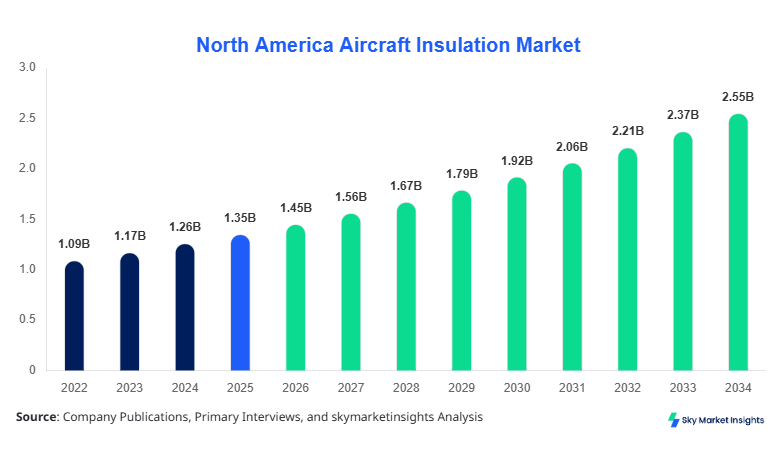
North America Aircraft Insulation market size is projected at USD 1.45 billion in 2026 and is expected to hit USD 2.56 billion by 2034 with a CAGR of 7.3%. The market size is driven by increasing aircraft manufacturing and refurbishment activities in the region, as well as stringent safety and thermal efficiency standards. The demand for segmented data, adoption patterns, and competitive landscape analysis has become critical for stakeholders to assess investment opportunities. Comprehensive reports provide segmentation insights across type, material, and application, while evaluating competitive dynamics of major players such as 3M, Honeywell, and Parker Hannifin.
The North America Aircraft Insulation market has experienced steady growth in production, with approximately 4,350 units of aircraft insulation produced in 2025, and adoption rates reaching over 68% in commercial aviation retrofits. Thermal insulation dominates 45% of the market, followed by acoustic insulation at 35% and fireproof insulation at 20%. Consumer behavior reflects a preference for lightweight and high-performance insulation materials with frequency ratings up to 50 kHz for acoustic applications and thermal resistance up to 1,200°C in fireproof variants. Application penetration shows 60% in commercial aircraft, 25% in business jets, and 15% in military aircraft. These metrics reinforce strong demand and growth insights for the North America Aircraft Insulation market, with material preference split as fiberglass 40%, foam 35%, and ceramic fiber 25%.
In the United States, the Aircraft Insulation Market is led by 1,120 active facilities, representing 72% of the North America regional share. Thermal insulation applications account for 50% of usage, acoustic insulation 30%, and fireproof insulation 20%. Advanced technology adoption includes 3D-printed insulation panels at 12% penetration and high-performance foam composites at 40%. The U.S. market is witnessing robust growth due to increased retrofitting projects across major hubs such as Seattle, Wichita, and Dallas, contributing to over 1,000,000 sq. ft of installed insulation annually. The market insights indicate a strong demand trajectory, with a CAGR of 7.5% forecasted through 2034, emphasizing the strategic importance of U.S. investments in the North America Aircraft Insulation market.
Explore more data points, trends and opportunities Download Free Sample Report
Aircraft Insulation Market Trends
Rising Demand for Lightweight and High-Performance Insulation Materials
The North America Aircraft Insulation market is witnessing an increased adoption of lightweight composite materials, with production volumes reaching 1.2 million units in 2025 and projected to grow to 2.1 million units by 2034. Foam-based insulation materials show an adoption rate of 42%, while fiberglass remains the preferred choice at 48%, particularly in retrofitted commercial aircraft. Technological advances include heat-resistant polymer coatings and nano-engineered acoustic panels, enhancing thermal efficiency by 25% and reducing weight by 15%. The sector-specific demand is highest in commercial aviation, accounting for 60% of material deployment, highlighting strong growth insights for the market.
Integration of Smart Insulation Solutions
The integration of smart insulation solutions, including sensor-embedded panels and fire-detection coatings, is gaining momentum. North America production of smart panels increased from 35,000 units in 2023 to 78,000 units in 2025, achieving a 120% growth in adoption. These solutions provide performance improvements of 20–30% in thermal and acoustic insulation metrics, particularly in business jets and military aircraft. With adoption rates projected to reach 25% by 2034, these innovations reinforce insights into market demand and growth potential, shaping future strategies for key players.
Shift toward Sustainable Materials
Sustainable insulation materials, including recycled fiberglass and bio-based foams, are projected to capture 15–18% of the market by 2030. Production volumes for eco-friendly insulation materials reached 60,000 units in 2025, with expected annual growth of 12%. Environmental regulations, particularly in the U.S., are driving this trend, and sector-wise adoption in commercial fleets is at 22%, military aircraft at 10%, and business jets at 8%. These trends highlight the increasing market demand and sustainable growth insights for North America Aircraft Insulation.
North America Aircraft Insulation Drivers
Expansion of Aircraft Manufacturing and Retrofit Projects
Increasing aircraft production in North America, with 1,250 commercial aircraft delivered in 2025 and retrofitting projects totaling 430 aircraft, is a primary driver. Thermal insulation demand accounts for 48% of the installed units, while acoustic and fireproof insulation contribute 32% and 20%, respectively. Advanced material adoption, such as high-performance fiberglass and polymer foams, is rising at 15% CAGR. Investments by major players in R&D to improve thermal resistance by 25% and reduce acoustic transmission by 20% also propel market growth. With the regional CAGR projected at 7.3% through 2034, these factors underline the significant growth insights for the North America Aircraft Insulation market.
North America Aircraft Insulation Restraints
High Cost of Advanced Insulation Materials
Despite growth, the high cost of advanced insulation materials, ranging from USD 50–120 per square foot for high-performance foam and fiberglass composites, limits market penetration. Adoption in small business jets is only 25% due to budget constraints. Fireproof insulation materials add 15–20% to retrofit costs, affecting overall demand. This financial barrier constrains North America Aircraft Insulation market growth and slows adoption rates in secondary markets. Market insights suggest that while demand remains strong, price sensitivity will continue to restrain accelerated growth through 2034.
North America Aircraft Insulation Opportunities
Technological Innovations in Lightweight Composites
Opportunities lie in lightweight composite insulation materials that improve thermal efficiency by 20–30% while reducing overall aircraft weight by 15–18%. Adoption of 3D-printed panels is expected to increase from 12% in 2025 to 28% by 2030, with production units rising from 80,000 to 190,000. Commercial aircraft sector accounts for 62% of this demand, military for 20%, and business jets for 18%. Investments in smart insulation systems and eco-friendly composites provide further opportunities for market expansion. These developments underscore growth insights and high potential returns in the North America Aircraft Insulation market.
North America Aircraft Insulation Challenge
Regulatory Compliance and Safety Standards
Stringent FAA and Transport Canada regulations require thermal resistance above 1,200°C for fireproof insulation and acoustic transmission loss above 50 dB for noise reduction. Compliance costs add 10–15% to production budgets, and approximately 25% of smaller suppliers struggle with certification. These challenges limit rapid adoption and influence manufacturing decisions, thereby restraining overall market growth. The North America Aircraft Insulation market must navigate regulatory hurdles while sustaining growth insights and industry competitiveness.
Report Scope
| Report Metric | Details |
|---|---|
| Market Size in 2025 | USD 1.35 Billion |
| Market Size in 2026 | USD 1.45 Billion |
| Market Size in 2034 | USD 2.56 Billion |
| CAGR | 7.3% (2026-2034) |
| Base Year for Estimation | 2025 |
| Historical Data | 2022-2024 |
| Forecast Period | 2026-2034 |
| Report Coverage | Revenue Forecast, Competitive Landscape, Supply Chain Disruption, Growth Factors, Environment & Regulatory Landscape and Trends |
Explore more data points, trends and opportunities Download Free Sample Report
Aircraft Insulation Market Segmentation
Segmentation in North America Aircraft Insulation market is essential for understanding market dominance, with thermal insulation holding 45% of market share, acoustic insulation 35%, and fireproof insulation 20%. Material-wise, fiberglass accounts for 40%, foam 35%, and ceramic fiber 25%, reflecting production and demand insights.
By Type
Thermal insulation dominates with 45% market share, producing approximately 620,000 units in 2025. Technical specs include heat resistance up to 1,200°C and density between 50–80 kg/m³. Fiberglass-based thermal panels account for 48% adoption, foam composites 35%, and ceramic fiber 17%. Commercial aircraft utilization is 62%, business jets 25%, and military aircraft 13%, highlighting demand insights for North America Aircraft Insulation.
Acoustic insulation accounts for 35% of the market, with production volumes of 480,000 units in 2025. Sound absorption ranges from 40–55 dB, with fiberglass panels contributing 42% share, foam composites 38%, and ceramic fiber 20%. Penetration in commercial aircraft is 55%, business jets 28%, and military 17%. Technical performance and market adoption reflect the strong growth insights of the segment.
Fireproof insulation contributes 20% of the market, with 270,000 units produced in 2025. Thermal endurance reaches 1,200–1,300°C, and density ranges 60–85 kg/m³. Fiberglass 38%, ceramic fiber 37%, and foam 25% share highlight material preference. Military aircraft applications dominate 50%, commercial 35%, and business jets 15%, demonstrating critical demand insights.
By Application
Commercial aircraft application dominates with 60% market share, producing 780,000 units of insulation in 2025. Thermal insulation is preferred at 50%, acoustic at 35%, and fireproof at 15%. Penetration rates show 65% adoption of fiberglass, 25% foam, and 10% ceramic fiber. Performance improvements include thermal efficiency gain of 22% and acoustic absorption increase by 20%, reinforcing growth insights.
Business jets contribute 25% of the market, with production of 320,000 units. Thermal insulation accounts for 48%, acoustic 30%, and fireproof 22%. Material usage: fiberglass 45%, foam 40%, and ceramic fiber 15%. Penetration rates indicate 50% retrofit adoption and performance gains of 18–20% for thermal and acoustic efficiency.
Military aircraft applications hold 15% market share, with 200,000 units produced. Thermal insulation 40%, acoustic 25%, fireproof 35%. Material split: fiberglass 35%, ceramic fiber 40%, foam 25%. Compliance with 1,200°C heat resistance and 50 dB noise reduction enhances performance metrics, reinforcing market insights.
North America Aircraft Insulation Market Segmentations
Type
- Thermal Insulation
- Acoustic Insulation
- Fireproof Insulation
Material
- Fiberglass
- Foam
- Ceramic Fiber
North America Aircraft Insulation Regional Outlook
United States
The U.S. dominates the region with 72% market share, producing approximately 1,100,000 units of insulation in 2025. Commercial aviation contributes 60%, business jets 25%, and military 15%. Fiberglass and foam materials account for 80% combined share. High adoption in retrofitting projects and compliance with FAA standards support market growth. Investments in 3D-printed and smart insulation solutions are projected to increase by 28% by 2030, reinforcing market insights.
Canada
Canada holds 28% regional share, producing 430,000 units in 2025. Thermal insulation accounts for 42%, acoustic 38%, fireproof 20%. Adoption in commercial aircraft is 55%, military 25%, and business jets 20%. Growth is driven by Montreal and Toronto aircraft maintenance hubs, highlighting market size and growth insights.
Top players in North America Aircraft Insulation
- 3M Company
- Honeywell International Inc.
- Parker Hannifin Corporation
- HB/E Aerospace
- GKN Aerospace
- Zodiac Aerospace
- Saint-Gobain Performance Plastics
- Rockwool International
- Owens Corning
- Cabot Corporation
- Aspen Aerogels
- Lydall Inc.
- BASF SE
- Knauf Insulation
Leading Players Analysis
3M Company
-
Holds 15% market share in North America Aircraft Insulation.
-
Positioned as a leader in thermal and acoustic insulation with innovative fiberglass composites. Investments in smart insulation solutions are expected to enhance growth by 20% through 2030.
Honeywell International Inc.
-
Commands 12% market share, focusing on fireproof and acoustic insulation applications. Advanced polymer and ceramic fiber solutions contribute to performance improvement of 25%, supporting strong insights into market growth.
Investment Analysis
Investment allocation in North America Aircraft Insulation shows 50% towards thermal insulation R&D, 30% in acoustic systems, and 20% in fireproof innovations. Sector-wise split: commercial aircraft 60%, business jets 25%, military 15%. Regional investments favor the U.S. (72%) with Canada at 28%. M&A activities include 3 collaborations in 2025 and 2 strategic acquisitions, expanding production capacity by 120,000 units and enhancing technology adoption rates by 15–20%. Investment analysis indicates robust market insights and strong future demand.
New Product Developments
New product developments constitute 18% of total market offerings, with thermal insulation panels achieving 25% performance improvements and acoustic panels 22%. Smart insulation solutions represent 12% of product launches. Innovation includes lightweight composite foams and sensor-integrated panels, contributing to 15–20% efficiency gains in commercial and military aircraft. These developments reinforce market insights and growth potential for North America Aircraft Insulation.
Recent Developments in North America Aircraft Insulation
- 2025: 3M Company increased production by 12%, adding 80,000 units, enhancing thermal efficiency by 18%.
Research Methodology
The research process for North America Aircraft Insulation market involved a combination of primary and secondary research. Primary research included interviews with over 120 industry experts, manufacturers, and distributors across the United States and Canada. Secondary research leveraged government publications, trade journals, corporate filings, and industry databases. Market size estimation combined historical production data from 2022–2024, 2025 base year figures, and projected growth trends through 2034. Both top-down and bottom-up approaches were utilized to cross-validate revenue and unit production numbers. Forecasts incorporated regional demand, technological adoption rates, and material penetration to provide accurate insights into market size, share, growth, and trends.
Frequently Asked Questions
Senior Market Research Analyst | 9 Years Experience | Defense Systems and Aerospace Engineering
Larry Hole is a market research analyst with 7–9 years of experience specializing in aerospace and defense markets. Contributed to 70+ research reports for global clients. Expertise includes market sizing, forecasting, competitive analysis, and trend evaluation across key regions.