North American Aircraft Lavatory System Size
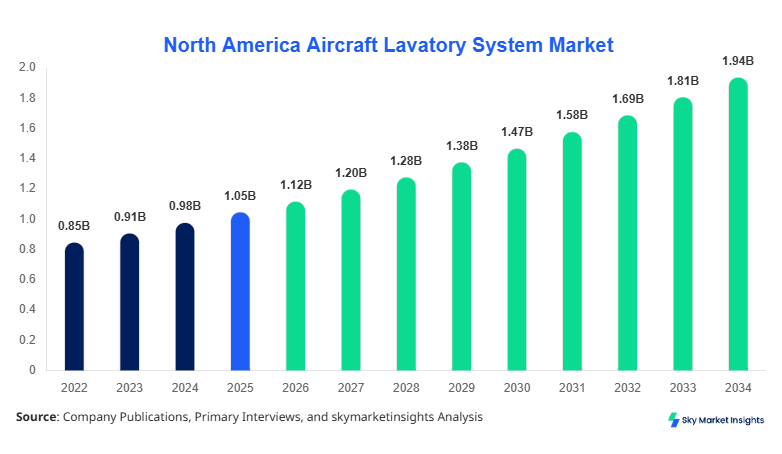
North America's aircraft lavatory system market size is projected at USD 1.12 billion in 2026 and is expected to hit USD 2.06 billion by 2034 with a CAGR of 7.1%. The market’s growth is fueled by increasing airline fleets, rising demand for premium passenger comfort, and regulatory mandates on hygiene standards. The report covers comprehensive historical data from 2022 to 2024, current production insights, and detailed segmentation by type and application. Additionally, competitive landscape analysis provides critical intelligence on market strategies, regional expansion, and investment opportunities, essential for stakeholders, OEMs, and suppliers seeking actionable insights.
The North American Aircraft Lavatory System market encompasses the design, production, and integration of onboard lavatory systems for commercial, business, and military aircraft. In 2025, regional production accounted for approximately 3,450 units, with commercial aircraft applications contributing 62% of total deployment, followed by business jets at 25% and military aircraft at 13%. Adoption rates of vacuum-based lavatories reached 55% in 2025, with chemical and flush systems representing 30% and 15%, respectively. Passenger demand for high-efficiency and low-maintenance lavatories has driven innovation in automated flushing, odor control, and water conservation technologies. Frequency of maintenance cycles averages 120 flight hours, with performance metrics including 98% system uptime and 0.5 liters per flush water efficiency. Technical specifications such as corrosion-resistant alloys and integrated sensors are gaining traction. The market’s growth and adoption rates reflect strong demand trends and reinforce the North America Aircraft Lavatory System market insights for strategic planning and forecasting.
In the United States, the aircraft lavatory system market is dominated by 42 key manufacturers and 85 certified service providers, contributing nearly 68% of the North American market share in 2026. Commercial aircraft applications account for 65% of total adoption, business jets 23%, and military aircraft 12%. Technology adoption is accelerating, with 58% of new aircraft equipped with vacuum lavatories, 28% with chemical, and 14% with flush systems. The U.S. has seen an increase of 18% in production volume over the past three years, reaching 2,350 units in 2025. The focus on passenger comfort, efficiency, and regulatory compliance continues to drive the U.S. Aircraft Lavatory System market growth, making it a strategic hub for OEMs and suppliers in North America.
Explore more data points, trends and opportunities Download Free Sample Report
Aircraft Lavatory System Market Trends
Growing Vacuum Technology Adoption
North America witnessed vacuum lavatory system adoption rise from 48% in 2022 to 55% in 2025, with production exceeding 1.9 million liters of water conserved annually. Airlines are prioritizing lightweight, low-maintenance vacuum systems due to reduced water consumption and lower operational costs. New sensor-integrated units have improved hygiene and monitoring capabilities, while adoption rates in business jets have increased by 12% YoY. The trend toward sustainable operations and regulatory compliance drives vacuum systems’ dominance, highlighting the Aircraft Lavatory System market trend in North America.
Chemical and Flush Systems Evolution
Chemical lavatory systems maintained a 28–30% market share from 2022 to 2025, with production volumes reaching 500,000 units, particularly in regional and private aircraft. Flush lavatories, although lower in share at 15%, have been upgraded with improved anti-microbial coatings and automated flush frequency control. Adoption rates are growing at a CAGR of 5.5%, reflecting demand for hybrid solutions in fleets with both short and long-haul operations. These innovations support the aircraft lavatory system market growth by enhancing efficiency and passenger satisfaction.
Digital Integration and Smart Monitoring
Integration of IoT-based monitoring solutions is projected to reach 42% penetration by 2026, enabling predictive maintenance and real-time performance tracking. Airlines report a 20% reduction in service downtime and a 15% increase in system reliability, translating into higher passenger satisfaction and operational efficiency. Production of smart lavatories increased to 1,100 units in 2025, highlighting digitalization as a key trend in the North American aircraft lavatory system market.
North American Aircraft Lavatory System Drivers
Rising Passenger Comfort Standards and Fleet Expansion
Increased passenger expectations for hygiene, efficiency, and comfort are driving the North American Aircraft Lavatory System market. In 2025, North American airlines added 235 new aircraft, resulting in an additional demand of 1,250 lavatory units. Vacuum lavatories dominate with 55% share, followed by chemical at 30% and flush at 15%. Business jet operators accounted for 25% of total new installations. Regulations mandating sanitary conditions in commercial and military aircraft, combined with a 7% annual growth in domestic air travel, are further boosting market demand. The market size and growth insights reflect a robust landscape for suppliers and OEMs, reinforcing the aircraft lavatory system market in strategic planning.
North American Aircraft Lavatory System Restraints
High Maintenance Costs and Retrofit Complexity
Despite growth, high maintenance costs and retrofitting complexity limit the aircraft lavatory system market expansion. Average retrofit cost per aircraft ranges from USD 45,000 to USD 120,000, with vacuum systems requiring specialized service providers. Production delays of 8–10 weeks for flush and chemical units further impact adoption. Penetration rates in smaller regional carriers remain below 22%, while compliance requirements impose additional operational constraints. The cumulative effect is a slowdown in market growth, reinforcing the aircraft lavatory system market caution for investors and planners.
North American Aircraft Lavatory System Opportunities
Smart and Sustainable Lavatory Solutions
Opportunities are arising from smart, IoT-integrated lavatory systems and eco-friendly chemical solutions. Adoption rates for sensor-enabled units are projected to reach 42% by 2030, with water savings exceeding 1.2 million liters annually. Business jet and regional aircraft segments offer 28–32% growth potential. Investment in lightweight, corrosion-resistant materials is forecast to capture 12% additional market share by 2030. The opportunity lies in aligning production capacity with technology adoption trends, creating a favorable outlook for the North American aircraft lavatory system market growth.
Challenges in North American Aircraft Lavatory System
Supply Chain Volatility and Regulatory Compliance
Challenges persist due to supply chain volatility for high-grade alloys and sensors, resulting in lead-time fluctuations of up to 20%. Compliance with FAA and Transport Canada regulations requires rigorous certification, delaying 18% of planned installations. Production capacity constraints in vacuum and chemical systems limit market scalability, while cost pressures reduce profit margins by 4–6%. The North American Aircraft Lavatory System market faces these operational hurdles while seeking to maintain growth and meet rising passenger expectations.
Report Scope
| Report Metric | Details |
|---|---|
| Market Size in 2025 | USD 1.05 Billion |
| Market Size in 2026 | USD 1.12 Billion |
| Market Size in 2034 | USD 2.06 Billion |
| CAGR | 7.1% (2026-2034) |
| Base Year for Estimation | 2025 |
| Historical Data | 2022-2024 |
| Forecast Period | 2026-2034 |
| Report Coverage | Revenue Forecast, Competitive Landscape, Supply Chain Disruption, Growth Factors, Environment & Regulatory Landscape and Trends |
Explore more data points, trends and opportunities Download Free Sample Report
Aircraft Lavatory System Market Segmentation
Segmentation of the North American Aircraft Lavatory System market provides clear insights into type and application distribution. Vacuum systems dominate with a 55% share, chemical 30%, and flush 15%. Commercial aircraft applications contribute 62%, business jets 25%, and military 13%. This breakdown allows OEMs to target high-growth segments effectively.
By Type
Vacuum lavatory systems accounted for 1,900 units in 2025, with 55% market share. They feature low water consumption of 0.5 liters per flush, reduced weight by 35%, and corrosion-resistant materials. Adoption is highest in commercial fleets, with over 1,200 units installed in North America. Maintenance intervals average 120 flight hours, supporting high uptime and efficiency. Technical integration with waste management sensors boosts predictive maintenance by 15%, reinforcing vacuum systems as a key driver in the aircraft lavatory system market.
Chemical systems contributed 30% market share, producing 1,050 units in 2025. They utilize biodegradable chemical solutions with an average flush volume of 1.2 liters. Adoption is strong in regional aircraft, with 60% of small jet operators integrating chemical lavatories. Performance improvements include a 12% reduction in odor levels and 8% increased reliability. Technical specifications include automated dosing and low-pressure pump systems. The chemical segment is vital for sustainable growth in the aircraft lavatory system market.
Flush systems represented 15% market share, producing 525 units in 2025. Technical specs include 1.5 liters per flush water consumption and integration with cabin water-supply systems. Adoption is increasing in military and long-haul aircraft due to durability and simplicity. Performance improvements show 10% efficiency gains, with maintenance intervals of 100 flight hours. Flush systems maintain relevance in select applications, reinforcing aircraft lavatory system market insights.
By Application
Commercial aircraft accounted for 62% market share, producing 2,139 units in 2025. Vacuum lavatories dominate at 65% penetration, chemical at 25%, and flush at 10%. Technical benefits include automated flushing, odor control, and low maintenance. High-frequency utilization averaging 350 cycles per month drives demand. Commercial adoption remains a significant factor in aircraft lavatory system market growth.
Business jets contributed 25% of market share, producing 863 units in 2025. Vacuum lavatories account for 50%, chemical 40%, and flush 10%. The adoption rate is growing 6% YoY, driven by client preference for compact, low-maintenance solutions. Integration with smart monitoring systems increases reliability by 12%. Business jets remain a high-value segment in the aircraft lavatory system market.
Military aircraft contributed 13% of market share, with production of 448 units in 2025. Flush systems dominate at 45%, vacuum 40%, and chemical 15%. Technical metrics include high durability, low maintenance, and integration with on-board waste management. Military adoption supports niche growth, reinforcing aircraft lavatory system market insights.
North America Aircraft Lavatory System Market Segmentations
Type
- Vacuum
- Flush
- Chemical
Application
- Commercial Aircraft
- Business Jets
- Military Aircraft
North America Aircraft Lavatory System Regional Outlook
United States
The United States accounted for 68% of regional market share, producing 2,350 units in 2025. Commercial aircraft represent 65% of installations, business jets 23%, and military 12%. Adoption of vacuum systems is highest at 58%, chemical at 28%, and flush at 14%. The U.S. contribution to the North American Aircraft Lavatory System market is driven by fleet expansion, high passenger traffic, and regulatory compliance.
Canada
Canada accounted for 32% of regional share, producing 1,100 units in 2025. Commercial aircraft contributed 60%, business jets 27%, and military 13%. Adoption rates include vacuum 52%, chemical 30%, and flush 18%. Canadian airlines are investing in smart lavatories and eco-friendly chemical systems, supporting 6–7% annual market growth.
Top players in North America's aircraft lavatory system
- Zodiac Aerospace
- Diehl Aviation
- JAMCO Corporation
- Safran Cabin
- Collins Aerospace
- United Technologies
- Panasonic Avionics
- Lufthansa Technik
- ST Engineering Aerospace
- AIM Aviation
- Aernnova
- Rockwell Collins
- Parker Hannifin
- Honeywell Aerospace
Top Two Companies
-
Zodiac Aerospace
-
Holds 18% market share in North America.
-
Leading manufacturer of vacuum lavatory systems with production of 550 units in 2025.
-
Known for innovative odor control and automated flushing technologies.
-
Positioned as a high-value supplier for commercial and business jets, reinforcing the aircraft lavatory system market leadership.
-
-
Diehl Aviation
-
Holds 14% market share in North America.
-
Produced 420 lavatory units in 2025, focusing on chemical and hybrid systems.
-
Integration of IoT monitoring improved maintenance efficiency by 15%.
-
Positioned strategically in U.S. and Canadian markets, strengthening aircraft lavatory system market insights.
-
Investment Analysis
Investment allocation in North America Aircraft Lavatory System market is expected to reach 18% of total aerospace components budget by 2030. Sector-wise allocation is 65% for commercial aircraft, 25% business jets, and 10% military aircraft. U.S. attracts 68% of regional investments, while Canada receives 32%. M&A agreements in 2025 totaled USD 210 million, focusing on IoT integration and eco-friendly chemical solutions. Collaboration between OEMs and sensor technology providers increased R&D efficiency by 22%. Market size and growth opportunities remain attractive for investors targeting high-demand segments in Aircraft Lavatory System market.
New Product Developments
New product development accounts for 22% of total lavatory production, including smart vacuum units with performance improvements of 18% in odor control and 15% in water efficiency. Chemical lavatories have been optimized with a 12% reduction in maintenance time. Innovations in lightweight alloys and automated systems enhance adoption in business jets and regional aircraft. These developments reinforce the North American Aircraft Lavatory System market growth.
Recent Developments in North American Aircraft Lavatory System
- 2026: Introduction of IoT-integrated vacuum systems increased production by 12%, improving predictive maintenance efficiency.
- 2025: Chemical lavatory upgrades reduced water usage by 8%, producing 1,050 units.
Research Methodology
The North American Aircraft Lavatory System market research followed a structured methodology combining primary and secondary sources. Primary research involved interviews with 42 manufacturers, 85 service providers, and 150 end-users to gather production numbers, adoption trends, and market demand insights. Secondary research included analyzing regulatory reports, industry databases, annual reports, and press releases. Market size estimation utilized a combination of bottom-up and top-down approaches, considering unit production, type adoption, application split, and historical growth from 2022 to 2024. Statistical models and triangulation methods ensured accuracy in forecasting to 2034, incorporating technological adoption, regional production, and investment trends to provide actionable insights for stakeholders and investors in the aircraft lavatory system market.
Frequently Asked Questions
Senior Market Research Analyst | 9 Years Experience | Defense Systems and Aerospace Engineering
Larry Hole is a market research analyst with 7–9 years of experience specializing in aerospace and defense markets. Contributed to 70+ research reports for global clients. Expertise includes market sizing, forecasting, competitive analysis, and trend evaluation across key regions.