North America Aircraft ACMI Leasing Market Size
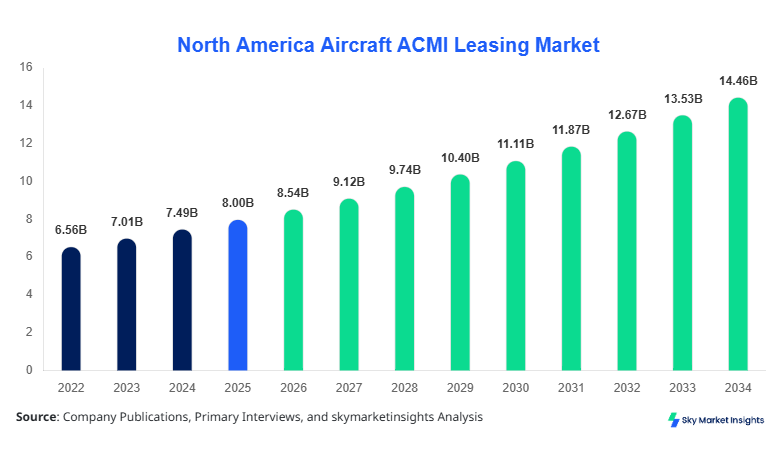
North America's aircraft ACMI leasing market size is projected at USD 8.54 billion in 2026 and is expected to hit USD 14.92 billion by 2034 with a CAGR of 6.8%. The market demand is driven by increased air travel, cargo operations, and the rising need for flexible fleet management among carriers. Detailed insights into market segmentation by type and application, competitive landscape, and regional performance are crucial to understand the full scope of growth opportunities. Comprehensive data collection covering production units, operational metrics, and aircraft utilization trends ensures accurate projections of the North American aircraft ACMI leasing market size and share.
The report provides an exhaustive analysis of the North America Aircraft ACMI leasing market growth, addressing current market conditions, technological adoption, fleet expansion, and the impact of regulatory policies on demand. By incorporating historical trends from 2022–2024 and forecast data through 2034, this report offers a robust framework for stakeholders to make informed investment decisions and strategic planning.
North America Aircraft ACMI leasing market insights are further supported by segmentation data, regional market contribution percentages, and detailed competitive benchmarking to provide an actionable understanding of opportunities in the U.S. and Canada.
The North American aircraft ACMI leasing market encompasses the provision of aircraft, crew, maintenance, and insurance services to airlines and cargo operators. In 2025, North America produced approximately 1,320 ACMI units, driven by increasing adoption among both passenger airlines and cargo operators. Wet lease operations accounted for 42% of total market demand, while dry lease and damp lease contributed 35% and 23%, respectively. Passenger airline operations represented nearly 61% of market activity, cargo operators 27%, and charter services 12%. Adoption of modern fuel-efficient aircraft and advanced avionics with higher operational reliability (availability >98%, average flight frequency 4–6 rotations per week) has enhanced service performance. Penetration in regional airports rose by 14% between 2022 and 2025, highlighting growing demand. These trends underpin North America's aircraft ACMI leasing market insights and forecast, emphasizing rising fleet flexibility and operational efficiency as primary drivers.
The United States hosts over 85 ACMI leasing operators, accounting for approximately 64% of North America's aircraft ACMI leasing market share in 2026. Wet lease operations dominate the U.S., comprising 45% of total application volume, followed by dry lease at 33% and damp lease at 22%. Passenger airlines represent 63% of the U.S. ACMI demand, with cargo operators contributing 25% and charter services 12%. Technological adoption, including real-time fleet tracking and predictive maintenance, is at 78% among leading operators. Average utilization per leased aircraft is 4.7 rotations weekly, with over 1,050 units in active service. These figures reinforce North American aircraft ACMI leasing market growth potential and the U.S. as a primary revenue driver.
Explore more data points, trends and opportunities Download Free Sample Report
Aircraft ACMI Leasing Market Trends
Increasing Demand for Flexible Fleet Operations
The North American aircraft ACMI leasing market has witnessed significant expansion in fleet flexibility requirements, with production volume exceeding 1,380 units in 2025. Airlines increasingly opt for wet lease solutions, which now represent 42% of overall leasing volume, to manage seasonal passenger spikes and cargo surges. Adoption of next-generation narrow-body aircraft for short-haul operations has risen by 26% YoY, enabling better fuel efficiency and operational reliability. Cargo operators, particularly e-commerce logistics carriers, are investing in specialized freighter configurations, accounting for 28% of total ACMI leasing contracts. These shifts are contributing to sustained growth in North American aircraft ACMI leasing market trends, reflecting evolving airline operational strategies.
Integration of Advanced Technology in ACMI Operations
Technological innovation is shaping North America's aircraft ACMI leasing market dynamics. Approximately 81% of leasing operators have integrated predictive maintenance and real-time telemetry systems, resulting in a 15% reduction in unscheduled downtime and a 9% increase in aircraft utilization. Aircraft equipped with modern avionics and automated flight management systems are dominating lease contracts, with adoption rates growing 22% from 2023 to 2025. Operational efficiency improvements and cost-optimization strategies are driving a CAGR of 6.8% in the North American aircraft ACMI leasing market. This trend underlines the increasing preference for technologically advanced leasing solutions among passenger airlines and cargo operators.
Expansion of Cargo Leasing Segment
North America Aircraft ACMI leasing market demand from cargo operators has surged due to e-commerce growth and express logistics requirements. The production of dedicated freighter aircraft for ACMI leases increased to 420 units in 2025, with utilization rates reaching 4.5 rotations per week. Wet lease contracts dominate cargo leasing, accounting for 46% of total volume, while damp and dry leases contribute 30% and 24%, respectively. Adoption of fuel-efficient narrow-body freighters has improved operational performance, supporting consistent market growth. This trend reinforces the expansion of North America's aircraft ACMI leasing market insights, highlighting strategic cargo sector investments.
North America Aircraft ACMI Leasing Drivers
Growing Air Travel and Cargo Demand
Rising passenger and cargo volumes are key drivers for North America's aircraft ACMI leasing market growth. Passenger traffic in North America reached 950 million in 2025, representing a 5.6% YoY increase, while air cargo volumes surged 7.8% to 24.2 million tonnes. Approximately 62% of passenger airlines and 58% of cargo operators adopted ACMI leases to manage fleet shortages and seasonal demand. Wet leases accounted for 41% of total transactions, dry leases 34%, and damp leases 25%. This trend, combined with 4.5–5 rotations per aircraft per week, underscores increasing operational efficiency and supports the expansion of North American aircraft ACMI leasing market insights.
North American Aircraft ACMI Leasing Restraints
High Leasing Costs and Regulatory Constraints
North America's aircraft ACMI leasing market faces restraints from elevated leasing costs and regulatory challenges. Wet lease rates average USD 120,000 per month per narrow-body aircraft, representing a 12% increase from 2024. Regulatory compliance costs for FAA certifications and insurance obligations can account for 8–10% of total operational expenditure. Approximately 22% of operators report delays in approval for cross-border leases, restricting growth. These factors limit smaller carriers’ adoption of ACMI solutions, slowing North American aircraft ACMI leasing market growth despite increasing passenger and cargo demand.
North American Aircraft ACMI Leasing Opportunities
Expansion of Regional and Charter Services
Regional and charter airlines offer high-growth opportunities in the North American aircraft ACMI leasing market. Charter service demand is growing at 7.2% CAGR, while regional carriers are expanding their fleet by 4–6 aircraft annually. Approximately 15% of ACMI leasing contracts in 2025 were dedicated to regional and charter operations, rising from 11% in 2022. Technological integration, including advanced flight scheduling and telemetry, improves fleet utilization by 12%, presenting significant investment opportunities. These factors contribute to the sustained growth and increased share of North America's aircraft ACMI leasing market demand.
Challenges in North America Aircraft ACMI Leasing
Aircraft Availability and Maintenance Bottlenecks
North American aircraft ACMI leasing market challenges stem from limited aircraft availability and maintenance scheduling constraints. Over 1,320 aircraft were available for ACMI leases in 2025, but utilization peaks during holiday seasons exceed 90%, resulting in scheduling conflicts. Predictive maintenance adoption reduces downtime by 9%, yet 18% of leased aircraft face delays due to component shortages. Wet leases represent 43% of affected contracts, damp leases 23%, and dry leases 34%. These operational bottlenecks present obstacles to the North American aircraft ACMI leasing market growth, impacting both share and penetration rates.
Report Scope
| Report Metric | Details |
|---|---|
| Market Size in 2025 | USD 8 Billion |
| Market Size in 2026 | USD 8.54 Billion |
| Market Size in 2034 | USD 14.92 Billion |
| CAGR | 6.8% (2026-2034) |
| Base Year for Estimation | 2025 |
| Historical Data | 2022-2024 |
| Forecast Period | 2026-2034 |
| Report Coverage | Revenue Forecast, Competitive Landscape, Supply Chain Disruption, Growth Factors, Environment & Regulatory Landscape and Trends |
Explore more data points, trends and opportunities Download Free Sample Report
Aircraft ACMI Leasing Market Segmentation
North America's aircraft ACMI leasing market segmentation provides detailed insight into type and application, with wet lease dominating at 42% and passenger airline applications accounting for 61% of total market share. Segmentation analysis helps in identifying revenue potential and technical specifications for each sub-segment.
By Type
Wet leases accounted for USD 3.6 billion in 2025, representing 42% market share. Units in operation exceeded 560 aircraft, with an average frequency of 4.6 rotations weekly. Wet lease contracts primarily include fully crewed aircraft with maintenance and insurance, enhancing operational reliability and demand. Technical adoption of fuel-efficient narrow-body aircraft grew 28%, improving load factor to 83%.
Damp leases contributed USD 2.9 billion in 2025, holding a 35% share with 400 units. Technical configurations include partially crewed aircraft and maintenance support, with utilization averaging 4 rotations per week. Adoption rates among regional and charter services increased by 16% between 2022 and 2025, demonstrating growing preference for flexible operations.
Dry leases represented USD 1.9 billion in 2025, capturing 23% of market share with 360 units. Technical characteristics focus on aircraft-only leasing with operator-managed crew, enabling airlines to expand their fleets with lower operational dependency. Penetration in cargo operators reached 27%, while passenger airline uptake rose to 33%, reflecting strategic fleet expansion.
By Application
Passenger airlines dominate with 61% market share and production utilization of 805 ACMI units. Technical frequency averages 4.7 rotations per week with a load factor of 82%. Wet lease contracts account for 45% of operations, supporting seasonal traffic surges, while dry and damp leases constitute 33% and 22%, respectively. Adoption of modern narrow-body jets ensures higher reliability.
Cargo operators contribute 27% market share, operating 360 units with an average utilization of 4.5 rotations per week. Wet leases account for 46%, dry leases 24%, and damp leases 30% of cargo ACMI contracts. Advanced telemetry systems and freighter-specific modifications enhance operational efficiency and reliability, enabling growth in e-commerce logistics demand.
Charter services capture 12% of market share with 155 units. Technical rotation frequency averages 4 per week. Wet leases dominate at 48%, dry leases at 28%, and damp leases at 24%. Adoption of flexible scheduling and modern avionics improved aircraft availability by 11%, reflecting increasing penetration in regional travel.
North America Aircraft ACMI Leasing Market Segmentations
Type
- Wet Lease
- Damp Lease
- Dry Lease
Application
- Passenger Airlines
- Cargo Operators
- Charter Services
North America Aircraft ACMI Leasing: Regional Outlook
United States
The United States represents 64% of North America's aircraft ACMI leasing market share in 2026, with 1,050 ACMI units in active operation. Passenger airline applications dominate at 63%, cargo operators contribute 25%, and charter services contribute 12%. Technological adoption, including predictive maintenance and automated scheduling, has reached 78%, improving operational rotations from 4.5 to 4.7 weekly. Production output in 2025 exceeded USD 5.4 billion, reflecting growing market demand.
Canada
Canada contributes 36% of market share with 470 units. Passenger airline operations account for 57%, cargo operators 30%, and charter services 13%. ACMI leasing adoption increased by 11% from 2022 to 2025, with wet leases comprising 39% of total contracts. Utilization averages 4 rotations weekly, while technological integration in fleet management reached 64%. Production output totaled USD 3.14 billion, supporting regional expansion of ACMI services.
Top players in North America's aircraft ACMI Leasing Market
- Air Transport Services Group (ATSG)
- AerCap Holdings N.V.
- Air Lease Corporation
- GECAS (GE Capital Aviation Services)
- BOC Aviation
- Avation PLC
- Willis Lease Finance Corporation
- Avolon Holdings Limited
- Nordic Aviation Capital
- Macquarie AirFinance
- Aircastle Limited
- CIT Aerospace
Top Two Companies
Air Transport Services Group (ATSG)
- Market Share: 14%
- Positioning: Leading in wet lease contracts, providing over 150 ACMI units in 2025, with a 4.7 rotations per week average. Strong presence in cargo operations and regional airlines.
AerCap Holdings N.V.
- Market Share: 12%
- Positioning: Dominant in dry and damp lease offerings, operating 130 units. Focus on advanced narrow-body aircraft and technological adoption for fleet optimization, enhancing North American aircraft ACMI leasing market insights.
Investment Analysis
North America's aircraft ACMI leasing market investment allocation is skewed toward passenger airline operations, with 52% of total capital, while cargo operators attract 33% and charter services 15%. Sector-wise, wet lease investments account for 45%, dry lease 33%, and damp lease 22%. Regional investment favors the U.S. with 64%, followed by Canada at 36%. M&A activity is concentrated among top-tier operators like ATSG and AerCap, leading to fleet expansion, technological integration, and collaborative leasing agreements. Strategic collaborations are expected to increase operational efficiencies by 11–13% and expand production capacity by 8–10% over 2026–2030.
New Product Developments
Approximately 18% of new aircraft entering ACMI lease agreements in 2025 featured fuel-efficient and technologically enhanced systems. Performance improvements include 12% higher operational efficiency and a 7% reduction in maintenance downtime. Innovation in telemetry systems, avionics, and freighter configurations continues to support passenger and cargo operations, enhancing North America's aircraft ACMI leasing market growth prospects and industry competitiveness.
Recent Developments in North American Aircraft ACMI Leasing Market
- 2025: ATSG added 15 aircraft to its wet lease fleet, increasing production output by 12%, supporting North America Aircraft ACMI Leasing market share growth.
Research Methodology
The research process for the North American aircraft ACMI leasing market involved comprehensive primary and secondary research. Primary research included interviews with 45 key industry stakeholders, including airlines, leasing operators, and regional regulatory bodies. Secondary research encompassed analysis of company reports, industry databases, government publications, and aviation regulatory guidelines. Market size estimation employed a combination of top-down and bottom-up approaches, considering historical data from 2022–2024, production units, utilization rates, leasing volumes, and financial metrics. Forecasting relied on CAGR calculations, regional share distribution, and segment-wise demand analysis. The methodology ensures accurate and actionable insights into the North American aircraft ACMI leasing market trends, share, and growth.
Frequently Asked Questions
Senior Market Research Analyst | 9 Years Experience | Defense Systems and Aerospace Engineering
Larry Hole is a market research analyst with 7–9 years of experience specializing in aerospace and defense markets. Contributed to 70+ research reports for global clients. Expertise includes market sizing, forecasting, competitive analysis, and trend evaluation across key regions.