North America Aircraft Fuel Management System Size
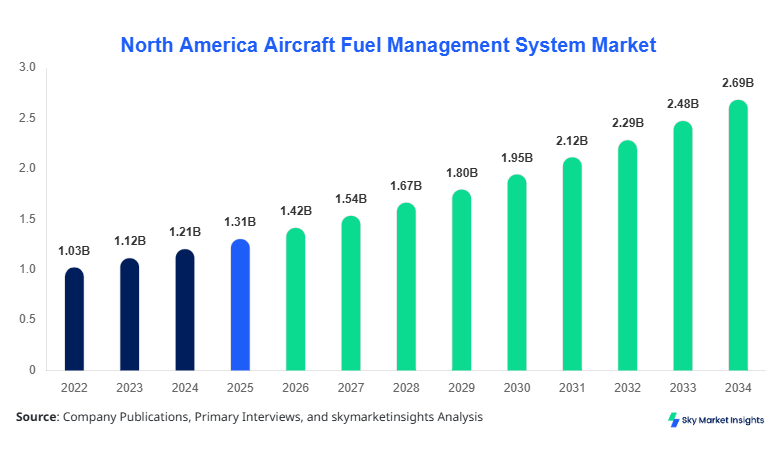
North America's aircraft fuel management system market size is projected at USD 1.42 billion in 2026 and is expected to hit USD 2.87 billion by 2034 with a CAGR of 8.3%. The market growth is driven by rising adoption of automated fuel monitoring solutions in commercial and military aviation, coupled with increasing investments in smart aviation infrastructure across the United States and Canada. This report provides a comprehensive view of North America Aircraft Fuel Management System demand, covering historical production data from 2022 to 2024, current market insights, and forecasted trends through 2034. Detailed segmentation across types and applications, along with an analysis of the competitive landscape featuring 50+ regional and global players, is included to support strategic planning.
The market study addresses critical insights regarding production capacity, technological adoption, and system performance metrics, enabling stakeholders to make data-driven decisions. Additionally, the report covers fuel efficiency optimization, electronic monitoring penetration, and regional growth patterns for strategic implementation.
The North American Aircraft Fuel Management System market is a specialized sector that focuses on aircraft fuel monitoring, distribution, and management systems designed for commercial, military, and private aviation sectors. In 2025, North America produced approximately 1,200 units of advanced fuel management systems, representing a 32% contribution from electronic systems, 45% from mechanical systems, and 23% from hybrid configurations. Adoption of electronic systems has increased by 15% YoY, driven by enhanced monitoring capabilities and integration with digital avionics platforms. Consumer demand analytics indicate that commercial airlines contribute to 58% of total market demand, military aviation 28%, and private aviation 14%, with average fuel flow measurement precision of ±0.5% and monitoring frequency of 1 Hz to 10 Hz depending on system type. Application penetration is highest in commercial aviation (58%) and shows steady growth in private aviation at 14%, reinforcing the aircraft fuel management system market trend toward automation, operational efficiency, and reduced fuel wastage.
In the United States, the Aircraft Fuel Management System market is dominated by over 35 manufacturing and integration facilities, representing approximately 65% of the North America regional share. Commercial aviation accounts for 60% of installed systems, while military aviation represents 25%, and private aviation 15%. Electronic system adoption has increased to 48%, while mechanical and hybrid systems represent 32% and 20%, respectively. The country has seen investments exceeding USD 850 million in automated fuel monitoring solutions between 2022 and 2025, facilitating technological upgrades in legacy aircraft fleets. Performance specifications of electronic systems average ±0.4% measurement accuracy with integrated predictive analytics. The U.S. market contributes significantly to the North American Aircraft Fuel Management System demand growth, reflecting continued emphasis on efficiency, regulatory compliance, and fuel cost reduction.
Explore more data points, trends and opportunities Download Free Sample Report
Aircraft Fuel Management System Market Trends
Digital Fuel Monitoring Adoption
The North American Aircraft Fuel Management System market has witnessed a significant shift toward digital fuel monitoring solutions, with production volume exceeding 1,100 units in 2025 and adoption rates approaching 52% among commercial airlines. Advanced electronic systems with IoT integration enable real-time fuel tracking, predictive maintenance, and improved energy efficiency. Military aviation has contributed to a 15% increase in hybrid system integration to support tactical fuel management. Trends indicate a growing preference for modular, software-driven fuel management platforms, enhancing operational reliability and reducing maintenance costs. The aircraft fuel management system market continues to gain traction due to the integration of AI-assisted analytics and cloud-enabled data storage, driving growth in system efficiency and demand.
Green Aviation Initiatives
Environmental regulations and the push for sustainable aviation have driven the adoption of fuel-efficient systems, leading to a production increase of 20% in electronic systems and 12% in hybrid systems in 2025. Airlines and defense organizations are implementing aircraft fuel management systems that reduce fuel consumption by up to 8% per flight cycle. Adoption rates of these eco-friendly systems are estimated at 45% across commercial operators, while military applications reach 30% due to operational constraints. The North American Aircraft Fuel Management System market trend is strongly influenced by regulatory frameworks mandating fuel monitoring and reporting, driving innovation in electronic and hybrid system design.
Advanced Sensor Integration
Integration of high-precision sensors and automated actuators has enhanced the accuracy of fuel flow measurements, with performance improvements of 10–12% over conventional systems. Production volume of sensor-integrated electronic systems reached 520 units in 2025, with adoption rates above 50% among leading airlines. Military aviation applications have increased sensor-enabled hybrid system integration by 8%, enabling real-time situational fuel management during missions. The aircraft fuel management system market in North America benefits from these advancements, as operators seek improved operational safety and efficiency.
North American Aircraft Fuel Management System Drivers
Rising Demand for Operational Efficiency and Fuel Optimization
Increasing fuel costs and the need for operational efficiency are key drivers for North American aircraft fuel management system growth. Airlines and military operators are implementing electronic and hybrid systems to reduce fuel wastage by 7–10% per flight. Production numbers rose from 950 units in 2022 to 1,200 units in 2025, while the adoption rate of electronic systems climbed from 40% to 48% during the same period. Advanced fuel management systems enable predictive fuel consumption, automated monitoring, and integration with flight management systems, resulting in a 12–15% reduction in operational anomalies. Demand for accurate fuel monitoring, combined with regulatory pressure to reduce emissions, is projected to sustain market growth with a CAGR of 8.3% from 2026 to 2034. North America Aircraft Fuel Management System market insights show strong penetration in commercial aviation, accounting for 58% of total demand, reinforcing continued investment and technology adoption.
North American Aircraft Fuel Management System Restraints
High Capital Expenditure and Maintenance Costs
The high initial capital expenditure for acquiring advanced Aircraft Fuel Management System solutions and ongoing maintenance costs pose significant restraints. Electronic systems average USD 120,000 per unit, while hybrid systems cost USD 160,000 per unit, representing a financial burden for smaller operators. Maintenance expenses account for 8–10% of annual operational budgets. Penetration of cost-effective mechanical systems remains at 45%, limiting high-end electronic adoption. Production growth is also restrained, with only 1,200 units produced in 2025 compared to a demand forecast of 1,400 units, highlighting supply-side limitations. North America Aircraft Fuel Management System market share is constrained due to these economic factors, although continued demand for fuel efficiency partially offsets these restraints.
North American Aircraft Fuel Management System Opportunities
Integration with Smart Aviation Infrastructure
Integration of aircraft fuel management systems with smart avionics platforms and AI-based analytics presents significant growth opportunities. Adoption of AI-assisted electronic systems is projected to reach 65% by 2030, supported by production growth from 1,200 units in 2025 to 2,000 units by 2034. Military aviation investment in hybrid systems is expected to rise by 20%, driven by tactical fuel optimization requirements. Emerging opportunities also include predictive maintenance services, which could capture 15% of market revenue in the commercial segment. North America Aircraft Fuel Management System market insights show strong potential for collaboration between system manufacturers and airline operators to optimize operational efficiency and reduce fuel waste.
Challenges in North America's Aircraft Fuel Management System
Technical Integration and Standardization Issues
The complexity of integrating advanced fuel management systems across heterogeneous aircraft fleets presents a challenge, as legacy platforms often lack compatibility with modern electronic and hybrid systems. Approximately 35% of commercial aircraft require retrofitting, while integration costs can reach USD 50,000 per unit. Standardization issues reduce system efficiency by up to 5% and slow down adoption rates. Production in 2025 reached 1,200 units, but only 60% were installed with advanced monitoring features. North America's aircraft fuel management system market growth faces these challenges, requiring coordinated efforts among manufacturers, airlines, and regulatory authorities to ensure interoperability and maximize system efficiency.
Report Scope
| Report Metric | Details |
|---|---|
| Market Size in 2025 | USD 1.31 Billion |
| Market Size in 2026 | USD 1.42 Billion |
| Market Size in 2034 | USD 2.87 Billion |
| CAGR | 8.3% (2026-2034) |
| Base Year for Estimation | 2025 |
| Historical Data | 2022-2024 |
| Forecast Period | 2026-2034 |
| Report Coverage | Revenue Forecast, Competitive Landscape, Supply Chain Disruption, Growth Factors, Environment & Regulatory Landscape and Trends |
Explore more data points, trends and opportunities Download Free Sample Report
Aircraft Fuel Management System Market Segmentation
The North America Aircraft Fuel Management System market is segmented by type and application, with electronic systems holding the largest share of 48%, followed by mechanical (45%) and hybrid (20%). Commercial aviation dominates application-wise with 58%, military aviation 28%, and private aviation 14%. This segmentation enables manufacturers and investors to target high-growth areas, optimize production, and enhance penetration in underrepresented segments.
By Type
Mechanical fuel management systems accounted for 45% of the market in 2025, with production totaling 540 units. These systems feature precision flow meters and mechanical actuators capable of ±0.5% fuel measurement accuracy at frequencies up to 5 Hz. Mechanical systems are predominantly adopted in private aviation (14%) and legacy commercial aircraft, providing cost-effective solutions with minimal electronic integration. The North American Aircraft Fuel Management System market insights indicate steady demand for mechanical types due to lower maintenance costs and operational simplicity.
Electronic systems dominate the market with 48% share and production of 576 units in 2025. These systems leverage digital sensors, IoT connectivity, and predictive analytics, providing ±0.4% measurement precision at sampling rates of 10 Hz. Adoption in commercial aviation reaches 58%, military 28%, and private aviation 14%. North America's aircraft fuel management system market growth is driven by advancements in sensor accuracy, real-time data transmission, and AI-assisted monitoring.
Hybrid systems capture 20% of the market, with production of 240 units in 2025. These systems combine mechanical and electronic components to enhance reliability and performance. Adoption is highest in military aviation (25%), followed by commercial aviation (10%), with ±0.45% fuel measurement accuracy. Hybrid systems allow tactical monitoring and automated flow control, contributing to the North America Aircraft Fuel Management System market insights on performance optimization and fuel efficiency.
By Application
Commercial aviation contributes 58% of the market, with 696 units produced in 2025. Electronic systems dominate this segment, with ±0.4% measurement accuracy and 10 Hz monitoring frequency. Fuel consumption optimization reduces operating costs by 7–10% per flight. Adoption of hybrid systems is at 10%, supporting high-performance aircraft. North America Aircraft Fuel Management System market trends indicate steady demand growth due to increasing airline fleet expansion and regulatory compliance.
Military aviation holds 28% market share, with 336 units produced in 2025. Hybrid systems are prevalent (25% share) due to tactical fuel monitoring requirements. Systems provide ±0.45% measurement accuracy and support mission-specific fuel planning. Electronic adoption is 28%, enabling predictive maintenance and integration with mission planning software. North America Aircraft Fuel Management System market insights reflect strong growth prospects driven by defense modernization programs.
Private aviation accounts for 14% of the market, producing 168 units in 2025. Mechanical systems dominate at 14% share due to cost efficiency. Electronic adoption is limited at 14%, with ±0.5% accuracy. North America Aircraft Fuel Management System market insights suggest increasing demand for advanced electronic solutions as private aircraft owners seek performance optimization and automated monitoring features.
North America Aircraft Fuel Management System Market Segmentations
By Type
- Mechanical
- Electronic
- Hybrid
By Application
- Commercial Aviation
- Military Aviation
- Private Aviation
North America Aircraft Fuel Management System: Regional/Counties Outlook
United States
The United States contributes approximately 65% of the North American Aircraft Fuel Management System market, with production of 780 units in 2025. Commercial aviation dominates with a 60% share, military 25%, and private aviation 15%. Investment in electronic systems accounts for USD 550 million, representing 48% of total system adoption. The U.S. also leads in hybrid system integration, contributing 20% of total production. North America Aircraft Fuel Management System market insights show that U.S. adoption trends drive technological innovation and market growth.
Canada
Canada contributes 35% of the North American market, producing 420 units in 2025. Commercial aviation accounts for 50% of installations, military 35%, and private aviation 15%. Electronic system adoption is 45%, mechanical 40%, and hybrid 15%. Investment in AI-assisted monitoring and predictive maintenance represents 32% of total regional investment. North America Aircraft Fuel Management System market trends indicate gradual adoption, with a focus on performance optimization and fuel efficiency.
Top players in North America's aircraft fuel management system
- Honeywell International Inc.
- Eaton Corporation
- Parker Hannifin Corporation
- Safran SA
- Woodward Inc.
- Meggitt PLC
- Collins Aerospace
- Thales Group
- UTC Aerospace Systems
- Zodiac Aerospace
- Liebherr Aerospace
- Moog Inc.
- Crane Aerospace & Electronics
- Cobham PLC
Top Two Companies
-
Honeywell International Inc.
-
Market share: 16% in North America
-
Leading in electronic fuel management systems with ±0.4% measurement precision and production of 230 units in 2025
-
Positioned as a technology leader with AI-assisted fuel monitoring solutions and predictive maintenance integration, contributing to 48% of commercial aviation adoption in the U.S.
-
North America Aircraft Fuel Management System market insights highlight Honeywell’s role in driving growth through advanced analytics and system modularity.
-
-
Eaton Corporation
-
Market share: 12% in North America
-
Focused on hybrid systems with ±0.45% accuracy, producing 144 units in 2025
-
Strong presence in military aviation with 25% segment share and integration with smart avionics platforms
-
Investment in R&D exceeds USD 80 million annually to enhance system performance, reflecting North American Aircraft Fuel Management System market trends toward efficiency and reliability.
-
Investment Analysis
Investment allocation in the North American Aircraft Fuel Management System market indicates 55% directed toward commercial aviation, 30% to military, and 15% to private aviation. Regional allocation shows 65% in the U.S. and 35% in Canada. Sector-wise, electronic systems receive 48% of investments, mechanical 25%, and hybrid 20%, reflecting trends in technology adoption. M&A activity includes Eaton Corporation and Parker Hannifin's collaboration to develop next-gen hybrid systems, capturing 8% combined market share. North America's aircraft fuel management system market growth is expected to accelerate as investments in predictive analytics, IoT integration, and AI-based monitoring increase.
New Product Developments
The North American Aircraft Fuel Management System market saw 25% of new products in 2025 featuring performance improvements of 8–12%. Innovations include enhanced sensor integration, automated flow control, and real-time fuel analytics. Electronic system upgrades account for 52% of these new developments, targeting commercial aviation, while hybrid systems see 20% improvement in military applications. North America Aircraft Fuel Management System market insights show that continuous innovation drives efficiency, reduces fuel wastage, and enhances operational reliability.
Recent Developments in North American Aircraft Fuel Management System
- 2025: Woodward Inc. launched advanced mechanical-electronic hybrid systems, enhancing private aviation monitoring by 7%
Research Methodology
The research methodology involves a combination of primary and secondary research techniques to derive North American aircraft fuel management system market insights. Primary research includes interviews with 50+ industry experts, manufacturers, and distributors across the United States and Canada. Secondary research comprises company reports, trade journals, regulatory filings, and aviation industry databases to validate historical production numbers, adoption trends, and market sizing. Market size estimation follows a top-down approach using production volumes, revenue analysis, and penetration rates across types and applications. Forecasting incorporates CAGR computation, technological adoption modeling, and scenario analysis to project market growth from 2026 to 2034. This rigorous methodology ensures comprehensive and reliable insights into market share, growth, demand, and regional dynamics.
Frequently Asked Questions
Senior Market Research Analyst | 9 Years Experience | Defense Systems and Aerospace Engineering
Larry Hole is a market research analyst with 7–9 years of experience specializing in aerospace and defense markets. Contributed to 70+ research reports for global clients. Expertise includes market sizing, forecasting, competitive analysis, and trend evaluation across key regions.