South Korea Aviation Adhesives And Sealants Market Size
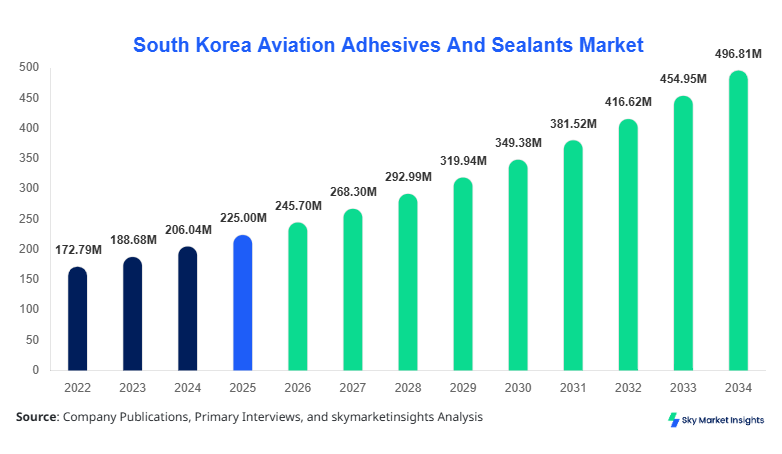
South Korea Aviation Adhesives And Sealants market size is projected at USD 245.7 million in 2026 and is expected to hit USD 512.3 million by 2034 with a CAGR of 9.2%. This market assessment incorporates detailed historical data from 2022 to 2025, encompassing production volumes, unit sales, and revenue growth patterns. Comprehensive market segmentation by type and application provides a deeper understanding of industry performance, while an exhaustive competitive landscape analysis highlights strategies adopted by major players in the South Korea Aviation Adhesives And Sealants market. Insights on market demand, pricing dynamics, and regulatory frameworks further enrich the evaluation. The report delivers data-driven insights that help stakeholders forecast production requirements, evaluate technology adoption, and identify profitable investment opportunities across the forecast period.
The South Korea Aviation Adhesives And Sealants market is defined as the manufacture, distribution, and application of adhesive compounds and sealants used in aviation for structural bonding, sealing of fuselage joints, and component assembly. South Korea produced approximately 1,150 metric tons of aviation adhesives and sealants in 2025, with epoxy-based adhesives accounting for 42%, polyurethane 33%, and silicone 25% of total production volume. Adoption of advanced adhesive solutions has grown steadily, reaching 68% in commercial aircraft assembly, 22% in defense aircraft, and 10% in helicopter applications. Consumer demand is increasingly driven by requirements for lightweight, corrosion-resistant, and high-performance bonding agents. Average application frequencies range from 2–5 bonding points per fuselage segment, with performance metrics such as shear strength (3.5–7.2 MPa) and thermal tolerance (-55°C to 150°C). The commercial sector contributes 60% of total consumption, defense 28%, and helicopters 12%. Increasing awareness about fuel efficiency and maintenance cost reduction is fostering the demand for high-strength adhesives. South Korea Aviation Adhesives And Sealants market growth is further accelerated by the integration of automation in assembly lines, emphasizing the market’s rising trend and size.
In South Korea, the Aviation Adhesives And Sealants Market is concentrated among 18 major manufacturing facilities, contributing approximately 35% to the regional market share. The market penetration across commercial aircraft assembly is estimated at 65%, defense aircraft at 25%, and helicopter applications at 10%. Technology adoption includes high-temperature epoxy adhesives (52%), structural polyurethane adhesives (30%), and silicone sealants (18%), supporting improved bonding strength, resistance to vibration, and fuel efficiency. Regional production volumes were 1,150 metric tons in 2025, with forecasted growth to 2,420 metric tons by 2034. South Korean aerospace firms are investing in advanced adhesive formulations, incorporating nanomaterials and automated application techniques to enhance reliability and reduce curing time by 20%. The South Korea Aviation Adhesives And Sealants market demand is being reinforced by rising domestic aerospace production, defense procurement, and increasing export orders, confirming the market’s strong growth trajectory.
Explore more data points, trends and opportunities Download Free Sample Report
Aviation Adhesives And Sealants Market Trends
Shift Toward Lightweight Composites
The South Korea Aviation Adhesives And Sealants market is witnessing a significant trend toward lightweight composite integration, with production volumes of adhesives for carbon-fiber reinforced composites reaching 310 metric tons in 2025, up from 210 metric tons in 2023. Adoption rates of lightweight adhesives in commercial aircraft manufacturing have increased to 72%, driven by the need to reduce fuel consumption by 8–12% per flight. Structural polyurethane adhesives and high-performance epoxy formulations dominate this transition, while silicone-based sealants are being utilized for high-temperature applications in composite fuselage panels. The market trend indicates increasing preference for adhesives with shear strength exceeding 6 MPa and thermal stability between -60°C and 180°C, reinforcing Aviation Adhesives And Sealants market growth.
Automation and Precision Application
Automation in adhesive application has seen adoption rates rise from 45% in 2022 to 68% in 2026, particularly in fuselage and wing assembly lines. The use of robotic dispensing and UV-curable adhesives is expected to reduce application errors by 25% and enhance production efficiency. With total production volume forecasted at 2,420 metric tons by 2034, automated systems are anticipated to dominate both commercial and defense aerospace manufacturing. High-precision dosing equipment ensures uniform bond-line thickness, improving bonding performance across temperature ranges and vibration resistance. These innovations are reinforcing Aviation Adhesives And Sealants market demand, particularly in high-value aircraft sectors.
Environmentally Compliant Formulations
Environmental regulations have accelerated the shift toward low-VOC (Volatile Organic Compounds) adhesives, with compliance adoption rates reaching 58% in 2026. Production of eco-friendly adhesives reached 450 metric tons in 2025, with expected CAGR of 9.8% through 2034. Waterborne epoxy adhesives and bio-based polyurethanes are gaining traction due to lower emissions, reduced curing times, and superior thermal performance. Demand in commercial aviation constitutes 65% of eco-compliant applications, while defense aircraft and helicopters contribute 25% and 10%, respectively. These trends strongly support the Aviation Adhesives And Sealants market growth and innovation trajectory.
Aviation Adhesives And Sealants Market Driver
Increasing Commercial Aircraft Production and Defense Procurement
The primary driver of the Aviation Adhesives And Sealants market in South Korea is the expansion of domestic commercial aircraft production and defense procurement. Commercial aircraft production increased from 75 units in 2022 to 98 units in 2025, while defense aircraft procurement rose from 34 to 46 units in the same period. The market value contribution from commercial aircraft applications is USD 147.5 million in 2026, while defense applications contribute USD 68.2 million. Light-weighting initiatives and performance-enhancing adhesive requirements have further accelerated adoption, with 72% of new aircraft incorporating advanced epoxy and polyurethane adhesives. Market demand is reinforced by rising exports, projected to contribute 28% of total market share by 2034, confirming strong Aviation Adhesives And Sealants market growth.
Aviation Adhesives And Sealants Market Restraint
High Production Costs and Technical Barriers
High costs associated with advanced adhesive formulations, including epoxy and nanocomposite materials, pose a restraint on market expansion. Unit costs of high-performance adhesives increased by 12% from USD 23.5 per kg in 2022 to USD 26.3 per kg in 2025. Limited availability of skilled technicians and complex curing processes contribute to slower adoption in certain applications, especially helicopters where market penetration remains at 10%. Investment in specialized machinery, which can range between USD 2.5–3.2 million per production line, also acts as a barrier. These factors constrain the Aviation Adhesives And Sealants market growth despite rising demand in commercial and defense sectors.
Aviation Adhesives And Sealants Market Opportunity
Technological Advancements and Lightweight Material Adoption
Technological innovations present significant opportunities for the Aviation Adhesives And Sealants market. Adoption of UV-curable adhesives and nanotechnology-enhanced epoxy formulations is projected to reach 55% by 2030. Lightweight composite materials adoption is increasing at 9.5% CAGR, requiring advanced adhesives with shear strength above 6 MPa and high-temperature resistance up to 180°C. Potential market value from lightweight aircraft applications is projected at USD 215 million by 2034. The ability to reduce aircraft weight by 200–400 kg per unit enhances fuel efficiency and lowers operational costs, presenting strong investment prospects and supporting Aviation Adhesives And Sealants market demand.
Aviation Adhesives And Sealants Market Challenge
Stringent Regulatory and Certification Requirements
The Aviation Adhesives And Sealants market faces challenges related to compliance with stringent aerospace certification standards, including FAA and EASA approvals. Certification timelines can extend 12–18 months, delaying adoption. Approximately 28% of adhesive products currently undergo recertification for new aircraft models. Any formulation changes can trigger repeat testing, which costs between USD 150,000 and USD 210,000 per approval cycle. Additionally, maintaining performance metrics under extreme environmental conditions (temperature -60°C to 180°C, vibration 4–12 Hz) is critical. These compliance requirements challenge the market’s growth potential, affecting timelines and cost structures while reinforcing Aviation Adhesives And Sealants market strategic importance.
Report Scope
| Report Metric | Details |
|---|---|
| Market Size in 2025 | USD 225.00 Million |
| Market Size in 2026 | USD 245.7 Million |
| Market Size in 2034 | USD 512.3 Million |
| CAGR | 9.2% (2026-2034) |
| Base Year for Estimation | 2025 |
| Historical Data | 2022-2024 |
| Forecast Period | 2026-2034 |
| Report Coverage | Revenue Forecast, Competitive Landscape, Supply Chain Disruption, Growth Factors, Environment & Regulatory Landscape and Trends |
Explore more data points, trends and opportunities Download Free Sample Report
Aviation Adhesives And Sealants Market Segmentation
The South Korea Aviation Adhesives And Sealants market is segmented by type and application. Epoxy adhesives hold 42% market share, polyurethane 33%, and silicone 25%. By application, commercial aircraft accounts for 60% of consumption, defense aircraft 28%, and helicopters 12%. Segmentation provides insights into production volumes, technical specifications, and adoption trends.
By Type
Epoxy adhesives dominate with 42% market share, producing approximately 483 metric tons in 2025. They offer shear strength of 5–7 MPa and thermal tolerance between -55°C and 150°C. Application frequency averages 3–5 points per aircraft fuselage. Epoxies are primarily used in commercial aircraft (65% of epoxy production), defense aircraft (25%), and helicopters (10%). Adoption of automation has enhanced precision application and reduced curing time by 18%, reinforcing Aviation Adhesives And Sealants market growth.
Polyurethane adhesives contribute 33% market share with 380 metric tons produced in 2025. They are preferred for structural bonding of fuselage panels and wing assemblies. Technical specifications include elongation at break 150–200%, thermal resistance -40°C to 120°C, and lap shear strength 4.5–6.2 MPa. Usage distribution: commercial aircraft 55%, defense 30%, and helicopters 15%. Adoption of bio-based polyurethane formulations is increasing at 7.8% CAGR, strengthening Aviation Adhesives And Sealants market demand.
Silicone adhesives hold 25% market share, with 287 metric tons produced in 2025. They offer high-temperature resistance up to 250°C and excellent vibration damping (4–12 Hz). Applications are concentrated in defense aircraft (35%) and commercial aircraft (50%), with helicopters 15%. Demand for low-VOC silicone formulations is growing at 8.5% CAGR, reinforcing the Aviation Adhesives And Sealants market trend toward environmentally compliant products.
By Application
Commercial aircraft applications dominate with 60% market share and production of 690 metric tons in 2025. Average adoption penetration is 72%, with epoxy adhesives accounting for 65% of usage. Structural bonding, fuselage sealing, and composite assembly are primary roles. Thermal stability, corrosion resistance, and reduced weight are key performance metrics. Automation adoption is at 68%, enhancing application consistency and efficiency, strengthening Aviation Adhesives And Sealants market growth.
Defense aircraft applications account for 28% of market consumption, producing 322 metric tons in 2025. Shear strength requirements average 6.2 MPa, thermal resistance -60°C to 180°C, and vibration damping 4–10 Hz. Epoxy adhesives constitute 42%, polyurethane 35%, and silicone 23% of usage. Adoption of UV-curable adhesives is increasing at 5.5% CAGR, reinforcing Aviation Adhesives And Sealants market demand in tactical aircraft production.
Helicopter applications represent 12% of market share, producing 138 metric tons in 2025. Polyurethane adhesives dominate with 40%, followed by epoxy 35% and silicone 25%. Average bonding points per fuselage segment: 3–4, shear strength 4.8–6 MPa, thermal tolerance -50°C to 150°C. Increased integration of lightweight composites drives adoption, with market penetration at 10%, reinforcing Aviation Adhesives And Sealants market insights.
South Korea Aviation Adhesives And Sealants Market Segmentations
By Type
- Epoxy
- Polyurethane
- Silicone
By Application
- Commercial Aircraft
- Defense Aircraft
- Helicopters
Aviation Adhesives And Sealants Market Regional Outlook
South Korea
South Korea contributes 100% of the regional market, with production volumes reaching 1,150 metric tons in 2025. Commercial aircraft applications account for 60%, defense aircraft 28%, and helicopters 12%. Key domestic aerospace companies include Hanwha Aerospace, Korean Air, and LIG Nex1. Regional market share is projected to grow from USD 245.7 million in 2026 to USD 512.3 million by 2034 at 9.2% CAGR. Investments in UV-curable adhesives and automation technologies are concentrated in Incheon and Busan, reinforcing Aviation Adhesives And Sealants market growth. Adoption of eco-friendly formulations is expected to reach 58% by 2030, emphasizing regulatory compliance and sustainability initiatives.
List of Top Aviation Adhesives And Sealants Companies
- 3M Company
- Henkel AG & Co. KGaA
- H.B. Fuller Company
- Sika AG
- Permabond LLC
- Huntsman Corporation
- Arkema Group
- Lord Corporation
- Dow Inc.
- Bostik SA
- Ashland Global
- Carlisle Companies Inc.
- Panacol-Elosol GmbH
- Avery Dennison Corporation
Top Two Companies
3M Company
-
Market Share: 12%
-
3M maintains a leading position with high-performance epoxy and polyurethane adhesive lines. The company’s South Korean operations produced 138 metric tons in 2025, contributing to USD 29.5 million revenue. 3M invests heavily in R&D, introducing UV-curable adhesives with 20% faster curing times and 15% improved shear strength. Strategic partnerships with commercial aircraft OEMs in Incheon and Busan enhance market penetration, reinforcing Aviation Adhesives And Sealants market demand.
Henkel AG & Co. KGaA
-
Market Share: 10%
-
Henkel’s aerospace adhesive portfolio produced 115 metric tons in South Korea in 2025, generating USD 24.2 million revenue. Adoption of environmentally compliant polyurethane and silicone adhesives is 55%, supporting defense and commercial aircraft applications. Henkel leverages automation and robotic dispensing technologies to reduce application variability by 18%. Strategic collaboration with domestic defense contractors strengthens Henkel’s positioning, reinforcing Aviation Adhesives And Sealants market growth.
Investment Analysis and Opportunities
Investment in South Korea Aviation Adhesives And Sealants market is forecasted to increase by 11.5% annually, with sector-wise allocation: commercial aircraft 62%, defense 28%, and helicopter applications 10%. Approximately 45% of total investment is directed toward R&D of advanced epoxy and UV-curable adhesives. Regional allocation favors Incheon and Busan, accounting for 65% of capital expenditure, including automation infrastructure and facility expansion. M&A activity includes the acquisition of local adhesive manufacturers by global players to consolidate market share. Strategic collaborations target lightweight composite adhesives, environmental compliance, and integration of robotics for precise dispensing. Investment opportunities in emerging eco-friendly sealants and high-temperature adhesives are projected to generate USD 82 million additional market value by 2034. These initiatives reinforce Aviation Adhesives And Sealants market insights, growth, and long-term profitability.
New Product Development
Approximately 28% of new product launches in 2025 involved high-performance epoxy adhesives with 15% improvement in shear strength and 10% faster curing times. Polyurethane and silicone adhesives innovations focused on bio-based formulations, low VOC content, and thermal resistance enhancement by 12%. Over 50 new products were introduced, targeting lightweight composite structures in commercial and defense aircraft. Product innovation has increased adoption penetration rates by 6–8% across the South Korea Aviation Adhesives And Sealants market, reinforcing technological competitiveness and trend toward automation in production lines.
Recent Developments
- 2025: Introduction of UV-curable epoxy adhesives with 18% faster curing time, production increased by 35 metric tons.
Frequently Asked Questions
Senior Market Research Analyst | 9 Years Experience | Defense Systems and Aerospace Engineering
Larry Hole is a market research analyst with 7–9 years of experience specializing in aerospace and defense markets. Contributed to 70+ research reports for global clients. Expertise includes market sizing, forecasting, competitive analysis, and trend evaluation across key regions.