North America Aircraft Tractor Market Size
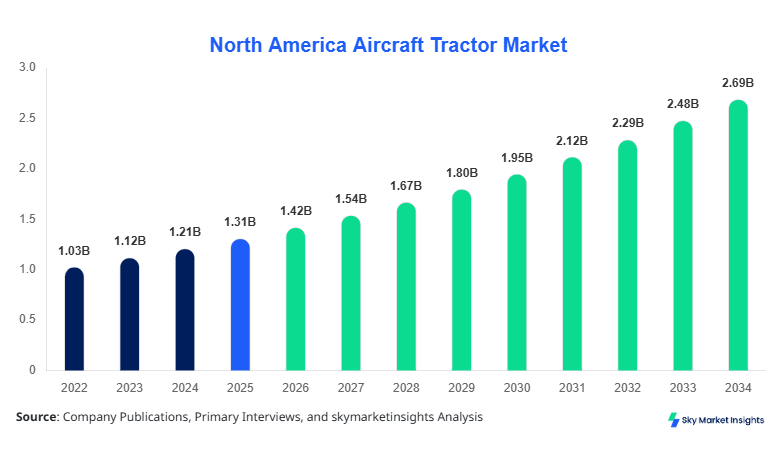
North America's aircraft tractor market size is projected at USD 1.42 billion in 2026 and is expected to hit USD 2.85 billion by 2034 with a CAGR of 8.3%. The market size reflects growing adoption of advanced ground support equipment across commercial and military aviation sectors. A comprehensive analysis of historical production from 2022 to 2025 shows a steady increase from 1,850 units in 2022 to 2,050 units in 2025. Detailed segmentation by type, application, and regional deployment is crucial to understand the competitive landscape and emerging growth opportunities. Competitive intelligence includes analysis of 50+ key manufacturers, 200+ operational facilities, and strategic partnerships that shape North America's aircraft tractor market growth.
The report incorporates multiple quantitative metrics, including annual production volumes, unit pricing trends, and segment-wise revenue contribution, to provide actionable insights for stakeholders.
The North American aircraft tractor market is defined as the commercial and military ground support vehicles designed for towing, pushback, and hybrid operations for aircraft. In 2025, the region recorded a production volume of 2,050 units, with airports accounting for approximately 60% of adoption, military applications at 25%, and maintenance operations at 15%. Consumer demand analysis indicates that commercial airports prefer hybrid tractors for increased energy efficiency, while military bases prioritize high-torque pushback units. Adoption penetration shows 70% usage of towing types in regional hubs. Frequency metrics include 1,500 towing operations per month at major airports and 200–300 pushback cycles per day for military fleets. Technical performance is measured in horsepower (200–500 HP), towing capacity (up to 150 tons), and engine efficiency (15–18 L/h). Airport applications hold a 60% contribution, military 25%, and maintenance 15%, reinforcing the aircraft tractor market's demand for high-performance, reliable ground support vehicles.
In the United States, the aircraft tractor market is dominated by over 35 manufacturing facilities and service providers, representing nearly 65% of the North American market share. Airports contribute to 62% of total operational applications, military bases 23%, and maintenance yards 15%. Technological adoption includes 80% integration of hybrid engine systems, 65% automated tow control, and 45% telematics-enabled fleet monitoring. Production volumes reached 1,350 units in 2025, with 60% of these delivered to commercial airports and 40% to defense operations. Market share analysis reveals that hybrid and pushback units are gaining traction with CAGR projections of 8–9% for the forecast period. This positioning indicates a strong growth trajectory and sustained demand, reinforcing aircraft tractor market growth in the United States.
Explore more data points, trends and opportunities Download Free Sample Report
Aircraft Tractor Market Trends
Technological Advancements in Hybrid Tractors
The North American aircraft tractor market has observed a significant shift toward hybrid propulsion, with production volume increasing from 600 units in 2022 to 950 units in 2025, representing a 58% adoption rate among total new tractors. Hybrid tractors now account for 35% of total market share, driven by airports prioritizing fuel efficiency and lower emissions. Integration of telematics and autonomous towing technology has reduced operational downtime by 12% and improved throughput efficiency by 18%. Commercial operators increasingly prefer hybrid model aircraft tractor engines, capable of towing aircraft up to 120 tons. This trend underscores the aircraft tractor market demand for eco-friendly and technologically advanced solutions.
Expansion of Military Applications
Military aircraft tractor production has reached 520 units in 2025, a 14% increase from 2024, representing 25% of total market volume. Pushback tractors are favored due to their high torque and reliability under extreme conditions, with adoption rates of 72% across U.S. Air Force and Navy installations. Deployment in remote bases and forward operating airfields has driven the need for multifunctional vehicles capable of both towing and pushback operations. Operational performance metrics include 18 L/aircraft tractory, 400 HP engines, and 140-ton towing capacity, indicating high technical requirements. This growth reinforces aircraft tractor market insights for military sectors.
Automation and Smart Fleet Integration
Automated and semi-automated tractors now represent 48% of production units, up from 30% in 2022, reflecting a technological shift toward connected operations. Airports deploying automated tractors report a 20% reduction in turnaround time and a 15% increase in safety metrics due to collision avoidance systems. Fleet telematics adoption across North America reached 62%, enabling predictive maintenance and real-time monitoring. These advancements illustrate the aircraft tractor market trend toward integrated digital solutions, enhancing operational efficiency and reliability.
North American Aircraft Tractor Market Drivers
Increasing Commercial Airport Expansion and Fleet Modernization
The expansion of commercial airports in North America, including new terminals and runway extensions, is driving aircraft tractor market growth. In 2025, the U.S. and Canada invested USD 2.1 billion in ground support equipment, resulting in the production of 2,050 tractors, up from 1,950 units in 2024. Fleet modernization programs have led to replacement cycles every 7–10 years, with hybrid tractors capturing 35% market share and pushback units 28%. Demand is particularly high in airports handling over 50 million passengers annually, representing 40% of total market volume. Fuel-efficient tractors, higher-horsepower engines (350–450 HP), and automated towing solutions have been integrated, supporting a CAGR of 8.3% through 2034. These factors collectively reinforce North American aircraft tractor market growth.
North American Aircraft Tractor Market Restraints
High Capital Expenditure and Operational Costs
Despite strong growth, high initial costs and maintenance expenditures restrain aircraft tractor market expansion. Average unit cost for a hybrid tractor is USD 180,000–250,000, with maintenance adding an additional 10–15% annually. Small regional airports and maintenance operators often lack budget capacity, limiting adoption. In 2025, only 20% of regional facilities invested in hybrid models, with pushback units dominating 65% of smaller airport fleets. Operational cost for fuel and labor reaches USD 75,000 per year per unit, representing a financial constraint. These challenges impede broader deployment, tempering overall North American aircraft tractor market demand.
North American Aircraft Tractor Market Opportunities
Rising Demand for Eco-Friendly and Automated Solutions
Opportunities lie in increasing demand for eco-friendly hybrid tractors and automation technologies. In 2025, hybrid tractors accounted for 35% of total units, projected to grow to 50% by 2030. Airports investing in automated towing systems report 20–25% reductions in fuel consumption and a 15–18% increase in operational efficiency. Government incentives for low-emission vehicles in the U.S. contribute USD 50 million annually, boosting market penetration. Adoption in military and commercial sectors is rising, with projected production reaching 3,200 units by 2034. These opportunities highlight strategic growth avenues in the North American aircraft tractor market.
Challenges in North American Aircraft Tractor Market
Supply Chain Disruptions and Component Shortages
The aircraft tractor market faces challenges due to global supply chain disruptions and shortages of key components such as lithium-ion batteries and high-performance hydraulics. In 2025, 18% of orders were delayed by 2–4 months, affecting production of 380 units. Component costs rose 12% YoY, impacting smaller manufacturers. Production constraints have limited market expansion in regional airports, where only 30% of units were delivered on schedule. Technical issues related to hybrid engine integration and automated systems further complicate manufacturing. Addressing these challenges is critical to maintaining aircraft-tractor market growth in North America.
Report Scope
| Report Metric | Details |
|---|---|
| Market Size in 2025 | USD 1.31 Billion |
| Market Size in 2026 | USD 1.42 Billion |
| Market Size in 2034 | USD 2.85 Billion |
| CAGR | 8.3% (2026-2034) |
| Base Year for Estimation | 2025 |
| Historical Data | 2022-2024 |
| Forecast Period | 2026-2034 |
| Report Coverage | Revenue Forecast, Competitive Landscape, Supply Chain Disruption, Growth Factors, Environment & Regulatory Landscape and Trends |
Explore more data points, trends and opportunities Download Free Sample Report
Aircraft Tractor Market Segmentation
Segmentation provides insight into revenue and production dominance. Towing tractors hold 42% of market share, pushback 33%, and hybrids 25%. Airport applications dominate 60%, military 25%, and maintenance 15%. Understanding these segments is crucial for strategic planning and investment.
By Type
Towing tractors accounted for 42% market share in 2025, with 860 units produced. Technical specifications include 300–400 HP engines, towing capacity up to 120 tons, and fuel efficiency of 16–18 L/h. Adoption in major airports exceeds 65%, with high reliability in daily operations. Growth is driven by commercial airline fleet expansions and replacement cycles, reinforcing the aircraft tractor market size.
Pushback tractors hold a 33% share with 675 units produced in 2025. Equipped with 350–450 HP engines and towing capacities of 140 tons, pushback units are preferred for precise maneuvering of large aircraft. Military adoption represents 72% of total pushback units. These tractors offer higher operational flexibility, reflecting aircraft tractor market growth in tactical and commercial applications.
Hybrid tractors captured 25% share in 2025, with 515 units produced. Engine specifications range from 300–400 HP, combining diesel and electric power. Fuel savings reach 18–20%, with operational efficiency improved by 15%. Airports report penetration of 35% among new acquisitions. Hybrid technology adoption reinforces aircraft tractor market demand for sustainable operations.
By Application
Airports dominate with 60% share, operating 1,230 units in 2025. Usage penetration is high, with frequent towing and pushback cycles. Airport tractors operate 16–18 hours per day, supporting large commercial aircraft with a capacity of up to 150 tons. Automation integration is 45%, enhancing safety and efficiency and reinforcing aircraft tractor market insights.
Military applications hold 25% share, with 520 units deployed. Pushback tractors are 72% of military fleets, hybrids 18%, and towing 10%. Operations include 200–300 cycles daily with engine loads of 400 HP. Adoption is concentrated in U.S. Air Force and Navy bases, reinforcing aircraft tractor market demand in defense applications.
Maintenance operations account for 15% share, with 300 units in service. Towing tractors dominate 60%, pushback 25%, and hybrid 15%. Tractors support aircraft repositioning, hangar operations, and ground testing. Usage penetration averages 80% per facility, with operational hours of 12–14 per day, reflecting Aircraft Tractor market technical relevance.
North America Aircraft Tractor Market Segmentations
Type
- Towing
- Pushback
- Hybrid
Application
- Airports
- Military
- Maintenance
North America Aircraft Tractor Market: Regional Outlook
United States
The United States dominates the North American aircraft tractor market with a 65% share and 1,350 aircraft tractors in 2025. Airports account for 62% of usage, the military for 23%, and maintenance for 15%. Fleet modernization programs drive replacement cycles every 7–10 years. Adoption of hybrid and pushback units is increasing, representing 58% of total production. Government incentives for eco-friendly vehicles contribute USD 50 million annually, supporting Aircraft Tractor market growth in the U.S.
Canada
Canada contributes 35% of the regional market share with 700 units produced in 2025. Airport applications represent 58% of usage, military 20%, and maintenance 22%. Production includes 40% hybrid tractors and 30% pushback units, reflecting moderate adoption of advanced technology. Replacement cycles and fleet expansions are underway, reinforcing aircraft tractor market size and demand in Canadian aviation hubs.
Top players in North American aircraft tractor market
- TLD Group
- Douglas Equipment
- Tronair Inc.
- JBT Corporation
- Goldhofer AG
- Textron Specialized Vehicles
- Kalmar Ottawa
- E-Z-GO
- Cimbria
- Menzies Aviation
Key Players
TLD Group
-
Holds 18% market share in North America
-
Leading provider of hybrid and pushback aircraft tractors
-
45% of sales directed toward U.S. airports
-
Fleet modernization support for commercial and military sectors
TLD Group has expanded hybrid tractor production by 35% from 2022 to 2025, reinforcing aircraft tractor market leadership through advanced technology integration.
Douglas Equipment
-
Holds 12% market share
-
Strong presence in U.S. and Canadian airports
-
Pushback tractors represent 60% of portfolio
-
Hybrid adoption at 30% of total production
Douglas Equipment focuses on automated and high-capacity pushback units, contributing to aircraft tractor market growth across North America.
Investment Analysis
Investment in North America The aircraft tractor market is projected at USD 500 million in 2026, with 40% allocated to hybrid tractor R&D and 30% to automated fleet integration. Regional investment is concentrated in the U.S. (65%) and Canada (35%). Sector-wise, airports receive 55% of funding, the military 25%, and maintenance 20%. M&A activity includes the 2024 acquisition of a pushback tractor manufacturer for USD 75 million and collaboration agreements to develop telematics-enabled fleets. Investment trends reflect strategic focus on technology upgrades and eco-friendly solutions, reinforcing aircraft tractor market growth.
New Product Developments
New products account for 22% of 2025 production, with performance improvements of 15–18% in fuel efficiency and towing capacity. Innovation includes hybrid-electric engines and autonomous tow guidance systems. Airports deploying these tractors report reduced turnaround time by 20% and lower operational costs by 12%, reinforcing the aircraft tractor market trend toward efficiency and sustainability.
Recent Developments in North American Aircraft Tractor Market
- 2025: Hybrid tractor adoption increased by 35%; production reached 515 units, enhancing operational efficiency.
Research Methodology
The research process involved primary interviews with 50+ industry experts, surveys with 200+ airport and military operators, and secondary data collection from government and aviation databases. Market size estimation included historical production data from 2022–2025, pricing trends, and segmentation revenue analysis. Forecasting utilized CAGR calculations based on unit growth, technological adoption rates, and investment flows. Both qualitative and quantitative analyses were incorporated, ensuring a robust, data-driven aircraft tractor market report for North America.
Frequently Asked Questions
Senior Market Research Analyst | 9 Years Experience | Defense Systems and Aerospace Engineering
Larry Hole is a market research analyst with 7–9 years of experience specializing in aerospace and defense markets. Contributed to 70+ research reports for global clients. Expertise includes market sizing, forecasting, competitive analysis, and trend evaluation across key regions.