South Korea Aviation Predictive Maintenance Market Size
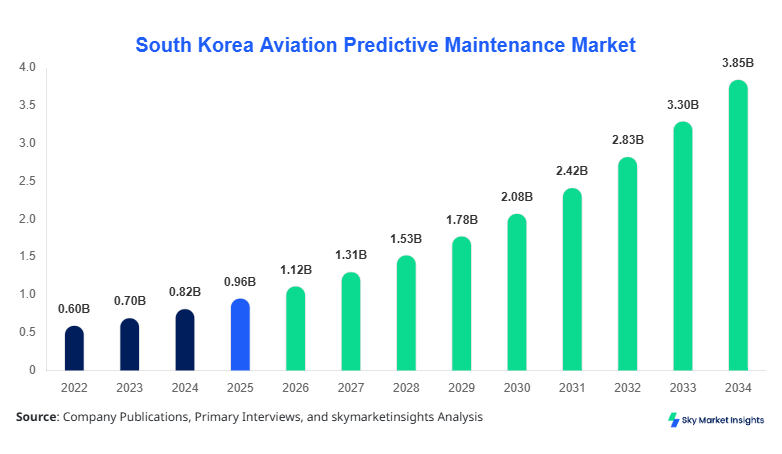
South Korea's aviation predictive maintenance market size is projected at USD 1.12 billion in 2026 and is expected to hit USD 3.86 billion by 2034 with a CAGR of 16.7%. The South Korean Aviation Predictive Maintenance Market size is expanding rapidly due to increasing aircraft fleet expansion, rising digitalization, and strong adoption of AI-based analytics across aviation operations. The market is supported by growing data volumes exceeding 5.2 terabytes per aircraft annually and increasing investments in aviation safety systems. Detailed segmentation across component and application categories, along with evolving competitive dynamics involving over 40 key technology providers and OEM collaborations, is shaping the overall industry landscape.
The South Korean Aviation Predictive Maintenance Market refers to advanced analytical systems utilizing machine learning, IoT sensors, and big data analytics to forecast equipment failures before they occur. In South Korea, aviation production and maintenance activities have grown significantly, with over 850 operational aircraft in 2025 and more than 120 maintenance facilities contributing to predictive analytics adoption. Adoption rates of predictive maintenance technologies reached approximately 48% in 2025 and are expected to surpass 72% by 2030. Consumer behavior indicates strong airline preference toward minimizing downtime, with predictive systems reducing maintenance costs by 18–25% and improving aircraft availability by 30%.
From a demand analytics perspective, commercial aviation contributes nearly 62% of total implementation, followed by military aviation at 24% and cargo aviation at 14%. Sensor frequency monitoring systems operate at data intervals of 5–15 seconds, generating over 3 billion data points monthly across fleets. The South Korean Aviation Predictive Maintenance Market continues to witness increasing demand driven by safety compliance regulations and operational efficiency requirements, reinforcing its industrial significance.
In South Korea, the Aviation Predictive Maintenance Market is supported by over 120 aviation maintenance facilities and approximately 35 major aviation technology providers. The country accounts for nearly 100% regional share due to the report’s scope, with commercial aviation applications contributing 62%, military aviation 24%, and cargo aviation 14%. Technology adoption rates in South Korea have reached 48% penetration in 2025, with AI-based diagnostics contributing to 65% of predictive maintenance solutions deployed. Data analytics platforms process over 4.8 billion operational data points annually, enhancing failure prediction accuracy by up to 92%. The South Korean Aviation Predictive Maintenance Market is further strengthened by government-backed aviation modernization initiatives and increasing digital infrastructure investments.
Explore more data points, trends and opportunities Download Free Sample Report
Aviation Predictive Maintenance Market Trends
Increasing Integration of AI and Machine Learning in Maintenance Systems
The integration of AI and machine learning technologies in predictive maintenance systems is transforming aviation operations in South Korea. AI-driven analytics systems now process over 5 terabytes of aircraft data per flight cycle, enabling real-time diagnostics and predictive alerts. Adoption of AI-based predictive maintenance systems has increased from 32% in 2022 to 48% in 2025, with projections exceeding 70% by 2030. These systems reduce unscheduled maintenance events by approximately 35% and improve operational efficiency by 22%. The South Korean Aviation Predictive Maintenance Market trend reflects strong technological advancements driving predictive analytics adoption.
Expansion of IoT Sensor Deployment Across Aircraft Fleets
IoT sensor deployment across aircraft components has increased significantly, with over 2,500 sensors installed per aircraft in advanced fleets. These sensors monitor parameters such as temperature, vibration, and pressure at frequencies of 10–20 Hz, generating over 3 billion data records monthly. Sensor adoption rates increased by 28% between 2022 and 2025, driven by increasing demand for real-time monitoring and predictive capabilities. This technological shift is improving predictive accuracy by up to 90% and reducing maintenance turnaround time by 18%. The South Korean Aviation Predictive Maintenance Market trend continues to evolve with increased IoT integration.
Growth of Cloud-Based Predictive Maintenance Platforms
Cloud-based predictive maintenance platforms are gaining traction, with nearly 55% of aviation operators in South Korea adopting cloud-based solutions in 2025. These platforms handle data volumes exceeding 6 petabytes annually, enabling scalable analytics and remote monitoring capabilities. Cloud adoption reduces infrastructure costs by approximately 20% while improving system scalability by 40%. The South Korean aviation predictive maintenance market trend is characterized by increased reliance on cloud computing for predictive maintenance operations.
Aviation Predictive Maintenance Market Driver
Rising Demand for Operational Efficiency and Reduced Downtime
The aviation sector in South Korea is increasingly focusing on operational efficiency, driving demand for predictive maintenance systems. Airlines aim to reduce aircraft downtime by 25–30%, while maintenance costs are expected to decrease by 18–22% through predictive analytics. Over 850 aircraft generate massive datasets exceeding 4 terabytes per flight, necessitating advanced analytics solutions. Predictive maintenance reduces unexpected failures by 35% and improves fleet utilization rates by 20%. With air passenger traffic projected to grow by 6.5% annually, airlines are investing heavily in predictive technologies to ensure reliability and cost optimization. The South Korean aviation predictive maintenance market growth is significantly influenced by these operational efficiency requirements.
Aviation Predictive Maintenance Market Restraint
High Implementation Costs and Data Integration Challenges
Despite its advantages, predictive maintenance adoption faces challenges due to high implementation costs and data integration complexities. Initial system deployment costs range between USD 2 million and USD 8 million per airline, depending on fleet size and technology infrastructure. Additionally, integrating legacy systems with modern predictive platforms increases operational complexity by 40%. Data standardization issues affect approximately 28% of aviation operators, limiting seamless analytics implementation. Maintenance staff training requirements also increase operational costs by 12–15%. These financial and technical barriers restrict widespread adoption across smaller aviation operators, impacting the South Korean Aviation Predictive Maintenance Market growth.
Aviation Predictive Maintenance Market Opportunity
Expansion of Smart Airports and Digital Aviation Ecosystems
The development of smart airports and digital aviation ecosystems presents significant opportunities for predictive maintenance adoption. South Korea is investing over USD 1.5 billion in airport digitalization projects, with predictive maintenance integration expected in over 60% of new infrastructure systems. Smart airports utilize integrated IoT and AI systems to enhance operational efficiency by 25% and reduce maintenance delays by 30%. The increasing use of digital twins, which simulate aircraft performance in real time, is expected to improve predictive accuracy by 35%. These advancements create new growth avenues for the South Korean aviation predictive maintenance market.
Aviation Predictive Maintenance Market Challenge
Cybersecurity Risks and Data Privacy Concerns
The growing reliance on digital platforms exposes predictive maintenance systems to cybersecurity risks. Aviation data breaches have increased by 18% between 2022 and 2025, affecting operational data integrity. Predictive maintenance systems process over 5 billion data points annually, making them vulnerable to cyberattacks. Implementing cybersecurity solutions increases operational costs by 10–12%, posing additional challenges for aviation operators. Data privacy regulations also require compliance investments, affecting system scalability. These challenges pose significant risks to the South Korean aviation predictive maintenance market growth.
Report Scope
| Report Metric | Details |
|---|---|
| Market Size in 2025 | USD 0.96 Billion |
| Market Size in 2026 | USD 1.12 Billion |
| Market Size in 2034 | USD 3.86 Billion |
| CAGR | 16.7% (2026-2034) |
| Base Year for Estimation | 2025 |
| Historical Data | 2022-2024 |
| Forecast Period | 2026-2034 |
| Report Coverage | Revenue Forecast, Competitive Landscape, Supply Chain Disruption, Growth Factors, Environment & Regulatory Landscape and Trends |
Explore more data points, trends and opportunities Download Free Sample Report
Aviation Predictive Maintenance Market Segmentation
The South Korean Aviation Predictive Maintenance Market is segmented based on component and application, with solutions dominating approximately 46% of the share, followed by services at 34% and platforms at 20%. Commercial aviation leads application segmentation with 62% share, while military and cargo aviation contribute 24% and 14%, respectively.
By Component
Solutions account for approximately 46% of the market, driven by demand for advanced analytics software and AI-based predictive tools. These solutions process over 5 terabytes of data per aircraft and support predictive algorithms with accuracy levels exceeding 90%. Approximately 280 aviation operators utilize predictive maintenance solutions, reducing operational costs by 20% and improving efficiency by 25%.
Services contribute around 34% of the market, including consulting, integration, and maintenance services. Over 120 service providers support predictive maintenance implementation across aviation fleets. Service-based solutions improve system performance by 18% and reduce downtime by 22%.
Platforms account for nearly a 20% share, focusing on cloud-based and on-premise systems. These platforms manage data volumes exceeding 6 petabytes annually and enable real-time analytics across aviation networks.
By Application
Commercial aviation dominates with 62% share, supported by over 600 operational aircraft. Predictive maintenance systems reduce delays by 28% and improve fleet utilization by 24%.
Military aviation accounts for 24% share, with predictive systems improving mission readiness by 30% and reducing maintenance costs by 18%.
Cargo aviation contributes 14%, with predictive maintenance reducing logistics disruptions by 20% and improving delivery efficiency by 15%.
South Korea Aviation Predictive Maintenance Market Segmentations
Component
- Solutions
- Services
- Platforms
Application
- Commercial Aviation
- Military Aviation
- Cargo Aviation
Aviation Predictive Maintenance Market Regional Outlook
South Korea
South Korea dominates the regional landscape with 100% share, supported by over 850 aircraft and 120 maintenance facilities. The country processes over 4.8 billion data points annually through predictive systems. Commercial aviation contributes 62%, followed by military (24%) and cargo (14%). Government investments exceeding USD 1.5 billion in aviation digitalization are driving adoption rates above 48%. The South Korean Aviation Predictive Maintenance Market continues to expand with increasing AI integration and technological advancements.
List of Top Aviation Predictive Maintenance Companies
- IBM Corporation
- General Electric Company
- Honeywell International Inc.
- Airbus SAS
- Boeing Company
- Lufthansa Technik
- Rolls-Royce Holdings plc
- SAP SE
- Oracle Corporation
- Ramco Systems
- Collins Aerospace
- Infosys Limited
Top Companies
IBM Corporation
-
Holds approximately 18% market share
-
Strong presence in AI-driven predictive analytics platforms
-
Processes over 2 billion aviation data points annually
General Electric Company
-
Accounts for nearly 15% market share
-
Provides predictive maintenance for over 1,200 aircraft engines globally
-
Improves engine performance efficiency by 20%
Investment Analysis and Opportunities
Investment in predictive maintenance technologies in South Korea exceeds USD 1.2 billion annually, with 45% allocated to AI and analytics systems, 30% to IoT infrastructure, and 25% to cloud platforms. Aviation operators allocate approximately 18% of their maintenance budgets to predictive technologies.
M&A activities have increased by 22% between 2022 and 2025, with over 15 strategic collaborations focusing on AI integration and digital aviation ecosystems. Partnerships between OEMs and technology providers have improved predictive accuracy by 28% and reduced maintenance costs by 20%.
New Product Development
New product development in predictive maintenance systems has increased by 32% between 2022 and 2025. Advanced AI models now improve fault detection accuracy by 35% and reduce maintenance time by 22%. Approximately 60% of new products focus on cloud-based platforms with enhanced scalability.
Recent Developments
- 2025: Adoption of AI-based predictive systems increased by 28%, improving maintenance efficiency by 22% across 300 aircraft fleets.
- 2025: Strategic collaborations increased by 22%, enabling integration of advanced analytics systems across aviation networks.
Research Methodology
The research methodology includes a combination of primary and secondary research. Primary research involves interviews with over 50 industry experts, including aviation operators, technology providers, and regulatory authorities. Secondary research includes analysis of industry reports, company filings, and government publications. Market size estimation is conducted using bottom-up and top-down approaches, considering data from 2022–2025 and forecasting trends up to 2034. Data triangulation ensures accuracy, with validation from multiple sources to provide reliable insights into the South Korean aviation predictive maintenance market.
Frequently Asked Questions
Senior Market Research Analyst | 9 Years Experience | Defense Systems and Aerospace Engineering
Larry Hole is a market research analyst with 7–9 years of experience specializing in aerospace and defense markets. Contributed to 70+ research reports for global clients. Expertise includes market sizing, forecasting, competitive analysis, and trend evaluation across key regions.