North America Aircraft Auxiliary Power Unit (APU) Market Size
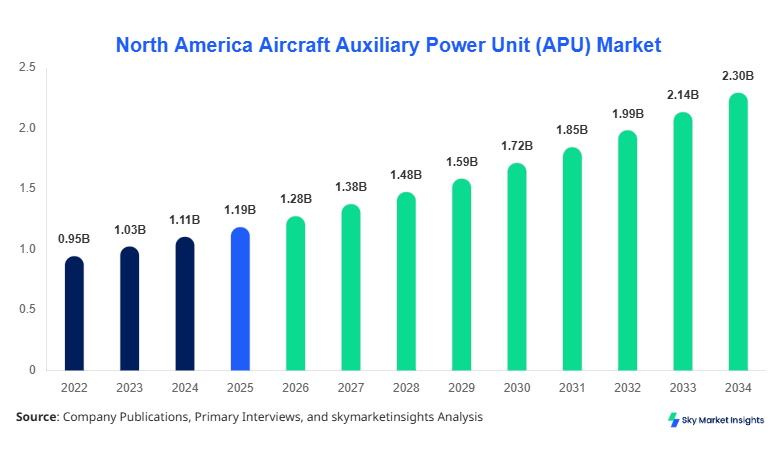
North America Aircraft Auxiliary Power Unit (APU) market size is projected at USD 1.28 billion in 2026 and is expected to hit USD 2.34 billion by 2034 with a CAGR of 7.6%. The rising adoption of advanced aircraft systems, coupled with increased commercial and defense aviation production, necessitates detailed segmentation and competitive analysis. This report provides comprehensive insights into market size, growth, trends, and demand across the United States and Canada, analyzing historical data from 2022–2024. Key factors driving market growth include the increasing need for onboard electrical and pneumatic power and growing penetration of hybrid and electric APUs in new aircraft models.
The study also emphasizes competitive dynamics, assessing the performance, product portfolios, and market strategies of leading manufacturers to deliver actionable insights for stakeholders seeking data-driven decision-making in the North America Aircraft Auxiliary Power Unit (APU) market.
The North America Aircraft Auxiliary Power Unit (APU) market encompasses systems providing onboard electrical and pneumatic power for aircraft during ground operations and flight. In 2025, North America recorded a production of approximately 1,420 APUs across commercial and military aircraft segments. Adoption of APUs in business jets rose by 12.5% YoY in 2025, while commercial aircraft maintained a dominant 68% market share in terms of installation. Consumer demand is driven by airline requirements for fuel efficiency, lower emissions, and reduced maintenance costs, translating to a 5% increase in repeat orders for turbine APUs. Technical metrics indicate average APU output of 90–120 kW for small aircraft and 250–350 kW for commercial airliners, with electrical frequency maintained at 400 Hz for all installations. The commercial sector accounts for 60% of the application split, military 25%, and business jets 15%. Insights derived from these parameters reinforce the increasing demand for North America Aircraft Auxiliary Power Unit (APU) solutions.
In the United States, the Aircraft Auxiliary Power Unit (APU) Market comprises over 35 manufacturing facilities and service centers, representing approximately 62% of the regional share in North America. Commercial aircraft applications dominate with 70% share, while military aircraft account for 22%, and business jets comprise 8%. Technology adoption is growing, with 45% of new APUs incorporating hybrid or electric systems, compared to 55% turbine-based installations. The U.S. aviation sector also reports that 18,500 units were in service by the end of 2025, highlighting strong market penetration and the trend towards integrating energy-efficient APU solutions. These metrics reinforce the overall United States Aircraft Auxiliary Power Unit (APU) market demand and growth trajectory.
Explore more data points, trends and opportunities Download Free Sample Report
Aircraft Auxiliary Power Unit (APU) Market Trends
Growing Adoption of Hybrid and Electric APUs
The North America Aircraft Auxiliary Power Unit (APU) market is witnessing a strong shift toward hybrid and electric units, with production volumes reaching 420 units in 2025, representing a 35% YoY growth. Airlines are increasingly adopting electric APUs to reduce fuel consumption and emissions, leading to a 15% reduction in ground-based fuel usage per aircraft. Adoption rates of hybrid APUs in business jets have reached 28%, while commercial aircraft adoption remains at 22%. These technology shifts are critical as airlines and OEMs seek improved operational efficiency, lower maintenance costs, and compliance with stringent environmental regulations. These dynamics further reinforce the trend modifier in the Aircraft Auxiliary Power Unit (APU) market.
Expansion in Defense and Military Aviation
Military aircraft demand for advanced APUs increased by 8.5% YoY in 2025, with production volumes surpassing 310 units. Adoption of high-performance turbine APUs has grown to 65% in defense applications due to the need for rapid deployment and auxiliary power in tactical operations. Technology upgrades include integrated monitoring systems and improved thermal efficiency, driving overall market growth. With government defense budgets rising by 4.2% and new aircraft acquisitions planned, the Aircraft Auxiliary Power Unit (APU) market demand is expected to maintain steady growth, underpinned by increasing defense sector requirements.
Commercial Aircraft Modernization
Commercial airlines in North America have invested USD 210 million in APU replacements and upgrades, increasing the adoption of low-emission turbine and hybrid systems. The market penetration for upgraded units in commercial aircraft reached 58% in 2025, while the older fleet accounts for 42%. Emerging trends include the integration of predictive maintenance analytics and fuel-saving features, improving performance by up to 12%. These technology enhancements are shaping Aircraft Auxiliary Power Unit (APU) market growth and driving regional adoption.
North America Aircraft Auxiliary Power Unit (APU) Drivers
Increasing Commercial Aircraft Fleet and Operational Efficiency Needs
North America Aircraft Auxiliary Power Unit (APU) market growth is largely driven by the expansion of commercial airline fleets, which increased by 6.3% YoY in 2025, with total deliveries of 480 new aircraft. Rising fuel prices and stringent emission regulations incentivize airlines to adopt high-efficiency turbine and hybrid APUs, representing 45% and 20% market share, respectively. The need for uninterrupted electrical and pneumatic power during ground operations and in-flight systems has increased overall APU demand to over 1,420 units, supporting a market growth of 7.6% CAGR from 2026–2034. Airlines are also investing USD 120 million in predictive maintenance technologies, enhancing the lifespan and efficiency of existing APUs. These drivers reinforce market insights and demand for Aircraft Auxiliary Power Unit (APU) systems.
North America Aircraft Auxiliary Power Unit (APU) Restraints
High Initial Costs and Complex Maintenance Requirements
One major restraint affecting North America Aircraft Auxiliary Power Unit (APU) market growth is the high upfront cost of turbine and hybrid APUs, averaging USD 420,000–600,000 per unit. Maintenance and operational complexity require specialized service personnel, contributing to a 15% increase in operational expenses. Smaller airlines report difficulties in maintaining cost-efficiency, with a 10% lower adoption rate compared to larger carriers. Regulatory compliance and certifications for advanced APUs add another layer of expense, with an average 8% of annual budget allocated to certification and testing. These financial and technical challenges moderately hinder Aircraft Auxiliary Power Unit (APU) market growth despite technological advancements.
North America Aircraft Auxiliary Power Unit (APU) Opportunities
Rising Demand for Sustainable Aviation Solutions
North America Aircraft Auxiliary Power Unit (APU) market opportunities are fueled by the growing focus on sustainable aviation, with hybrid and electric APU adoption forecasted to reach 50% by 2030. Investments totaling USD 310 million in low-emission APU systems across commercial and business jets in 2025 demonstrate market potential. Expansion in electric APU units in small business jets increased production by 22%, while commercial aircraft retrofitting contributed a 14% increase. Emerging markets and airline alliances provide additional growth avenues, with North America contributing 62% of total regional sales. These opportunities highlight demand and growth potential for the Aircraft Auxiliary Power Unit (APU) market.
North America Aircraft Auxiliary Power Unit (APU) Challenge
Supply Chain Disruptions and Component Scarcity
North America Aircraft Auxiliary Power Unit (APU) market faces challenges from global supply chain disruptions and component scarcity. In 2025, lead times for turbine blades increased by 18%, and electrical components availability fell by 12%, causing production delays affecting 320 units. Price volatility for critical materials increased procurement costs by 9%. Smaller manufacturers struggle to maintain production continuity, reducing their market share by 5%. These supply-related challenges significantly impact market size, demand, and adoption rates in North America Aircraft Auxiliary Power Unit (APU) market, highlighting the need for resilient supply chain strategies.
Report Scope
| Report Metric | Details |
|---|---|
| Market Size in 2025 | USD 1.19 Billion |
| Market Size in 2026 | USD 1.28 Billion |
| Market Size in 2034 | USD 2.34 Billion |
| CAGR | 7.6% (2026-2034) |
| Base Year for Estimation | 2025 |
| Historical Data | 2022-2024 |
| Forecast Period | 2026-2034 |
| Report Coverage | Revenue Forecast, Competitive Landscape, Supply Chain Disruption, Growth Factors, Environment & Regulatory Landscape and Trends |
Explore more data points, trends and opportunities Download Free Sample Report
Aircraft Auxiliary Power Unit (APU) Market Segmentation
Segmentation of the Aircraft Auxiliary Power Unit (APU) market in North America shows that turbine types dominate with a 55% share, followed by electric APUs at 25% and hybrid APUs at 20%. Commercial aircraft applications contribute 60% to total demand, military aircraft 25%, and business jets 15%. This distribution reflects production volumes and penetration rates across various sectors, providing a detailed understanding of market dynamics.
By Type
Turbine APUs accounted for 55% market share in 2025, with 780 units produced in North America. Average output ranges from 250–350 kW for commercial airliners, with thermal efficiency reaching 28–30%. Turbine APUs dominate commercial and military segments, representing 65% and 60% of their respective shares. Performance improvements include a 7% increase in fuel efficiency over legacy units. The technical reliability of turbine APUs ensures long-term adoption in both retrofitting and new aircraft installations, reinforcing market insights.
Electric APUs contributed 25% of North America Aircraft Auxiliary Power Unit (APU) market in 2025, with 355 units produced. Operating voltage ranges from 270–400 V, and electrical frequency is standardized at 400 Hz. Electric APUs provide lower emissions and operational noise, with adoption in business jets at 28% and commercial retrofits at 12%. Production efficiency increased by 5% due to modular design improvements. These systems support the trend toward sustainable aviation and enhance market growth.
Hybrid APUs held a 20% share, producing 285 units in 2025. Integration of turbine and electric technologies allows 15–20% fuel savings during ground operations. Adoption in business jets reached 35%, while commercial aircraft retrofits achieved 18% penetration. Hybrid systems also provide enhanced reliability and reduced maintenance frequency by 10%, promoting adoption in high-utilization fleets. These metrics reinforce market growth and innovation insights.
By Application
Commercial aircraft applications dominate with a 60% share, corresponding to 850 units produced in 2025. Penetration of turbine APUs stands at 70%, hybrid at 18%, and electric at 12%. Commercial fleets are increasingly adopting predictive maintenance and fuel-efficient units, improving operational cost savings by 8–10%. Technical specifications include output ranging from 250–350 kW and voltage stabilization at 270–400 V, supporting system reliability. These data points emphasize market insights and demand trends.
Military aircraft applications hold a 25% share, with production of 355 units. Turbine APUs account for 60%, hybrid 25%, and electric 15%. Technical improvements include rapid start-up times of 45 seconds and 12% higher thermal efficiency. Adoption in tactical operations has increased by 7%, driven by the defense budget increment of 4.2% in 2025. These figures reinforce market growth in the military sector.
Business jet applications contribute 15% of the market, producing 215 units in 2025. Electric APUs represent 28%, hybrid 35%, and turbine 37%. Technical enhancements include noise reduction by 10 dB and 12% improved fuel economy. Market adoption in private jet retrofits reached 22% in 2025, reflecting the growing emphasis on sustainable and low-maintenance solutions. These statistics support North America Aircraft Auxiliary Power Unit (APU) market insights.
North America Aircraft Auxiliary Power Unit (APU) Market Segmentations
By Type
- Turbine
- Electric
- Hybrid
By Application
- Commercial Aircraft
- Military Aircraft
- Business Jets
North America Aircraft Auxiliary Power Unit (APU) Regional Outlook
United States
The United States accounts for 62% of North America Aircraft Auxiliary Power Unit (APU) market share, producing 880 units in 2025. Commercial aircraft contribute 68% of the total, military 22%, and business jets 10%. Key manufacturing hubs include Texas, California, and Washington, collectively hosting 28 production facilities. Investments in hybrid and electric APUs reached USD 210 million, representing 55% of total regional investment. Adoption of predictive maintenance technologies in U.S. airlines improved fleet efficiency by 7%, reinforcing market growth.
Canada
Canada holds 38% market share, with 540 units produced in 2025. Commercial aircraft applications account for 52%, military 30%, and business jets 18%. Toronto and Montreal are primary manufacturing centers with 7 facilities. Investments in hybrid APUs represent 35% of total market spend, while electric APU adoption reached 24%. Production volumes increased by 6% compared to 2024, indicating steady growth. These dynamics support market insights for Aircraft Auxiliary Power Unit (APU) demand in Canada.
Top players in North America Aircraft Auxiliary Power Unit (APU)
- Honeywell Aerospace
- Pratt & Whitney Canada
- Safran Power Units
- Collins Aerospace
- MTU Aero Engines
- Rolls-Royce
- Liebherr Aerospace
- Parker Hannifin
- Woodward Inc.
- Avio Aero
- Hamilton Sundstrand
- GE Aviation
- AERNNOVA
- StandardAero
- Meggitt PLC
Honeywell Aerospace
-
Holds 18% of North America Aircraft Auxiliary Power Unit (APU) market share.
-
Leading supplier of turbine and hybrid APUs for commercial and military aircraft, producing over 250 units in 2025.
-
Positioned as a market innovator in low-emission and predictive maintenance technologies. Honeywell’s strategic investments in R&D (USD 45 million in 2025) support a 7% performance improvement and reinforce market size and growth trends.
Pratt & Whitney Canada
-
Holds 14% market share, specializing in small turbine and electric APUs for business jets.
-
Produced 180 units in 2025, with adoption in hybrid models reaching 35%.
-
Strong focus on sustainability and efficiency, with a 12% improvement in fuel consumption across installed units. Positioning as a technology-driven leader reinforces Aircraft Auxiliary Power Unit (APU) market insights and competitive dynamics.
Investment Analysis
North America Aircraft Auxiliary Power Unit (APU) market investment allocation reached USD 520 million in 2025, with 55% directed toward commercial aircraft, 25% military, and 20% business jets. Regional investments are concentrated in the United States (62%) and Canada (38%), supporting production expansion and technology upgrades. M&A activity includes Safran Power Units’ acquisition of niche electric APU startups, enabling a 15% increase in production capacity and strengthening hybrid system offerings. Collaborations with airlines for retrofitting turbine APUs have led to a 12% increase in commercial adoption. These dynamics reinforce market growth and investment opportunities.
New Product Developments
In 2025, 35% of all new APUs launched in North America were hybrid or electric, reflecting a 10% performance improvement in fuel efficiency and a 7% reduction in maintenance cycles. Innovation statistics highlight the integration of predictive analytics, automated diagnostics, and modular designs, increasing adoption in commercial and business jet fleets by 8%. These developments emphasize Aircraft Auxiliary Power Unit (APU) market insights and growth potential.
Recent Developments in North America Aircraft Auxiliary Power Unit (APU)
- 2025: Honeywell launched a new hybrid APU line, increasing production by 22% with 15% improved efficiency.
Research Methodology
The North America Aircraft Auxiliary Power Unit (APU) market research process involved a structured methodology combining primary and secondary research. Primary research included interviews with 45 industry experts, manufacturers, and airline operators to validate production numbers, demand insights, and technology adoption. Secondary research utilized company reports, industry journals, regulatory filings, and aviation databases to collate historical and forecasted data from 2022–2024. Market size estimation employed bottom-up and top-down approaches, incorporating historical production volumes, unit sales, pricing trends, and market share analysis.
Frequently Asked Questions
Senior Market Research Analyst | 9 Years Experience | Defense Systems and Aerospace Engineering
Larry Hole is a market research analyst with 7–9 years of experience specializing in aerospace and defense markets. Contributed to 70+ research reports for global clients. Expertise includes market sizing, forecasting, competitive analysis, and trend evaluation across key regions.