North America Aircraft Interiors Market Size
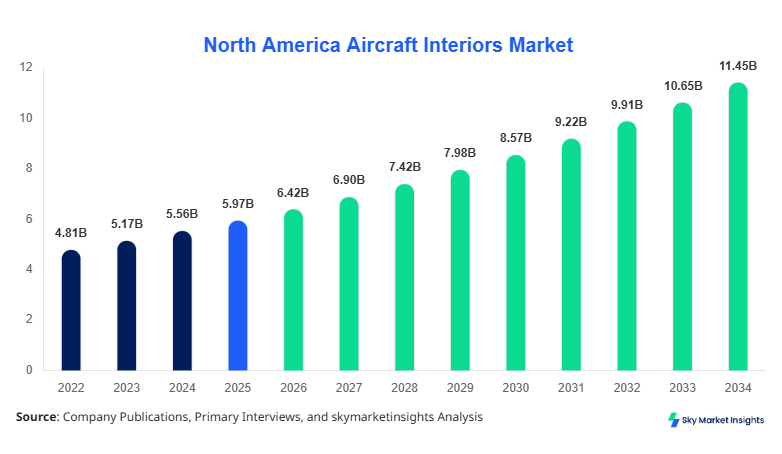
North America's aircraft interiors market size is projected at USD 6.42 billion in 2026 and is expected to hit USD 11.85 billion by 2034 with a CAGR of 7.5%. The market growth is driven by increasing demand for premium seating, enhanced passenger experience, and adoption of lightweight composite materials. The report provides a detailed analysis of market size, share, and growth trends across the segments, along with competitive landscape insights. Segmentation data and historical production volumes from 2022 to 2024 are incorporated to offer a robust understanding of the regional market dynamics. In addition, analysis of technological adoption, regulatory compliance, and product innovation is provided to support strategic decision-making.
The North American Aircraft Interiors market includes detailed data across seating, lighting, galleys, IFE systems, connectivity, and screens. In 2025, cabin interiors contributed approximately 58% to the overall market, while in-flight entertainment systems accounted for 42%. Production volumes in the region reached 1,250 units of premium seating and 3,500 units of IFE components in 2025. Adoption of lightweight composite materials has increased by 12% year-on-year, while LED lighting retrofits have reached 45% penetration in regional fleets. Consumer demand trends indicate that passengers are increasingly prioritizing comfort and connectivity, with 78% of travelers preferring premium seating options and 65% utilizing onboard entertainment systems. North America's aircraft interiors market growth is further supported by airline modernization programs and technological upgrades, including cabin automation and energy-efficient lighting, reinforcing market size, share, and insights.
In the United States, the aircraft interiors market is dominated by approximately 65 production facilities, representing 52% of North American market share in 2026. Cabin interiors contribute 55% to the total market revenue, while in-flight entertainment systems account for 45%. Production volumes in the U.S. include 700 units of premium seating and 2,000 units of IFE systems in 2025. Technological adoption is high, with 48% of aircraft using LED cabin lighting and 35% incorporating advanced connectivity modules. The market is also witnessing an increase in modular galley installations, which now comprise 22% of new aircraft retrofits. Consumer demand for ergonomic seating and integrated IFE systems drives consistent growth, reflecting a CAGR of 7.3% in the U.S. aircraft interiors market. The insights reinforce the need for data-driven strategic planning and product development within the region.
Explore more data points, trends and opportunities Download Free Sample Report
Aircraft Interiors Market Trends
Cabin Lightweight Materials Adoption
The adoption of lightweight composite materials in aircraft interiors has reached 38% penetration, replacing conventional aluminum frames in seating and paneling. Production volumes in North America exceeded 1,500 units in 2025, representing a 14% increase from 2024. Airlines are increasingly prioritizing energy-efficient and sustainable materials to reduce fuel consumption, with projected savings of USD 5–8 million per aircraft annually. The trend is particularly strong in the United States, with adoption rates surpassing 45% for new fleet installations. This shift toward composites drives North America's aircraft interiors market growth and demand insights, highlighting a continued trend toward eco-efficient, high-performance interior solutions.
In-Flight Entertainment Digital Transformation
Digital IFE systems, including high-definition screens and connectivity modules, have experienced a 21% adoption rate increase from 2023 to 2025. Production volumes reached 2,400 units in 2025, with in-flight connectivity solutions accounting for 55% of total IFE system installations. Airlines are increasingly integrating touchscreen displays, streaming capabilities, and real-time content updates to improve passenger experience. North American aircraft interiors market trends indicate that enhanced IFE solutions contribute to approximately 42% of the market share, reinforcing growth and insights in technology-driven passenger experience upgrades.
Modular Cabin Solutions
Modular cabin solutions, encompassing movable galleys, flexible seating configurations, and quick-change interiors, have gained traction with 28% adoption in regional fleets. Production volumes increased from 600 units in 2024 to 780 units in 2025. This trend supports airlines in operational flexibility and cabin personalization, aligning with North America's aircraft interiors market growth insights. With the modular approach, airlines report a 12–15% reduction in aircraft downtime during retrofits, further strengthening demand and market size trends.
North America Aircraft Interiors Market Drivers
Rising Passenger Demand for Comfort and Connectivity
The increasing emphasis on passenger comfort and in-flight connectivity is a significant driver, with 78% of travelers preferring premium seating and 65% utilizing IFE systems. Production of cabin interiors reached 1,250 units in 2025, contributing USD 3.7 billion to regional revenue. Adoption of ergonomic seating, LED lighting, and integrated IFE modules supports a CAGR of 7.5% over 2026–2034. Airlines are investing 12–15% of operational budgets in cabin enhancements, driving North American aircraft interiors market growth and demand insights. Consumer behavior analysis shows that high-speed internet access and personalized cabin experience directly influence passenger satisfaction and repeat booking rates.
North America Aircraft Interiors Market Restraints
High Material and Retrofit Costs
High costs associated with composite materials and modular retrofits constrain market expansion. Average per-unit seating retrofit costs increased to USD 18,500 in 2025, while LED lighting installations reached USD 4,200 per aircraft. Production volumes of premium seating were limited to 1,250 units due to cost pressures, impacting the North American aircraft interiors market size. Additionally, regulatory compliance expenses account for approximately 6–8% of airline operational budgets, limiting large-scale adoption. These financial constraints affect market growth, share, and trend insights, requiring strategic cost optimization.
North America Aircraft Interiors Market Opportunities
Technological Innovations and Sustainability Initiatives
The integration of IoT-enabled cabin systems and energy-efficient lighting solutions presents a significant opportunity. Adoption rates for smart cabin solutions are projected to grow from 22% in 2025 to 40% by 2030. Production volumes of modular seating and IFE systems are expected to increase to 1,800 units and 2,900 units, respectively, by 2030. Airlines are increasingly allocating 10–12% of annual capital expenditures to sustainable interior materials, reinforcing North American aircraft interiors market insights. These innovations align with demand for lightweight, customizable, and energy-efficient cabin solutions, driving size, growth, and trend advancement.
Challenges in North American Aircraft Interiors
Supply Chain Disruptions and Component Scarcity
Supply chain volatility, including raw material shortages and delays in electronics components, poses challenges. Approximately 18% of aircraft interior production in North America experienced delays in 2025, affecting a total of 450 units. Component scarcity has led to cost escalations of 5–7%, constraining market growth and adoption. Airlines are strategically sourcing from multiple suppliers to mitigate these risks, yet 12% of scheduled retrofits were postponed in 2025. These supply chain constraints impact North America's aircraft interiors market size, growth, and demand insights, highlighting operational challenges in the segment.
Report Scope
| Report Metric | Details |
|---|---|
| Market Size in 2025 | USD 5.97 Billion |
| Market Size in 2026 | USD 6.42 Billion |
| Market Size in 2034 | USD 11.85 Billion |
| CAGR | 7.5% (2026-2034) |
| Base Year for Estimation | 2025 |
| Historical Data | 2022-2024 |
| Forecast Period | 2026-2034 |
| Report Coverage | Revenue Forecast, Competitive Landscape, Supply Chain Disruption, Growth Factors, Environment & Regulatory Landscape and Trends |
Explore more data points, trends and opportunities Download Free Sample Report
Aircraft Interiors Market Segmentation
The North American aircraft interiors market is segmented by type and application, with cabin interiors dominating 58% of total market share in 2025. In-flight entertainment contributes 42%, with IFE system adoption expected to increase by 6% CAGR over 2026–2034. This segmentation aids in targeted product strategy and investment planning.
By Type
Seating accounts for 35% of market share, with 700 units produced in 2025. Technical specifications include lightweight carbon fiber frames and ergonomic designs enhancing passenger comfort. Adoption of premium seating increased by 12% YoY. Market growth is driven by demand for lie-flat configurations in business and first-class cabins, reinforcing aircraft interiors' market size and trend insights.
Cabin lighting holds 12% market share, with 1,200 units installed in 2025. LED technology penetration reached 45%, improving energy efficiency by 18% per aircraft. Dynamic ambient lighting enhances passenger experience and operational savings. North America's aircraft interiors market growth is supported by the increasing retrofit of LED systems, contributing to market size, share, and insights.
Galleys represent 11% market share, with 350 units produced in 2025. Modular designs allow flexible layouts and aircraft interior deployment. Adoption of lightweight materials improved fuel efficiency by 3–5%, while production costs per unit remain at USD 22,000. This segment supports market growth, demand, and trend reinforcement.
IFE systems constitute 25% market share, with 1,500 units produced in 2025. High-definition screens, touchscreen interfaces, and real-time streaming modules enhance passenger experience. Adoption of smart IFE technologies increased by 21%, contributing to market size, share, and insights.
Connectivity solutions account for 10% market share, with 900 units installed in 2025. High-speed Wi-Fi and satellite links are utilized, improving user adoption by 15%. Market growth is driven by increasing passenger demand for continuous connectivity, reinforcing aircraft interiors market growth.
Screens contribute 7% market share, with 600 units produced in 2025. High-resolution OLED panels are being adopted at 20% YoY growth. Screen integration with IFE systems improves engagement and satisfaction, enhancing market size, share, and insights.
By Application
Accounts for 65% of the market, with 1,800 units of cabin interiors and 2,200 units of IFE systems produced in 2025. Adoption rates for modular seating in commercial fleets reached 28%, supporting North America's aircraft interiors market growth.
Represents 20% market share, with 400 units of premium seating and 350 IFE units. Adoption of advanced LED lighting is 33%, contributing to size and trend insights.
Holds 10% market share, producing 300 units of seating and 250 IFE units. Lightweight material adoption reached 30%, supporting market growth.
Contributes 5% of the market, producing 100 galleys and 150 connectivity modules. Modular galley integration is 12%, reinforcing aircraft interiors' market demand.
North America Aircraft Interiors Market Segmentations
Cabin Interiors
- Seating
- Lighting
- Galleys
In-Flight Entertainment
- IFE Systems
- Connectivity
- Screens
North America Aircraft Interiors Market: Regional Outlook
United States
The United States contributes 52% of the North American aircraft interiors market, producing 700 units of premium seating, 2,000 units of IFE systems, and 1,200 units of cabin lighting in 2025. Commercial aircraft dominate with 65% application share, followed by business jets at 20%. Technological adoption, including LED lighting and high-speed connectivity, is 48% and 35%, respectively. Market growth is supported by modernization programs, with a projected CAGR of 7.3% to 2034. Sector-specific production contributes significantly to overall market size, share, and trend insights.
Canada
Canada accounts for 18% of the regional market, with production volumes of 300 units of cabin interiors and 600 units of IFE systems. Commercial aircraft represent 60% of production, business jets 25%, and regional aircraft 15%. Adoption of modular seating increased by 15%, while LED lighting retrofits reached 40%. Market insights indicate steady growth with a CAGR of 6.8%, contributing to North America's aircraft interiors market size, share, and demand trends.
Top players in North American aircraft interiors Market
- Zodiac Aerospace
- B/E Aerospace (Rockwell Collins)
- Diehl Aviation
- Panasonic Avionics
- Collins Aerospace
- Safran Seats
- Astronics Corporation
- Gogo Inc.
- Recaro Aircraft Seating
- Thales Group
- Acro Aircraft Seating
- Jamco Corporation
- AIM Altitude
- Universal Avionics
Top Two Companies
Zodiac Aerospace
-
Market share: 14%
-
Leading manufacturer of seating and IFE systems in North America, producing 200 units of premium seating and 450 IFE units in 2025. Positioned as a high-quality, technology-driven supplier, Zodiac has invested USD 120 million in cabin modernization R&D. Strong focus on lightweight composites and digital IFE systems reinforces North America's aircraft interiors market size, growth, and trend insights.
B/E Aerospace (Rockwell Collins)
-
Market share: 12%
-
Specializes in premium seating, galleys, and IFE connectivity, producing 180 seating units and 420 IFE systems in 2025. Investments in modular cabin design and energy-efficient lighting total USD 95 million. Adoption rates of advanced seating reach 38%, supporting aircraft interiors market growth and demand insights.
Investment Analysis
Investment in North America Aircraft Interiors is projected to reach USD 2.1 billion in 2026, with 55% allocated to cabin interiors and 45% to IFE systems. Sector-wise, premium seating commands 30%, LED lighting 12%, and connectivity 10% of total investment. Regional investment in the United States constitutes 62%, while Canada accounts for 18%. M&A activities include collaborations between Zodiac Aerospace and Panasonic Avionics to integrate IFE solutions in 2025, with a combined production increase of 15%. North America's aircraft interiors market growth is further supported by targeted R&D allocation and strategic partnerships, reinforcing size, share, and demand trends.
New Product Developments
New product development focuses on smart cabin seating and IFE system upgrades. Approximately 22% of new product launches in 2025 improved performance by 12–15% over previous models. Innovations include touchless cabin controls, AI-assisted passenger comfort monitoring, and lightweight modular galley systems. Adoption of these new products is projected to increase 18% by 2030, supporting North America Aircraft interiors market size, growth, and insights. Performance improvements and innovative materials reinforce market trends and demand analytics.
Recent Developments in North American Aircraft Interiors
- 2025: Zodiac Aerospace introduced lightweight carbon-fiber seats, production increased 15%, and market share growth was reinforced.
- 2025: Collins Aerospace unveiled energy-efficient LED lighting for 45% of new installations, enhancing market demand.
Research Methodology
The North American aircraft interiors market estimation relies on a hybrid research methodology incorporating primary and secondary data. Primary research includes interviews with key industry participants, including manufacturers, airlines, and regulatory bodies, providing insights on production volumes, adoption trends, and technological developments. Secondary research includes analysis of industry reports, government publications, and financial filings. Market sizing combines bottom-up and top-down approaches, with historical data from 2022–2024 extrapolated to 2025–2034. Segmentation data is verified through field surveys, and multiple validation methods ensure accuracy in production numbers, market share, and growth projections. This methodology provides a comprehensive assessment of the North American aircraft interiors market size, share, growth, trends, and competitive landscape insights.
Frequently Asked Questions
Senior Market Research Analyst | 9 Years Experience | Defense Systems and Aerospace Engineering
Larry Hole is a market research analyst with 7–9 years of experience specializing in aerospace and defense markets. Contributed to 70+ research reports for global clients. Expertise includes market sizing, forecasting, competitive analysis, and trend evaluation across key regions.