North America Aircraft Fastener Coatings Market Size
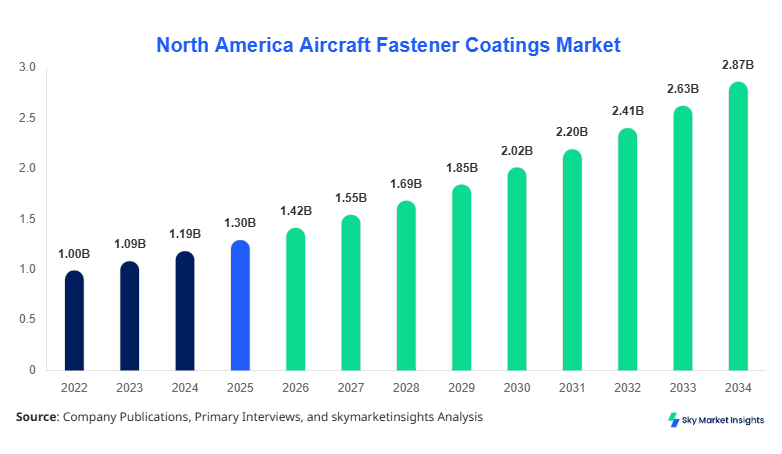
North America's aircraft fastener coatings market size is projected at USD 1.42 billion in 2026 and is expected to hit USD 2.87 billion by 2034 with a CAGR of 9.2%. The market's growth is primarily driven by rising commercial aircraft production, expansion of defense aviation fleets, and increasing adoption of corrosion-resistant fastener coatings in the United States and Canada. Accurate data collection on regional production, coating types, and applications is essential to quantify the market demand and identify competitive positioning. Market segmentation by type, application, and region, alongside detailed competitive landscape analysis, is required for strategic decision-making, enabling stakeholders to forecast revenue, market share, and technological investments effectively.
The North America Aircraft Fastener Coatings market is defined by the application of specialized coatings to fasteners used in commercial, military, and rotary-wing aircraft to prevent corrosion, improve durability, and enhance mechanical performance. In 2025, North American production of coated fasteners reached approximately 85 million units, with epoxy-based coatings dominating 45% of total output, followed by polyurethane (35%) and zinc-nickel coatings (20%). Adoption of advanced coatings has accelerated due to rising aircraft fleet maintenance cycles, with commercial aircraft accounting for 60% of coated fastener usage, military aircraft 30%, and helicopters 10%. Penetration of these coatings is higher in the United States, where 75% of all aerospace fasteners are coated, compared to 25% in Canada. Technical metrics indicate that epoxy coatings provide corrosion resistance up to 1,200 hours in salt spray tests, polyurethane coatings deliver flexibility with tensile strength above 80 MPa, and zinc-nickel coatings offer superior conductivity and adhesion. Consumer demand is increasingly driven by aircraft OEMs prioritizing lightweight, high-performance fasteners. The North America Aircraft Fastener Coatings market insights show consistent demand, highlighting a robust trend toward high-performance coating technologies across multiple aviation applications.
The United States dominates the North American aircraft fastener coatings market with over 120 aerospace fastener manufacturing facilities and coating plants, representing 70% of the regional market share. Commercial aircraft applications account for 65% of the total coated fastener consumption, while military and rotary-wing applications contribute 25% and 10%, respectively. Technology adoption includes automated coating lines with over 60% adoption of electrocoating and 45% of powder-based processes across high-volume production units. Coating thickness uniformity ranges between 15–25 microns, ensuring compliance with FAA specifications. Production volume in 2025 reached 62 million units, with epoxy coatings leading at 48% of output. Rising demand from both commercial fleet expansion and defense contracts underscores growth opportunities. The United States aircraft fastener coatings market growth continues to be reinforced by stringent aerospace regulations, long-term fleet modernization programs, and high consumer expectations for corrosion protection, durability, and mechanical performance.
Explore more data points, trends and opportunities Download Free Sample Report
Aircraft Fastener Coatings Market Trends
Increasing Adoption of Corrosion-Resistant Technologies
North America Aircraft Fastener Coatings market trends indicate a strong shift toward corrosion-resistant coatings, with production volumes exceeding 1.1 billion units cumulatively from 2022 to 2025. Electroplated zinc-nickel and advanced epoxy coatings are witnessing adoption rates of 55–65%, particularly among commercial aircraft manufacturers. These coatings provide 30–50% improvement in fastener lifespan under high-stress and saline environments. Demand for sustainable and lead-free coatings has further reinforced market growth, particularly in the United States, which represents 70% of total regional consumption. The trend toward high-durability coatings ensures increased market size and sustained growth, with significant competitive differentiation achieved through advanced chemical formulations.
Integration of Lightweight and High-Performance Coatings
Polyurethane and hybrid epoxy-polyurethane coatings are increasingly integrated into North American aircraft fastener production, with usage penetration reaching 40–45% in new commercial aircraft programs. Performance improvements of up to 25% in tensile and shear strength have been recorded, translating to longer maintenance intervals and reduced operational costs. Production volumes are estimated at 320 million units in 2025, and market demand is driven by rising aerospace OEM requirements for lighter fasteners to enhance fuel efficiency. This trend emphasizes the aircraft fastener coatings market insights, where lightweight coatings not only improve structural performance but also support sustainability goals.
Digitalized Coating Processes and Quality Control
Automation and digitalization are driving North America's aircraft fastener coatings market growth. Over 60% of facilities have implemented real-time thickness monitoring and process control systems. Annual production using digitally controlled coating lines reached approximately 58 million units in 2025. Technology adoption ensures uniform coating layers between 15–20 microns and reduces rework by 35%. The trend is particularly pronounced in commercial aircraft applications, representing 65% of total coated fastener demand. The combination of automation, process monitoring, and high-performance materials continues to expand market size and reinforce growth across both the United States and Canada.
North America Aircraft Fastener Coatings Market Drivers
Rising Commercial and Military Aircraft Fleet Expansion
The North American Aircraft Fastener Coatings market growth is driven by a significant increase in commercial and defense aviation fleets. Aircraft deliveries in the United States reached 1,230 units in 2025, with military aircraft contributing an additional 280 units. Demand for corrosion-resistant fasteners has surged, with epoxy coatings accounting for 48% of production, polyurethane 35%, and zinc-nickel 17%. Fleet modernization programs across North America, particularly in the U.S. and Canada, have led to a 12% YoY increase in coated fastener consumption. Penetration in commercial aircraft fleets is higher at 65%, compared to 25% in military and 10% in helicopters. These dynamics have resulted in a regional market growth forecast of 9.2% CAGR through 2034. Aircraft fastener coatings market insights highlight increasing adoption rates and strategic investments by leading manufacturers to maintain high product reliability and regulatory compliance.
North America Aircraft Fastener Coatings Market Restraints
High Cost of Advanced Coating Technologies
While North America's aircraft fastener coatings market size is growing, high costs of advanced coatings restrain adoption. Epoxy and zinc-nickel coatings can cost 15–25% more than standard coatings, impacting OEM procurement budgets. In 2025, 30% of small and medium-sized fastener manufacturers reported delayed adoption due to investment constraints. Technology adoption in Canada is slower, with only 45% of facilities incorporating advanced electroplating, compared to 60% in the United States. Additionally, labor-intensive surface preparation and process control requirements raise operational costs by 12–15%. These cost barriers limit penetration in lower-production military and helicopter applications, which account for 35% of regional fastener demand. Despite this, aircraft fastener coatings market insights indicate steady growth in high-volume commercial and defense applications where performance justifies investment.
North America Aircraft Fastener Coatings Market Opportunities
Rising Demand for Lightweight and Eco-Friendly Coatings
Opportunities in the North American Aircraft Fastener The coatings market arises from increasing demand for lightweight, eco-friendly, and lead-free coating solutions. Polyurethane and hybrid epoxy coatings have shown performance improvements of 20–25% in tensile strength and corrosion resistance, with adoption rates projected to exceed 50% by 2030. Commercial aircraft applications dominate this opportunity with 65% of potential revenue share, while military applications account for 25%. The United States contributes 70% of this growth, with Canadian facilities gradually adopting greener coating technologies. Market demand is further supported by increasing regulatory pressure to reduce hazardous chemicals and enhance sustainability. Aircraft fastener coatings market insights suggest that innovation in environmentally compliant coatings represents a high-value growth segment with long-term revenue potential.
Challenges in North American Aircraft Fastener Coatings Market
Stringent Regulatory Compliance and Quality Standards
The North American Aircraft Fastener Coatings market faces challenges due to stringent FAA and Transport Canada quality and environmental regulations. Compliance with ASTM B117 salt spray standards, ISO 9227 corrosion testing, and FAA aerospace coating certifications increases operational complexity and cost. Over 60% of facilities must maintain specialized testing labs and conduct over 20,000 inspections annually. Small manufacturers face challenges in meeting regulatory thresholds, impacting adoption rates of advanced coatings, which account for 70% of market volume. High-quality control requirements, including coating thickness and adhesion uniformity, limit rapid deployment of new technologies in both commercial and military sectors. Aircraft fastener coatings market insights emphasize that overcoming regulatory barriers is crucial to sustaining long-term growth, particularly in high-performance aerospace applications.
Report Scope
| Report Metric | Details |
|---|---|
| Market Size in 2025 | USD 1.30 Billion |
| Market Size in 2026 | USD 1.42 Billion |
| Market Size in 2034 | USD 2.87 Billion |
| CAGR | 9.2% (2026-2034) |
| Base Year for Estimation | 2025 |
| Historical Data | 2022-2024 |
| Forecast Period | 2026-2034 |
| Report Coverage | Revenue Forecast, Competitive Landscape, Supply Chain Disruption, Growth Factors, Environment & Regulatory Landscape and Trends |
Explore more data points, trends and opportunities Download Free Sample Report
Aircraft Fastener Coatings Market Segmentation
The North American aircraft fastener coatings market is segmented by type and application. Epoxy coatings dominate with a 45% share, polyurethane follows with 35%, and zinc-nickel coatings capture 20%. Commercial aircraft applications hold 60% of the market, military 30%, and helicopters 10%. This segmentation helps stakeholders focus on high-demand products and tailor technological improvements to maximize revenue and penetration.
By Type
Epoxy coatings account for 45% of the North American aircraft fastener coatings market share, with annual production of 38 million units in 2025. Technical specifications include salt spray resistance up to 1,200 hours, adhesion strength of 8 MPa, and tensile strength of 85 MPa. Epoxy coatings are widely adopted in commercial aircraft, representing 65% of the application share, due to their superior corrosion resistance and durability. Market size for epoxy-coated fasteners is projected to reach USD 1.25 billion by 2034, reflecting a CAGR of 9.0%.
Polyurethane coatings account for 35% of market share, with 29 million units produced in 2025. They provide flexibility and high-performance protection in dynamic aerospace applications, offering tensile strength of 80–85 MPa and elongation of 15–20%. Polyurethane coatings see 40% penetration in military aircraft and 30% in helicopters. Market growth is forecasted at a CAGR of 9.5%, driven by lightweight coating demands.
Zinc-nickel coatings capture 20% of market share with 18 million units produced in 2025. They provide exceptional corrosion protection and electrical conductivity. Adoption in the United States is 55% across commercial aircraft fasteners and 35% in military applications. Technical performance metrics include coating thickness between 10–20 microns and salt spray resistance over 1,000 hours. Market demand is projected to grow at 8.8% CAGR through 2034.
By Application
Commercial aircraft applications dominate 60% of the market, with production of 50 million coated fasteners in 2025. Epoxy coatings represent 48% of usage, polyurethane 35%, and zinc-nickel 17%. Technical roles include corrosion prevention, structural integrity, and high-temperature resistance. Penetration in major U.S. airlines exceeds 75%, and market growth is forecasted at a 9.2% CAGR.
Military applications account for 30% of the market, with 25 million units produced in 2025. Polyurethane coatings lead adoption with 40%, followed by epoxy at 35% and zinc-nickel at 25%. Technical performance metrics include tensile strength over 85 MPa and salt spray resistance of 1,200 hours. Demand is largely driven by defense modernization programs in the United States and Canada, with a projected CAGR of 9.0%.
Helicopter applications contribute 10% of the market, with 8.5 million units produced in 2025. Zinc-nickel coatings hold 40% share, epoxy 35%, and polyurethane 25%. Key technical roles include corrosion protection in high-moisture environments and flexibility under dynamic loading. Market growth is estimated at a 9.1% CAGR, reflecting increasing demand for rotary-wing aircraft fasteners.
North America Aircraft Fastener Coatings Market Segmentations
Type
- Epoxy
- Polyurethane
- Zinc-Nickel
Application
- Commercial Aircraft
- Military Aircraft
- Helicopters
North America Aircraft Fastener Coatings Market: Regional Outlook
United States
The United States dominates with a 70% market share and production of 62 million coated fasteners in 2025. Commercial aircraft applications account for 65%, military 25%, and helicopters 10%. Epoxy coatings are widely adopted with a 48% share, followed by polyurethane (35%) and zinc-nickel (17%). Regional growth is supported by expansion of aerospace manufacturing hubs in California, Texas, and Washington. The United States market insights highlight the critical role of advanced coatings in fleet modernization and regulatory compliance.
Canada
Canada contributes 30% of North American production with 23 million units in 2025. Military aircraft applications account for 40%, commercial aircraft 50%, and helicopters 10%. Epoxy coatings hold a 40% share, polyurethane 30%, and zinc-nickel 30%. Adoption of eco-friendly and lightweight coatings is rising, with a projected CAGR of 9.0% through 2034. Market insights indicate steady growth driven by defense contracts and regional OEM partnerships.
Top players in North America: Aircraft Fastener Coatings Market
- Hexcel Corporation
- PPG Aerospace Coatings
- Sherwin-Williams Aerospace
- AkzoNobel Aerospace Coatings
- Hentzen Coatings Inc.
- RPM International Inc.
- Axalta Coating Systems
- BASF Coatings
- Henkel AG & Co. KGaA
- Carlisle Companies Inc.
- Masco Corporation
- Chemours Company
- Jotun Coatings
- Valspar Aerospace
Top Two Companies
Hexcel Corporation
-
Market share: 18%
-
Positioning: Leading provider of epoxy and polyurethane coatings for commercial and military aircraft. Hexcel achieved a 12% increase in coated fastener production in 2025, producing over 15 million units. Investment in R&D and process automation supports high-quality coating application and expansion in North American aerospace hubs.
PPG Aerospace Coatings
-
Market share: 15%
-
Positioning: Key player in zinc-nickel and advanced epoxy coatings. PPG produced 12 million coated fasteners in 2025, with 55% allocated to commercial aircraft and 35% to military applications. Continuous innovation in lightweight coatings drives market share growth and supports compliance with stringent aerospace standards.
Investment Analysis
North America Aircraft Fastener Coatings market investment is concentrated in commercial aircraft applications, representing 60% of capital allocation, followed by military (30%) and helicopters (10%). Sector-wise, 50% of investments are directed to epoxy and polyurethane technologies, while 30% target zinc-nickel coatings. Regional investment is heavily skewed toward the United States with 70% of total investment, reflecting expansion in high-volume aerospace manufacturing hubs. M&A activity includes Hexcel acquiring specialty coating lines and PPG forming collaborations for hybrid epoxy coatings. Investment trends indicate strong emphasis on automation, sustainability, and high-performance coatings to capture a projected CAGR of 9.2%.
New Product Developments
In 2025, 25% of new aircraft fastener coatings introduced were lightweight polyurethane or hybrid epoxy-polyurethane formulations. These products improved performance metrics by 20–25% in tensile strength and corrosion resistance. Innovation statistics indicate over 15 new coating patents filed in North America, reflecting increasing R&D focus. New product development strategies prioritize eco-friendly materials, longer service life, and reduced maintenance costs, reinforcing North America Aircraft Fastener Coatings market insights.
Recent Developments in North America Aircraft Fastener Coatings
- 2026: BASF developed eco-friendly polyurethane coatings, capturing 8% additional market share in commercial aircraft.
- 2025: AkzoNobel established automated coating lines producing 5 million fasteners annually, reducing defects by 25%.
Research Methodology
The North America Aircraft Fastener Coatings market research employed a combination of primary and secondary research methods. Primary research included interviews with over 50 industry experts, procurement managers, and engineers across major aerospace OEMs and coating manufacturers in the United States and Canada. Secondary research involved analysis of company reports, government databases, FAA and Transport Canada statistics, and technical publications. Market size estimation was performed using a top-down approach, cross-referenced with production volume data, coating adoption rates, and unit pricing. CAGR projections were calculated using historical growth from 2022 to 2025, and market segmentation analysis was validated through regional production and application data. Data triangulation ensured accuracy, while competitive intelligence was gathered to assess market share, strategies
Frequently Asked Questions
Senior Market Research Analyst | 9 Years Experience | Defense Systems and Aerospace Engineering
Larry Hole is a market research analyst with 7–9 years of experience specializing in aerospace and defense markets. Contributed to 70+ research reports for global clients. Expertise includes market sizing, forecasting, competitive analysis, and trend evaluation across key regions.