Asia Pacific Aircraft Insulation Market Size
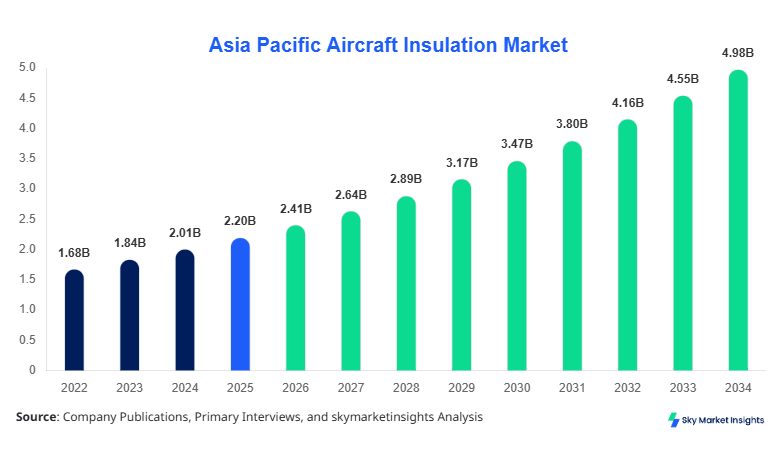
Asia Pacific Aircraft Insulation market size is projected at USD 2.41 billion in 2026 and is expected to hit USD 4.98 billion by 2034 with a CAGR of 9.51%. The Asia Pacific Aircraft Insulation Market reflects strong expansion driven by rising aircraft production volumes exceeding 1,800 units annually across China, India, and Japan, alongside retrofit demand growing at 6.8% annually. Increasing need for advanced insulation materials, detailed segmentation by type and application, and evolving competitive landscape with over 45 regional and global players further define the Asia Pacific Aircraft Insulation Market.
The aircraft insulation market refers to specialized materials used to provide thermal, acoustic, and electrical protection within aircraft structures, ensuring passenger comfort and system efficiency. In Asia Pacific, aircraft production reached approximately 1,720 units in 2025, with China contributing 32%, Japan 18%, and India 14% of total regional output. Adoption of lightweight insulation materials has increased by 42% over the past three years, with penetration in new aircraft reaching 78% and retrofit penetration at 61%. Consumer demand analytics indicate that airlines prioritize noise reduction by 35% and thermal efficiency by 28%, while safety compliance accounts for 22% of purchasing decisions. Thermal insulation dominates with 46% contribution, followed by acoustic insulation at 34% and electric insulation at 20%. Applications are distributed across commercial aviation (68%), military aviation (21%), and general aviation (11%). Performance metrics include temperature resistance up to 650°C, noise reduction efficiency of 25–40 dB, and weight reduction benefits of up to 18%. These factors collectively reinforce Asia Pacific Aircraft Insulation Market growth.
In the China, the Aircraft Insulation Market accounts for approximately 36% of the Asia Pacific share, supported by over 120 aerospace manufacturing facilities and more than 60 active component suppliers. The country produces over 560 aircraft annually, with commercial aviation representing 72% of insulation usage, military aviation 19%, and general aviation 9%. Adoption of advanced composite insulation materials has reached 64%, while fire-resistant insulation penetration stands at 58%. Thermal insulation accounts for 48% of domestic demand, acoustic insulation 33%, and electric insulation 19%. The presence of major OEMs and increasing government investment exceeding USD 15 billion annually in aerospace infrastructure are further accelerating China’s Aircraft Insulation Market demand.
Explore more data points, trends and opportunities Download Free Sample Report
Aircraft Insulation Market Trends
Advanced Lightweight Materials Adoption
The Asia Pacific Aircraft Insulation Market is witnessing a significant shift toward lightweight insulation materials, with production volumes exceeding 320 million square meters annually. Composite-based insulation solutions have achieved adoption rates of 67% in new aircraft programs, reducing overall aircraft weight by 12–18% and improving fuel efficiency by 8–10%. Nanofiber-based insulation materials are gaining traction, with a growth rate of 14.2% annually, particularly in commercial aviation where demand accounts for 71% of total consumption. Acoustic insulation technologies with enhanced soundproofing capabilities are being adopted in over 62% of newly delivered aircraft, improving passenger comfort by reducing cabin noise levels by up to 38 dB. These advancements strongly support Aircraft Insulation Market trends.
Increasing Retrofit and Maintenance Demand
Retrofit demand within the Aircraft Insulation Market has increased by 9.3% annually, driven by aging fleets exceeding 12 years in service across Asia Pacific. Maintenance, repair, and overhaul (MRO) facilities process over 1,200 aircraft annually, with insulation replacement accounting for 18% of total maintenance activities. Fire-resistant insulation materials have seen adoption rates increase from 42% in 2022 to 59% in 2025, driven by stricter safety regulations. Additionally, electric insulation demand has risen by 11.6% annually due to the integration of advanced avionics systems in modern aircraft. Military aviation contributes approximately 24% to retrofit demand, with governments investing over USD 6.5 billion annually in fleet modernization. These patterns highlight evolving Aircraft Insulation Market trends.
Asia Pacific Aircraft Insulation Drivers
Rising Aircraft Production and Fleet Expansion Driving Market Demand
The Asia Pacific Aircraft Insulation Market is driven by increasing aircraft production, which exceeded 1,720 units in 2025 and is projected to surpass 2,400 units by 2030. Commercial aviation accounts for 68% of total production, while military aviation contributes 21% and general aviation 11%. Passenger traffic growth of 7.8% annually has led to a surge in airline fleet expansion, with over 3,500 aircraft orders placed across the region. Insulation demand per aircraft averages 1,200–1,800 square meters, leading to total annual consumption exceeding 2.3 billion square meters. Lightweight insulation materials have gained 63% adoption due to their ability to reduce fuel consumption by 8–12%, while fire-resistant materials have seen a 15% increase in demand due to regulatory compliance. Government investments in aerospace infrastructure, exceeding USD 25 billion annually, further support Aircraft Insulation Market growth.
Asia Pacific Aircraft Insulation Restraints
High Material Costs and Complex Certification Processes Limiting Expansion
Despite strong demand, the Aircraft Insulation Market faces challenges due to high material costs, with advanced insulation materials costing 25–40% more than conventional alternatives. Certification processes for aviation-grade insulation materials require 18–36 months and involve compliance with over 120 regulatory standards, increasing development costs by 20–30%. Small and medium manufacturers account for 42% of market participants but face barriers in scaling production due to capital requirements exceeding USD 50 million for advanced manufacturing facilities. Additionally, supply chain disruptions have led to raw material price increases of 12–18% annually, affecting profit margins. These factors collectively restrain Aircraft Insulation Market growth.
Asia Pacific Aircraft Insulation Opportunities
Emergence of Electric and Hybrid Aircraft Creating New Demand Avenues
The development of electric and hybrid aircraft presents significant opportunities for the Aircraft Insulation Market, with over 85 active projects in Asia Pacific. Electric insulation demand is expected to grow at 13.5% annually, driven by increasing electrification of aircraft systems. Hybrid aircraft programs are projected to account for 12% of new aircraft deliveries by 2034, requiring advanced insulation solutions capable of handling higher voltage systems. Investment in sustainable aviation technologies has reached USD 9.8 billion annually, with insulation materials contributing 14% of total component innovation. These developments create new Aircraft Insulation Market insights.
Asia Pacific Aircraft Insulation Challenge
Technological Integration and Weight Optimization Challenges
One of the key challenges in the Aircraft Insulation Market is balancing insulation performance with weight optimization, as airlines demand weight reductions of 10–15% without compromising safety. Integration of multi-functional insulation materials that provide thermal, acoustic, and electric protection simultaneously remains complex, increasing R&D costs by 18–22%. Additionally, achieving fire resistance standards while maintaining flexibility and durability has led to increased production costs of 12–16%. Limited availability of skilled workforce, with a shortage of 25% in specialized aerospace manufacturing roles, further complicates production scaling. These issues impact Aircraft Insulation Market growth.
Report Scope
| Report Metric | Details |
|---|---|
| Market Size in 2025 | USD 2.20 Billion |
| Market Size in 2026 | USD 2.41 Billion |
| Market Size in 2034 | USD 4.98 Billion |
| CAGR | 9.51% (2026-2034) |
| Base Year for Estimation | 2025 |
| Historical Data | 2022-2024 |
| Forecast Period | 2026-2034 |
| Report Coverage | Revenue Forecast, Competitive Landscape, Supply Chain Disruption, Growth Factors, Environment & Regulatory Landscape and Trends |
Explore more data points, trends and opportunities Download Free Sample Report
Aircraft Insulation Market Segmentation
The Aircraft Insulation Market segmentation is dominated by thermal insulation with 46% share, followed by acoustic insulation at 34% and electric insulation at 20%. By application, commercial aviation leads with 68%, military aviation 21%, and general aviation 11%.
By Type
Thermal insulation accounts for approximately 46% of the Aircraft Insulation Market, with production exceeding 1.1 billion square meters annually. These materials are designed to withstand temperatures up to 650°C and reduce heat transfer by 35–50%. Adoption in commercial aircraft exceeds 72%, while military applications account for 18% and general aviation 10%. Lightweight thermal insulation materials contribute to weight reduction of 12–15%, improving fuel efficiency by 8–10%. Demand is driven by increasing aircraft production and stringent safety standards.
Acoustic insulation holds a 34% share, with production volumes reaching 820 million square meters annually. These materials reduce cabin noise by 25–40 dB, enhancing passenger comfort. Adoption rates in commercial aviation exceed 68%, while military aviation accounts for 22% and general aviation 10%. Advanced acoustic insulation solutions are being integrated into over 60% of new aircraft deliveries, driven by increasing passenger expectations and regulatory requirements.
Electric insulation represents 20% of the market, with annual production exceeding 480 million square meters. These materials provide protection against electrical faults and support high-voltage systems in modern aircraft. Adoption rates have increased by 11.6% annually, driven by the integration of advanced avionics systems. Electric insulation materials are capable of withstanding voltages up to 1,000V and temperatures exceeding 300°C.
By Application
Commercial aviation dominates with 68% share, consuming over 1.6 billion square meters of insulation materials annually. Aircraft production exceeds 1,200 units per year, with insulation usage per aircraft averaging 1,500 square meters. Adoption of advanced insulation materials has reached 74%, driven by passenger comfort and fuel efficiency requirements. Noise reduction and thermal management are key factors influencing demand.
Military aviation accounts for 21% share, with production volumes exceeding 520 million square meters annually. Insulation materials are used in fighter jets, transport aircraft, and helicopters, with adoption rates of 62%. High-performance insulation materials capable of withstanding extreme conditions are in demand, with temperature resistance exceeding 700°C.
General aviation represents 11% share, with production volumes of 260 million square meters annually. Insulation materials are used in private jets and small aircraft, with adoption rates of 58%. Demand is driven by increasing private aviation and regional connectivity.
Asia Pacific Aircraft Insulation Market Segmentations
By Type
- Thermal Insulation
- Acoustic Insulation
- Electric Insulation
By Application
- Commercial Aviation
- Military Aviation
- General Aviation
Asia Pacific Aircraft Insulation Regional Outlook
China
China holds 36% share of the Aircraft Insulation Market, with production exceeding 560 aircraft annually. The country’s aerospace sector is supported by over 120 manufacturing facilities and significant government investment. Commercial aviation accounts for 72% of insulation demand, while military aviation contributes 19% and general aviation 9%.
South Korea
South Korea accounts for 12% share, with production volumes of 210 aircraft annually. The country focuses on advanced insulation technologies, with adoption rates exceeding 65%. Military aviation contributes 28% of demand, while commercial aviation accounts for 60%.
Japan
Japan holds 18% share, with production exceeding 310 aircraft annually. The country emphasizes high-performance insulation materials, with adoption rates of 70%. Commercial aviation dominates with 66% share, followed by military aviation at 24%.
India
India accounts for 14% share, with production volumes of 240 aircraft annually. The country’s aerospace sector is growing rapidly, with insulation demand increasing by 10.2% annually. Commercial aviation accounts for 69% of demand.
Australia, Singapore, Taiwan, South East Asia
These regions collectively account for 20% share, with production volumes exceeding 400 aircraft annually. Commercial aviation dominates with 65% share, while military aviation contributes 23%.
Top players in Asia Pacific Aircraft Insulation
- BASF SE
- 3M Company
- DuPont
- Zotefoams PLC
- Triumph Group
- Johns Manville
- Rogers Corporation
- Morgan Advanced Materials
- Ametek Inc.
- Duracote Corporation
- Polymer Technologies Inc.
- Boyd Corporation
3M Company
-
Holds approximately 14% market share
-
Strong presence in thermal and acoustic insulation
-
Invests over USD 1.2 billion annually in R&D
DuPont
-
Holds approximately 11% market share
-
Focuses on high-performance insulation materials
-
Strong presence in electric insulation segment
Investment Analysis
Investment in the Aircraft Insulation Market has increased significantly, with over USD 12.5 billion allocated annually across Asia Pacific. Approximately 42% of investments are directed toward thermal insulation technologies, 33% toward acoustic solutions, and 25% toward electric insulation. China leads with 38% of regional investment, followed by Japan at 21% and India at 16%. M&A activities have increased by 18% annually, with over 25 deals completed in 2025 alone. Strategic collaborations between OEMs and insulation manufacturers have resulted in a 22% increase in innovation output.
New Product Developments
New product development in the Aircraft Insulation Market has accelerated, with over 120 new products launched between 2023 and 2025. Approximately 48% of these products focus on lightweight materials, while 32% emphasize fire resistance and 20% target electric insulation. Performance improvements include 15–20% weight reduction and 25% enhancement in thermal efficiency.
Recent Developments in Asia Pacific Aircraft Insulation
- 2025: A leading manufacturer increased production capacity by 18%, reaching 120 million square meters annually.
- 2025: Strategic partnership between OEMs led to a 14% increase in acoustic insulation adoption.
Research Methodology
The research methodology for the Aircraft Insulation Market involves a combination of primary and secondary research. Primary research includes interviews with over 120 industry experts, manufacturers, and suppliers, providing insights into production volumes, adoption rates, and market dynamics.
Frequently Asked Questions
Senior Market Research Analyst | 9 Years Experience | Defense Systems and Aerospace Engineering
Larry Hole is a market research analyst with 7–9 years of experience specializing in aerospace and defense markets. Contributed to 70+ research reports for global clients. Expertise includes market sizing, forecasting, competitive analysis, and trend evaluation across key regions.