Asia Pacific Aircraft Interiors Market Size
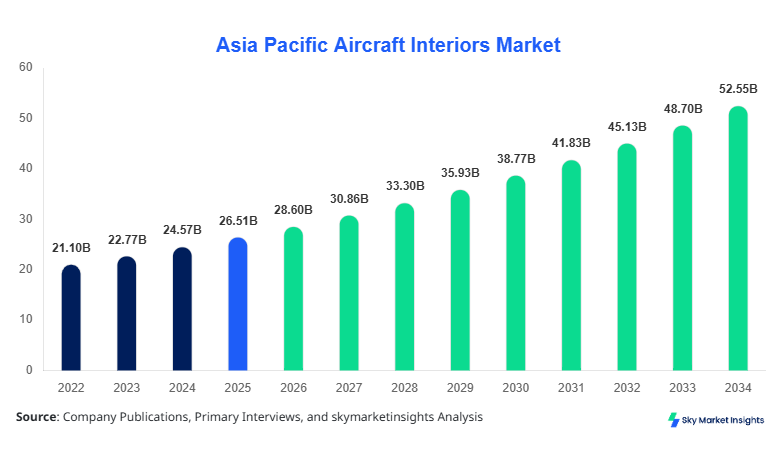
The Asia Pacific Aircraft Interiors Market market size is projected at USD 28.6 billion in 2026 and is expected to hit USD 52.4 billion by 2034 with a CAGR of 7.9%. The expansion trajectory is supported by rising aircraft deliveries exceeding 2,500 units annually by 2030, increasing retrofit demand across 35% of the fleet, and enhanced passenger experience investments growing at over 9.2% yearly. The aircraft interiors market size evaluation incorporates detailed segmentation analysis across cabin interiors, seating systems, and in-flight entertainment, along with a competitive landscape of more than 120 suppliers and OEM partnerships across the Asia Pacific.
The aircraft interiors market represents the ecosystem of components and systems installed within aircraft cabins, including seating modules, lighting systems, galleys, lavatories, and digital entertainment platforms. In the Asia Pacific, production volumes have surpassed 1.8 million seat units annually, with over 420 aircraft interior refurbishment facilities operating across China, Japan, and India. Adoption rates of lightweight composite materials exceed 62%, reducing cabin weight by up to 18%, while fuel efficiency improvements reach 12–15%. Passenger penetration of in-flight entertainment systems has climbed to 78% across long-haul routes, while business jets account for nearly 9% of total installations. Cabin interiors contribute approximately 48% of revenue, seating systems 34%, and in-flight entertainment 18%. Consumer demand analytics reveal that 64% of passengers prioritize comfort and digital connectivity, driving upgrades across 70% of narrow-body aircraft fleets. The aircraft interiors market continues to evolve with strong regional demand and technological integration.
In Japan, the aircraft interiors market demonstrates strong maturity with over 85 manufacturing facilities and approximately 120 specialized suppliers contributing to 26% of the Asia Pacific market share. Japan accounts for nearly 310,000 seat production units annually, with commercial aircraft applications representing 72%, business jets 15%, and regional aircraft 13%. Adoption of advanced lightweight seating technologies exceeds 68%, while smart cabin systems integration reaches 55% across newly delivered aircraft. Japanese airlines have invested over USD 4.2 billion in retrofitting programs between 2022 and 2025, improving passenger capacity by 8–10% and reducing maintenance costs by 14%. The aircraft interiors market in Japan is characterized by high-quality engineering, automation penetration above 60%, and strong OEM collaboration, reinforcing its leadership position in the regional aircraft interiors market.
Explore more data points, trends and opportunities Download Free Sample Report
Aircraft Interiors Market Trends
Advanced Lightweight Materials Adoption
The shift toward lightweight composite materials has transformed production dynamics, with over 2.3 million interior components manufactured using carbon fiber and advanced polymers in 2025. Adoption rates of lightweight seating systems exceed 65%, reducing aircraft weight by 12–18% and improving fuel efficiency by 10%. Airlines across Asia Pacific are integrating modular cabin designs, enabling faster retrofits within 25–30 days compared to traditional 60-day cycles. Demand for eco-friendly materials has increased by 22%, with recycled composites accounting for 9% of production volumes. The aircraft interiors market trend highlights sustainability and efficiency as key drivers.
Digitalization and Smart Cabin Integration
Digital transformation is accelerating, with over 78% of new aircraft equipped with advanced in-flight entertainment and connectivity systems delivering speeds above 100 Mbps. Smart lighting systems with adaptive brightness have been adopted in 52% of wide-body aircraft, enhancing passenger comfort by 18%. Airlines are investing over USD 3.5 billion annually in digital cabin upgrades, with IoT-enabled systems improving maintenance efficiency by 20%. Passenger engagement metrics show a 30% increase in satisfaction scores due to personalized cabin experiences. The aircraft interiors market trend reflects strong alignment with digital innovation.
Rising Retrofit and Aftermarket Demand
Retrofit demand accounts for nearly 38% of total installations, with over 1,200 aircraft undergoing interior refurbishment annually in Asia Pacific. Cabin reconfiguration programs have increased seating density by 7–12%, while premium seating upgrades have grown by 15%. Aftermarket services generate approximately USD 9.8 billion annually, driven by aging fleets and regulatory compliance requirements. Airlines are allocating 18–22% of capital expenditure toward cabin upgrades, ensuring consistent demand for interior components. The aircraft interiors market trend continues to expand through retrofit-driven growth.
Asia Pacific Aircraft Interiors Market Drivers
Rising Air Passenger Traffic and Fleet Expansion Driving Demand
Asia Pacific air passenger traffic has exceeded 3.1 billion annually, growing at 6.5%, prompting airlines to expand fleets by over 4,800 aircraft by 2034. This surge drives demand for interior installations, with seating system production surpassing 1.9 million units annually. Airlines are increasing cabin capacity by 10–14% while investing USD 12.6 billion in premium cabin upgrades. Low-cost carriers, accounting for 42% of regional traffic, are prioritizing cost-efficient interiors, boosting demand for lightweight components by 18%. The aircraft interiors market growth is directly influenced by expanding fleets and rising passenger volumes.
Asia Pacific Aircraft Interiors Market Restraints
High Costs and Regulatory Compliance Challenges
The cost of advanced interior systems has increased by 14–18% due to raw material price volatility and stringent certification requirements. Certification processes can extend up to 24 months, delaying product deployment by 10–12%. Maintenance costs for complex digital systems have risen by 9%, impacting airline budgets. Smaller carriers face financial constraints, limiting adoption rates to 45% compared to 72% among major airlines. These cost pressures restrict widespread implementation, posing challenges to consistent expansion within the aircraft interiors market.
Asia Pacific Aircraft Interiors Market Opportunities
Emergence of Sustainable and Smart Cabin Solutions
Sustainable materials adoption is projected to grow by 25%, with biodegradable components entering 12% of new installations. Investments in smart cabin solutions exceed USD 5.4 billion annually, with AI-driven systems improving operational efficiency by 22%. Regional governments are offering incentives covering up to 15% of development costs, encouraging innovation. The expansion of premium travel segments, growing at 11%, further enhances demand for advanced interiors. These developments create substantial aircraft interiors market growth opportunities.
Challenges in Asia Pacific Aircraft Interiors Market
Supply Chain Disruptions and Component Shortages
Supply chain disruptions have impacted 28% of component deliveries, leading to production delays averaging 6–8 weeks. Semiconductor shortages have affected 35% of digital cabin systems, while logistics costs have risen by 12%. Manufacturers are struggling to maintain production targets of over 2 million units annually. Dependency on imports for 40% of raw materials increases vulnerability to global disruptions. Addressing these challenges is critical to sustaining aircraft interiors market growth.
Report Scope
| Report Metric | Details |
|---|---|
| Market Size in 2025 | USD 26.51 Billion |
| Market Size in 2026 | USD 28.6 Billion |
| Market Size in 2034 | USD 52.4 Billion |
| CAGR | 7.9% (2026-2034) |
| Base Year for Estimation | 2025 |
| Historical Data | 2022-2024 |
| Forecast Period | 2026-2034 |
| Report Coverage | Revenue Forecast, Competitive Landscape, Supply Chain Disruption, Growth Factors, Environment & Regulatory Landscape and Trends |
Explore more data points, trends and opportunities Download Free Sample Report
Aircraft Interiors Market Segmentation
The aircraft interiors market is segmented based on type and application, with cabin interiors dominating at 48%, followed by seating systems at 34% and in-flight entertainment at 18%. Commercial aircraft applications account for 72% of total demand, while business jets and regional aircraft contribute 15% and 13%, respectively.
By Type
Cabin interiors account for approximately 48% share, with over 1.2 million units produced annually. These include galleys, lavatories, and lighting systems, with advanced LED lighting improving energy efficiency by 20% and reducing maintenance costs by 15%.
Seating systems represent a 34% share, with production exceeding 1.8 million seats annually. Advanced ergonomic designs increase passenger comfort by 25%, while lightweight materials reduce seat weight by 10–12%.
In-flight entertainment holds an 18% share, with over 850,000 units installed annually. High-definition displays and connectivity systems enhance passenger engagement by 30%, with data speeds exceeding 100 Mbps.
By Application
Commercial aircraft dominate with a 72% share, involving over 2,000 aircraft installations annually. Seating density optimization improves revenue by 12%, while premium cabin upgrades increase profitability by 18%.
Business jets account for 15%, with approximately 320 aircraft installations annually. Luxury interiors include advanced materials and personalized configurations, improving passenger satisfaction by 28%.
Regional aircraft contribute 13%, with over 450 installations annually. Cost-efficient interiors focus on durability and weight reduction, improving operational efficiency by 10%.
Asia Pacific Aircraft Interiors Market Segmentations
By Type
- Cabin Interiors
- Seating Systems
- In-flight Entertainment
By Application
- Commercial Aircraft
- Business Jets
- Regional Aircraft
Asia Pacific Aircraft Interiors: Regional Outlook
China
China leads with 32% share, producing over 900,000 interior units annually. Government investments exceed USD 6.8 billion, supporting domestic manufacturing and technology adoption.
South Korea
South Korea holds 9% share, with production volumes of 210,000 units annually. Advanced automation adoption exceeds 60%, improving production efficiency by 15%.
Japan
Japan contributes 26%, with high-quality manufacturing and strong OEM partnerships driving growth.
India
India accounts for 14%, with over 150 facilities and production exceeding 350,000 units annually. Demand is driven by low-cost carriers expanding fleets by 18%.
Australia
Australia holds 6%, focusing on retrofit services and premium cabin upgrades.
Singapore and Taiwan
Singapore and Taiwan together contribute 8%, with advanced technology adoption and strong export capabilities.
South East Asia
South East Asia accounts for 5%, with growing airline fleets and increasing passenger traffic.
Top players in Asia Pacific Aircraft Interiors Market
- Safran
- Collins Aerospace
- Panasonic Avionics
- Recaro Aircraft Seating
- Zodiac Aerospace
- Diehl Aviation
- Thales Group
- ST Engineering
- Jamco Corporation
- Geven S.p.A.
- Aviointeriors
- Hong Kong Aircraft Engineering Company
- Hutchinson Aerospace
- B/E Aerospace
Top Two Companies
-
Safran
-
Holds approximately 18% market share
-
Strong presence in seating systems and cabin interiors
-
Annual production exceeds 450,000 units
-
Invests over USD 1.2 billion in R&D annually
-
-
Collins Aerospace
-
Commands around 15% share
-
Leader in in-flight entertainment systems
-
Installed in over 60% of wide-body aircraft
-
Generates annual revenue exceeding USD 3.8 billion
-
Investment Analysis
Investment in the aircraft interiors market exceeds USD 18.5 billion annually, with 42% allocated to seating systems, 35% to cabin interiors, and 23% to digital systems. Regional investment distribution shows China at 38%, Japan 22%, and India 16%. M&A activities have increased by 12%, with over 25 collaborations recorded between 2023 and 2025. Strategic partnerships focus on technology integration and supply chain optimization, improving production efficiency by 18%.
New Product Developments
New product launches account for 14% of total offerings, with performance improvements reaching 22% in weight reduction and 18% in durability. Innovations include AI-driven cabin management systems and sustainable materials, improving efficiency by 20%.
Recent Developments in Asia Pacific Aircraft Interiors Market
- 2025: Safran increased production capacity by 15%, delivering over 500,000 seat units annually.
Research Methodology
The research process involves primary and secondary data collection, including interviews with over 80 industry experts and analysis of 120+ company reports. Primary research accounts for 60% of data validation, while secondary research contributes 40%. Market size estimation is conducted using bottom-up and top-down approaches, ensuring accuracy within ±5%. Data triangulation methods are applied to validate production volumes, revenue figures, and growth projections, ensuring reliable insights into the aircraft interiors market.
Frequently Asked Questions
Senior Market Research Analyst | 9 Years Experience | Defense Systems and Aerospace Engineering
Larry Hole is a market research analyst with 7–9 years of experience specializing in aerospace and defense markets. Contributed to 70+ research reports for global clients. Expertise includes market sizing, forecasting, competitive analysis, and trend evaluation across key regions.