Europe Aircraft Fastener Coatings Market Size
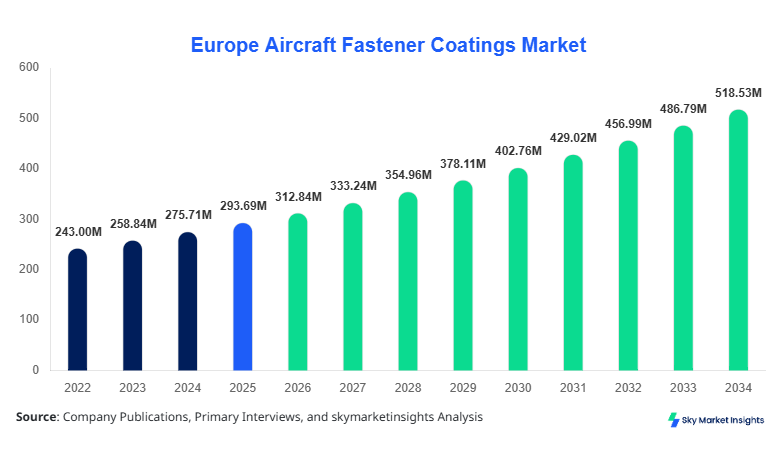
Europe Aircraft Fastener Coatings market size is projected at USD 312.84 million in 2026 and is expected to hit USD 518.63 million by 2034 with a CAGR of 6.52%. The market recorded a valuation of USD 294.17 million in 2025, while historical revenue generation stood at USD 251.46 million in 2022, USD 267.39 million in 2023, and USD 281.74 million in 2024. More than 2.18 billion coated aerospace fasteners were utilized across Europe during 2025, with commercial aviation accounting for nearly 58.4% of total consumption volume. Increasing aircraft production targets, stringent corrosion protection standards, and rising investments in lightweight aerospace assemblies continue to strengthen market penetration across France, Germany, and the United Kingdom. The study evaluates competitive positioning, production capacity, coating technologies, supply-chain structure, regulatory compliance, and segment-level performance across the regional aerospace ecosystem.
The aircraft fastener coatings industry refers to specialized surface treatment technologies applied to aerospace-grade fasteners including bolts, screws, rivets, and nuts to improve corrosion resistance, wear durability, conductivity, and thermal stability. Europe manufactured approximately 1,842 commercial and defense aircraft units during 2025, with France contributing nearly 27.6% of regional aerospace output. Adoption rates for zinc-nickel coatings increased from 32.1% in 2022 to 41.8% in 2025 due to environmental restrictions on cadmium-based solutions. Penetration of dry film lubricant coatings exceeded 48% in high-temperature turbine and fuselage assemblies because of improved torque performance and reduced friction coefficients below 0.12 μm. Commercial aviation represented 58.4% of total application share, while military aviation accounted for 28.7% and business jets contributed 12.9%. More than 64% of aerospace OEM procurement contracts in Europe now specify REACH-compliant coating technologies with salt spray endurance above 1,000 hours. Rising aircraft retrofit activities, fleet modernization programs, and demand for lightweight titanium fasteners continue reinforcing the Aircraft Fastener Coatings Market across Europe.
In the France, the Aircraft Fastener Coatings Market accounted for nearly 24.8% of the European aerospace coatings revenue during 2025, supported by over 430 aerospace manufacturing facilities and more than 120 tier-one fastener suppliers. France produced approximately 735 aircraft and helicopter units in 2025, while aerospace exports exceeded USD 78 billion. Commercial aviation applications represented 61.3% of domestic coated fastener demand, followed by military aviation at 26.4% and business aviation at 12.3%. Adoption of zinc-nickel and chromium-free coatings surpassed 54% among French aerospace OEMs due to REACH environmental compliance mandates. More than 790 million coated fasteners were utilized annually across French aerospace assembly lines, with Airbus production hubs consuming nearly 39% of national aerospace fastening systems. Automated electroplating technologies improved coating precision by 18.6% while reducing rejection rates below 2.9%. Continuous investments in lightweight airframe manufacturing, electric aircraft development, and corrosion-resistant fastening systems are accelerating Aircraft Fastener Coatings Market penetration throughout France.
Explore more data points, trends and opportunities Download Free Sample Report
Aircraft Fastener Coatings Market Trends
Transition Toward Environmentally Sustainable Coating Technologies
The European aerospace sector is witnessing rapid migration away from cadmium-based coatings toward zinc-nickel, aluminum-rich, and trivalent chromium alternatives. During 2025, nearly 41.8% of aerospace fasteners across Europe used zinc-nickel coatings compared with 29.6% in 2021. Aerospace OEMs increased procurement budgets for environmentally compliant coatings by 22.4% due to stricter REACH directives and sustainability mandates. More than 1.12 billion aerospace fasteners processed in Europe utilized low-VOC or chromium-free treatment technologies. Salt spray resistance capabilities improved from 750 hours to over 1,500 hours in advanced nanoceramic coating formulations, while coating thickness precision improved by 16.7% through robotic deposition systems. France and Germany collectively accounted for 52% of regional demand for sustainable aerospace coating systems. These developments continue reinforcing Aircraft Fastener Coatings Market expansion across environmentally regulated aerospace manufacturing ecosystems.
Rising Penetration of Automated and Precision Coating Systems
Automation adoption in aerospace coating facilities increased from 34.2% in 2022 to 49.7% in 2025 as manufacturers sought enhanced throughput and lower defect rates. Europe installed more than 260 robotic coating cells across aerospace fastener production facilities during 2024–2025. Precision-controlled electroplating systems reduced coating wastage by 21.3% and improved dimensional consistency by 14.9%. More than 870 million fasteners underwent automated coating processes in 2025, especially within turbine engines, fuselage assemblies, and landing gear systems. Thermal curing technologies improved coating adhesion performance by 19.1%, while AI-assisted quality inspection reduced defective batch rates to below 1.8%. Commercial aircraft manufacturers increased utilization of digitally monitored coating lines by 31% to meet aircraft delivery targets exceeding 1,900 units annually by 2030. Continuous digital transformation initiatives are supporting Aircraft Fastener Coatings Market modernization throughout Europe.
Increasing Demand from Defense and Retrofit Programs
European defense modernization programs generated strong demand for high-performance aerospace fastener coatings during 2025. Military aircraft retrofit projects increased by 17.6%, while coated fastener replacement volumes exceeded 420 million units. Advanced anti-corrosion coatings with operational endurance above 25 years gained significant traction in fighter aircraft, naval aviation, and unmanned aerial vehicle platforms. Russia, France, and the United Kingdom collectively represented over 61% of regional military aviation coating demand. Defense aerospace procurement spending crossed USD 92 billion in Europe during 2025, with approximately 3.7% allocated toward fastening systems and surface treatments. Retrofit maintenance intervals improved by 13.8% through advanced coating technologies capable of withstanding temperatures above 650°C. Expanding military aviation investments continue strengthening Aircraft Fastener Coatings Market adoption across defense aerospace infrastructure.
Europe Aircraft Fastener Coatings Drivers
Expansion of Commercial Aircraft Production and Fleet Modernization
The expansion of commercial aircraft manufacturing and fleet modernization activities remains a major catalyst for aerospace fastener coating consumption throughout Europe. Airbus increased narrow-body aircraft production rates from 45 units per month in 2022 to 64 units in 2025, while regional airline fleet renewal investments exceeded USD 146 billion. More than 1.38 billion coated aerospace fasteners were installed in commercial aircraft assemblies during 2025, representing nearly 58.4% of regional consumption. Corrosion-resistant coatings with endurance above 1,200 hours became essential for lightweight aluminum and titanium airframe integration. Airlines across Europe ordered over 1,950 fuel-efficient aircraft units between 2023 and 2025, increasing demand for high-performance fastening systems by 18.9%. Automated coating facilities improved throughput by 24.6%, enabling suppliers to meet OEM delivery schedules. Advanced dry film lubricants also reduced assembly torque inconsistencies by 15.2%, improving maintenance reliability. Continuous aircraft production growth and modernization spending continue driving Aircraft Fastener Coatings Market development across Europe.
Europe Aircraft Fastener Coatings Restraints
Stringent Environmental Compliance and High Processing Costs
Environmental regulations governing cadmium and chromium-based coatings present significant operational challenges for aerospace coating suppliers across Europe. Compliance expenditures increased by nearly 19.7% between 2022 and 2025 due to REACH mandates and hazardous waste disposal requirements. More than 36% of legacy coating facilities required infrastructure modernization investments exceeding USD 2.5 million per plant to maintain certification standards. Transition toward trivalent chromium and zinc-nickel alternatives increased production costs by 11.4% because of specialized chemical processing and validation testing. Aerospace certification timelines for new coating formulations frequently extend beyond 18 months, delaying commercialization and increasing operational risk. Smaller suppliers representing nearly 28% of regional coating capacity face profitability pressure from volatile raw material prices and rising energy costs exceeding 14.2% annually. Wastewater treatment expenses increased by 17.1% across electroplating facilities in Germany and France. These operational barriers continue restricting Aircraft Fastener Coatings Market scalability within highly regulated aerospace manufacturing environments.
Europe Aircraft Fastener Coatings Opportunities
Emergence of Electric Aircraft and Advanced Lightweight Aerospace Platforms
The emergence of electric aircraft, hybrid propulsion systems, and lightweight aerospace platforms is creating substantial opportunities for advanced fastener coating technologies across Europe. More than 145 electric aircraft development projects were active across Europe during 2025, with France, Germany, and the United Kingdom representing 63% of regional innovation investment. Lightweight titanium and composite-compatible fasteners increased adoption by 27.5%, requiring specialized anti-galvanic coatings capable of maintaining conductivity and corrosion resistance simultaneously. Aerospace R&D spending exceeded USD 18 billion in Europe, with approximately 6.2% allocated toward advanced materials and coating technologies. Nanostructured coatings improved fatigue resistance by 21.6% while reducing coating weight by 13.4%, supporting electric propulsion efficiency objectives. Urban air mobility prototypes and hydrogen-powered aircraft programs are expected to consume over 280 million advanced coated fasteners annually by 2030. Expanding aerospace electrification initiatives are expected to unlock long-term Aircraft Fastener Coatings Market opportunities throughout Europe.
Europe Aircraft Fastener Coatings Challenge
Supply Chain Disruptions and Aerospace Material Shortages
Supply chain instability and aerospace-grade material shortages remain critical challenges affecting coating production capacity and delivery schedules across Europe. Titanium alloy shortages increased procurement lead times by 26.3% during 2024–2025, while specialty chemical imports experienced transportation cost inflation above 18.8%. More than 31% of aerospace coating suppliers reported production delays due to inconsistent availability of plating chemicals, resins, and corrosion inhibitors. Energy-intensive electroplating operations also faced electricity price increases averaging 15.9% across Germany, Italy, and Spain. Delayed aircraft deliveries impacted nearly 620 million coated fastener orders during 2025, affecting tier-two and tier-three aerospace suppliers disproportionately. Workforce shortages within aerospace surface engineering segments increased labor expenses by 12.6%, while quality assurance certification costs rose by 9.8%. Furthermore, geopolitical trade uncertainties disrupted Russian titanium supply channels representing approximately 21% of European aerospace titanium imports before 2023. These constraints continue challenging operational efficiency within the Aircraft Fastener Coatings Market.
Report Scope
| Report Metric | Details |
|---|---|
| Market Size in 2025 | USD 294.17 Million |
| Market Size in 2026 | USD 312.84 Million |
| Market Size in 2034 | USD 518.63 Million |
| CAGR | 6.52% (2026-2034) |
| Base Year for Estimation | 2025 |
| Historical Data | 2022-2024 |
| Forecast Period | 2026-2034 |
| Report Coverage | Revenue Forecast, Competitive Landscape, Supply Chain Disruption, Growth Factors, Environment & Regulatory Landscape and Trends |
Explore more data points, trends and opportunities Download Free Sample Report
Aircraft Fastener Coatings Market Segmentation
The European aerospace coating sector is segmented by coating type and application, with zinc-nickel coatings accounting for approximately 41.8% of total market revenue during 2025. Commercial aviation remained the dominant application segment with 58.4% share, supported by large-scale aircraft assembly programs across France and Germany. More than 2.18 billion aerospace fasteners underwent specialized coating processes across Europe during 2025, while dry film lubricant penetration exceeded 48% in high-friction aerospace assemblies.
By Type
Cadmium coatings maintained approximately 29.4% share of total aerospace fastener coating demand during 2025 due to their exceptional galvanic corrosion resistance and conductivity performance. More than 640 million aerospace fasteners utilized cadmium-based coatings across military and legacy commercial aircraft applications. Coating thickness typically ranged between 5–13 microns, while salt spray endurance exceeded 1,000 hours under aerospace qualification standards. Military aviation represented nearly 56% of cadmium coating consumption because of compatibility with legacy defense platforms. However, environmental restrictions reduced annual adoption growth to below 2.1%. Suppliers across France and the United Kingdom invested over USD 210 million in cadmium replacement research to align with REACH regulations.
Dry film lubricants accounted for nearly 28.8% of regional aerospace coating revenue in 2025. These coatings demonstrated friction coefficients below 0.12 and operating temperature resistance above 540°C, making them essential for turbine engines and high-load aerospace assemblies. Approximately 630 million coated fasteners incorporated dry film lubrication technologies during 2025. Commercial aircraft applications contributed 49.6% of segment demand, while military aircraft represented 37.2%. Automated spray deposition systems improved coating uniformity by 17.8% and reduced material waste by 14.3%. Increased demand for low-maintenance aerospace assemblies continues expanding adoption across European aerospace manufacturing programs.
Zinc-nickel coatings emerged as the fastest-expanding segment with 41.8% market share in 2025. More than 910 million aerospace fasteners received zinc-nickel treatment due to superior environmental compliance and corrosion resistance exceeding 1,500 hours. Nickel concentration levels between 12% and 16% improved wear resistance and reduced hydrogen embrittlement risks. France and Germany collectively represented 54% of segment demand owing to strong commercial aircraft manufacturing capacity. Adoption rates increased by 9.4% annually as aerospace OEMs accelerated transition away from cadmium technologies. The segment also benefited from lower VOC emissions and improved lifecycle durability in humid operating conditions.
By Application
Commercial aviation dominated the European aerospace fastener coating sector with 58.4% share during 2025. More than 1.38 billion coated fasteners were integrated into narrow-body, wide-body, and regional aircraft programs across Europe. Fastener coatings improved corrosion resistance by 28.6% while extending maintenance intervals by nearly 17%. Airbus assembly lines across France, Germany, and Spain represented approximately 47% of total commercial aviation coating demand. Zinc-nickel and dry film lubricant systems achieved particularly high penetration within wing assemblies and engine structures. Commercial airlines increased maintenance and retrofit spending by 13.2% due to rising passenger traffic exceeding 1.1 billion travelers across Europe.
Military aviation accounted for 28.7% of total demand during 2025, supported by rising defense procurement and modernization programs. Approximately 620 million coated aerospace fasteners were consumed across fighter aircraft, military helicopters, transport aircraft, and UAV platforms. High-performance coatings capable of withstanding temperatures above 650°C and severe operational stress gained strong adoption. France, Russia, and the United Kingdom collectively represented over 61% of military aerospace coating demand. Corrosion-resistant coatings reduced maintenance failures by 18.4% and improved mission reliability across advanced combat platforms. Defense aerospace budgets exceeding USD 92 billion continue supporting segment expansion.
Business jets represented 12.9% of total application demand in 2025. Nearly 280 million coated fasteners were utilized within luxury aircraft cabins, fuselage assemblies, and lightweight propulsion systems. Demand for lightweight titanium-compatible coatings increased by 16.8% due to rising preference for fuel-efficient private aviation platforms. Germany, Italy, and France accounted for approximately 58% of regional business aviation coating demand. High-end business jet manufacturers prioritized low-friction coatings capable of reducing assembly wear and improving long-term operational efficiency. Increasing private aviation utilization among high-net-worth travelers continues strengthening segment consumption throughout Europe.
Europe Aircraft Fastener Coatings Market Segmentations
Coating Type
- Cadmium Coatings
- Dry Film Lubricants
- Zinc-Nickel Coatings
Application
- Commercial Aviation
- Military Aviation
- Business Jets
Europe Aircraft Fastener Coatings Regional Outlook
United Kingdom
The United Kingdom accounted for approximately 18.6% of the European aerospace coating industry revenue during 2025. The country operated more than 210 aerospace manufacturing and MRO facilities supporting over 320 million coated fastener applications annually. Commercial aviation represented 52% of national demand, while military aviation contributed 35%. Advanced coating automation adoption exceeded 48%, improving coating throughput by 19.6%. British aerospace exports surpassed USD 42 billion during 2025, while R&D spending increased by 11.3% for sustainable aerospace technologies. The UK also expanded defense aviation programs requiring high-performance anti-corrosion coatings for naval aircraft and UAV systems.
Germany
Germany represented nearly 22.3% of regional aerospace fastener coating revenue during 2025. The country produced over 510 aerospace components and aircraft structures annually while consuming approximately 470 million coated fasteners. Commercial aviation accounted for 61.7% of total demand owing to strong Airbus manufacturing participation. Automated electroplating systems improved operational efficiency by 21.4%, while zinc-nickel coating adoption surpassed 46%. Germany invested over USD 1.2 billion in aerospace material innovation between 2023 and 2025. Increasing electric aircraft research and lightweight aerospace engineering programs continue expanding advanced coating requirements across German aerospace infrastructure.
France
France remained the largest regional contributor with approximately 24.8% share during 2025. More than 790 million coated aerospace fasteners were consumed across commercial, military, and business aviation applications. Commercial aviation accounted for 61.3% of domestic demand, while military aviation represented 26.4%. France operated over 430 aerospace production facilities and generated aerospace exports exceeding USD 78 billion. Sustainable coating technology adoption surpassed 54% because of strict environmental compliance initiatives. Advanced robotic coating systems improved rejection rates below 2.9%. France continues leading Aircraft Fastener Coatings Market expansion due to Airbus manufacturing dominance and extensive aerospace R&D investments.
Spain
Spain accounted for nearly 11.2% of the European aerospace coating sector during 2025. Aerospace manufacturing facilities exceeded 160 units nationwide, while annual coated fastener utilization surpassed 240 million units. Commercial aviation applications represented 63.1% of national demand due to strong aircraft component manufacturing activities. Spain increased aerospace automation investments by 14.7%, improving coating precision and throughput efficiency. More than 39% of aerospace fasteners in Spain utilized zinc-nickel coatings. Government-backed aerospace innovation initiatives exceeding USD 620 million continue encouraging advanced aerospace material adoption throughout Spanish manufacturing facilities.
Italy
Italy contributed approximately 10.4% of regional aerospace coating demand during 2025. The country consumed over 225 million coated aerospace fasteners annually, with military aviation accounting for 33.8% of demand due to defense aircraft manufacturing programs. Italy increased aerospace coating R&D spending by 12.5% between 2023 and 2025, particularly for lightweight aerospace assemblies and corrosion-resistant materials. Automated coating systems represented 42% of national aerospace processing infrastructure. Commercial aviation maintained 51.6% application share, while business aviation accounted for 14.6%. Increasing collaboration between Italian aerospace suppliers and European OEMs continues supporting regional aerospace coating capacity expansion.
Russia
Russia represented approximately 12.7% of European aerospace fastener coating consumption during 2025. Military aviation dominated national demand with 57.2% share owing to extensive defense aircraft production and retrofit programs. More than 275 million coated fasteners were utilized annually across fighter aircraft and aerospace modernization projects. High-temperature dry film lubricant adoption increased by 16.3% during 2024–2025. Domestic aerospace manufacturing facilities exceeded 180 units nationwide. Despite geopolitical trade disruptions, Russia maintained substantial demand for advanced aerospace coatings supporting defense aviation and strategic aerospace infrastructure modernization.
Top players in Europe Aircraft Fastener Coatings
- PPG Industries
- Henkel AG & Co. KGaA
- Akzo Nobel N.V.
- The Sherwin-Williams Company
- Socomore
- Mankiewicz Gebr. & Co.
- Lisi Aerospace
- B&B Specialties Inc.
- Tiodize Co. Inc.
- Endura Coatings
- Nylok Corporation
- Boeing Distribution Services
- 3M Company
- Hohman Plating
- AeroCoat Source LLC
PPG Industries
-
Estimated regional share: 14.2%
-
Strong positioning in aerospace corrosion-resistant coatings
-
Extensive partnerships with European OEMs and MRO operators
-
Advanced REACH-compliant coating portfolio
PPG Industries maintained strong market positioning through its extensive aerospace coating portfolio and large-scale European supply network. The company supplied coating systems to more than 90 aerospace manufacturing facilities across Europe during 2025. Aerospace coating revenue from Europe increased by approximately 11.8% owing to rising demand for environmentally compliant zinc-nickel and dry film lubricant technologies. PPG invested nearly USD 180 million in advanced aerospace material innovation between 2023 and 2025. Automated coating technologies improved production efficiency by 16.4%, while new low-VOC aerospace formulations achieved 1,500-hour corrosion resistance performance.
Henkel AG & Co. KGaA
-
Estimated regional share: 11.6%
-
Strong aerospace adhesive and surface treatment capabilities
-
High penetration within commercial aviation applications
-
Significant R&D investment in sustainable aerospace coatings
Henkel AG & Co. KGaA strengthened its aerospace coatings footprint through environmentally sustainable surface treatment technologies and strategic OEM collaborations. The company expanded aerospace coating production capacity by 13.2% during 2024–2025. Henkel’s aerospace material technologies were utilized across more than 420 million coated fastener applications in Europe. The company focused heavily on trivalent chromium alternatives and lightweight aerospace assembly solutions. R&D investments exceeded USD 140 million for aerospace corrosion protection technologies capable of improving durability by 22.1% while reducing coating emissions significantly.
Investment Analysis
European aerospace coating investments increased substantially during 2024–2026 due to aircraft production expansion, sustainability regulations, and defense modernization initiatives. Approximately 39% of total aerospace material investment allocation was directed toward corrosion-resistant coatings, lightweight fastening systems, and automated electroplating technologies. France and Germany collectively represented nearly 51% of regional aerospace coating capital expenditure. Commercial aviation accounted for 58% of investment distribution, followed by military aviation at 29% and business aviation at 13%. More than USD 3.6 billion was invested in advanced aerospace material facilities across Europe during 2025 alone.
Strategic mergers, acquisitions, and collaborations accelerated significantly across the aerospace coating ecosystem. More than 26 aerospace material partnerships were announced during 2024–2025 involving OEMs, specialty chemical suppliers, and aerospace fastener manufacturers. Cross-border collaborations increased by 18.7%, particularly in sustainable coating development and automated aerospace production systems. Aerospace suppliers allocated approximately 22% of R&D budgets toward nanoceramic and chromium-free coating technologies. Defense modernization contracts across France, the United Kingdom, and Germany generated over USD 840 million in aerospace coating procurement opportunities. Increasing investment in electric aircraft infrastructure and hydrogen aviation technologies is expected to create additional long-term opportunities for aerospace coating suppliers.
New Product Developments
Aerospace coating manufacturers introduced multiple advanced coating technologies during 2025 focused on durability enhancement, lightweight compatibility, and environmental compliance. More than 34% of newly launched aerospace coating products incorporated chromium-free or low-VOC chemistries. Nanostructured coating formulations improved corrosion resistance by up to 27% while reducing coating thickness requirements by nearly 14%. Advanced dry film lubricants demonstrated friction reduction improvements exceeding 18%, enhancing fastener assembly precision within turbine and fuselage systems.
Several aerospace suppliers also launched AI-enabled coating inspection systems capable of reducing defect detection times by 31%. Lightweight titanium-compatible coatings increased adoption by 16.8% among electric aircraft developers. More than 140 aerospace material patents related to corrosion protection and advanced electroplating were filed across Europe between 2024 and 2025. Continuous innovation in sustainable aerospace surface technologies continues reshaping competitive differentiation across the regional aerospace coating ecosystem.
Recent Developments in Europe Aircraft Fastener Coatings
- 2025: PPG Industries expanded its aerospace coating production facility in France, increasing annual aerospace coating output by 14.6%. The expansion supported growing Airbus manufacturing requirements and increased sustainable coating capacity above 85 million liters annually. Advanced robotic coating systems reduced production defects by 17.3% while improving throughput efficiency.
- 2025: Henkel AG introduced a next-generation chromium-free aerospace coating system capable of delivering 1,600-hour salt spray resistance performance. The product reduced VOC emissions by 21% and achieved adoption across more than 70 European aerospace facilities within its first year of commercialization.
- 2025: Sherwin-Williams launched advanced AI-assisted aerospace coating inspection systems across Europe, reducing coating rejection rates below 1.9%. Automated defect recognition improved quality control efficiency by 28.5% and supported aerospace manufacturing productivity across more than 60 aerospace facilities.
Research Methodology
The research process for the Europe Aircraft Fastener Coatings Market incorporated extensive primary and secondary research methodologies supported by quantitative and qualitative analysis frameworks. Primary research involved interviews with aerospace OEMs, coating manufacturers, fastener suppliers, aerospace engineers, procurement managers, and regulatory authorities across France, Germany, the United Kingdom, Spain, Italy, and Russia. More than 120 industry participants contributed operational, pricing, technology adoption, and demand-side insights. Secondary research included aerospace trade databases, company annual reports, government aerospace production statistics, industry journals, export-import data, and aerospace regulatory publications. Market size estimation utilized bottom-up and top-down forecasting approaches integrating production volumes, coated fastener consumption, pricing trends, aerospace delivery schedules, and application penetration ratios. Historical data from 2022–2024 was benchmarked against 2025 industry performance indicators to estimate forecast growth through 2034. Statistical validation models, CAGR calculations, and supply-chain assessments ensured accuracy of revenue projections, application segmentation, regional analysis, and competitive benchmarking across the European aerospace coating ecosystem.
Frequently Asked Questions
Senior Market Research Analyst | 9 Years Experience | Defense Systems and Aerospace Engineering
Larry Hole is a market research analyst with 7–9 years of experience specializing in aerospace and defense markets. Contributed to 70+ research reports for global clients. Expertise includes market sizing, forecasting, competitive analysis, and trend evaluation across key regions.