Europe Aircraft Lavatory System Market Size
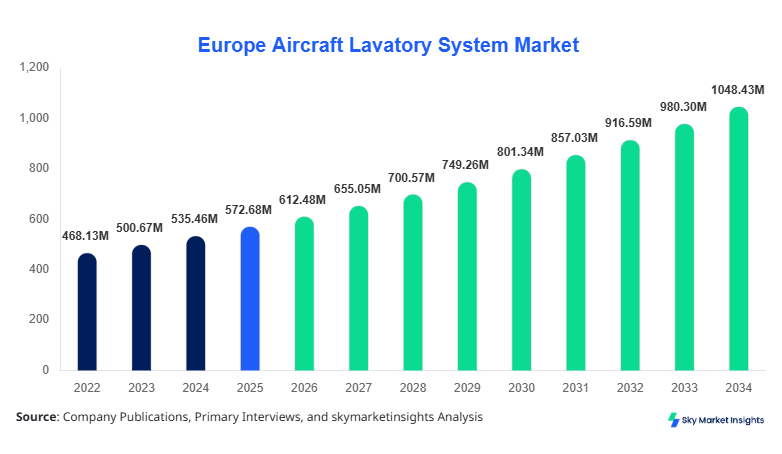
Europe's aircraft lavatory system market size is projected at USD 612.48 million in 2026 and is expected to hit USD 1,048.36 million by 2034 with a CAGR of 6.95%. The increasing procurement of narrow-body and wide-body aircraft across Europe, coupled with modernization programs in airline cabin interiors, is accelerating the deployment of advanced aircraft lavatory technologies. The market assessment incorporates extensive data analysis related to aircraft production rates, airline retrofit spending, passenger traffic recovery, OEM supply contracts, and competitive benchmarking across major aviation manufacturers operating in Europe. The report further evaluates component integration trends, operational efficiency metrics, and supplier positioning influencing the Europe Aircraft Lavatory System market size.
The aircraft lavatory system market comprises integrated sanitation, waste management, water storage, vacuum flushing, and electronic monitoring systems installed in commercial aircraft, military aircraft, and business jets. Europe manufactured more than 865 aircraft units in 2025, of which nearly 71% were equipped with vacuum-based lavatory systems due to weight-reduction benefits and lower water consumption. Adoption levels of smart lavatory monitoring systems exceeded 38% among newly delivered aircraft in Western Europe, while retrofit penetration reached 24% in aging fleets operated by low-cost carriers. Passenger preference for touchless lavatory solutions increased by 43% after 2023, influencing OEMs to integrate antimicrobial surfaces, automated faucets, and sensor-enabled waste systems. Commercial aircraft contributed approximately 67% of total installations, followed by business jets at 19% and military aviation at 14%. Vacuum systems accounted for nearly 58% of installations owing to operational efficiency and up to 35% lower water usage compared to traditional recirculating systems. Advanced electric lavatory systems demonstrated operational reliability above 97.2% across long-haul operations exceeding 12 flight hours. Growing aircraft deliveries, rising cabin refurbishment spending, and expanding airline fleets continue reinforcing the Europe Aircraft Lavatory System market size.
In France, the Aircraft Lavatory System Market accounted for nearly 28% of the regional revenue contribution in 2025 owing to the strong presence of Airbus manufacturing facilities, cabin interior suppliers, and aerospace component manufacturers. France operated more than 1,540 active commercial aircraft and produced approximately 132 aircraft units during 2025, creating significant demand for integrated lavatory modules and vacuum waste systems. Commercial aviation applications represented nearly 64% of total installations, while military aviation contributed 18% and business aviation contributed 18%. More than 61% of newly delivered aircraft in France incorporated lightweight vacuum lavatory systems featuring electronic monitoring and touchless technologies. Smart sensor integration adoption increased by 32% among French airlines aiming to reduce maintenance downtime and improve passenger hygiene. Retrofit activities across narrow-body fleets increased by 21% between 2024 and 2025 as airlines focused on cabin modernization programs. The France market also recorded an average lavatory system operational efficiency rate of 98.1% in long-haul aircraft platforms, strengthening the Europe Aircraft Lavatory System Market Share.
Explore more data points, trends and opportunities Download Free Sample Report
Aircraft Lavatory System Market Trends
Increasing Integration of Smart and Touchless Cabin Technologies
Aircraft manufacturers and airline operators across Europe are increasingly integrating smart cabin technologies into lavatory systems to improve hygiene, passenger comfort, and operational monitoring. More than 44% of newly delivered aircraft in Europe during 2025 featured touchless lavatory controls, including automated flushing systems, sensor-operated faucets, and antimicrobial surfaces. Airlines operating long-haul fleets reported a 17% reduction in maintenance interventions due to predictive maintenance systems integrated into smart lavatories. Production of connected lavatory modules surpassed 6,800 units across Europe in 2025, reflecting strong demand from premium airline operators. Cabin digitization investments by major airlines increased by 29% between 2023 and 2025, particularly for wide-body aircraft servicing high passenger volumes above 300 passengers per flight. Smart occupancy sensors and automated water management technologies reduced water wastage by nearly 26%, while maintenance response efficiency improved by 31%. Adoption of lightweight composite materials also reduced lavatory module weight by 18% to 22%, supporting airline fuel efficiency targets. These developments continue to reinforce the aircraft lavatory system market trend.
Rising Demand for Lightweight Vacuum-Based Systems
Vacuum lavatory systems continue dominating aircraft cabin integration projects due to lower water requirements and improved operational efficiency. Nearly 58% of aircraft delivered across Europe during 2025 utilized advanced vacuum systems capable of reducing water consumption by up to 35 liters per flight cycle. Airbus narrow-body programs alone consumed over 3,200 vacuum lavatory units during the year. Demand for lightweight composite structures increased significantly as airlines sought fuel efficiency gains exceeding 2.8% annually. Advanced vacuum technologies also reduced waste handling time by approximately 19% at airport maintenance facilities. The replacement rate of recirculating systems in older fleets increased by 16% during 2025, especially among carriers operating aircraft older than 15 years. Electric vacuum systems integrating digital diagnostics experienced adoption growth of 27% among premium airlines focusing on passenger experience optimization. Suppliers are increasingly investing in noise-reduction technologies capable of lowering flush sound levels by 12 decibels compared to conventional systems. These factors collectively support long-term aircraft lavatory system market trend expansion.
Expansion of Retrofit and Cabin Refurbishment Programs
European airlines are investing heavily in aircraft retrofit programs to modernize cabin interiors and improve passenger satisfaction metrics. Cabin refurbishment expenditures exceeded USD 2.6 billion across Europe in 2025, with lavatory upgrades accounting for approximately 11% of total retrofit spending. Retrofit penetration among aircraft older than 12 years reached 37%, driven by demand for touchless and compact lavatory modules. More than 4,500 retrofit lavatory units were installed during 2025 across low-cost carriers and full-service airlines. Demand for space-saving lavatory designs increased by 24% as airlines attempted to optimize seating density without compromising passenger comfort. Long-haul aircraft refurbishment projects reported a 14% increase in passenger satisfaction scores after lavatory modernization initiatives. Integration of antibacterial coating technologies expanded by 33% among retrofit programs focused on premium cabin segments. The growing pace of aircraft interior modernization continues strengthening the aircraft lavatory system market demand.
Europe Aircraft Lavatory System Drivers
Growing Commercial Aircraft Deliveries and Fleet Expansion
The rising delivery of commercial aircraft across Europe remains a major driver for aircraft lavatory system deployment. European airlines added more than 780 commercial aircraft between 2023 and 2025 to address recovering passenger traffic, which surpassed 1.2 billion passenger movements in 2025. Narrow-body aircraft accounted for approximately 72% of deliveries, creating substantial demand for compact vacuum lavatory modules with weight reduction capabilities. Airbus production rates increased from 61 aircraft per month in 2024 to 75 aircraft monthly targets for 2026, accelerating procurement requirements for cabin interior systems. Airlines are increasingly prioritizing lightweight lavatory technologies capable of reducing fuel burn by 1.5% to 2.3% annually per aircraft. Demand for multi-functional lavatory units with integrated digital diagnostics increased by 28% during 2025, while premium carriers invested over USD 480 million in cabin modernization programs. Additionally, airport infrastructure expansion across France, Germany, and Spain contributed to a 19% increase in regional aircraft utilization rates. These developments collectively support long-term European aircraft lavatory system growth.
Europe Aircraft Lavatory System Restraints
High Installation and Maintenance Costs for Advanced Systems
Despite increasing adoption of advanced lavatory technologies, high procurement and maintenance costs remain major constraints for airline operators. Installation costs for advanced vacuum lavatory systems range between USD 85,000 and USD 210,000 per aircraft depending on aircraft type and customization requirements. Retrofit integration expenses increased by approximately 18% during 2025 due to rising aerospace-grade composite material prices and labor shortages within the European aviation maintenance sector. Airlines operating aging fleets older than 18 years reported maintenance expenditures nearly 24% higher than newer fleets equipped with modular smart lavatory systems. Additionally, electronic sensor failures and vacuum pump maintenance contribute to operational downtime averaging 11.4 hours annually per aircraft. Small regional carriers operating fewer than 40 aircraft continue delaying modernization investments because cabin upgrade expenditures represent over 14% of annual maintenance budgets. Supply chain disruptions affecting electronic components and lightweight materials further increased lead times by 9% to 13% during 2025. These factors continue restricting Europe's aircraft lavatory system growth.
Europe Aircraft Lavatory System Opportunities
Expansion of Sustainable and Water-Efficient Technologies
Growing sustainability initiatives across the European aviation industry are creating significant opportunities for advanced water-efficient lavatory systems. Airlines operating within the European Union are increasingly adopting carbon reduction strategies aligned with net-zero aviation targets by 2050. Vacuum lavatory systems capable of reducing water usage by 35% to 45% compared to traditional systems are witnessing accelerating procurement rates. More than 46% of European airline operators announced sustainability-focused cabin modernization plans during 2025, while green aviation investment exceeded USD 4.1 billion across Europe. Lightweight lavatory modules utilizing recycled composite materials demonstrated up to 17% lower lifecycle emissions compared to conventional aluminum systems. Development of low-energy waste management systems reduced onboard power consumption by nearly 13%, supporting airline energy optimization strategies. Smart water recycling technologies integrated into long-haul aircraft prototypes improved operational efficiency by 21%. The increasing regulatory emphasis on sustainable aviation operations is expected to generate substantial European aircraft lavatory system demand over the forecast period.
Challenges in Europe's Aircraft Lavatory System
Technical Integration Complexity and Regulatory Compliance
Aircraft lavatory system manufacturers face considerable challenges associated with stringent aviation certification standards and technical integration complexity. Compliance with EASA airworthiness regulations and hygiene standards significantly extends product development timelines, often requiring 24 to 36 months for certification approval. More than 31% of OEM suppliers reported delays in component integration due to evolving safety requirements related to electronic monitoring systems and fire-resistant materials. Integration complexity is particularly high in retrofit projects involving older aircraft platforms where electrical architecture limitations restrict compatibility with advanced smart lavatory technologies. Airlines also face difficulties in maintaining interoperability between digital cabin management systems and onboard lavatory diagnostics. Engineering modification costs for legacy fleets increased by 22% during 2025 because of rewiring requirements and structural adjustments. Additionally, shortages of aerospace-qualified technicians across Europe contributed to maintenance backlogs rising by nearly 14%. These operational and regulatory barriers continue affecting Europe's aircraft lavatory system share.
Report Scope
| Report Metric | Details |
|---|---|
| Market Size in 2025 | USD 572.69 Million |
| Market Size in 2026 | USD 612.48 Million |
| Market Size in 2034 | USD 1048.36 Million |
| CAGR | 6.95% (2026-2034) |
| Base Year for Estimation | 2025 |
| Historical Data | 2022-2024 |
| Forecast Period | 2026-2034 |
| Report Coverage | Revenue Forecast, Competitive Landscape, Supply Chain Disruption, Growth Factors, Environment & Regulatory Landscape and Trends |
Explore more data points, trends and opportunities Download Free Sample Report
Aircraft Lavatory System Market Segmentation
The aircraft lavatory system market is segmented by type and application based on aircraft operational requirements, passenger capacity, maintenance efficiency, and technology integration levels. Vacuum toilet systems dominated the market with approximately 58% share in 2025 due to lower water consumption and superior operational efficiency. Commercial aircraft applications represented nearly 67% of total installations owing to high fleet volumes and expanding passenger traffic across Europe. Increasing adoption of lightweight materials and smart electronic monitoring systems is reshaping procurement preferences among airlines and OEMs.
By Type
Vacuum toilet systems held nearly 58% of the total market volume in 2025 due to superior water efficiency and lightweight operational characteristics. More than 7,400 vacuum lavatory units were installed across European aircraft fleets during the year, primarily in narrow-body and wide-body commercial aircraft. These systems reduce water consumption by up to 45% compared to recirculating systems and decrease aircraft weight by approximately 90 to 120 kilograms per aircraft configuration. Airbus and leading cabin interior suppliers increased procurement contracts for digitally integrated vacuum modules featuring automated diagnostics and predictive maintenance functions. Average operational reliability exceeded 98%, while maintenance downtime declined by nearly 19% in fleets using advanced vacuum technology. Demand from low-cost carriers increased significantly because fuel efficiency improvements of 1.8% to 2.2% directly support operating margin optimization. Additionally, compact vacuum systems enabled airlines to improve cabin space utilization by nearly 7%. Continuous innovations in noise reduction and waste compression technologies further support segment expansion within the Europe Aircraft Lavatory System Market Size.
Recirculating toilet systems accounted for approximately 24% of market installations in 2025, primarily within older aircraft fleets and certain regional aviation operations. More than 2,900 recirculating lavatory systems remained operational across Europe, particularly in aircraft operating short-haul regional routes with lower passenger capacity requirements. These systems continue to offer lower upfront acquisition costs, averaging 32% below advanced vacuum systems, making them suitable for smaller airline operators with limited modernization budgets. However, water usage rates remain significantly higher, averaging 15 to 20 liters per flush cycle compared to less than 2 liters in vacuum systems. Maintenance requirements for recirculating systems are approximately 21% higher due to chemical treatment handling and waste tank servicing complexities. Despite declining market penetration, several military and charter aircraft operators continue utilizing upgraded recirculating systems integrated with lightweight polymer tanks and enhanced odor-control technologies. Suppliers are also improving sanitation efficiency through antimicrobial coatings and advanced filtration components. The segment maintains moderate relevance within the European Aircraft Lavatory System Market Share.
Electric toilet systems represented nearly 18% of market demand during 2025 and are witnessing increasing adoption in premium business jets and technologically advanced commercial aircraft. More than 1,800 electric lavatory systems were deployed across Europe during the year, supported by rising demand for digitally controlled cabin interiors and passenger-centric amenities. These systems integrate automated flushing mechanisms, occupancy sensors, and smart water management technologies capable of reducing onboard power consumption by approximately 13%. Business jet manufacturers increasingly favor electric lavatory systems due to compact integration capabilities and improved passenger comfort metrics. Operational efficiency rates exceeded 97.5% in long-range aircraft platforms, while sensor-based maintenance diagnostics reduced service interruptions by 16%. Touchless functionality penetration surpassed 41% among newly delivered business jets in Europe. Advanced electric systems also enable airlines to monitor consumable inventory levels in real time, reducing supply replenishment delays by 22%. Increasing investment in intelligent aircraft cabin systems continues accelerating adoption across the European aircraft lavatory system market demand.
By Application
Commercial aircraft dominated the application landscape with approximately 67% market contribution in 2025 owing to expanding airline fleets and increasing passenger traffic across Europe. More than 10,200 lavatory systems were installed in commercial aircraft during the year, primarily in Airbus A320neo and A350 platforms. Narrow-body aircraft represented nearly 74% of total commercial installations because of rapid low-cost carrier expansion and intra-European route growth. Airlines increasingly adopted lightweight vacuum systems capable of reducing annual fuel consumption by 2% per aircraft. Smart lavatory technologies featuring predictive maintenance capabilities achieved adoption rates exceeding 39% among premium carriers. Passenger satisfaction surveys indicated a 14% improvement in onboard hygiene perception after installation of touchless lavatory modules. Long-haul aircraft configurations integrated up to 12 lavatory units per aircraft, while compact single-aisle aircraft averaged 3 to 4 units. Retrofit modernization programs within commercial aviation increased by 23% between 2024 and 2025, further strengthening demand for advanced lavatory solutions across the European Aircraft Lavatory System Market Size.
Business jets accounted for nearly 19% of total market installations during 2025, supported by rising private aviation activity and increasing demand for luxury cabin interiors. Europe recorded more than 1,900 active business jet deliveries and retrofit projects involving advanced lavatory integration during the year. Premium aircraft owners increasingly preferred electric and vacuum lavatory systems equipped with noise reduction technology, touchless operation, and antimicrobial materials. Luxury cabin refurbishment spending within the business aviation sector increased by 18% during 2025, while demand for custom lavatory designs grew by 26%. High-end business jets often integrate compact modular lavatories weighing less than 75 kilograms while maintaining operational reliability above 98%. Water-saving systems capable of reducing onboard resource consumption by 28% are increasingly deployed in long-range private aircraft. Approximately 48% of newly manufactured European business jets incorporated digital lavatory monitoring systems connected to centralized cabin management interfaces. These factors continue driving premium adoption trends within the European Aircraft Lavatory System Market Demand.
Military aircraft represented approximately 14% of market installations in 2025 due to ongoing fleet modernization programs across France, Germany, Italy, and the United Kingdom. European defense aviation programs installed nearly 1,600 lavatory systems across transport aircraft, surveillance aircraft, and multi-role military platforms. Military operators increasingly demanded durable vacuum systems capable of operating efficiently under variable altitude and temperature conditions. Advanced lavatory systems designed for military transport aircraft demonstrated operational durability rates exceeding 99% during extended deployment missions. Retrofit modernization of tactical transport aircraft increased by 17% during 2025 as defense agencies prioritized crew comfort and long-range operational readiness. Lightweight composite lavatory modules reduced aircraft payload weight by approximately 4% while improving maintenance accessibility by 21%. Several defense procurement programs also incorporated antimicrobial materials and low-maintenance waste management systems to improve operational efficiency during prolonged missions. Continuous investment in European military aviation modernization continues supporting the Europe Aircraft Lavatory System market share.
Europe Aircraft Lavatory System Market Segmentations
Type
- Vacuum Toilet Systems
- Recirculating Toilet Systems
- Electric Toilet Systems
Application
- Commercial Aircraft
- Business Jets
- Military Aircraft
Europe Aircraft Lavatory System: Regional Outlook
United Kingdom
The United Kingdom accounted for approximately 18% of the European aircraft lavatory system industry during 2025 due to extensive commercial aviation operations and business jet activity. The country operated more than 1,100 commercial aircraft and recorded retrofit modernization activities across over 340 aging aircraft fleets. Commercial aviation contributed nearly 69% of total lavatory system demand, while business jets accounted for 21% and military applications contributed 10%. British airlines increasingly adopted touchless lavatory technologies, with adoption penetration exceeding 36% among newly refurbished fleets. Heathrow and Gatwick airport expansion programs further stimulated airline fleet additions and cabin modernization investments. More than 1,200 lavatory units were installed during 2025, with vacuum systems accounting for 61% of total installations. Airlines operating transatlantic routes prioritized lightweight composite lavatory modules capable of improving fuel efficiency by nearly 2.1%. Cabin interior refurbishment expenditures across the United Kingdom exceeded USD 420 million in 2025, supporting continued market expansion.
Germany
Germany represented nearly 21% of the regional market owing to strong aerospace manufacturing infrastructure and extensive airline operations. Airbus component manufacturing facilities and cabin interior suppliers generated significant procurement demand for advanced lavatory systems. Germany produced approximately 146 aircraft-related cabin modules during 2025 while supporting over 2,300 aviation component suppliers. Commercial aircraft applications represented 65% of total installations, while military aviation modernization programs contributed 17%. German airlines increased investments in smart cabin technologies by approximately 27% during 2025, with predictive maintenance-enabled lavatory systems gaining rapid adoption. Retrofit demand among legacy fleets increased by 19% due to rising operational efficiency targets. Germany also recorded a 34% increase in touchless lavatory integration within premium airline fleets. Sustainability initiatives encouraging lightweight cabin materials reduced average lavatory module weight by 18%, supporting fuel optimization objectives throughout the aviation sector.
France
France remained the leading contributor to the regional industry with approximately 28% market participation during 2025. Airbus manufacturing activities and aerospace supplier ecosystems generated robust procurement volumes for integrated lavatory systems. More than 132 aircraft units were produced in France during the year, while cabin modernization spending exceeded USD 610 million. Commercial aviation represented 64% of installations, followed by business aviation at 18% and military applications at 18%. Smart sensor-enabled lavatory adoption increased by 32%, while vacuum systems accounted for over 63% of newly installed units. French airlines invested heavily in touchless hygiene technologies following increased passenger awareness regarding onboard sanitation. Long-haul carriers operating international routes integrated advanced electronic monitoring systems capable of reducing maintenance interventions by 21%. France continues to dominate technological innovation and production within the regional aviation supply chain.
Spain
Spain accounted for nearly 11% of the regional market due to growing tourism-driven airline expansion and increasing low-cost carrier activity. Spanish airlines operated more than 760 active commercial aircraft during 2025 and completed over 510 cabin retrofit projects involving lavatory modernization. Low-cost carriers represented approximately 58% of total aircraft procurement demand in Spain, favoring lightweight vacuum lavatory systems with compact cabin integration. Passenger traffic growth exceeding 14% during 2025 accelerated aircraft utilization rates and refurbishment investments. More than 780 lavatory units were installed during the year, while touchless system adoption increased by 24%. Airlines also implemented smart maintenance technologies capable of reducing service downtime by nearly 17%. Spain continues benefiting from tourism-related aviation growth and fleet modernization initiatives supporting aircraft interior investments.
Italy
Italy contributed approximately 10% of total regional demand during 2025 owing to expanding business aviation activities and commercial airline modernization programs. Italian aerospace maintenance providers completed more than 430 retrofit projects involving cabin interior upgrades and advanced lavatory installations. Commercial aircraft represented 62% of demand, while business jets contributed 24% due to increasing private aviation utilization. Italy witnessed a 22% increase in vacuum lavatory system adoption during 2025 as airlines prioritized water-efficient technologies and fuel optimization strategies. Airlines invested over USD 180 million in cabin refurbishment initiatives, particularly targeting medium-haul fleets operating across Southern Europe. Smart electronic monitoring integration reached approximately 29% penetration among newly upgraded aircraft. The country continues strengthening its aviation maintenance ecosystem and supporting advanced aircraft component deployment.
Russia
Russia accounted for nearly 12% of the regional market during 2025 despite supply chain challenges affecting aviation procurement activities. Domestic aircraft maintenance and modernization programs supported continued demand for lavatory system upgrades across commercial and military aviation fleets. More than 920 lavatory units were installed or refurbished during 2025, with military aviation contributing approximately 27% of total demand. Russian operators increasingly focused on locally sourced cabin systems to reduce import dependency. Vacuum system adoption exceeded 49%, while electric lavatory technologies gained moderate penetration within premium commercial fleets. Aircraft refurbishment projects increased by approximately 15% during the year as airlines extended operational lifecycles of existing fleets. Maintenance providers also emphasized durable waste management systems capable of operating in extreme climatic conditions. Continued fleet modernization efforts are expected to sustain demand across Russia’s aviation sector.
Top players in Europe's aircraft lavatory system
- Safran S.A.
- Collins Aerospace
- Diehl Aviation
- Jamco Corporation
- The Boeing Company
- Airbus SE
- Dometic Group
- Zodiac Aerospace
- Bucher Group
- Yokohama Aerospace
- Mecaer Aviation Group
- AVIC Cabin Systems
- Astronics Corporation
- Geven S.p.A.
- Lufthansa Technik
Safran S.A.
-
Safran S.A. accounted for approximately 19% of the regional industry revenue during 2025 due to its strong cabin interior integration capabilities and extensive OEM relationships with Airbus and European airline operators.
-
The company supplied over 3,100 lavatory modules across commercial and military aircraft platforms in Europe. Safran significantly expanded investment in lightweight composite lavatory structures capable of reducing module weight by 16% while improving maintenance accessibility.
-
The company also introduced smart predictive maintenance systems integrated with onboard cabin monitoring platforms, improving operational uptime by nearly 22%. Its strong aftermarket servicing network across France, Germany, and the United Kingdom further strengthens supplier positioning within European aviation markets.
Collins Aerospace
-
Collins Aerospace held nearly 15% market participation in 2025, supported by advanced vacuum technology integration and digital cabin innovation capabilities.
-
The company supplied more than 2,400 advanced lavatory systems during the year, focusing heavily on touchless operation and water-efficient technologies capable of reducing consumption by up to 40%. Collins Aerospace increased R&D expenditure by approximately 18% toward intelligent cabin analytics and predictive servicing technologies.
-
Strategic partnerships with premium airlines and retrofit service providers supported rapid adoption among long-haul fleets operating across Europe. The company also strengthened business jet penetration by introducing compact modular lavatory solutions optimized for space efficiency and passenger comfort enhancement.
Investment Analysis
Investment activity within the European aircraft lavatory system industry increased substantially during 2025 as airlines, OEMs, and aerospace suppliers accelerated cabin modernization initiatives. Total aviation interior investment across Europe exceeded USD 5.8 billion, with approximately 13% allocated specifically toward lavatory systems, hygiene technologies, and cabin sanitation infrastructure. France and Germany collectively represented nearly 49% of total regional investment due to extensive aerospace manufacturing ecosystems and aircraft production activities. Commercial aviation applications received approximately 67% of lavatory-related investment allocation, while military aviation accounted for 19% and business aviation represented 14%. Private equity participation in aerospace cabin suppliers increased by 16% between 2024 and 2025 as demand for lightweight, sustainable, and digitally integrated systems expanded rapidly.
Merger and acquisition activity also intensified across the aircraft cabin systems industry. More than 14 collaboration agreements involving cabin electronics, smart sensors, and lightweight composite material suppliers were announced during 2025. Aerospace manufacturers increasingly pursued vertical integration strategies to improve supply chain stability and reduce lead-time volatility. Strategic investments in predictive maintenance technologies increased by 27%, while automation-focused production facilities attracted nearly USD 620 million in capital expenditure commitments. Joint ventures between OEMs and cabin system specialists focused heavily on sustainable material innovation, electronic diagnostics, and touchless passenger technologies.
Recent Developments
- 2025: Safran S.A. expanded its production of lightweight composite aircraft lavatory modules across Europe, supplying more than 3,100 lavatory systems while introducing predictive maintenance capabilities that improved operational uptime by nearly 22%.
- 2025: Collins Aerospace strengthened its European presence by supplying over 2,400 advanced lavatory systems featuring touchless operation, smart cabin analytics, and water-efficient technologies capable of reducing water consumption by up to 40%.
Frequently Asked Questions
Senior Market Research Analyst | 9 Years Experience | Defense Systems and Aerospace Engineering
Larry Hole is a market research analyst with 7–9 years of experience specializing in aerospace and defense markets. Contributed to 70+ research reports for global clients. Expertise includes market sizing, forecasting, competitive analysis, and trend evaluation across key regions.