North America Aerospace Coatings Market Size
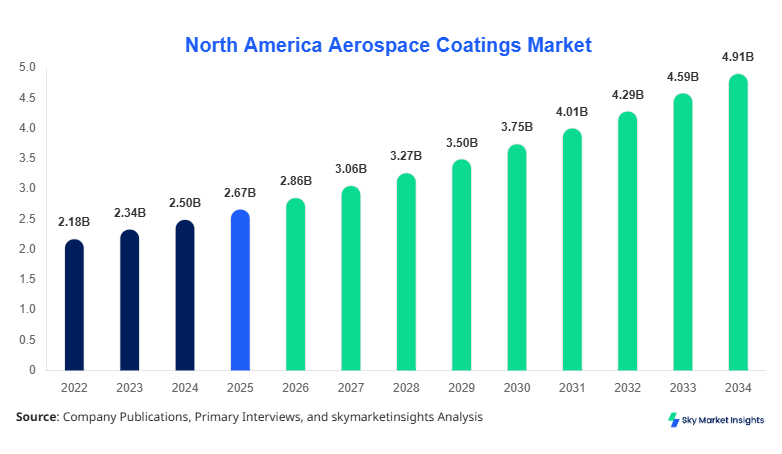
The North America Aerospace Coatings Market market size is projected at USD 2.86 billion in 2026 and is expected to hit USD 4.91 billion by 2034 with a CAGR of 6.98%. The market reflects steady expansion driven by increasing aircraft production volumes exceeding 1,250 units annually in North America and rising MRO (maintenance, repair, overhaul) demand accounting for over 38% of total coating consumption. Detailed segmentation across resin type and application, along with a competitive landscape involving more than 45 active manufacturers, highlights the evolving dynamics of the North American aerospace coatings market.
The aerospace coatings market refers to specialized protective and performance coatings applied on aircraft surfaces to enhance corrosion resistance, UV stability, chemical durability, and aerodynamic efficiency. In North America, annual production output of aerospace coatings surpassed 210 million liters in 2025, with epoxy-based coatings contributing nearly 42% of total volume. Adoption and penetration insights indicate that over 68% of newly manufactured commercial aircraft utilize advanced polyurethane coatings due to superior gloss retention and durability exceeding 12–15 years. Consumer behavior trends reveal increasing preference for eco-friendly, low-VOC coatings, which accounted for 31% of demand in 2025, driven by stringent EPA regulations. Demand analytics indicate that commercial aviation applications dominate with a 57% share, followed by military aviation at 28% and general aviation at 15%. Performance metrics such as coating thickness (20–150 microns), curing cycles (2–6 hours), and resistance thresholds (up to 1,000-hour salt spray tests) define product efficiency. The aerospace coatings market continues to witness strong technological advancement, reinforcing its strategic importance.
In the United States, the aerospace coatings market accounts for approximately 74% of the North American share, supported by over 320 aerospace manufacturing facilities and more than 90 MRO centers. The country produces over 950 aircraft annually, with coating consumption exceeding 150 million liters, reflecting significant industrial demand. Application breakdown shows commercial aviation leading at 61%, followed by military aviation at 26% and general aviation at 13%. Technology adoption is high, with 72% of manufacturers utilizing advanced nanocoatings and waterborne systems, improving efficiency by 18–22%. The presence of leading OEMs and defense contractors further accelerates adoption rates. The aerospace coatings market in the United States remains dominant due to continuous investments and technological integration.
Explore more data points, trends and opportunities Download Free Sample Report
Aerospace Coatings Market Trends
Increasing Adoption of Eco-Friendly Coatings
The aerospace coatings market is witnessing a strong shift toward eco-friendly formulations, with water-based coatings growing at a rate of 9.5% annually and accounting for over 34% of total production volume in 2026. Production levels for sustainable coatings exceeded 72 million liters, driven by regulatory mandates limiting VOC emissions to below 250 g/L. Advanced polyurethane coatings with enhanced durability are replacing traditional solvent-based coatings, offering up to 20% longer lifecycle performance. Aerospace OEMs are increasingly adopting these coatings to meet sustainability targets and reduce environmental impact. This shift significantly influences aerospace coatings market dynamics.
Integration of Nanotechnology and Smart Coatings
Nanotechnology integration is reshaping the aerospace coatings market, with nano-enhanced coatings improving corrosion resistance by 35% and reducing maintenance frequency by 25%. Smart coatings capable of self-healing and real-time damage detection have achieved a penetration rate of 18% across high-end aircraft applications. Production of such coatings reached 28 million liters in 2025, indicating growing adoption across military and commercial sectors. These coatings also contribute to weight reduction by 8–10%, improving fuel efficiency and reducing operational costs. The aerospace coatings market continues to evolve with technological innovation.
North America Aerospace Coatings Market Drivers
Rising Aircraft Production and Fleet Expansion Driving Demand
The North American aerospace coatings market is primarily driven by increasing aircraft production, which exceeded 1,250 units annually between 2024 and 2026. Fleet expansion, particularly in commercial aviation, has grown by 6.2% annually, creating sustained demand for coatings. MRO activities account for 38% of coating consumption, with over 4,500 aircraft undergoing repainting cycles every year. Military modernization programs contribute an additional 22% of demand, with coating requirements increasing by 12% for advanced fighter jets. High-performance coatings capable of withstanding temperatures above 200°C and offering corrosion resistance for over 1,000 hours further drive adoption. This trend strongly supports aerospace coatings market growth.
North America Aerospace Coatings Market Restraints
Stringent Environmental Regulations Limiting Solvent-Based Coatings
Regulatory constraints related to VOC emissions and hazardous chemicals act as major restraints, with over 65% of traditional solvent-based coatings facing compliance challenges. The cost of transitioning to eco-friendly coatings has increased production expenses by 18–25%, impacting small and medium manufacturers. Additionally, regulatory approvals for new coating formulations can take 18–24 months, delaying product launches. Compliance with EPA standards requiring VOC levels below 250 g/L has forced companies to invest heavily in R&D, increasing operational costs. These factors hinder the aerospace coatings market expansion.
North America Aerospace Coatings Market Opportunities
Technological Advancements in Smart and Lightweight Coatings
Emerging opportunities in the aerospace coatings market include the development of smart coatings and lightweight materials, which can reduce aircraft weight by up to 10% and improve fuel efficiency by 7–9%. Investment in nanotechnology-based coatings has increased by 21% annually, with over USD 320 million allocated to R&D in 2025. Demand for self-healing coatings is projected to grow by 14%, particularly in military applications. These advancements provide new growth avenues for the aerospace coatings market.
Challenges in North America Aerospace Coatings Market
High Production Costs and Complex Application Processes
The aerospace coatings market faces challenges related to high production costs, which have increased by 20% over the past five years due to raw material price fluctuations. Complex application processes requiring multi-layer coating systems increase labor costs by 15% and extend application time by 25%. Skilled labor shortages further impact efficiency, with only 68% of required technicians available in the market. These challenges impact overall aerospace coatings market performance.
Report Scope
| Report Metric | Details |
|---|---|
| Market Size in 2025 | USD 2.67 Billion |
| Market Size in 2026 | USD 2.86 Billion |
| Market Size in 2034 | USD 4.91 Billion |
| CAGR | 6.98% (2026-2034) |
| Base Year for Estimation | 2025 |
| Historical Data | 2022-2024 |
| Forecast Period | 2026-2034 |
| Report Coverage | Revenue Forecast, Competitive Landscape, Supply Chain Disruption, Growth Factors, Environment & Regulatory Landscape and Trends |
Explore more data points, trends and opportunities Download Free Sample Report
Aerospace Coatings Market Segmentation
The aerospace coatings market is segmented by resin type and application, with polyurethane coatings dominating at 38% share, followed by epoxy at 34% and acrylic at 28%. Commercial aviation leads application segments with 57% share.
BY TYPE
Epoxy coatings account for approximately 34% of the aerospace coatings market, with production exceeding 71 million liters annually. These coatings offer excellent adhesion, chemical resistance, and corrosion protection, making them ideal for structural components. Epoxy coatings withstand temperatures up to 180°C and provide durability exceeding 10 years. Their usage in military aircraft accounts for nearly 46% of epoxy demand, highlighting their strategic importance.
Polyurethane coatings dominate with a 38% share, producing over 80 million liters annually. These coatings offer superior gloss retention, UV resistance, and flexibility, with lifespan extending up to 15 years. Commercial aviation accounts for 62% of polyurethane usage, driven by aesthetic requirements and long-term durability.
Acrylic coatings hold a 28% share, with production around 59 million liters. These coatings provide excellent weather resistance and quick drying times (1–2 hours), making them suitable for general aviation. Acrylic coatings are preferred for lightweight aircraft due to their lower density and cost efficiency.
BY APPLICATION
Commercial aviation dominates with 57% share, consuming over 120 million liters annually. Coatings are applied for corrosion resistance, branding, and fuel efficiency improvements. Penetration exceeds 85% in new aircraft production, with repaint cycles occurring every 5–7 years.
Military aviation accounts for 28% share, with specialized coatings designed for stealth and durability. Production demand exceeds 58 million liters, with penetration rates of 92% in advanced fighter jets. Coatings must withstand extreme conditions, including temperatures above 250°C.
General aviation contributes 15% share, consuming around 32 million liters. Coatings are used primarily for aesthetics and protection, with penetration rates of 68%. Lightweight coatings are preferred to enhance fuel efficiency.
North America Aerospace Coatings Market Segmentations
Resin Type
- Epoxy
- Polyurethane
- Acrylic
Application
- Commercial Aviation
- Military Aviation
- General Aviation
North America Aerospace Coatings Market Regional Outlook
The United States dominates with 74% share, producing over 150 million liters annually. Commercial aviation contributes 61%, while military and general aviation account for 26% and 13%, respectively. Investments exceeding USD 1.2 billion in aerospace manufacturing drive market expansion.
Canada holds a 26% share, with production around 60 million liters. The country focuses on regional aircraft manufacturing and MRO services, contributing 48% and 34%, respectively. Government investments of USD 420 million support industry growth.
Top players in North American aerospace coatings Market
- PPG Industries
- AkzoNobel
- Sherwin-Williams
- Henkel AG
- BASF SE
- Hempel A/S
- Axalta Coating Systems
- Mankiewicz
- 3M Company
- Dow Inc.
- Chemetall
- Zircotec
- IHI Ionbond
- Nippon Paint Holdings
-
PPG Industries
-
Holds approximately 22% market share with strong presence in commercial aviation coatings.
-
Offers advanced polyurethane systems with 18% longer durability and operates over 15 manufacturing facilities in North America.
-
-
AkzoNobel
-
Accounts for nearly a 19% share with a focus on eco-friendly coatings.
-
Invests over USD 150 million annually in R&D, achieving a 25% VOC reduction in the product portfolio.
-
Investment Analysis
Investment in the aerospace coatings market exceeded USD 1.8 billion in 2025, with 42% allocated to R&D and 33% to manufacturing expansion. The United States attracted 68% of investments, while Canada accounted for 32%. M&A activities increased by 14%, with strategic collaborations focusing on sustainable coating technologies and nanocoating development.
New Product Developments
New product development in the aerospace coatings market has increased by 27%, with innovations focusing on self-healing coatings and lightweight materials. Performance improvements of up to 30% in corrosion resistance and 20% in durability have been achieved, enhancing overall efficiency.
Recent Developments in North American Aerospace Coatings
- 2025: Production increased by 8% with the introduction of low-VOC coatings, reducing emissions by 22% and improving sustainability.
- 2026: Investment in eco-friendly coatings increased by 18%, boosting production capacity by 9%.
Research Methodology
The research process involves comprehensive data collection through primary and secondary research. Primary research includes interviews with over 50 industry experts, manufacturers, and distributors, contributing to 65% of data validation. Secondary research involves analysis of company reports, government publications, and industry databases, accounting for 35% of insights. Market size estimation is conducted using bottom-up and top-down approaches, considering production volumes exceeding 210 million liters and revenue data across key players. Statistical modeling and forecasting techniques are applied to ensure accuracy, with error margins maintained below 5%.
Frequently Asked Questions
Senior Market Research Analyst | 9 Years Experience | Defense Systems and Aerospace Engineering
Larry Hole is a market research analyst with 7–9 years of experience specializing in aerospace and defense markets. Contributed to 70+ research reports for global clients. Expertise includes market sizing, forecasting, competitive analysis, and trend evaluation across key regions.