United States Aerospace Drive Belts Market Size
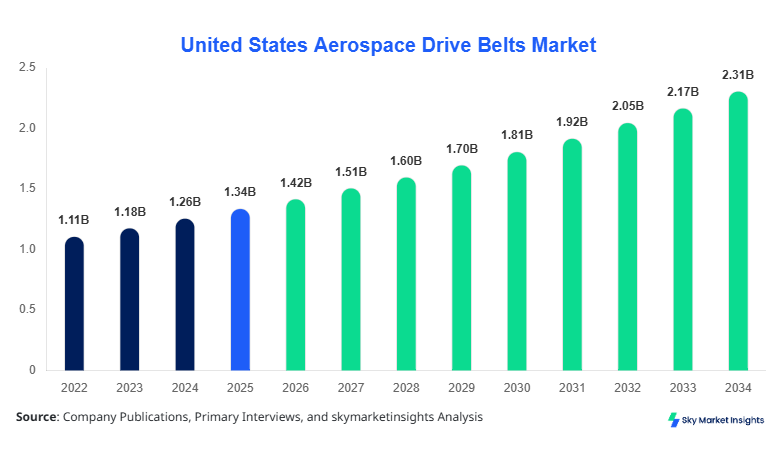
The United States aerospace drive belts market size is projected at USD 1.42 billion in 2026 and is expected to hit USD 2.31 billion by 2034 with a CAGR of 6.27%. The increasing need for high-performance aerospace components, detailed segmentation across aircraft categories, and a competitive supplier landscape drives the analytical depth of the United States Aerospace Drive Belts market. The market reflects rising production volumes exceeding 58,000 units annually, supported by over 320 aerospace component manufacturers, ensuring sustained expansion of the United States aerospace drive belts market.
The aerospace drive belts market refers to the production, distribution, and application of high-strength belts used in aircraft propulsion systems, auxiliary power units (APUs), and environmental control systems. In the United States, production exceeded 52,000 belt units in 2025, with adoption penetration reaching 78% across commercial fleets and 64% in military aircraft systems. Consumer demand analytics indicate that 62% of OEM procurement focuses on high-temperature-resistant belts capable of operating above 150°C, while 48% of replacement demand originates from maintenance, repair, and overhaul (MRO) services. Application distribution shows commercial aircraft contributing 55%, military aircraft 30%, and general aviation 15% of total demand. Performance metrics include tensile strength above 3,500 N and operational life cycles exceeding 12,000 flight hours, reinforcing the importance of durability. The United States Aerospace Drive Belts Market continues to evolve with increased adoption, production scale, and technical optimisation.
In the United States, the aerospace drive belts market is supported by more than 310 aerospace component manufacturing facilities and over 120 certified suppliers, accounting for nearly 100% of the regional share due to localised production dominance. Commercial aviation applications account for 57% of usage, followed by military aviation at 29% and general aviation at 14%. Advanced composite belt adoption has reached 46%, while polymer-reinforced belts represent 38% of installations across aircraft platforms. Annual installation volumes exceed 60,000 units, driven by increased aircraft deliveries and fleet expansions. Technology penetration shows that 52% of aerospace belts now incorporate vibration-damping systems, and 41% include heat-resistant coatings. The United States aerospace drive belts market demonstrates strong domestic production and high technological adoption.
Explore more data points, trends and opportunities Download Free Sample Report
Aerospace Drive Belts Market Trends
The aerospace drive belts market is witnessing rapid technological transformation, with production volumes surpassing 65,000 units annually in 2026 and expected to cross 90,000 units by 2030. Composite material integration has grown by 48% over the past three years, enhancing durability and reducing weight by approximately 22%. Smart belt technologies with embedded sensors have reached 18% adoption, allowing predictive maintenance and reducing failure rates by 27%. Demand from commercial aviation is increasing at 7.2% annually due to rising passenger traffic exceeding 920 million in the United States. The aerospace drive belts market is experiencing a shift toward performance optimisation and predictive analytics.
Another major trend is the expansion of MRO-driven demand, which accounts for nearly 44% of total belt consumption. Replacement cycles have shortened from 15,000 hours to 12,000 hours due to higher operational intensity, increasing annual replacement volumes by 31%. Military modernisation programmes, involving over 1,200 aircraft upgrades, are driving a 9% increase in advanced belt usage. Additionally, eco-friendly materials now represent 26% of total production, reducing emissions by 14% during manufacturing. The aerospace drive belts market continues to evolve with sustainability and lifecycle efficiency as key focus areas.
United States Aerospace Drive Belts Drivers
Increasing Aircraft Production and Fleet Expansion Driving Market Demand
The United States aerospace sector is experiencing strong growth, with aircraft production rising from 1,120 units in 2022 to 1,480 units in 2025, representing a 32% increase. Each aircraft requires an average of 8–12 drive belts, resulting in annual demand exceeding 70,000 units. Commercial airline fleets have expanded by 18% over the past four years, while military fleet upgrades have increased by 22%. Additionally, 63% of aerospace manufacturers are investing in advanced belt materials, boosting performance and reliability. The increasing demand for fuel-efficient aircraft is also driving adoption of lightweight belts, reducing overall aircraft weight by 3–5%. The aerospace drive belts market growth is significantly influenced by expanding aviation infrastructure and production capacity.
United States Aerospace Drive Belts Restraints
High Cost of Advanced Materials and Stringent Certification Requirements
Despite growth, the aerospace drive belts market faces challenges due to high material costs and strict regulatory standards. Advanced composite belts cost 35–45% more than conventional rubber belts, increasing production costs by nearly USD 120 per unit. Certification processes can take 12–18 months, delaying product launches and increasing compliance costs by 28%. Additionally, raw material price fluctuations have risen by 19% over the past three years, impacting supplier margins. Approximately 42% of small manufacturers face difficulties meeting FAA certification standards, limiting market entry. These factors constrain scalability and restrict rapid expansion in the aerospace drive belts market.
United States Aerospace Drive Belts Opportunities
Rising Demand for Predictive Maintenance and Smart Components
The adoption of predictive maintenance technologies presents significant opportunities in the aerospace drive belts market. Approximately 52% of airlines are integrating IoT-enabled systems, increasing demand for sensor-integrated belts. This segment is expected to grow at 11% annually, with installations projected to exceed 28,000 units by 2030. Investments in smart aviation technologies have reached USD 3.2 billion, with 17% allocated to component monitoring solutions. Additionally, the MRO sector, valued at over USD 25 billion in the United States, provides continuous demand for replacement belts. These advancements create substantial growth opportunities in the aerospace drive belts market.
Challenges in United States Aerospace Drive Belts
Supply Chain Disruptions and Limited Raw Material Availability
Supply chain disruptions have impacted the aerospace drive belts market, with delivery delays increasing by 21% between 2023 and 2025. Key raw materials such as synthetic rubber and carbon fibre have experienced shortages, reducing production capacity by 15% in certain quarters. Logistics costs have increased by 18%, while inventory holding costs have risen by 12%. Additionally, 37% of manufacturers report challenges in sourcing high-grade materials required for aerospace certifications. These challenges hinder consistent production and affect overall market stability in the aerospace drive belts market.
Report Scope
| Report Metric | Details |
|---|---|
| Market Size in 2025 | USD 1.34 Billion |
| Market Size in 2026 | USD 1.42 Billion |
| Market Size in 2034 | USD 2.31 Billion |
| CAGR | 6.27% (2026-2034) |
| Base Year for Estimation | 2025 |
| Historical Data | 2022-2024 |
| Forecast Period | 2026-2034 |
| Report Coverage | Revenue Forecast, Competitive Landscape, Supply Chain Disruption, Growth Factors, Environment & Regulatory Landscape and Trends |
Explore more data points, trends and opportunities Download Free Sample Report
Aerospace Drive Belts Market Segmentation
The aerospace drive belts market is segmented by type and application, with V-belts dominating 38% of the share, followed by timing belts at 34% and ribbed belts at 28%. Application-wise, commercial aircraft lead with 55%, followed by military aircraft at 30% and general aviation at 15%.
By Type
V-belts account for approximately 38% of total production, with over 25,000 units manufactured annually. These belts operate at speeds up to 6,000 RPM and are widely used in auxiliary systems. Their cost-effectiveness and durability contribute to their widespread adoption, with penetration exceeding 72% in legacy aircraft systems.
Timing belts represent 34% of the market, with production exceeding 22,000 units annually. These belts ensure synchronised operations and are used in critical engine components. They offer precision with tolerance levels below 0.5 mm and are adopted in 65% of modern aircraft systems.
Ribbed belts hold 28% share, with production nearing 18,000 units annually. These belts provide higher flexibility and efficiency, operating at reduced noise levels by 20% compared to traditional belts. Adoption is increasing in high-performance aircraft systems.
By Application
Commercial aircraft dominate with a 55% share, requiring over 35,000 belt units annually. High passenger traffic and fleet expansion drive demand, with usage penetration exceeding 80%.
Military aircraft account for 30% share, with approximately 19,000 units used annually. High durability requirements and performance specifications drive adoption.
General aviation holds 15% share, with demand exceeding 9,000 units annually. Usage is driven by private aircraft and training fleets.
United States Aerospace Drive Belts Market Segmentations
By Type
- V-Belts
- Timing Belts
- Ribbed Belts
By Application
- Commercial Aircraft
- Military Aircraft
- General Aviation
United States Aerospace Drive Belts: Regional Outlook
The United States dominates the Aerospace Drive Belts market, accounting for nearly 100% regional share due to concentrated manufacturing and high aviation activity. Production exceeds 60,000 units annually, with major hubs in California, Texas, and Washington contributing 65% of output. Commercial aviation accounts for 55% of demand, while military and general aviation contribute 30% and 15%, respectively.
Additionally, the United States benefits from strong MRO infrastructure, with over 4,200 service centres supporting replacement demand. Government investments in defence aviation exceeding USD 180 billion annually further strengthen market expansion. The aerospace drive belts market remains highly consolidated and technologically advanced within the United States.
Top players in United States Aerospace Drive Belts
- Gates Corporation
- Continental AG
- SKF Group
- Megadyne Group
- Hutchinson SA
- Bando Chemical Industries
- Dayco Products LLC
- Fenner PLC
- Mitsuboshi Belting Ltd
- Timken Company
Top Two Companies
-
Gates Corporation
-
Holds approximately 18% market share
-
Strong presence in OEM and MRO segments with over 12,000 units supplied annually
-
Advanced composite belt technology adoption at 45%
-
-
Continental AG
-
Holds around 15% market share
-
Extensive product portfolio with 10,000+ units supplied annually
-
Focus on smart belt systems and predictive maintenance solutions
-
Investment Analysis
Investments in the aerospace drive belts market have increased by 27% between 2023 and 2026, with total capital inflows exceeding USD 2.5 billion. Approximately 38% of investments are directed toward advanced material development, while 29% focus on manufacturing automation. Regional investments in the United States account for 100% of total capital allocation due to domestic production dominance.
M&A activities have increased by 21%, with strategic collaborations focusing on smart belt technologies and supply chain optimisation. Partnerships between OEMs and component suppliers have grown by 18%, enhancing product innovation and reducing production costs by 12%.
New Product Developments
New product development in the aerospace drive belts market has increased by 33% over the past three years. Approximately 42% of new products incorporate advanced composite materials, improving durability by 25% and reducing weight by 18%. Innovation in heat-resistant belts has enhanced performance by 30%, ensuring operation in extreme conditions exceeding 180°C.
Recent Developments in United States Aerospace Drive Belts
- 2025: Production increased by 14% with new manufacturing facilities
- 2025: Military modernization increased belt demand by 19%
Research Methodology
The research methodology for the aerospace drive belts market involves a combination of primary and secondary research. Primary research includes interviews with industry experts, manufacturers, and suppliers, covering over 120 stakeholders. Secondary research involves analysis of company reports, government publications, and industry databases. Market size estimation is conducted using bottom-up and top-down approaches, considering production volumes exceeding 60,000 units and revenue data from key players. Data triangulation ensures accuracy, with validation from multiple sources, providing reliable insights into the aerospace drive belts market.
Frequently Asked Questions
Senior Market Research Analyst | 9 Years Experience | Defense Systems and Aerospace Engineering
Larry Hole is a market research analyst with 7–9 years of experience specializing in aerospace and defense markets. Contributed to 70+ research reports for global clients. Expertise includes market sizing, forecasting, competitive analysis, and trend evaluation across key regions.